Skip to content
A 1st DWI in Texas is a serious charge that can throw your entire family into a state of fear and confusion. Getting convicted means you’re facing real penalties—jail time, thousands of dollars in fines, and a driver's license suspension that can turn your daily life upside down. The moment you get that call, or see those flashing lights, your world feels like it’s tilting off its axis.
The Shock of a First DWI Arrest

Seeing red and blue lights flashing in the rearview mirror is a moment of pure, gut-wrenching panic. For most families, the hours and days that follow a DWI arrest are a blur of fear and confusion. You’re suddenly shoved into a legal system you don't understand, worrying about your job, your reputation, and what this one mistake will mean for your family’s future. The weight of "what happens now?" can feel crushing.
This guide is your first step toward getting some clarity. We understand how overwhelming this feels, and our goal is to replace that anxiety with knowledge. We'll walk you through the entire process of a 1st DWI in Texas, from the traffic stop to the long-term consequences, in simple, human terms, so you can feel empowered to protect your family.
Understanding the Initial Charges
In Texas, the law defines Driving While Intoxicated (DWI) as operating a motor vehicle in a public place while you are intoxicated. The most common way the state proves this is by showing your blood alcohol concentration (BAC) was 0.08% or higher.
For a first-time offense with no aggravating factors (like an accident or a child in the car), the charge is typically a Class B Misdemeanor. This isn't just a traffic ticket; it's a criminal charge with serious teeth that can have lasting effects on your family.
To give you a clearer picture, let's break down the potential penalties you're up against.
Quick Overview of First DWI Penalties in Texas
This table summarizes the potential criminal and administrative penalties for a standard first-time DWI offense in Texas.
| Penalty Type | Standard Penalty (Class B Misdemeanor) |
|---|---|
| Jail Time | 72 hours to 180 days in county jail |
| Criminal Fines | Up to $2,000 |
| Driver's License Suspension | 90 days to 1 year |
| Annual Surcharges | $1,000 to $2,000 per year for 3 years to keep your license |
| Community Service | 24 to 100 hours |
| Probation (Community Supervision) | Up to 2 years with strict conditions |
| Ignition Interlock Device | Often required as a condition of bond or probation |
As you can see, the consequences add up quickly and can impact every corner of your life. For a deeper dive into these penalties, you can discover more insights about Texas DWI penalties here.
Facing a DWI charge can feel like your world is collapsing. The legal system is intimidating, but it's important to remember that an arrest is not a conviction. You have rights, and there are pathways to protect your future.
Why This Guide Can Help Your Family
We created this resource to give you an honest, authoritative roadmap for what comes next. By understanding the process, you can start making informed decisions to protect what matters most. We’ll explain the legal system without the confusing jargon, so you feel empowered, not overwhelmed.
Here’s a glimpse of what you'll learn:
- The immediate steps you need to take right after an arrest.
- How the criminal case and the separate license suspension case work.
- The true costs and hidden consequences of a DWI conviction.
- How a skilled defense attorney can fight for you and your family.
This is your starting point for taking back control. Let's get started.
The Arrest and the First 24 Hours
That sickening flash of red and blue lights in the rearview mirror triggers a disorienting mix of adrenaline and dread. But for the family, the real nightmare begins with a phone call—the one from a loved one who has been arrested for a 1st DWI in Texas. That call plunges you into a world of urgent questions and a deep, gnawing fear. The first 24 hours are absolutely critical, and just understanding what's happening can give you a small sense of control when everything feels like it's spinning.
It almost always starts with a simple traffic stop. In Texas, an officer needs reasonable suspicion to pull a driver over. This could be for something as minor as speeding or a broken taillight, or it could be for more obvious signs of impairment, like weaving across lanes. Once you're pulled over, the interaction can quickly shift from a routine stop to a full-blown DWI investigation if the officer notices anything—the smell of alcohol, slurred speech, or even fumbling to get your license out.
The Critical Roadside Choice
At this point, the officer will likely ask you to perform Standardized Field Sobriety Tests (SFSTs). It's crucial to know this: you are not legally required to perform these tests. They are notoriously subjective and difficult to pass even when sober. After the SFSTs (or your refusal), the officer will almost certainly request a chemical test—either a breathalyzer on the scene or a blood draw at a station or hospital—to measure your Blood Alcohol Concentration (BAC).
This is a make-or-break moment, governed by Texas's implied consent law. The simple act of having a Texas driver's license means you have already legally consented to provide a breath or blood sample if you are lawfully arrested for DWI.
- Refusing the test won't make the DWI charge disappear. The prosecutor can still build their case using other evidence, like the officer's testimony about your driving and appearance.
- A refusal automatically triggers a driver's license suspension. This is called an Administrative License Revocation (ALR), and it's a civil process completely separate from your criminal DWI case.
- You have only 15 days from the day of your arrest to request a hearing to fight this automatic suspension. If you miss this deadline, your license is suspended, no questions asked.
Imagine a father pulled over after having two beers with dinner celebrating an anniversary. He feels fine but is rattled by the situation. Fearing the breathalyzer isn't accurate, he refuses. He's still arrested for DWI, but now—on top of the criminal charge—he’s facing a guaranteed license suspension that will make it nearly impossible to get to work and take his kids to school, all before he even gets his day in court.
From Booking to Bail
After the arrest, your loved one will be taken to a police station or county jail for booking. This is an administrative process that follows a standard script:
- Recording Personal Information: They'll take down their name, address, and date of birth.
- Fingerprinting and Mugshots: They will be fingerprinted and have their photo taken for official records.
- Property Collection: Personal items like a wallet, phone, and keys will be taken, cataloged, and stored until they are released.
- Holding: Once booked, they will be placed in a holding cell.
The next step is the first court appearance, known as an arraignment, which usually happens within a few hours or up to a day later. A judge or magistrate will formally read the charges, explain their rights, and set the conditions for their release.
This is where bail is set. Bail is simply a financial guarantee that the person will show up for future court dates. To get out, you can post the full bail amount in cash with the court, or you can hire a bail bond company. A bondsman typically charges a non-refundable fee of 10-20% of the total bail amount.
Once bail is posted and the paperwork clears, your loved one will be released. This first 24-hour period is a chaotic whirlwind, but it's just the beginning. Now, the real work starts: building a defense and protecting your family’s future.
Fighting Your Case on Two Fronts
When a loved one gets arrested for a 1st DWI in Texas, the family’s first thoughts usually jump straight to the criminal charge. You start worrying about massive fines, probation, and the terrifying idea of jail time. What most people don't realize, though, is that a DWI arrest immediately kicks off two separate legal battles that run at the same time.
It’s like fighting a war on two fronts. One battle is in criminal court, dealing with the DWI charge itself. The other is an administrative fight with the Texas Department of Public Safety (DPS) over your driver's license. Winning one doesn’t mean you’ll win the other, and making a mistake in either one can have devastating consequences for your family’s future.
The Criminal Case: Your Day in Court
The criminal case is what everyone thinks of when they hear "DWI." This is the formal court process where a prosecutor has to prove, beyond a reasonable doubt, that you were operating a motor vehicle in a public place while intoxicated. This part of the process can drag on for months and involves several key stages.
Your first court date, called an arraignment, usually happens within a few weeks of the arrest. Here, the charges are officially read, and you'll enter a plea of "guilty" or "not guilty." The judge will also go over your bond conditions, which can include things like installing an ignition interlock device on your car, especially if your BAC was high. After that, a series of pretrial hearings gives your defense attorney the chance to challenge the prosecutor’s evidence, like filing motions to suppress breath or blood test results.
The flowchart below gives you a simple overview of what happens right after the arrest, leading up to these court dates.
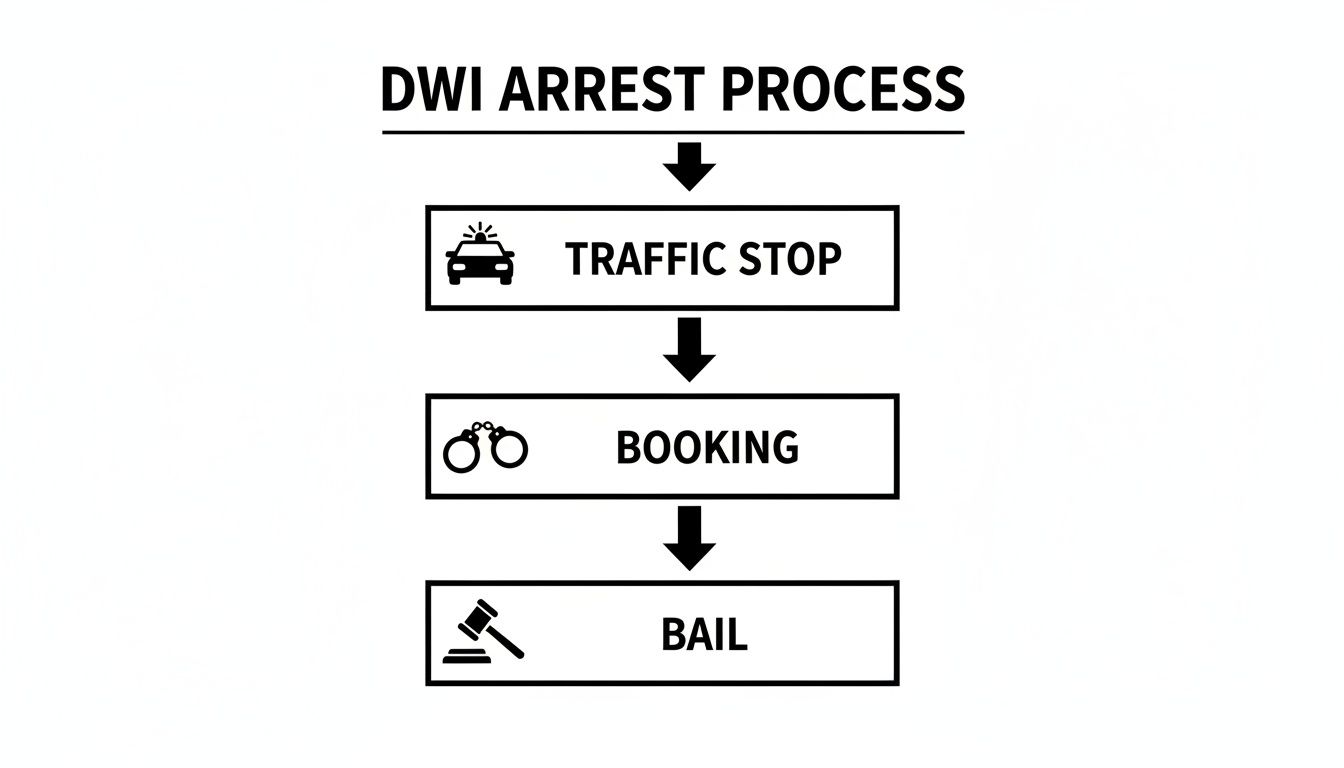
This visual breaks down the first critical steps, from the traffic stop all the way to getting out on bail. These are the events that set the stage for everything that happens in court. Ultimately, the criminal case will end in one of two ways: a plea agreement negotiated by your lawyer or a full-blown trial where a judge or jury decides the outcome.
The Administrative Case: Protecting Your License
While the criminal case is slowly making its way through the court system, another, much faster battle is unfolding with the DPS. This is the Administrative License Revocation (ALR) hearing, and its only purpose is to decide the fate of your driver's license. It has nothing to do with whether you are guilty or innocent of the DWI charge.
The state's goal in the ALR hearing is simple: to determine if the officer had reasonable suspicion to pull you over and probable cause to arrest you. If the state proves those two things, your license gets suspended.
This whole process gets triggered the moment you either refuse a chemical test (breath or blood) or provide a sample that shows a BAC of 0.08% or higher. As soon as that happens, a very unforgiving clock starts ticking.
You have only 15 days from the date of arrest to request an ALR hearing.
- If you request the hearing: Your license stays valid while you wait for the hearing date. This is a golden opportunity for your attorney to question the arresting officer under oath, which can uncover evidence that becomes incredibly useful for fighting the criminal case later on.
- If you miss the 15-day deadline: Your license is automatically suspended. Period. There are no extensions and no second chances. This is why you absolutely must act fast.
For most families in Texas, losing a driver's license isn't just an inconvenience—it's a catastrophe. It means struggling to get to work, drive kids to school, and just handle daily life. Understanding that you have to proactively fight both the criminal charge and the license suspension is the very first step toward building a strong defense. Our guide on how to fight a DWI in Texas dives deeper into the strategies for tackling both of these legal challenges.
The Real Cost of a DWI Conviction
When you first get hit with a 1st DWI in Texas, your mind probably jumps straight to the court-ordered penalties. You start worrying about the fines, whether you'll see the inside of a jail cell, and what life on probation will be like. And while those are all very real concerns, they're really just the start of it. A DWI conviction casts a long, dark shadow, creating a ripple effect of hidden costs that can throw your family's life into chaos for years to come.
The true cost of a DWI goes way beyond just writing a check to the court. It’s a series of financial gut punches and personal roadblocks that can feel absolutely relentless. Getting a handle on the full scope of what you're up against is the first step in realizing that a strong defense isn't some luxury—it's a flat-out necessity for your family's financial stability and future.
The Official Court Penalties
Let's start with what the judge can hand down. DWI is a massive enforcement and public safety issue here in Texas, and the penalties for a first offense show just how seriously the state takes it. You’re looking at a minimum of 3 days in jail and fines up to $2,000, and that’s before court fees get tacked on. It’s a clear financial and personal deterrent designed to make an impact.
But a standard Class B Misdemeanor can escalate in a heartbeat. If your Blood Alcohol Concentration (BAC) was 0.15% or higher, the charge gets bumped up to a Class A Misdemeanor. This enhancement can nearly double the potential penalties right down the line.
A high BAC is like pouring gasoline on the fire. It transforms an already serious situation into a critical one, dramatically ratcheting up the potential jail time, fines, and long-term consequences you’re facing.
Let’s put these two scenarios side-by-side to see just how much one number can change everything.
Texas First DWI Penalties Standard vs Aggravated
This table breaks down the potential penalties for a standard first DWI charge (Class B Misdemeanor) compared to an aggravated DWI with a high BAC (Class A Misdemeanor).
| Penalty | Standard DWI (BAC < 0.15%) | High BAC DWI (BAC ≥ 0.15%) |
|---|---|---|
| Criminal Charge | Class B Misdemeanor | Class A Misdemeanor |
| Maximum Fine | Up to $2,000 | Up to $4,000 |
| Maximum Jail Time | Up to 180 days | Up to 1 year |
| License Suspension | 90 days to 1 year | Up to 2 years |
As you can see, the stakes get significantly higher when a BAC of 0.15% or more is involved. This is why the details of your arrest—especially the chemical test results—are so incredibly important to your defense.
The Hidden Collateral Damage
The penalties handed down in court are just the tip of the iceberg. It's the "collateral" consequences that often do the most damage and stick around the longest. These are the real-world impacts that mess with your ability to provide for your family and just live a normal life.
- Skyrocketing Insurance Premiums: Once you have a DWI conviction, you’re officially a "high-risk driver" in the eyes of insurance companies. Your auto insurance rates can easily double or even triple, costing your family thousands of extra dollars over the next several years.
- Employment Risks: A lot of employers run background checks. A DWI popping up on your record can make it tough to land a new job or even get you fired from your current one, especially if your work involves driving, professional licenses, or using company vehicles.
- Housing and Loan Applications: A criminal conviction can be a major red flag for landlords and mortgage lenders. This can create unexpected hurdles when you're trying to secure safe housing for your family.
- Child Custody Complications: In family court, a DWI can be painted as evidence of poor judgment or a potential substance abuse problem. It can seriously complicate child custody agreements and visitation rights, adding a huge amount of emotional strain to an already stressful situation.
These hidden penalties can feel overwhelming, but it’s crucial to remember that an arrest is not a conviction. Understanding the full list of potential consequences of a DWI in Texas makes it crystal clear why every single detail of your case matters and why fighting the charge is so critical.
How a Defense Attorney Protects Your Future

It’s a common misconception that getting arrested for a 1st DWI in Texas means a conviction is inevitable. That couldn't be further from the truth. In this fight, an experienced DWI defense attorney is the single most important asset you can have—they are your shield and your advocate when everything feels like it's crumbling.
Hiring a skilled lawyer isn't about finding a loophole or "getting away with something." It’s about accountability. It's about making sure the State of Texas is held to its incredibly high burden of proof and that your constitutional rights are protected at every single step. A dedicated attorney levels the playing field against the prosecution's massive resources.
Scrutinizing Every Piece of Evidence
A prosecutor's case is only as strong as its weakest link. A sharp defense attorney knows this and immediately puts on their detective hat, poring over every detail of your arrest to find procedural errors, rights violations, and simple human mistakes. Their job is to find the cracks in the foundation of the state's case.
This intense review covers the entire timeline of the incident:
- The Initial Traffic Stop: Did the officer have a legitimate, legal reason to pull you over in the first place? If there was no reasonable suspicion, any evidence collected afterward could be completely thrown out.
- Field Sobriety Test Administration: Were the tests conducted by the book, on a proper surface, without distractions? These tests are notoriously subjective and are frequently administered incorrectly, making them unreliable.
- Breath and Blood Test Procedures: Was the Intoxilyzer machine properly calibrated and maintained? For a blood test, was the sample handled with a perfect, unbroken chain of custody to prevent any chance of contamination?
Even one small error can render a key piece of evidence inadmissible in court. Sometimes, that’s all it takes to weaken the prosecution's case enough to force a dismissal or a much more favorable plea deal.
Crafting a Strategic Defense
Beyond just picking apart the evidence, your attorney builds a defense strategy custom-fit to the unique facts of your case. They understand the science behind BAC testing and the legal precedents that shape DWI law in Texas, which allows them to challenge the very core of the state's arguments.
A common angle is to attack the accuracy of the chemical tests themselves. Breathalyzers, for example, can be thrown off by dozens of factors, from medical conditions like acid reflux to something as simple as residual mouth alcohol from mouthwash. A knowledgeable attorney knows how to expose these scientific and procedural flaws, creating reasonable doubt about the test results.
An arrest for a first DWI in Texas feels like the end of the road. But for a defense attorney, it's just the starting point. They see a set of facts to challenge, a story to tell, and a future to protect.
Think about this scenario: someone has a couple of drinks at a work dinner and gets pulled over for a rolling stop. They agree to a breathalyzer and blow just over the legal limit. An attorney might later discover the officer failed to observe the mandatory 15-minute waiting period before giving the test—a critical procedural violation that can get the result tossed out entirely. That single detail could be the key to getting the charge dropped or reduced.
Your Advocate in Both Legal Arenas
As we've covered, a DWI arrest kicks off two separate legal battles. Your attorney is your champion in both. They will represent you in the criminal court and also handle the all-important Administrative License Revocation (ALR) hearing to fight to save your driver's license. To better understand their role, it's helpful to know the nuances between attorney and lawyer.
Their goal is always to minimize the impact on your life and secure the best outcome possible. This could mean:
- Seeking a Full Dismissal: If the evidence is weak or was obtained illegally.
- Negotiating a Reduced Charge: Arguing for a lesser offense like Obstruction of a Highway, which has far less severe long-term consequences.
- Fighting for a Not Guilty Verdict at Trial: Taking your case to a judge or jury and presenting a compelling defense.
Choosing the right legal partner is the most critical decision you'll make in this process. You need someone with proven, specific experience in Texas DWI cases—a person who can calmly guide you through the storm while fiercely defending your future. And remember, acting fast is crucial to preserve evidence and meet strict deadlines, like the 15-day window you have to request your ALR hearing.
Taking Control With Your Next Steps
The moments after a loved one is arrested for a 1st DWI in Texas are a blur of confusion and anxiety. It's completely normal to feel overwhelmed, even paralyzed. But this is the exact moment when clear, decisive action can make all the difference. The key is to shift from fear to forward motion, and you don't have to figure it out alone.
Taking these next steps proactively is the single best way to start protecting your family's future. The first few days are absolutely critical for laying the groundwork for a strong defense. What you do right now truly matters.
Your Immediate Action Plan
Here’s a simple, practical checklist to get you through the next crucial days. Don't try to do it all at once; focus on one task at a time.
- Document Everything: As soon as possible, write down every detail you can remember about the arrest. What was the reason for the traffic stop? What did the officer say? Where did it happen, and what time was it? Were there any witnesses? Memories fade incredibly fast, and these seemingly small details can become powerful pieces of evidence for an attorney.
- Review Bond Conditions Carefully: Once released, you will have to follow strict bond conditions. This could mean anything from checking in with a probation officer and avoiding alcohol to installing an ignition interlock device on the car. Violating any of these conditions will lead to another arrest, so read the paperwork carefully and make sure every rule is followed to the letter.
- Schedule a Confidential Consultation: This is your most important next step, period. You need to get a skilled DWI defense attorney on the phone immediately to review the case. They are your guide to meeting the critical 15-day deadline to request an ALR hearing and will start building a defense to protect what's at stake.
Taking control doesn't mean you have all the answers. It means you are taking the right steps to find them. By documenting details and seeking professional guidance, you are actively working to protect your family and your future.
A DWI charge can feel like a permanent mark, but there are always pathways forward. For some, it may even be possible to clear the record entirely down the road. You can learn more about that process in our guide on how to get a record expunged in Texas.
The legal road ahead is complicated, but it is not one you have to walk by yourself. The choices you make in these first few days will significantly shape the outcome of this case. We are here to provide the compassionate, experienced legal help your family deserves during this difficult time.
Frequently Asked Questions About a First Texas DWI
When you’re staring down a 1st DWI in Texas, it feels like your world stops. The questions come fast and furious, and the uncertainty can be paralyzing. When your family’s future is on the line, you don't need legal jargon; you need straight, honest answers. Let's tackle some of the biggest concerns we hear from families who are right where you are now.
Our goal here is to cut through the noise and give you some clarity. Understanding what you're up against is the first step toward taking back control.
Will I Definitely Go to Jail for a 1st DWI in Texas?
This is usually the first question on everyone's mind, and the answer is: not necessarily. While a first-time DWI is a Class B Misdemeanor that carries a potential jail sentence of up to 180 days, it’s far from a guaranteed outcome.
For most first offenders, especially when there aren't complicating factors like a sky-high BAC or an accident, avoiding jail time is a very real possibility. This is where a sharp defense attorney makes all the difference. They can negotiate with the prosecutor for alternatives, most commonly probation (or "community supervision"), which lets you serve your sentence in the community under certain court-ordered rules. Every case is unique, so what happens in yours will depend entirely on the specifics.
Can My DWI Charge Be Dismissed or Reduced?
Absolutely. An arrest is just the beginning of the story, not the end. The state's case against you might look solid on paper, but it's often full of holes that a good defense lawyer can expose.
A thorough attorney will put every single detail of your arrest under a microscope. This means challenging things like:
- The traffic stop itself. Did the officer even have a legal reason to pull you over?
- The field sobriety tests. Were they administered correctly? Did you have a medical condition that affected your performance?
- The breathalyzer. When was it last calibrated? Was the officer properly trained to use it?
- The blood draw. Was the sample handled correctly from start to finish?
If we find procedural mistakes or violations of your constitutional rights, we can file motions to get that evidence thrown out. Weakening the state's case this way often forces their hand, leading to a full dismissal or a plea bargain for a much less damaging charge, like "Obstruction of a Highway."
How Much Does a 1st DWI in Texas Actually Cost?
Brace yourself, because the court fine is just the tip of the iceberg. When you add everything up, the total financial hit from a first DWI can easily land somewhere between $5,000 and over $20,000. It's a staggering figure that catches most people completely off guard.
The sticker shock of a DWI conviction isn't the fine; it's the years of hidden costs that follow. These collateral financial consequences can place an immense and lasting strain on a family's budget.
Think about it: you've got court costs, hefty legal fees, monthly probation fees, mandatory DWI classes, and fees to get your license back. On top of that, you're likely looking at the cost of installing an ignition interlock device in your car and, of course, skyrocketing car insurance premiums that can haunt you for years. This is exactly why investing in a strong legal defense from the very beginning is so critical—it can save you an incredible amount of money and stress down the road.
A DWI charge can feel like an impossible weight, but you and your family do not have to carry it alone. The attorneys at the Law Office of Bryan Fagan have the experience and compassion to see you through this difficult time. We understand what’s at stake—not just a court case, but your family's stability and future. We are here to protect your rights, provide clear guidance, and fight for the best possible outcome for you and your loved ones. Contact us today for a free, confidential consultation to understand your options and take the first step toward putting this behind you.