Skip to content
The moment CPS removes your child is a blur of shock and terror. Your world is turned upside down, and you’re left with a thousand questions and an overwhelming sense of helplessness. It’s a profoundly disorienting experience, but understanding what comes next is the first step toward regaining your footing and fighting for your family.
An adversary hearing in a CPS case in Texas is the first—and most critical—court date after your child has been removed. By law, as outlined in Texas Family Code Chapter 262, it must happen within 14 days of the removal. This is your first real opportunity to stand before a judge, challenge the state's actions, and fight for your child's immediate return home.
Understanding Your First Day in Court
The adversary hearing isn't the final trial that decides the entire case. Think of it more like a crucial legal checkpoint. It forces CPS to stop and justify its drastic actions to an impartial judge, and it gives you your first chance to fight back. This hearing is a fundamental legal safeguard written into the Texas Family Code, specifically to protect your rights as a parent and ensure your family isn't torn apart without a judge’s immediate review.
What Is the Purpose of This Hearing?
The purpose is to answer two specific questions:
- Was there an urgent need to remove your child? CPS has to prove there was an immediate danger to your child’s physical health or safety at the moment they were taken from your home.
- Is there a continuing danger right now? It's not enough to show danger existed in the past. The agency must also convince the judge that this danger still exists today, making it unsafe for your child to come home.
For instance, picture a single father, John, whose child is removed after an anonymous tip claims his home is unsafe due to "clutter." At the adversary hearing, John's attorney can present time-stamped photos of a clean, safe home and bring in a neighbor to testify about his attentive parenting. The hearing is where John gets to tell his side of the story and prove the state's drastic action was not justified.
The timeline below shows just how fast everything happens in the two weeks leading up to this hearing.
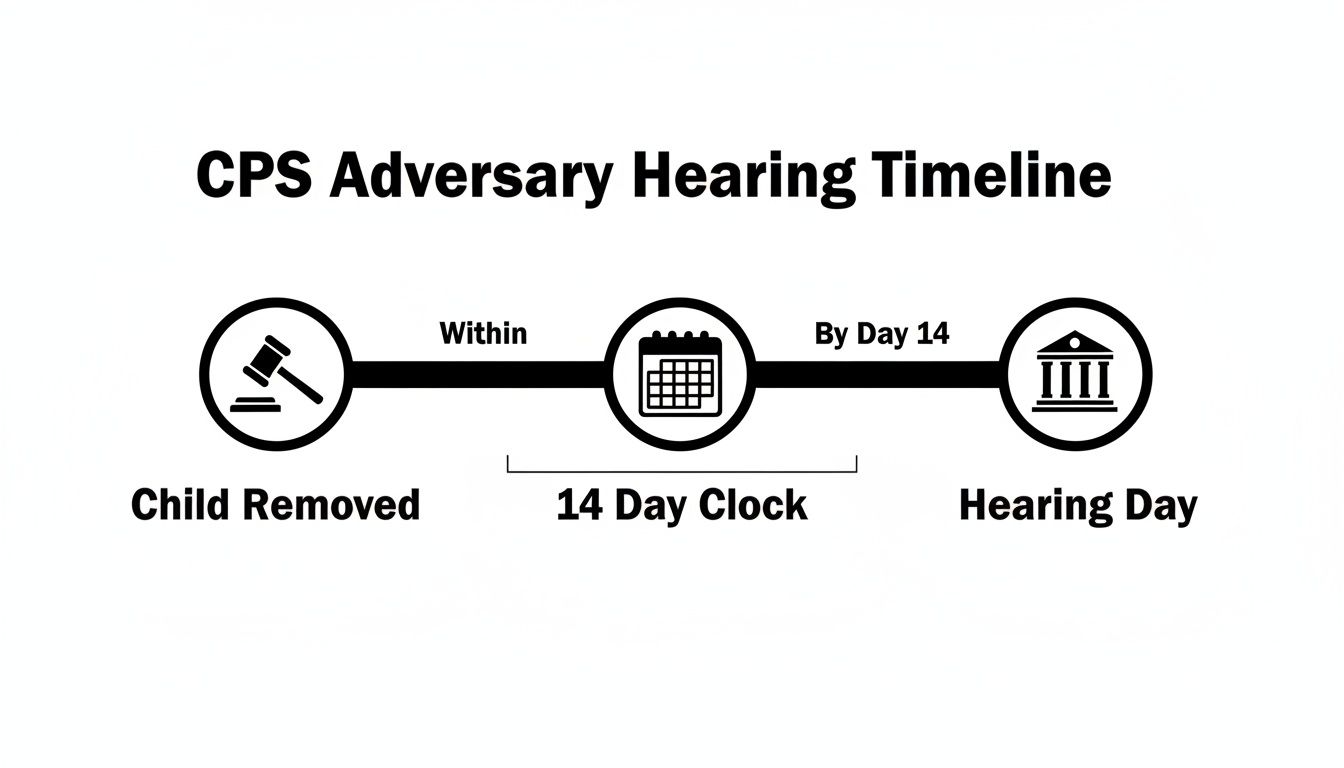
This tight 14-day window shows why you have to act quickly to build your defense.
The Critical Role of Legal Counsel
The law, specifically Texas Family Code §262.201(a), mandates this hearing to prevent families from being stuck in limbo. Yet, a huge problem exists. Data reveals that in many Texas counties, parents don't get a court-appointed lawyer until the day of the hearing itself. This leaves them to navigate those first two terrifying weeks completely on their own, a situation that puts families at a severe disadvantage.
Our guide on Texas CPS court hearings and timelines can help you understand the full legal process and your rights.
Walking into an adversary hearing without an experienced attorney is a massive risk. The state has its lawyers, and you should too. At The Law Office of Bryan Fagan, we know what’s at stake. We’re here to stand with you, challenge every piece of the state's evidence, and fight to bring your child home where they belong. You don't have to do this alone.
The Critical 14-Day Timeline from Removal to Hearing
The 14 days after CPS takes your child are a whirlwind of shock, fear, and a thousand unanswered questions. That clock starts the second they are removed, and every single day is a race against time. This isn’t just a painful waiting period; it’s the most critical window you have to build your case for the adversary hearing. Understanding this timeline is your roadmap from being paralyzed by the situation to taking focused, strategic action.

It all kicks off with a legal step most parents don't even know is happening. Within one business day of the removal, CPS goes before a judge for an ex parte hearing. Think of this as a quick, one-sided meeting. The judge only hears from the caseworker, reviews an affidavit, and signs temporary orders giving CPS custody.
You won’t be there. You won’t get to speak. But this hearing is what officially starts the 14-day countdown to your full adversary hearing, as required by Texas Family Code §262.201(a).
Navigating the First 72 Hours
The first few days are incredibly disorienting, but they are absolutely crucial for laying the groundwork for your defense. Let’s look at a relatable scenario. Imagine a single mother, Maria, whose toddler is removed after a simple misunderstanding at daycare spiraled into a neglect allegation.
- Day 1 (The Removal): Maria is in shock. Her first call isn’t to argue with the caseworker—it’s to an experienced CPS defense lawyer. She immediately writes down every detail she can remember about the removal: who was there, what was said, and the time everything occurred.
- Day 2 (The Ex Parte Hearing): While CPS is in court getting temporary custody, Maria’s attorney is already filing a notice of representation. Maria starts pulling together evidence: photos of her spotless home, her child’s medical records, and a list of supportive family members ready to vouch for her.
- Day 3 (Strategy Session): Maria meets with her lawyer. They tear apart the CPS allegations and begin building a game plan, preparing her testimony to prove her child is not only loved but safe in her care.
This proactive approach is essential. Instead of being frozen by fear, Maria took control. You can get a more complete picture of the entire process in our detailed guide on the Texas CPS timeline and what parents can expect.
The Week Leading Up to Your Hearing
As the hearing gets closer, your focus needs to sharpen. This is less about gathering new information and all about actively preparing your case with your legal team. Your lawyer will likely be in touch with the CPS attorney and the attorney appointed for your child (the Ad Litem) to see where things stand.
The adversary hearing is your first and best chance to tell your side of the story to a neutral judge. Preparation is not just about gathering documents; it's about building a compelling narrative that shows you are a loving, capable parent and that your child belongs at home.
During this week, your energy should be channeled into a few key actionable tasks:
- Finalizing Your Witness List: Work with your lawyer to decide who can best testify for you. This could be a grandparent who sees you every day, a teacher who knows your child is well-cared-for, or a neighbor who can speak to your character.
- Preparing Your Testimony: You will likely take the stand. Your attorney should practice questions with you. The goal is to stay calm, be honest, and stick to the facts that prove your child is safe with you.
- Reviewing CPS Evidence: Your lawyer will get a copy of the evidence CPS plans to use against you. You need to go through every single claim and document with them, identifying weaknesses and preparing your counter-arguments.
This 14-day sprint is intense, but by understanding the timeline and taking structured, daily action, you are no longer just reacting to what CPS does. You become an active participant fighting to bring your child home.
What to Expect Inside the Courtroom
Walking into a Texas courtroom for your adversary hearing can feel intimidating. The language is unfamiliar, the rules are rigid, and it feels like your family's entire future hangs in the balance. Our goal is to pull back the curtain and show you exactly what to expect, so you can walk in with a sense of control, not fear.

Think of the hearing as a highly structured conversation with the judge, not a chaotic free-for-all. When you sit down at the counsel table, you’ll see several key figures. Knowing their function demystifies the process and helps you understand what’s happening.
Key Players in a Texas CPS Adversary Hearing
| Courtroom Role | Who They Are | What They Do |
|---|---|---|
| The Judge | The neutral decision-maker. | Listens to all evidence, applies the law (Texas Family Code), and makes the final ruling based on the child's best interest. |
| The CPS Attorney | The lawyer for the Department of Family and Protective Services (DFPS). | Acts as your legal opponent, trying to convince the judge that removing your child was necessary and that a "continuing danger" exists. |
| The Attorney Ad Litem | An attorney appointed by the court specifically for your child. | Represents your child's legal interests—not yours or CPS's. They will investigate and make a recommendation to the judge. |
| Your Attorney | Your personal advocate and legal champion. | Their only job is to fight for you. They challenge the state's case and present evidence to get your child back home. |
The Burden of Proof Belongs to CPS
This is perhaps the single most important thing to understand about an adversary hearing: the burden of proof. In simple terms, it is CPS’s job to prove their case, not your job to prove your innocence.
Under the Texas Family Code, the CPS attorney must convince the judge of two things by a "preponderance of the evidence"—a legal standard that just means it's more likely than not their claims are true.
CPS must show:
- There was an immediate danger to your child’s physical health or safety that justified the removal.
- There is a continuing danger to your child that makes it unsafe for them to be returned to you right now.
Your attorney’s primary job is to dismantle these two arguments. They will do this by cross-examining the CPS caseworker, challenging their evidence, and highlighting your side of the story.
The adversary hearing is the state’s test, not yours. They carry the legal weight of proving danger, and an experienced attorney knows exactly how to challenge their evidence and expose the weaknesses in their case.
The unfortunate truth is that too many parents walk into this critical hearing alone. While there has been progress in legal representation, significant gaps remain. Studies have shown that many parents do not get an attorney appointed until the day of the hearing, robbing them of precious preparation time. You can learn more about the ongoing efforts for reform and representation in Texas CPS cases.
To make their case, CPS will present evidence like the caseworker’s testimony, sworn affidavits, photos, or police reports. Your attorney will object to improper evidence and question the caseworker to show the judge that the situation is not as clear-cut as CPS claims. You will also get a chance to testify and present your own evidence showing you can provide a safe and loving home. This hearing is your opportunity to finally be seen and heard.
How to Build Your Case for the Adversary Hearing
That 14-day window between your child's removal and the adversary hearing isn’t a time to wait by the phone. It's your time to act. This period is your first, and often best, chance to stop being a bystander in your own life and become an active fighter for your family. Building a strong case starts right now.
Feeling overwhelmed is completely normal, but channeling that anxiety into a clear, actionable plan can make all the difference. Your side of the story matters, and this is your opportunity to make sure it’s heard.

Your Immediate Action Plan
From the moment you learn about the hearing, every action you take should be strategic and aimed at one thing: proving your child is safe with you. Here is a practical, step-by-step plan:
Hire an Experienced CPS Defense Attorney: This is, without a doubt, the most important step. The state has its lawyers, and you absolutely need your own. An attorney who lives and breathes CPS cases knows the law, understands the local courts, and can dismantle the state’s arguments. Finding the right CPS lawyer near you immediately puts an advocate in your corner.
Document a Detailed Timeline: Your memory is a powerful piece of evidence. Write down everything you can recall leading up to, during, and after the removal. Be specific—include dates, times, who was there, and what was said. This detailed account helps your attorney find holes in the CPS version of events.
Gather Your Evidence: While your attorney handles legal strategy, you are the boots on the ground for collecting proof. This isn't just about defending against being a "bad" parent; it's about proactively showing you are a good one. Start collecting:
- Photos and Videos: Take clear pictures of your home showing it’s clean and safe, focusing on your child’s room, the kitchen, and living areas.
- School and Medical Records: Gather report cards, attendance records, and summaries from doctor's visits to show your child is healthy and cared for.
- Supportive Witnesses: Make a list of names and phone numbers for people who can speak to your character as a parent—relatives, neighbors, teachers, or faith leaders.
Prepare Your Testimony: There’s a very high chance you will take the stand. Your attorney will help you get ready. Your story is the heart of your testimony, and the goal is to be honest, calm, and focused on showing the judge your commitment to your child’s well-being.
Real-World Scenario: Proving Your Case
Picture this: a father, we'll call him David, has his child removed after a bitter ex-partner makes a false claim of neglect. CPS acts on the report, and suddenly David is blindsided by an adversary hearing. He feels completely powerless against the state’s accusations.
The adversary hearing is where facts can triumph over accusations. With the right evidence and preparation, you can dismantle a case built on misinformation and show the judge the truth about your family.
Instead of panicking, David and his lawyer get to work. They find text messages from the ex that reveal her motive. They track down a neighbor who provides a sworn statement about seeing David playing with his child in the yard every evening. They present photos of a well-stocked kitchen and a clean, safe home. At the hearing, this mountain of concrete evidence systematically tears down the false claims. The judge sees the truth and orders the child returned to David.
Essential Courtroom Etiquette
How you act and present yourself in the courtroom speaks volumes. It sends a powerful non-verbal message to the judge about how seriously you’re taking this fight.
- Dress Professionally: Treat it like an interview for the most important job of your life. Wear clean, conservative clothes.
- Address the Judge Respectfully: Always refer to the judge as "Your Honor." Stand when the judge enters or leaves.
- Stay Composed: This is an incredibly emotional time, but outbursts of anger or uncontrollable crying can damage your credibility. Let your attorney do the fighting. Your job is to remain calm, collected, and respectful.
This kind of preparation is your best weapon for the adversary hearing. It puts you back in control, armed with a strong case and the confidence you need to fight for your family.
Understanding the Possible Hearing Outcomes
The moment the judge starts to speak after the hearing, the world seems to stop. While the judge's decision at this stage isn't the final word on your case, it absolutely sets the course for everything that comes next. Knowing what could happen before the judge even says a word is critical. It gives you the power to prepare, both emotionally and practically, for the path ahead. In a Texas adversary hearing, the ruling will typically fall into one of three main categories.
Outcome 1: The Best-Case Scenario — Case Dismissed
The best possible outcome is that you win. This happens when the judge determines that CPS failed to meet its legal burden of proving a clear and present danger to your child. The judge orders your child returned to you immediately and dismisses the case entirely. It’s a complete victory. Your family can finally start the difficult process of healing without the state looking over your shoulder.
Outcome 2: A Middle Ground — Placement with a Trusted Relative
A very common outcome is a middle ground. This happens when the judge isn't convinced it's safe to send your child home just yet, but also wants to avoid the trauma of traditional foster care. The judge can order your child to be placed with a trusted relative or close family friend, known as a kinship placement. While it isn't the complete win you hoped for, it is far better than foster care. Your child gets to stay with people they know and love.
If this is the outcome, your case stays open. The judge will order you to begin a Family Plan of Service, a court-ordered to-do list designed to address the issues that led to CPS involvement.
"A kinship placement keeps your child connected to their family, which is always the goal. But the service plan is not optional—it's your roadmap back to reunification. Every single task must be completed diligently."
Your service plan is your new full-time job. It might include things like attending parenting classes, therapy, submitting to drug testing, or securing stable housing. Your compliance is non-negotiable.
Outcome 3: The Toughest Road — CPS Gets Temporary Custody
The most difficult outcome is when the judge sides with CPS, finding that a continuing danger exists. The judge will then sign temporary orders naming CPS the Temporary Managing Conservator of your child. This gives the state legal custody, and your child will likely remain in foster care or a kinship placement. Hearing these words is a devastating blow, but it is not a final defeat. This is simply the start of a longer legal battle.
Just as with a relative placement, you will be ordered to complete a Family Plan of Service under Texas Family Code Chapter 263. Completing this plan becomes your single most important mission. You must document everything—every class certificate, every clean drug test, every counseling session. Your commitment to this plan is the evidence you'll use in future hearings to prove it’s safe for your child to come home for good.
Answering Your Urgent Questions About the Adversary Hearing
When you’re staring down a CPS adversary hearing, it's completely normal for your mind to be spinning with questions and fear. The legal jargon and impossibly tight deadlines can feel crushing. This section is here to give you direct, clear answers to the most urgent questions we hear every day. In a fight like this, knowledge is your best tool.
Can I Get My Case Dismissed at the Adversary Hearing?
Yes, absolutely. A complete dismissal is the best possible outcome at an adversary hearing, and it is entirely achievable. This happens when your attorney successfully shows the judge that CPS has failed to meet its legal burden of proof. If they can't prove that a "continuing danger" makes it unsafe for your child to be home, the judge has the power to dismiss the case and order your child returned to you right then and there.
What if I Cannot Afford a Lawyer for the Hearing?
You are not alone with this worry, and Texas law provides a vital safeguard. The Texas Family Code guarantees your right to an attorney in a CPS case. If you cannot afford to hire one, you have the right to ask the court to appoint one for you. You must clearly state to the judge that you cannot afford a lawyer and are requesting a court-appointed one. You'll likely have to fill out a financial affidavit to prove your need.
Do not wait until the day of your hearing to figure this out. The 14-day timeline is incredibly short. The sooner you ask for a lawyer, the more time they'll have to build the strong defense you and your child deserve.
It is absolutely critical to act on this immediately. The moment you're notified of the hearing, contact the court clerk's office and find out their exact process for requesting an appointed attorney.
Will I Be Able to Speak Directly to the Judge?
Yes, you will have the chance to testify and share your side of the story. You’ll be placed under oath, and then your own attorney will ask you questions designed to present your case clearly and powerfully. The CPS attorney will then get a turn to cross-examine you. Preparing for your testimony with your lawyer is one of the most important things you can do. Your testimony is your chance to show the judge who you are as a parent, beyond the one-sided allegations in a CPS report. For a deeper dive on who's who in the courtroom, check out our guide on the key players in a Texas family court case.
What Happens if I Miss My Adversary Hearing?
Do not miss your adversary hearing. Failing to show up is one of the most destructive mistakes you can make. Your attendance is a legal command. If you aren't there, the judge can enter a "default judgment," which means they will almost certainly rule in favor of CPS without ever hearing your side. This makes it monumentally harder to fight your case. If a true, verifiable emergency keeps you from attending, you or a family member must contact the court clerk and your attorney before the hearing starts.
The path through a CPS case is tough, but you don’t have to walk it alone. At The Law Office of Bryan Fagan, we are dedicated to giving Texas parents the compassionate guidance and aggressive legal fight needed to protect their families. The fear and confusion you feel are real, but so is your power to fight back. If your child has been removed or you're facing an adversary hearing, contact us today for a free, confidential consultation. Let us stand with you and build a strategy to bring your child home.
Visit us at https://texascpslawyer.net to learn more.