Skip to content
When Child Protective Services (CPS) is involved in your family’s life, every decision you make feels like it’s under a microscope. A traffic stop, especially one that leads to a DWI investigation, can feel like a nightmare that threatens to unravel everything you’ve worked so hard to protect. The question of whether you can refuse a breathalyzer test isn’t just a legal puzzle; it’s a deeply personal dilemma that could have serious consequences for your CPS case and your ability to keep your family together.
The Roadside Dilemma During a Texas DWI Stop
Seeing those flashing red and blue lights in your rearview mirror is enough to make anyone’s heart pound. One minute, you're driving home, and the next, you're on the side of the road under intense pressure. For a parent already navigating the stress of a CPS investigation, the stakes feel impossibly high. The fear that this one moment could be twisted and used against you is overwhelming.
The situation gets even more stressful when an officer asks you to step out of the car and submit to a breathalyzer. In that moment, you’re forced to make a snap decision with long-lasting legal ripple effects. Knowing your rights before you're in that position is your best defense. While you absolutely have the right to say no, that refusal doesn't just make the problem go away. It kicks off a brand-new legal battle, one that has nothing to do with whether you were actually intoxicated, but one that CPS will be watching closely.
Texas Implied Consent Explained
This is where the idea of "implied consent" becomes incredibly important. Think of it like a contract you signed when you got your Texas driver's license. By accepting the privilege of driving on Texas roads, you automatically agreed to provide a breath or blood sample if you are ever lawfully arrested for driving while intoxicated.
When you refuse that test, you're essentially breaking that agreement. This immediately triggers a civil penalty called an Administrative License Revocation (ALR). This is a direct, automatic fight over your right to drive, and it happens completely separately from any criminal DWI charge. You can win your DWI case and still lose your license through the ALR process.
This flowchart breaks down the two paths your traffic stop can take, depending on what you decide.
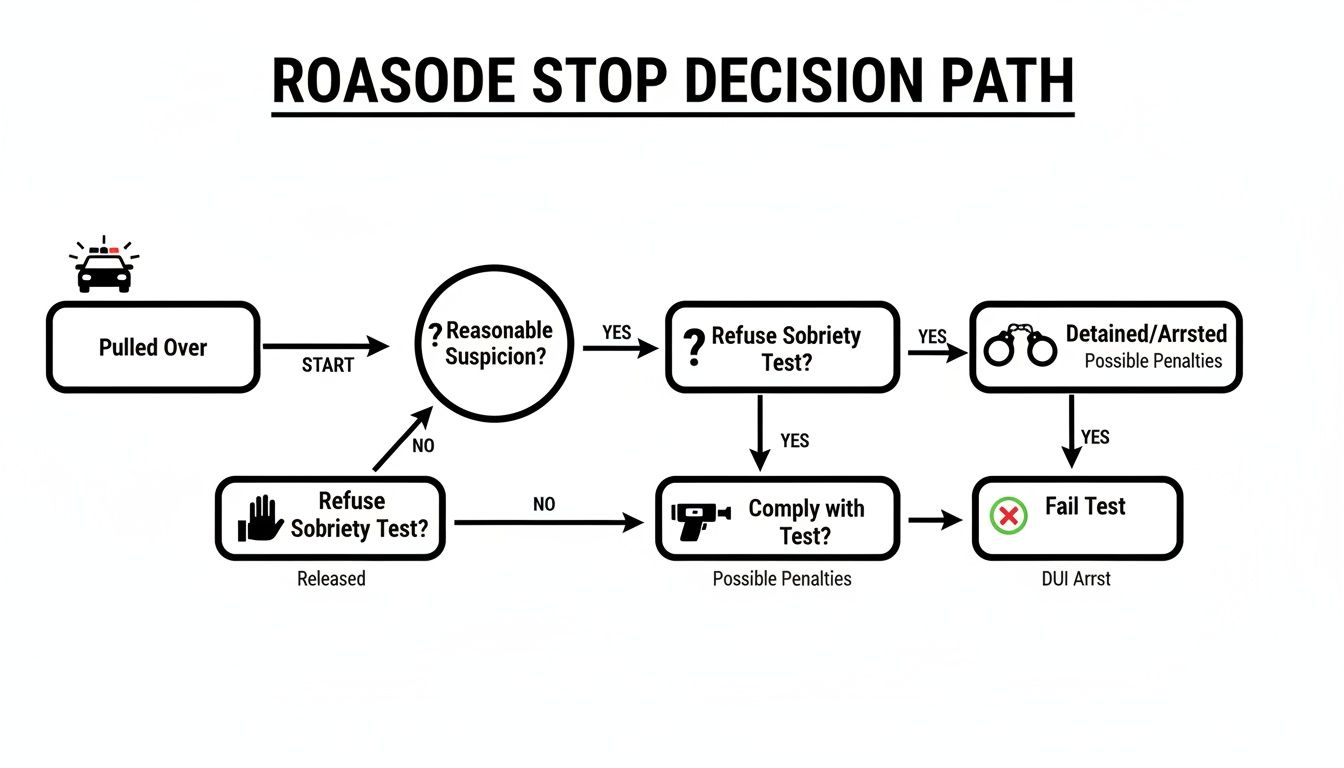
As you can see, both choices can still lead to a DWI arrest. The key difference is that refusing creates an instant, guaranteed administrative penalty against your driver's license.
To make this crystal clear, here’s a quick breakdown of what happens right away depending on your choice.
Refusal vs. Compliance Immediate Outcomes
| Action | Immediate Consequence | What Happens Next |
|---|---|---|
| Refuse the Test | Automatic license suspension process begins (ALR). | The state may seek a warrant for a blood draw. You now face two separate legal cases: the ALR and the criminal DWI. |
| Take the Test | If BAC is 0.08% or higher, the ALR process still begins. | The test result becomes the primary evidence in your DWI case. You face the ALR and the criminal DWI case. |
The bottom line is that a refusal doesn’t automatically get you out of a DWI charge, but it does guarantee a fight to keep your license. For a parent dealing with CPS, losing your license can be a catastrophic blow to your service plan, making it difficult or impossible to attend required classes, therapy sessions, or visitations with your children.
Here’s the core of it: refusing the test doesn't stop an arrest or a DWI charge. It just changes the kind of evidence the prosecution has and forces you into an immediate, separate legal battle to save your driving privileges.
The fear and confusion of a DWI stop are overwhelming, but understanding the basics of implied consent gives you a foundation to stand on. An experienced attorney can bring the calm and clarity you need to handle both the administrative and criminal fights that lie ahead, always keeping your family’s well-being at the forefront.
Understanding the Texas Implied Consent Law
When you’re pulled over and an officer asks you to blow into a machine, it feels like a simple request you can just say "no" to. While you absolutely have the right to refuse, the situation is a lot more complicated than it seems, all thanks to a legal rule called Texas Implied Consent. Getting a handle on this law is the first step to protecting yourself during a DWI stop, especially when your family is under CPS scrutiny.
Think of your Texas driver's license as more than just a piece of plastic; it’s basically a contract you signed with the state. The moment you accepted that license and the privilege to drive on Texas roads, you automatically gave your consent to provide a breath or blood sample if you are ever lawfully arrested for driving while intoxicated. This pre-existing agreement is the foundation of every DWI investigation in the state.
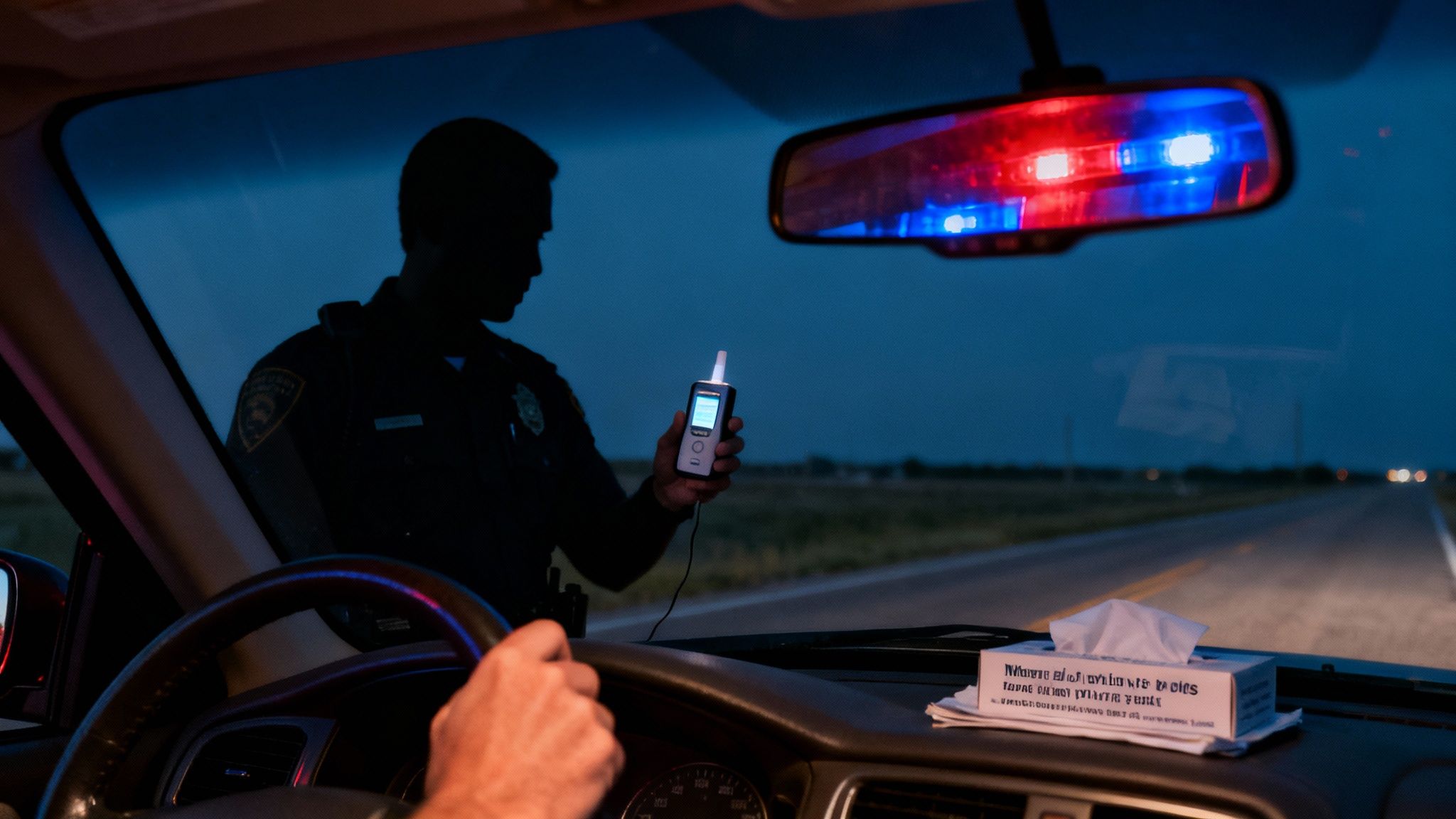
Because of this law, an officer's request for a chemical test isn't just a casual suggestion—it's a legal demand backed by the consent you've already given. Refusing that test is seen as breaking your side of the deal, and it triggers immediate, automatic administrative penalties, starting with the suspension of your driver’s license.
Roadside Breathalyzer vs. Evidentiary Test
One of the most confusing parts of a DWI stop is that there are often two different types of breath tests involved. Knowing which is which is critical to understanding your rights and what you’re required to do.
-
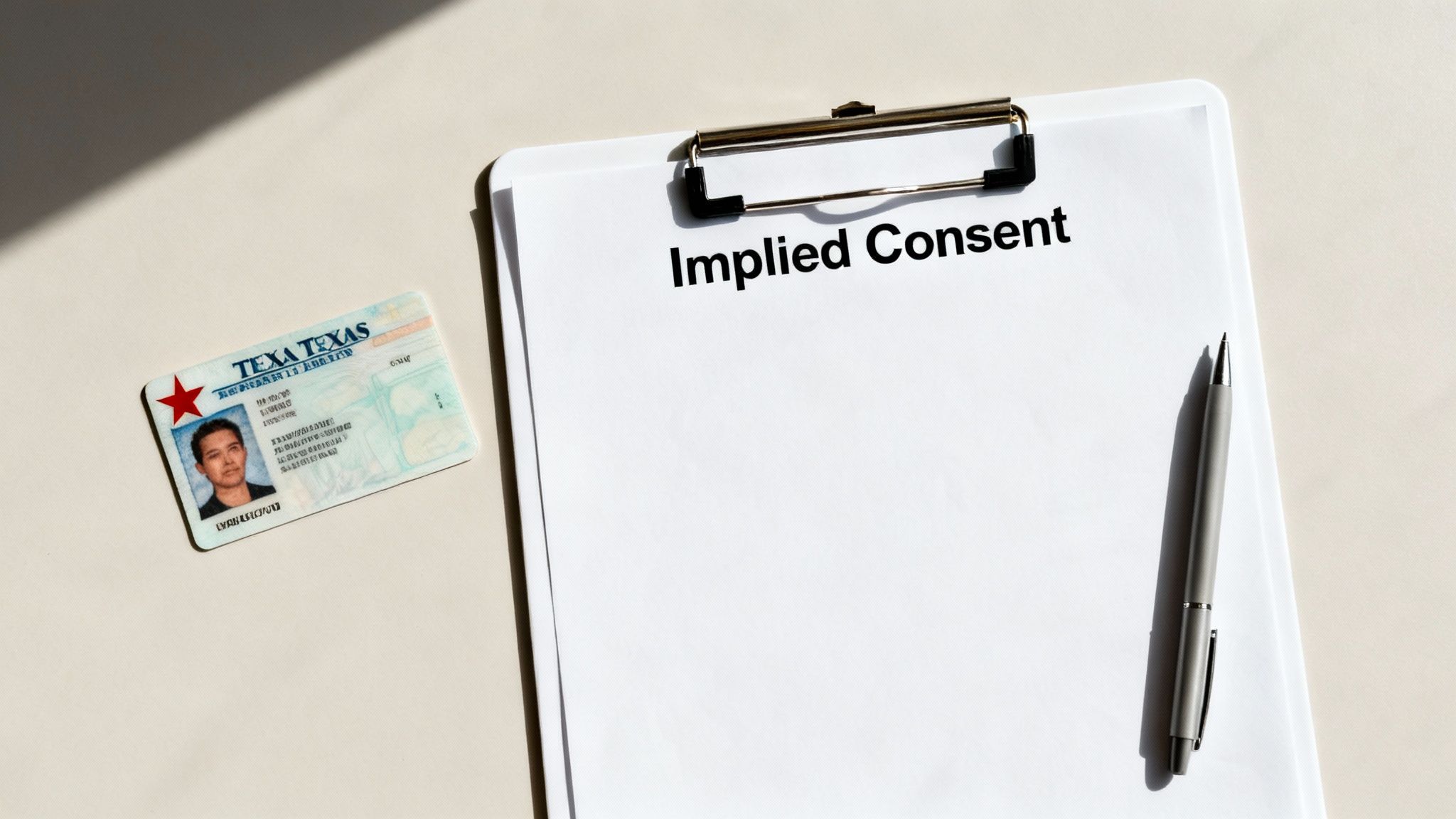
Preliminary Alcohol Screening (PAS) Test: This is the small, portable, handheld device an officer might ask you to blow into on the side of the road. In Texas, submitting to this roadside test is typically voluntary. Its results are often considered less reliable and are mainly used by the officer to establish probable cause for an arrest.
-
Evidentiary Breath Test: This is the larger, more sophisticated machine you'll find at the police station, jail, or a mobile DWI unit. This is the official test that the Texas Implied Consent law applies to after you have been arrested. Refusing this test is what triggers the automatic license suspension.
Key Takeaway: You can generally refuse the portable roadside breathalyzer without a direct penalty, but refusing the official evidentiary test at the station is a violation of implied consent and has serious consequences for your driver’s license.
The Consequences of Violating Implied Consent
When you refuse the official evidentiary test, you aren't dodging legal trouble; you're just swapping one problem for another. The state immediately kicks off a civil process to suspend your license, which is completely separate from the criminal DWI charge. This means even if you are never convicted of DWI, you can still lose your driving privileges just for the refusal itself.
The question of whether you can refuse a breathalyzer test is a common one across the country, with refusal rates varying a lot by state. National data shows that roughly one in four drivers arrested for suspected impaired driving choose not to provide a sample.
It's also crucial to understand the difference between a DUI and DWI in Texas, as the terms and penalties can be confusing. At the end of the day, the core issue is the same: an allegation of intoxicated driving kicks off a complex legal process that can turn your life upside down.
For a parent, losing the ability to drive can be devastating. It means you can't get your kids to school, drive to work to provide for your family, or make it to court-ordered appointments for your CPS case. The Law Office of Bryan Fagan understands that your driver's license isn't a luxury; it's a lifeline. We are here to help you navigate the complexities of a DWI charge and fight to protect what matters most.
The Two Legal Battles Triggered by a Refusal
A lot of folks think that saying "no" to a breathalyzer is a get-out-of-jail-free card. That if you just refuse, the whole problem might just… disappear. I've seen firsthand how this dangerous misunderstanding can wreck a family's life, especially when CPS is already a part of it.
Refusing the test doesn't end the process. It fractures it. You’re no longer fighting a single issue; you’re suddenly fighting a war on two fronts, at the very same time. One battle is for your freedom, the other is for your driver's license. Understanding how these two separate legal fights work is the first step toward building a defense that protects your family and your future.
Battle #1: The Administrative License Revocation (ALR)
The first punch comes fast, and it’s not from a criminal court. This is a civil action called the Administrative License Revocation (ALR) process. Its only mission is to suspend your Texas driver's license.
Because you refused the test, you technically violated the implied consent law. That triggers the Texas Department of Public Safety (DPS) to start the process of automatically revoking your driving privileges. This happens immediately and runs on a completely separate track from your criminal DWI case.
You could be found "not guilty" of DWI in criminal court and still have your license suspended through the ALR process. The two outcomes are completely independent.
For a parent trying to manage a household, losing your license is a catastrophe. How do you get to work? Pick up the kids from school? Get to a doctor's appointment or the grocery store? This administrative battle is where the consequences of a refusal hit home the fastest and the hardest. For families involved with CPS, it's even worse—a suspended license can be seen as a failure to comply with your service plan, jeopardizing reunification with your children.
Battle #2: The Criminal DWI Case
While you're scrambling to save your license, you still have to face the criminal charge of Driving While Intoxicated. This is the fight that happens in a criminal courtroom, where a prosecutor’s job is to convince a jury, beyond a reasonable doubt, that you were driving drunk. A conviction could be used by CPS as grounds to modify custody orders or even move towards termination of parental rights under Texas Family Code Chapter 161.
A DWI conviction carries heavy penalties that can destabilize any family:
- Crippling fines that can drain your savings.
- Potential jail time, pulling you away from your loved ones.
- A permanent criminal record that follows you to every future job application.
- Mandatory DWI classes and other expensive, time-consuming programs.
By refusing the breathalyzer, you've denied the prosecution a key piece of scientific evidence: your Blood Alcohol Concentration (BAC). But don't think that cripples their case. They can still use the officer’s testimony, dashcam video, and your performance on field sobriety tests. In fact, the prosecutor can and will tell the jury that your refusal itself is evidence of your guilt—arguing that you knew you were intoxicated and were trying to hide it.
The legal ground here is firm. The U.S. Supreme Court has made it clear that states can impose civil penalties like license suspension for refusing a breath test, viewing it as a minor inconvenience compared to the public safety risk. This solidifies the legal wall between the administrative penalties for refusal and the criminal prosecution for DWI. It’s a critical distinction in Texas. You can dive deeper into the legal precedents in this congressional report on implied consent laws.
The Critical 15-Day Deadline
Pay close attention to this. This is the most urgent part. After you are arrested and refuse the test, the clock starts ticking. You have only 15 days to request an ALR hearing to fight the automatic suspension of your license.
If you miss this deadline, it’s over. Your license will be suspended, no questions asked, and you will lose your only chance to challenge it.
This deadline is non-negotiable, which is why you must contact an experienced DWI attorney immediately. We can file the request for you, stop the automatic suspension, and give you a fighting chance to stay on the road while we prepare for the bigger battles ahead. Trying to manage these two legal fights on your own is a recipe for disaster, but it’s not a fight you have to face by yourself.
When Police Seek a Warrant for a Blood Draw
A lot of people think that refusing a breathalyzer is the final word on the matter—a hard "no" that shuts down any further chemical testing. That's a common and frankly dangerous assumption. In reality, your refusal often just forces the officer to switch gears, moving from asking for your consent to compelling your compliance with a judge's order.
When you refuse the big, evidentiary breath test at the police station, the officer doesn't just shrug their shoulders and let you go home. More often than not, they'll immediately pivot to getting a search warrant for a sample of your blood. And this isn't the slow, dramatic process you see on TV; it's usually shockingly quick.
The E-Warrant Process
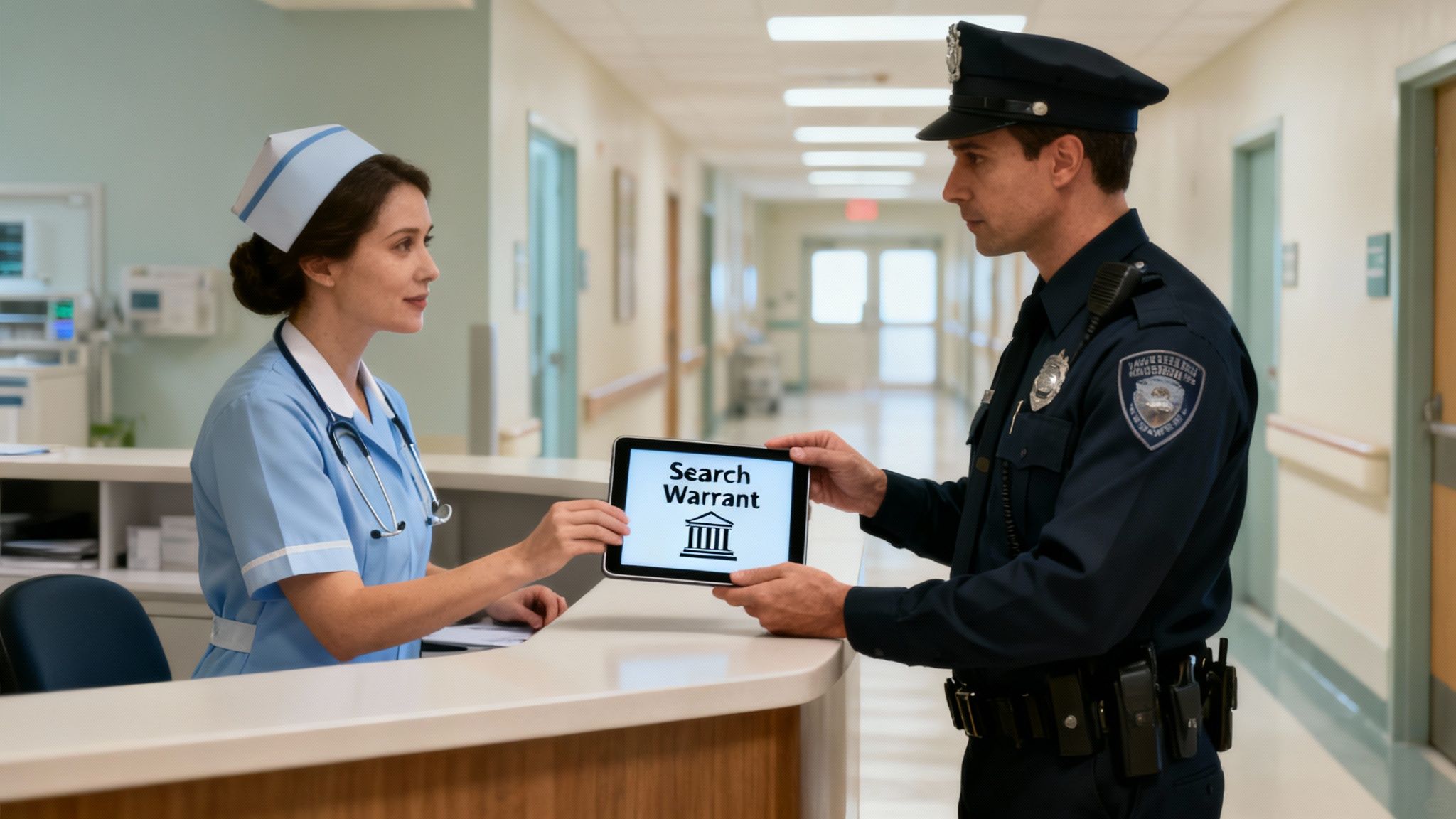
Technology has completely changed the game for law enforcement in Texas. Officers don't have to physically drive a stack of papers to a courthouse and hunt down a judge anymore. They use an electronic system, often called an "e-warrant," to submit a sworn affidavit directly to a magistrate who is on call, 24/7.
This affidavit lays out the probable cause for the warrant. It's the list of specific, observable facts that led the officer to believe you were driving while intoxicated. This could be anything from:
- Observations of erratic driving (swerving, speeding, etc.)
- The smell of alcohol on your breath or in your car
- Your physical appearance (bloodshot eyes, slurred speech)
- Your performance on the Standardized Field Sobriety Tests
- Any admissions you made about drinking
A judge can review this information on a tablet or computer and, if they agree there's enough evidence for probable cause, sign and return the warrant electronically in just a few minutes. From the officer's point of view, your refusal just adds one more small step to their paperwork. To get a better feel for this, you can learn about the process for securing warrants in Houston, TX and how it plays out in different scenarios.
A Relatable Scenario: The Inevitable Blood Draw
Let's imagine a dad, we'll call him Mark, who gets pulled over on his way home after having two beers with dinner. He's nervous. He remembers a friend once told him to always refuse the breathalyzer, so he politely declines the test back at the station, thinking he's protected himself.
But the arresting officer just pulls out a tablet, types up a quick statement detailing Mark’s driving, the smell of alcohol, and his slurred speech, and zaps it over to a judge. Less than 20 minutes later, while Mark is still being booked into the jail, a signed warrant pops up on the officer's device. Two officers then escort a handcuffed Mark to a nearby clinic where a phlebotomist draws his blood. His refusal didn't stop the test; it just delayed the inevitable by less than an hour. The results of that blood test will not only be used in his criminal case but could also become a key piece of evidence in a CPS hearing.
Once a valid search warrant is presented, you no longer have the right to refuse. The decision has been taken out of your hands and placed into the hands of the court.
Physically resisting a blood draw once a warrant is issued is a massive mistake. It won't stop the procedure—officers are legally allowed to use reasonable force to get the sample—and it will almost certainly get you a brand new criminal charge for resisting arrest or even assault on a public servant. Your DWI stop has now snowballed into a much more severe legal mess, all because of a simple misunderstanding of what a refusal actually accomplishes. The real question isn't just can you refuse a breathalyzer test, but what happens next.
How a DWI Attorney Defends a Refusal Case
If you’ve refused a breathalyzer test, it’s easy to feel like the fight is already over. The pressure and fear can be overwhelming, but this is the exact moment when having a skilled DWI defense attorney in your corner is most critical. A refusal isn’t an automatic conviction; it just changes the battlefield, and an experienced lawyer knows how to navigate this new terrain.
Instead of fighting against a number spit out by a machine, your attorney’s focus shifts to challenging the very foundation of the state’s case against you. Without a breath or blood sample, the prosecutor has to rely almost entirely on the arresting officer’s subjective observations and opinions. This is precisely where a strong defense begins.
Immediate Action to Protect Your License
The first thing your attorney will do—and it’s incredibly time-sensitive—is request your Administrative License Revocation (ALR) hearing. From the date of your arrest, you have only 15 days to get this request filed. Miss that deadline, and your license will be automatically suspended. It’s a non-negotiable window.
By filing for the ALR hearing, your attorney accomplishes two vital goals:
- It puts the brakes on the automatic suspension, which means you can keep driving legally while the case moves forward.
- It creates a crucial opportunity to get the arresting officer under oath and question them before the criminal trial even starts, which can unearth valuable evidence for your defense.
For parents who rely on their driver's license to get to work, take kids to school, and just manage the chaos of daily family life, this immediate action is an absolute lifeline. This is a practical, actionable step your attorney can take to show a family court judge that you are proactively handling the situation, which is vital in a CPS case.
Building a Defense Without a BAC Number
Once your license is safe from immediate suspension, your lawyer will start meticulously picking apart the prosecution's case. With a refusal, the defense often zeroes in on every single step of the police procedure.
Your attorney will dig into key questions, like:
- Was the initial traffic stop even legal? Did the officer have a legitimate reason, known as reasonable suspicion, to pull you over? If the stop was bad from the start, every piece of evidence that came after it could be thrown out.
- Was there probable cause for the arrest? Your lawyer will scrutinize the officer’s report and any dashcam footage to challenge their claims about your appearance, your speech, and how you performed on the field sobriety tests.
- Were there procedural mistakes with the warrant? If a warrant was obtained for a blood draw, was the affidavit accurate and sufficient to justify it? Was the warrant properly signed and executed? Any misstep can be grounds for suppressing the blood evidence.
A comprehensive guide on how to fight a DWI in Texas can offer more detail on these defense strategies. Your attorney essentially uses the lack of scientific BAC evidence to their advantage, highlighting just how subjective and unreliable an officer’s observations can be.
A refusal forces the prosecutor to prove intoxication the old-fashioned way—through opinion and observation. An experienced defense attorney knows exactly how to expose the weaknesses and inconsistencies in that kind of evidence.
Of course, a strong defense depends on open and honest communication with your lawyer. This is where understanding attorney-client privilege rules becomes so important, as it ensures everything you discuss remains completely confidential. You can speak freely, which is essential for building the strongest possible case. Your lawyer is your trusted advocate, and everything you say is protected.
Refusing a breathalyzer changes the fight, but it absolutely doesn't end it. With the right legal expert on your side, you can challenge the state’s case and work toward protecting your family, your career, and your future.
Deciding whether to refuse a breathalyzer is one of the toughest calls you can make, usually under intense pressure with flashing lights in your rearview mirror. There’s no simple “yes” or “no” answer that fits every situation. What feels like a smart move in the moment can easily backfire. As attorneys, we can't tell you in a blog post whether to refuse or comply—every stop is unique. What we can do is give you a clear framework to understand the strategic trade-offs involved.
Here’s the core dilemma: refusing the test keeps the prosecutor from getting a key piece of scientific evidence—your exact BAC number—but it guarantees an immediate, separate legal battle over your driver's license. On the other hand, submitting to the test might just hand the prosecutor the silver bullet they need to convict you, but it avoids the automatic penalties that come with a refusal.
Breaking Down the Decision
Let's think this through. Refusing the breathalyzer can absolutely make it harder for the State to prove you were intoxicated beyond a reasonable doubt in your criminal case. Without that hard number, they have to rely on more subjective evidence, like the officer's opinion about your speech, balance, or the smell of alcohol. A sharp defense attorney knows exactly how to pick that kind of testimony apart.
But the downsides are real, and they hit fast. The moment you refuse, the ALR process kicks in, putting your driver's license on the chopping block. And as we've already covered, a refusal doesn't mean the police just give up. It often motivates them to get a search warrant for a blood draw, which could give them an even more accurate—and potentially higher—BAC reading anyway.
And here's the kicker: your refusal can be used against you in court. A prosecutor will stand in front of a jury and argue that you said "no" because you knew you were guilty. They'll paint it as "consciousness of guilt," claiming you refused because you knew you were drunk and were trying to hide the evidence.
To help you really see the moving parts of this high-stakes choice, we’ve put together a table breaking down the key considerations. Think of it as a strategic map, highlighting the potential upsides and the very definite downsides of refusing the test.
Strategic Comparison Refusing vs. Submitting to a Breathalyzer
The choice to refuse a breathalyzer is a strategic gamble, pitting a potential advantage in your criminal DWI case against a certain penalty for your driver's license. The table below lays out this high-stakes trade-off, helping you understand the immediate and long-term consequences of your decision during a DWI stop in Texas.
| Consideration | Potential Pro of Refusing | Potential Con of Refusing |
|---|---|---|
| Evidence in Criminal Case | Denies the prosecution a specific BAC number, forcing them to rely on subjective officer testimony. | The refusal itself can be used as evidence of guilt. Police may obtain a warrant for a blood draw, yielding a more accurate BAC. |
| Driver's License Impact | No direct pro. Refusing always triggers an administrative penalty. | Automatic 180-day license suspension for a first offense, which you must fight in an ALR hearing. |
| Legal Process | May create more avenues for your attorney to challenge the case based on procedural errors or lack of evidence. | Instantly creates two separate legal battles: the administrative ALR hearing and the criminal DWI case. |
| Overall Control | Gives you a small measure of control over the evidence gathered at the scene. | You lose control over your license status and may be subjected to a mandatory, non-consensual blood draw if a warrant is issued. |
Ultimately, this is a calculated risk. Understanding the pros and cons is just the first step. Navigating the aftermath—whether you refused or not—requires immediate and strategic legal action to protect your rights, your license, and your future.
Got Questions? Let's Talk About Breathalyzer Refusals in Texas
When you're pulled over and the flashing lights are in your rearview mirror, your mind starts racing. It's a confusing, high-stress situation, and it's completely normal to have a flood of questions. When your job, your family's stability, and your freedom to drive are all on the line, you need clear, straightforward answers.
Here, we've broken down some of the most common concerns we hear from hardworking parents and professionals across Texas who find themselves asking, "Can I really refuse a breathalyzer test?"
Can I Still Be Convicted of DWI If I Refuse the Test?
Yes, you absolutely can. Refusing the test doesn't automatically kill the prosecutor's case; it just forces them to change their strategy. By saying no, you deny them a specific BAC number—often seen as the smoking gun—but you don't leave them empty-handed.
Instead of a number, the prosecutor will build their argument using other pieces of evidence. This could include:
- The arresting officer’s testimony about your driving—were you swerving or driving erratically?
- Dashcam or bodycam footage showing the stop and your interaction with the officer.
- Your physical appearance, like having bloodshot eyes, fumbling for your license, or slurring your words.
- Your performance on any Standardized Field Sobriety Tests you agreed to take.
Here's the kicker: the prosecutor is legally allowed to tell the jury that your refusal itself is a sign of guilt. They’ll argue that you only refused because you knew you were over the legal limit and were trying to hide the evidence.
Is Refusing a Field Sobriety Test the Same as Refusing a Breathalyzer?
No, and this is a critical distinction every driver in Texas needs to understand. The two are worlds apart.
Field sobriety tests—like the walk-and-turn, the one-leg stand, or the HGN (eye-tracking) test—are entirely voluntary. You can, and often should, politely decline to perform them. There is no automatic, legally mandated penalty for saying "no, thank you" to these roadside exercises.
Refusing an official evidentiary breath or blood test after you have been lawfully arrested is a completely different story. That action is what directly triggers the automatic license suspension under Texas Implied Consent law.
If My License Is Suspended for Refusing, Can I Still Drive to Work?
Losing your license is a nightmare, especially when you have kids to drop off at school or a job you need to get to. But there is often a way forward. You can petition the court for an Occupational Driver's License (ODL). Think of it as a special, restricted license that allows you to drive for essential, court-approved needs.
An ODL can give you permission to drive to and from:
- Your workplace.
- Your child's school, daycare, or after-school activities.
- Necessary household duties, like going to the grocery store or doctor's appointments.
Getting an ODL isn't automatic. It requires filing a formal legal petition and convincing a judge that you have an essential need to drive. An experienced DWI attorney can handle this process for you, helping to minimize the disruption to your family's life while your main case is being sorted out. This is a critical tool for parents in CPS cases who must demonstrate their ability to provide for their children and comply with court orders.
The moments following a DWI arrest are filled with uncertainty and fear, but you do not have to face them alone. The choices you make now can have a lasting impact on your family and your future, especially when CPS is involved. At The Law Office of Bryan Fagan, PLLC, we provide the clear-headed, compassionate legal guidance you need to protect what matters most. We understand the unique pressures parents face, and we are here to help you navigate both the criminal charges and the family law implications with strength and dignity. For a free, confidential consultation to discuss your case and understand your options, contact us today.