Skip to content
Facing a criminal charge, like a Class B misdemeanor in Texas for a first offense, is a terrifying experience that can send shockwaves through your entire family. One moment, life is normal; the next, a single mistake feels like it could unravel everything you've worked for, even threatening your relationship with your children. If you’re a parent in this situation, the fear and confusion can be paralyzing. The most important thing to remember is that while this is serious, it is manageable, and you are not alone. A conviction isn't a foregone conclusion, and for first-time offenders, there are often ways to protect your record and your family's future.
Understanding Your First Criminal Charge and Its Impact on Your Family
That first brush with the law can leave you feeling completely overwhelmed. The legal jargon is confusing, and the fear of what comes next—especially the potential impact on your kids or even a CPS investigation—can be paralyzing. If you're facing a Class B misdemeanor charge for the first time, take a deep breath. This is a critical moment, yes, but it isn't a life sentence.

It helps to think of the Texas criminal justice system as a ladder. A Class B misdemeanor is a few rungs up from the bottom—definitely more serious than a traffic ticket, but still well below a felony. It's a significant legal challenge, but it’s one you can navigate successfully with the right approach and guidance.
What Defines a Class B Misdemeanor
In Texas, criminal offenses are sorted by how serious they are, and Class B misdemeanors sit squarely in the middle of the misdemeanor scale. A conviction can absolutely change your life, but the penalties aren't as harsh as those for more severe crimes.
To give you a clearer picture, let's look at how the different misdemeanor classes stack up.
Texas Misdemeanor Penalties at a Glance
| Misdemeanor Class | Maximum Jail Time | Maximum Fine |
|---|---|---|
| Class C | None | Up to $500 |
| Class B | Up to 180 days | Up to $2,000 |
| Class A | Up to 1 year | Up to $4,000 |
As you can see, a Class B charge is a major step up from a Class C, which is usually just a fine. It's defined in the Texas Penal Code §12.22, which sets the punishment at up to 180 days in county jail, a fine of up to $2,000, or both.
Some of the most common charges that fall into this category include a first-time DWI, possession of less than two ounces of marijuana, or theft of property valued between $100 and $750.
A Common Scenario for Good People
Think about this: a parent is driving home after a dinner with friends where they had a couple of glasses of wine over several hours. They feel fine, but they're pulled over for a minor traffic violation. Suddenly, they're facing a DWI charge. Their first thought isn't about jail time; it's panic about who will pick up the kids from school tomorrow and whether this could trigger a call to Child Protective Services (CPS). This is a person who has never been in trouble, is dedicated to their family, and is now suddenly facing a criminal charge that feels like a threat to their entire world.
This kind of situation shows just how easily good, everyday parents can find themselves in a tough spot. One lapse in judgment does not have to ruin the rest of your life. The legal system recognizes this and provides options for first-time offenders to move forward.
Our goal here is to replace that anxiety with a clear understanding of what you're facing. A Class B misdemeanor in Texas for a first offense is a hurdle, not a roadblock. You have options, and the first step is knowing what's ahead.
When you hear a legal term like “Class B misdemeanor,” it’s easy for your mind to jump to the worst-case scenario. It sounds serious and maybe a little abstract. In reality, this classification covers a handful of very specific, surprisingly common situations that ordinary Texans find themselves in every day. Getting a handle on what these offenses actually are is the first step toward figuring out your next move.
These aren't just obscure laws on the books; they represent real people under a mountain of stress. Misdemeanor charges, including Class B offenses in Texas, are a huge part of the justice system. To give you some perspective, national data shows that misdemeanors made up about 35% of all jail admissions in 2023. That’s over 2.7 million cases. Charges like petty theft and first-time DWI, which are classic Class B offenses here, are a big reason why those numbers are so high. Learn more about the impact of misdemeanor charges on jail populations.
Let’s break down the most frequent charges that lead to a class B misdemeanor texas first offense arrest.
Driving While Intoxicated (First Offense)
A first-time DWI is hands-down one of the most common Class B misdemeanors in Texas. This charge comes into play when someone is arrested for driving in a public place while intoxicated, as long as their blood alcohol concentration (BAC) is under 0.15. It’s the kind of situation that can catch anyone off guard—a parent who had one glass of wine at dinner, or a college kid who misjudged how long to wait after a backyard barbecue.
For the state to get a conviction, the prosecutor has to prove three things:
- Operation: You were actually driving or in physical control of the vehicle.
- Public Place: This happened on a public street, highway, or another area accessible to the public.
- Intoxication: You either lost the normal use of your mental or physical abilities because of alcohol or drugs, OR you had a BAC of 0.08 or higher.
A good defense attorney will immediately start picking these elements apart. Was the initial traffic stop even legal? Were the field sobriety tests done by the book? Was the breathalyzer machine working correctly and properly calibrated? A single weak spot here can become the foundation of a powerful defense.
Possession of Marijuana (Under 2 Ounces)
Even with shifting attitudes and legalization in other states, possessing marijuana is still a crime in Texas. If you're caught with less than two ounces of marijuana plant material, it’s a Class B misdemeanor. We’re not talking about large quantities here—this could be a small baggie in the center console or a single pre-roll in your pocket. For a parent, the fear is not just the charge itself, but how it could be used against them in a custody dispute or a CPS case.
The key here is the substance and the amount. The law distinguishes sharply between marijuana plant material and THC concentrates (like those in vape pens or edibles), which can lead to much more serious felony charges, even for tiny amounts.
To get a conviction, the prosecutor must show you knowingly and intentionally had the marijuana. That means proving you knew it was there and had control over it. This "knowledge" factor is often where the fight is, especially if there were other people in the car or the home where the drugs were discovered.
Theft of Property or Services ($100 – $750)
Theft crosses the line into a Class B misdemeanor when the value of the stolen property or services is at least $100 but less than $750. This covers a huge range of scenarios, from shoplifting a few items at a big-box store to skipping out on a bill for services that fall within that dollar amount.
Think about a teenager who makes a dumb mistake and tries to walk out with a new video game and some accessories. Or maybe someone grabs a tool from a work site, thinking it’s not worth much. These are the kinds of lapses in judgment that can snowball into a criminal charge with lasting consequences.
To prove theft, the state has to show you took property unlawfully with the intent to deprive the owner of it for good. That word "intent" is everything. Did you just forget about an item at the bottom of your shopping cart, or was there a clear, deliberate plan to steal? A defense lawyer will dig into the evidence, like security videos and witness accounts, to challenge the prosecution’s story about what you were thinking.
Navigating the Texas Court System After Your Arrest
The time between an arrest and your first day in court is a blur of confusion and fear. It's easy to feel like you're lost in a maze designed to be intimidating, especially if you're facing a class b misdemeanor texas first offense. But this process, while complex, follows a predictable path. Once you understand the map, a frightening unknown turns into a series of manageable stages.
Think of an experienced attorney as your guide on a well-traveled but challenging trail. They know the shortcuts, the pitfalls, and the best route forward. Our goal is to give you that clear map, demystifying the legal proceedings you're about to face.
The infographic below shows the common sequence of events for some typical Class B misdemeanor charges in Texas.
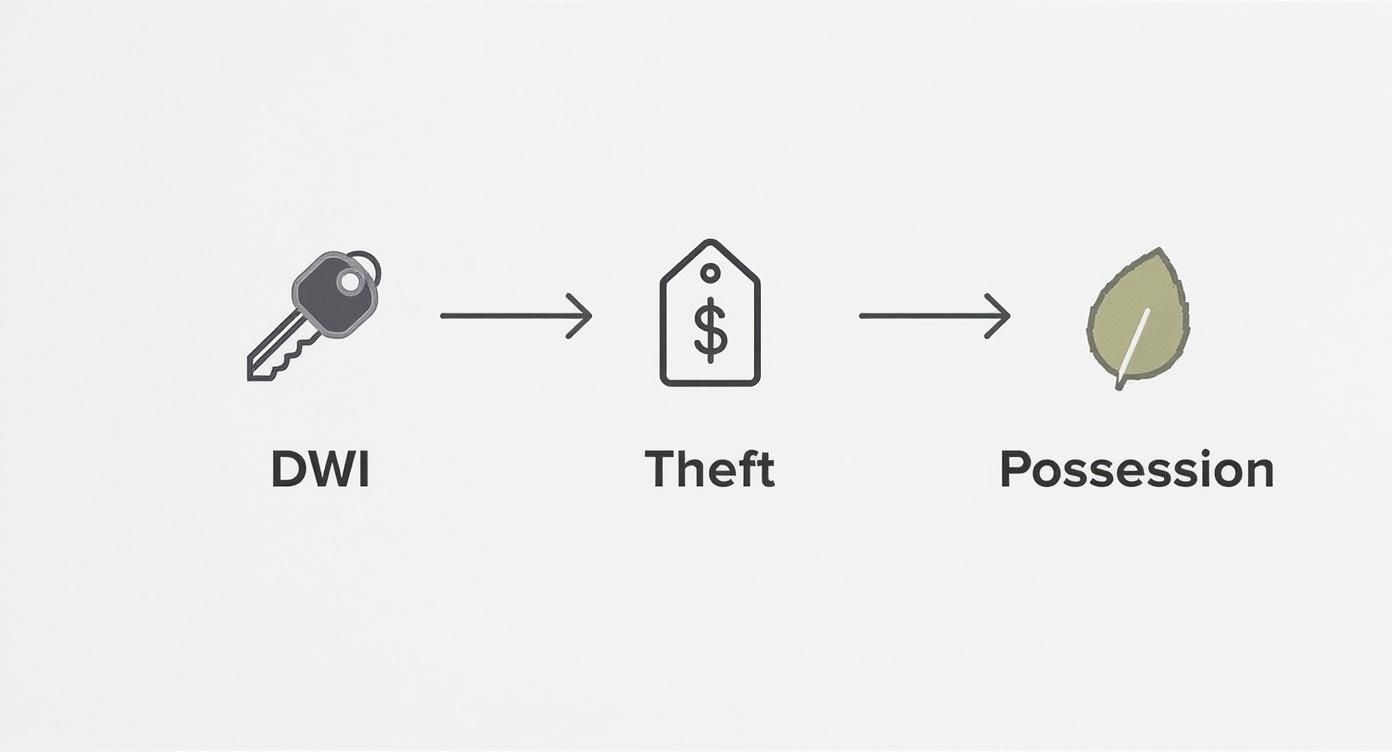
While the charges themselves are different, you can see that the initial court process often follows a similar structure, starting with the arrest and moving toward a final resolution.
From Arrest and Booking to Your First Court Date
Your journey through the system begins the moment you're taken into custody. This first phase, arrest and booking, is where your personal information, fingerprints, and mugshot are recorded and entered into the system. It’s a dehumanizing experience, but it’s standard administrative procedure for everyone.
After booking comes the next critical step: setting bond. Bond is essentially a financial promise that you'll show up for your future court dates. A judge or magistrate sets the amount based on things like the charge, your ties to the community, and your criminal history. For a first-time Class B misdemeanor, the bond is usually manageable, and you can often get released by paying a percentage to a bail bondsman.
Once you’re out, you'll be given a date for your first court appearance. This is where the formal legal process truly kicks off.
Understanding the Arraignment and Pre-Trial Phase
Your first time in front of a judge is called an arraignment. At this hearing, the judge will formally read the charges against you and ask you to enter a plea. Your options are "guilty," "not guilty," or "no contest," but pleading "not guilty" at this stage is almost always the right move. This plea doesn't mean you're denying everything—it just protects all your legal rights and gives your attorney time to dig into the evidence.
Entering a "not guilty" plea is a strategic first move. It opens the door for your attorney to begin the crucial work of building your defense, from requesting evidence from the prosecutor to identifying weaknesses in the state's case.
After the arraignment, your case moves into the pre-trial phase. This is where most of the legal heavy lifting happens. Your attorney will start the "discovery" process—formally demanding all the evidence the prosecutor has, like police reports, witness statements, and any video footage. They will also file pre-trial motions to challenge evidence that may have been obtained illegally or to address other legal snags.
This phase is also when plea bargaining usually starts. Your lawyer will negotiate with the prosecutor to see if a good deal can be reached without going to trial. This could mean getting the charge reduced or agreeing to a sentence that keeps a conviction off your record, like deferred adjudication. Getting a handle on what happens at an arraignment hearing is the first step in preparing for this critical phase.
Texas courts see a huge volume of these cases. In fiscal year 2023 alone, county courts handled about 62,673 Class A and B misdemeanor cases. That number might seem daunting, but it also means judges and prosecutors are very familiar with these charges. For a skilled attorney, that familiarity can create opportunities to negotiate effectively on your behalf.
Paths to a Positive Outcome Beyond a Conviction
Hearing the click of handcuffs or seeing flashing lights in the rearview mirror can make you feel like your fate is sealed. It's easy to think an arrest automatically leads to a conviction, especially for a Class B misdemeanor in Texas for a first offense. But that's rarely the whole story. This moment isn't just about facing consequences; it's about uncovering the strategic pathways available to protect your record and move on with your life.
The truth is, the justice system has built-in off-ramps for situations just like this. Most judges and prosecutors understand that one mistake shouldn't torpedo an otherwise clean record. That’s where options like deferred adjudication, pre-trial diversion, and probation come into play—they aren’t just legal jargon; they are powerful tools for a second chance.
Deferred Adjudication: A Second Chance at a Clean Record
For a first-time offender, deferred adjudication is often one of the best possible outcomes. It’s important to understand this is not a conviction. Instead, it’s a unique form of probation where you plead "guilty" or "no contest," but the judge holds off on finding you guilty. Instead, they place you on community supervision for a specific period.
Think of it like a deal with the court. You agree to follow a set of rules—pay fines, complete community service, attend specific classes, and most importantly, stay out of trouble. If you hold up your end of the bargain, the judge dismisses the case when the term is over. The charge doesn't vanish completely, but since you were never officially convicted, you can later petition to have the record sealed from the public.
Successfully completing deferred adjudication means you can legally deny that you were ever convicted of the crime. This is a game-changer for job applications, housing, and your overall peace of mind.
Imagine a parent gets caught shoplifting diapers and formula worth $120 during a moment of financial desperation. A conviction for theft could threaten their job and their ability to provide for their child. But through their lawyer's work, they get deferred adjudication. For six months, they check in with a probation officer, pay a fine, and finish an anti-theft class. Once done, the case is dismissed, their record remains clean, and their family's future stays on track. To dig deeper into how this works, learn more about what deferred adjudication is in Texas and see if it could be an option for you.
Pre-Trial Diversion Programs: An Early Exit
Even better than deferred adjudication is a pre-trial diversion program. This is a special track that can get your case dismissed without you ever having to enter a plea. Prosecutors typically reserve these programs for very minor offenses and people with squeaky-clean records.
If you’re accepted, your case is essentially paused while you complete certain requirements. These often include:
- Educational Courses: Like a DWI class or a drug awareness program.
- Community Service: A certain number of hours at an approved non-profit.
- Regular Check-ins: Reporting to a program coordinator to show progress.
- Staying Trouble-Free: No new arrests during the program period.
Once you’ve checked all the boxes, the prosecutor simply dismisses the charges. The biggest win here? Because the case was dropped before a plea, you are often eligible to have the entire arrest record completely expunged. That means it’s destroyed, as if it never even happened.
Standard Probation: When a Conviction Can't Be Avoided
Sometimes, the facts of a case or prior history make a dismissal or deferred adjudication impossible. When that happens, probation (officially called "community supervision") is still a viable alternative to spending time in jail, even though it comes with a conviction.
If you're sentenced to probation, you will be found guilty of the Class B misdemeanor. However, instead of going to jail, you serve your sentence out in the community under the supervision of a probation officer. The rules are strict and very similar to those for deferred adjudication.
While this path does result in a permanent conviction on your record, it keeps you out of a jail cell and allows you to keep your job and live your life. For a first offense, it is a much better outcome than incarceration and is often the result of tough negotiation by a skilled defense attorney.
How To Clear Your Record After A Misdemeanor Charge
Even after the court dates are a memory and the fines are paid, a criminal charge can cast a long shadow, creating unexpected roadblocks in your personal and professional life. For anyone facing a Class B misdemeanor Texas first offense, the story doesn't have to end there. Texas law actually provides a couple of powerful ways to get a truly clean slate, ensuring one mistake doesn’t define your future.

This process is about more than just filing paperwork; it's about reclaiming your reputation and your opportunities. Two key legal pathways make this possible: expunction and orders of nondisclosure. Figuring out the difference between them is the first step toward clearing your name for good.
Expunction The Ultimate Clean Slate
An expunction is the gold standard for clearing a criminal record in Texas. It doesn't just hide your record—it legally destroys it. When a judge grants an expunction, every government agency holding records of your arrest, from the local police to the court clerk, is ordered to physically destroy or erase them.
Once an expunction is granted, you can legally deny the arrest ever happened on almost any application—jobs, housing, professional licenses, you name it. In the eyes of the law, it's as if the whole incident never occurred.
But there's a catch: eligibility for an expunction is pretty strict. You generally only qualify if your case ended in one of these ways:
- You were arrested but never formally charged with a crime.
- The prosecutor ultimately dismissed your criminal charge.
- You went to trial and were found "not guilty" by a judge or jury.
- You successfully finished a pre-trial diversion program.
Because the bar is so high, an expunction offers the strongest protection available. If you want to dive deeper into the specifics, check out our detailed guide on how to get a record expunged in Texas.
Orders of Nondisclosure Sealing Your Record From Public View
So, what happens if you don’t qualify for an expunction? An order of nondisclosure is the next best thing. Instead of destroying the record, this court order seals it, essentially hiding it from public view. This means most private companies doing background checks for employers, landlords, and schools won't be able to see it.
Think of it like this: an expunction erases the book entirely, while a nondisclosure order locks it away in a private vault. Law enforcement can still see the record if they need to, but the general public cannot.
You might be eligible for an order of nondisclosure if you successfully completed deferred adjudication for a Class B misdemeanor. After a required waiting period, you can petition the court to seal the record. The benefit is huge; much like an expunction, it allows you to legally deny the arrest and prosecution to most private parties.
Let's break down how these two powerful options stack up against each other.
Expunction vs. Nondisclosure Which Is Right for You?
Choosing between these two options depends entirely on how your case was resolved. This table makes the key differences clear.
| Feature | Expunction (Record Destroyed) | Order of Nondisclosure (Record Sealed) |
|---|---|---|
| What Happens to the Record? | All records are physically destroyed. | Records are sealed from public access. |
| Who Can See It Afterward? | Essentially no one. | Government and law enforcement agencies. |
| Who Is Eligible? | Cases that were dismissed, acquitted, or completed through a diversion program. | Cases that were successfully completed through deferred adjudication. |
| Legal Status | You can legally deny the arrest ever occurred to anyone. | You can legally deny the arrest to private entities (e.g., employers, landlords). |
Both of these legal remedies are life-changing. They restore your ability to chase career opportunities and pass background checks without an old mistake holding you back. The path to a clear record can feel complicated, but with the right legal guidance, you can take decisive action to protect your future.
How a Defense Attorney Can Change Your Outcome
Facing a criminal charge feels like being pushed into a turbulent river alone. Hiring an attorney isn't just about getting a life raft; it's about partnering with an expert navigator who knows the currents, can spot the hidden rocks, and will steer you safely to shore. For a Class B misdemeanor in Texas, especially a first offense, the actions a skilled lawyer takes can mean the difference between a life-altering conviction and a second chance.
Simply having a lawyer isn't enough; it’s about what that lawyer does for you. A proactive attorney doesn't just sit back and wait for the prosecutor's next move. They immediately go on the offensive, demanding every piece of evidence—police reports, body cam footage, witness statements—and combing through it all, looking for procedural errors or weaknesses in the state's case.
Strategic Defense in Action
An experienced attorney approaches your case with a critical eye, constantly looking for opportunities to challenge the state's narrative. Their strategy often involves several key actions:
- Analyzing the Arrest: Was the initial stop or police encounter legally justified in the first place? If the answer is no, any evidence they found could be thrown right out of court.
- Challenging the Evidence: They scrutinize every single piece of evidence. Was the breathalyzer calibrated correctly? Was the chain of custody for the evidence handled properly? Every detail matters.
- Negotiating from a Position of Strength: By finding these flaws, your attorney gains leverage. This allows them to negotiate with the prosecutor for a much better outcome, like getting the charge reduced or even dismissed entirely.
This proactive defense is what truly changes the game. It moves you from a passive position of just accepting what happens to an active role in fighting for your future.
A common scenario is a DWI charge where the police report seems solid. But a sharp attorney reviews the dashcam video and discovers the officer didn't have a valid reason to pull the driver over. That illegal stop means all subsequent evidence gets suppressed, and the case gets dismissed.
This is the tangible difference expertise makes. It’s not about finding some secret loophole; it's about holding the system accountable and making sure your constitutional rights are protected at every single turn.
Your situation is unique, and you deserve a defense strategy built specifically for you. An attorney can help you explore options you might not even know exist, like pre-trial diversion programs that can lead to your charges being completely dismissed. Don't try to face this overwhelming process alone.
At the Law Office of Bryan Fagan, we understand the fear and uncertainty you're experiencing. We're here to offer not just legal advice, but compassionate support and a clear path forward. Contact us today for a free, confidential consultation to discuss your case and learn how we can help protect your future.
Frequently Asked Questions About a First-Time Misdemeanor
When you’re staring down a criminal charge for the first time, your mind is probably racing. The "what ifs" can be completely overwhelming, but getting clear, straight answers is the first real step toward taking back control. Let's tackle some of the most common worries people have about a class B misdemeanor Texas first offense, breaking down both the immediate hurdles and the bigger picture.
Will I Definitely Go to Jail for a First-Offense Class B Misdemeanor?
No, jail time is far from guaranteed. While a judge can sentence someone to up to 180 days in county jail for a Class B misdemeanor, that’s the maximum, not the standard outcome. For first-time offenders, judges and prosecutors often prefer more constructive solutions.
Things like probation, deferred adjudication, or even pre-trial diversion programs are common ways these cases get resolved without anyone seeing the inside of a jail cell. A good attorney's primary goal is often to negotiate one of these better outcomes, steering the focus toward rehabilitation instead of just punishment. The strength of the state's case and your legal strategy are what really determine whether jail is even on the table.
What Does It Typically Cost to Hire an Attorney for a Class B Misdemeanor?
There’s no single price tag. The cost for a lawyer really depends on a few things: how complex your case is, the attorney’s level of experience, and even where in Texas you were charged.
Some lawyers offer a flat fee for misdemeanor cases, which gives you a predictable, all-in cost. Others might bill by the hour. It’s critical to stop thinking of this as just a "cost" and start seeing it as an investment in your future. Many reputable firms, including ours, offer a free initial consultation to go over the details of your case and give you a clear picture of the legal fees involved.
The right attorney does more than just show up to court; they build a strategy to protect your record, your freedom, and your future opportunities. The long-term value of a positive outcome far outweighs the initial legal costs.
Can This Charge Affect My Job or Professional License?
Yes, unfortunately, a conviction can create some serious professional roadblocks. A lot of employers run background checks, and having a conviction for something like theft or DWI pop up can easily get you fired or prevent you from being hired in the first place.
It gets even more serious if you have a professional license—think nurses, teachers, pilots, or real estate agents. A conviction could trigger a review by your licensing board, which might lead to suspension or even having your license revoked. This is exactly why fighting for an outcome that avoids a final conviction, like a dismissal or deferred adjudication, is so incredibly important.
How Long Does a Misdemeanor Case Usually Take to Resolve in Texas?
The timeline can be anywhere from a few months to over a year. It really depends on the court's schedule, how complicated the evidence is, and the legal strategy you and your lawyer decide to use.
A straightforward case that ends in a plea deal will wrap up much faster than one that goes all the way to a jury trial. While the waiting can be frustrating, that time is actually valuable. It gives your attorney the space to conduct a thorough investigation, track down evidence, and negotiate effectively with the prosecutor for the best possible result.
A criminal charge is a serious matter, but it is not a journey you have to take by yourself. The choices you make now can profoundly impact the rest of your life. At The Law Office of Bryan Fagan, PLLC, we are dedicated to providing the strategic defense and compassionate guidance you need to navigate this difficult time and protect your future. Don’t wait to get the answers and support you deserve. Contact us today for a free and confidential consultation to discuss your case.