Skip to content
A knock on your door from Child Protective Services (CPS) can trigger a wave of fear and confusion that no parent should ever face alone. In that moment, your world shrinks to a single, terrifying question: what happens now? Here at the Law Office of Bryan Fagan, we understand the panic that sets in when your family is suddenly under a microscope. We have guided countless Texas parents through this daunting process, and we want you to know that understanding your rights is the first step toward taking back control.
The system for handling a CPS anonymous report in Texas changed significantly in 2023. These reports no longer automatically trigger a full-blown investigation, but are first sent to local law enforcement. This was a direct response to the weaponization of false reports that have traumatized innocent families. Knowing how this new law and the broader CPS process works is your most powerful tool in protecting your family.
The Moment a CPS Caseworker Knocks on Your Door

It’s an unexpected knock. You open the door, and there stands a Child Protective Services (CPS) caseworker. In that instant, a wave of pure panic washes over you. Your heart hammers against your ribs. Your mind races, cycling through a thousand worst-case scenarios. It’s a moment of confusion and terror that no parent should ever have to face. Here at the Law Office of Bryan Fagan, we’ve walked with countless families through that exact feeling of helplessness, and we want you to know you are not alone.
The single most important thing you can do to protect your family is to understand how the system works. The process for handling a CPS anonymous report in Texas has changed dramatically, and knowing those changes can make all the difference in the world.
How an Anonymous Report Can Upend Your Life
Picture this: you are navigating a difficult divorce, and tensions with your ex-spouse are high. One evening, after a heated phone call about parenting time, you get a knock on the door. It’s a CPS caseworker, saying they received a report alleging you are neglecting your children. Your ex, in a moment of anger, has weaponized the system to gain leverage in your custody dispute. Suddenly, your family is thrust under a microscope, facing a full-blown investigation—all because of a malicious and false claim.
This is an alarmingly common reality for Texas parents. Before 2023, anonymous tips were a massive driver of investigations. In Fiscal Year 2022 alone, the Department of Family and Protective Services (DFPS) managed 225,407 reports, with a huge number coming from unnamed sources. You can explore more DFPS data to see just how vast their work is in Texas.
A significant 2023 law, brought forward by State Representative Valarie Swanson, put a stop to CPS directly investigating completely anonymous complaints. The intent was clear: to cut down on the number of false or malicious reports used to weaponize the system and traumatize innocent families.
Now, a completely anonymous report gets rerouted to local law enforcement for a preliminary check. While this new law adds a much-needed filter, it doesn't erase the risk. Understanding this new system and your rights under the Texas Family Code is absolutely critical from the very first moment you interact with a caseworker. This knowledge gives you the power to stay calm, respond correctly, and build a foundation to defend your family for a positive outcome. If you find yourself in this situation, the best thing you can do is get legal guidance right away.
How Reports Are Made Under Current Texas Law
If you suspect a child is being abused or neglected, the thought of getting involved can be paralyzing. It's natural to fear retaliation or worry about the consequences of making a report. But Texas law provides clear, official channels to ensure your concerns are heard and, most importantly, that children are protected.
Knowing how to navigate these pathways is the first step toward acting responsibly and potentially saving a child from harm.
The Texas Department of Family and Protective Services (DFPS) is the primary agency for handling these reports. They've established two main ways for the public to voice their concerns: a dedicated hotline and an online reporting system. Both are staffed by trained intake specialists who know what questions to ask and how to assess the urgency of a situation.
Making a Report: The Hotline and Online System
The most immediate way to report is by calling the Texas Abuse Hotline at 1-800-252-5400. This line is open 24/7, staffed by professionals ready to walk you through the process. For situations that aren't life-threatening emergencies, you can also file a report online at TxAbuseHotline.org.
No matter which method you choose, coming prepared is key. Vague suspicions are hard for caseworkers to act on. They need concrete details to build a case and determine if an investigation is warranted.
Before you call or go online, try to gather as much of this information as you can:
- Who: The child’s name, approximate age, and address. If you know the name of the person you suspect is responsible, provide that as well.
- What: A clear, factual description of what you've seen or heard. Describe injuries, concerning behaviors, or the child's living conditions.
- When: The dates and times of specific incidents you are aware of. A pattern is often more compelling than a single event.
- Where: The location where the abuse or neglect is happening.
The more specific you are, the better equipped DFPS will be to take meaningful action.
To help you understand the different ways to report suspected child abuse or neglect in Texas, we've put together this table. It breaks down the primary methods, how they work, and the level of confidentiality you can expect with each.
Reporting Methods for Child Abuse in Texas
| Reporting Method | How It Works | Anonymity/Confidentiality | Best For |
|---|---|---|---|
| Texas Abuse Hotline | Call 1-800-252-5400 to speak directly with a trained intake specialist 24/7. | You can report anonymously or confidentially. Your identity is legally protected if you report confidentially. | Urgent situations requiring immediate attention and for those who prefer speaking to a person directly. |
| Online Reporting Portal | Submit a detailed report through the TxAbuseHotline.org website. | You can report anonymously or confidentially. Confidential reports protect your identity. | Non-emergency situations where you can provide detailed, written information and documentation. |
| Local Law Enforcement | Call 911 or your local police department's non-emergency number. | Reports are generally not anonymous, but your details may be kept confidential as part of an investigation. | Life-threatening emergencies or when a crime is actively being committed. |
Choosing the right method depends on the urgency of the situation and your comfort level with providing your personal information. However, as you'll see, a confidential report often carries more weight and allows for a more effective response.
Confidential vs. Anonymous Reports: A Critical Distinction
A recent change in Texas law has reshaped how a CPS anonymous report in Texas is handled. If you make a report and refuse to provide your name, it is now considered truly anonymous. These reports are forwarded directly to local law enforcement, who must first determine if the tip is credible before CPS can even begin an investigation. This can create delays.
The most effective way to report suspected abuse is confidentially. This means you give your name and contact information to the intake specialist, but your identity is protected by law. It will not be disclosed to the family being investigated.
A confidential report carries significantly more weight and allows CPS to follow up with you if they need to clarify details or gather more information.
Think about it from this perspective: you're a teacher who has noticed a student repeatedly coming to school with unexplained bruises and appearing withdrawn. As a mandated reporter, you have a legal and ethical duty to act. You can learn more about the specific responsibilities of a CPS mandatory reporter in our detailed guide.
By reporting confidentially, you provide a credible, firsthand account that helps CPS act quickly while your identity remains protected. This is far more powerful than an anonymous tip that might get stuck in a credibility check with law enforcement.
If you are a parent on the receiving end of a CPS investigation—whether from an anonymous, confidential, or other type of report—the situation can feel overwhelming and terrifying. Remember, you have rights. The single most important step you can take is to seek legal guidance immediately. An experienced attorney can help you understand the allegations, protect your rights, and navigate the complex process ahead.
Facing a CPS investigation is not something anyone should do alone. We at The Law Office of Bryan Fagan have seen firsthand the fear and uncertainty this process creates for families. We are here to defend your rights and fight for your family. Contact us today for a free, confidential consultation to discuss your case and learn how we can help.
Navigating the CPS Investigation Process
Once a report about your family is accepted for investigation, the entire process can feel like a blur of confusing and frightening steps. For any Texas parent, understanding what’s coming is your first and best defense. It helps you move from a state of panic to a state of prepared action, giving you the power to protect your family and your rights.
The process kicks off with intake and screening, where a CPS caseworker reviews the report. They’re looking at the severity of the allegations to decide if it warrants a full-blown investigation. Not every call leads to a home visit, but if the report contains specific details that suggest a child is at risk, you can absolutely expect to hear from them.
What to Expect During the Home Visit and Interviews
The most jarring part for many parents is the unannounced home visit. A caseworker might just show up at your door—sometimes with a police officer—to get a look at your child’s living situation. While the Texas Family Code, specifically Chapter 262, gives them the power to investigate, you still have rights.
Remember this: you are not legally obligated to let a caseworker into your home without a court order, unless they have reason to believe your child is in immediate, life-threatening danger. It's a delicate balance, though. Refusing them entry will likely lead them to get that court order, which may not look good in front of a judge. This is one of the first moments where having an attorney to call can be invaluable.
During the visit, you can expect the caseworker to:
- Interview you and your children separately: They are trained to speak with children alone, often at their school, to get what they believe is a more unfiltered account.
- Inspect your home: They’ll be looking for basics like adequate food, safe living conditions, and any obvious hazards.
- Request documents: This can be anything from your child’s medical records to school attendance reports.
It's absolutely crucial to remain calm and polite, but you do not have to answer every question on the spot. You have the right to not speak without an attorney present. Simply stating, "I would like to speak with my attorney before answering further questions," is a powerful and legally protected response.
Understanding Safety Plans and Your Rights
One of the most critical parts of an initial investigation is when a caseworker asks you to sign a "Parental Child Safety Placement" or a "Safety Plan." These documents can seem like a quick way to make the problem go away, but they carry serious legal weight.
A safety plan might require you to agree to things like:
- Moving out of your own home.
- Having another family member move in with you.
- Submitting to drug testing or counseling.
- Placing your child with a relative temporarily.
Actionable Advice for Parents: Do not sign any document from CPS without having an attorney review it first. These are technically voluntary agreements, but once you sign one, it can be used against you in court. You can get a more in-depth look at the entire timeline by reading our guide to the Texas CPS investigation process. An attorney can help you negotiate fair terms that truly protect your parental rights, making sure you don’t sign away more than you have to. This process is complex, but with the right guidance, you can face it with confidence.
Mandated Reporters and Weaponized False Allegations
In Texas, certain professionals—think teachers, doctors, and therapists—are designated as mandated reporters. This isn't just a title; it's a legal obligation. They are required by law to report any suspicion of child abuse or neglect. The system is designed to protect them for making reports in good faith, encouraging them to speak up without fear of legal blowback.
But this well-intentioned system has a dark side. While mandated reporters act from a place of professional duty, others file anonymous CPS reports for purely malicious reasons. One of the most devastating scenarios we see is when a parent weaponizes a false report to gain an edge in a bitter divorce or custody fight.
The Devastating Impact of Malicious Reports
Imagine this: You're navigating a high-conflict custody battle. Out of nowhere, you receive a call from a CPS investigator. Your ex has lodged a false claim that you're neglecting your kids, a calculated move to paint you as an unfit parent before a judge.
This single, malicious act can instantly plunge your life into chaos. It triggers intense emotional distress, strains your relationship with your children, and can force you to spend thousands of dollars on legal fees just to clear your name and protect your family. It's an ugly, and unfortunately common, tactic.
The process kicks into gear quickly. A simple phone call can trigger a full-scale, invasive investigation, as the flowchart below shows.
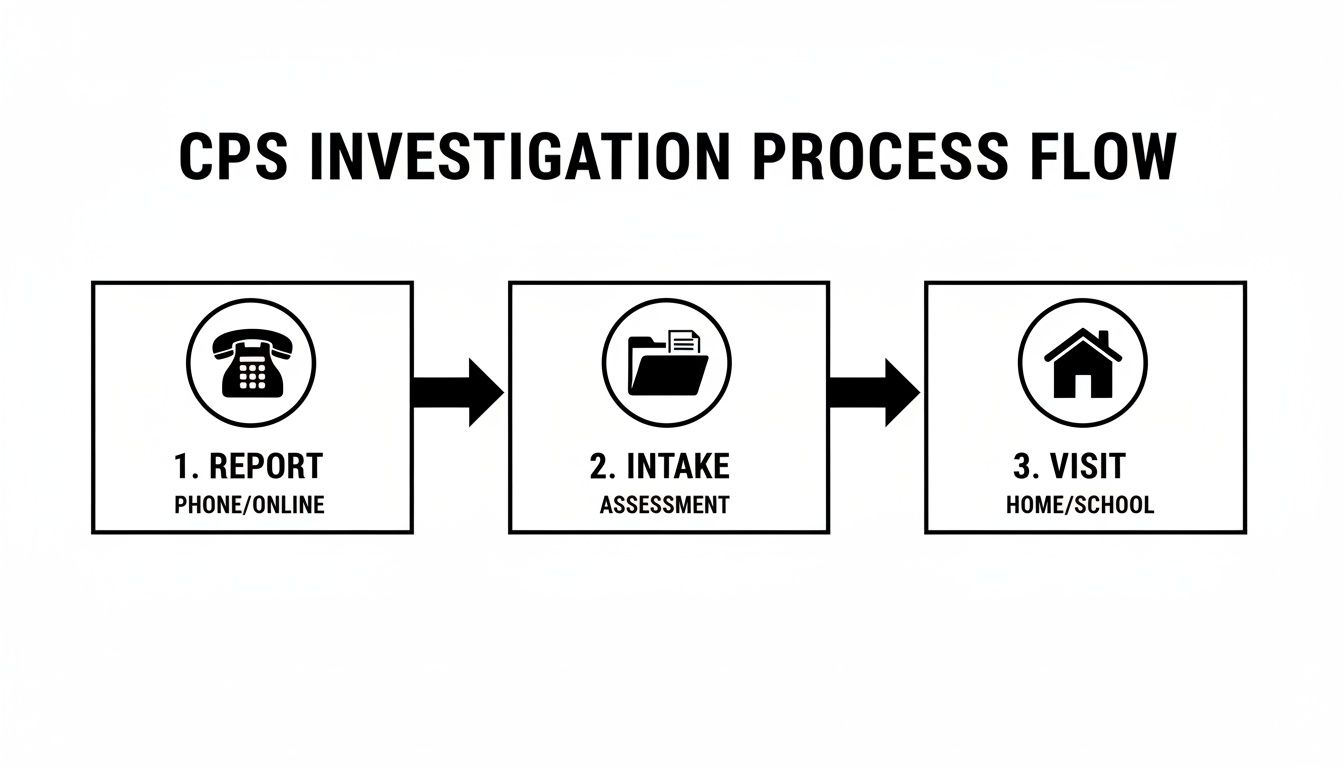
As you can see, a report moves swiftly from intake to an in-person visit at your home or your child's school. This shows just how fast a false allegation can escalate.
Proving Malicious Intent Is a Criminal Offense
Texas law does not take this lightly. Intentionally filing a false report with CPS is not just a dirty trick—it's a State Jail Felony. If you can prove someone knowingly lied to the state to cause harm, you can protect your family and fundamentally change the dynamic of your custody case.
A judge who sees hard evidence of a deliberately false and malicious report will likely view that parent’s behavior as a form of parental alienation. It's a direct threat to the child's best interest, and it can absolutely tank that parent's credibility and custody goals.
The sheer volume of reports puts an enormous strain on the system. In Fiscal Year 2022 alone, Texas CPS handled 225,407 intakes, which resulted in 166,187 completed investigations. While many of these are legitimate concerns, this number also includes baseless allegations that waste critical resources and inflict trauma on innocent families.
Proving a report was made with malicious intent is a high legal bar to clear. An experienced attorney can help you gather the necessary evidence—things like revealing text messages, emails, or witness testimony—that exposes the other party's true motive. This is a critical step in safeguarding your parental rights and holding the responsible person accountable. You can also read more about the legal and ethical consequences of weaponizing CPS in our detailed guide.
Protecting Your Rights When CPS Is Involved

If you're facing a CPS investigation, it can feel like you're navigating a minefield blindfolded. A caseworker might show up at your door with a friendly demeanor, but it's crucial to understand their job: they are there to build a case. Trying to handle this alone puts your family at a serious, unnecessary disadvantage.
The moment you get that first phone call or an unannounced visit, the clock is ticking. This is your most important window of opportunity to get legal protection. Before you answer their questions, let them in your home, or even think about signing a piece of paper, you have the right to speak with an attorney. A good lawyer will step in and make sure you don't say or do something under pressure that could jeopardize your family.
Critical Moments When You Need an Attorney
Some moments in a CPS investigation are more treacherous than others. One wrong move can have devastating results for your family. In these situations, an attorney isn’t just a good idea—they are absolutely essential to protecting your rights.
Actionable Advice for Parents: Know when to call a lawyer. Here are the moments when you need to seek legal counsel immediately:
- The First Contact: That initial conversation with a caseworker isn't just a friendly chat; it's a formal part of their investigation. An attorney can guide you on how to respond without accidentally making things worse.
- Before You Sign Anything: Caseworkers will often ask you to sign a "Safety Plan" or another type of agreement. These are voluntary legal documents that can strip away your parental rights. Never, ever sign one without having a lawyer review it first.
- If They Mention Removing Your Children: The second a caseworker brings up removing your kids, even for a short time, it’s a five-alarm fire. It means CPS is ready to take legal action that could land you in court.
- When You Receive a Court Notice: Any official notice for a hearing under the Texas Family Code means the situation has escalated. You need a lawyer in your corner, right now, to start preparing.
Calling an attorney isn't admitting you did something wrong. It’s an assertion of your constitutional rights. A lawyer makes sure CPS plays by the rules and that your side of the story is heard loud and clear.
The High Stakes of Texas Family Code
A CPS investigation can go from a simple inquiry to a formal court case with shocking speed. The Texas Family Code sets up a fast-paced legal process. Chapter 263 dictates the timeline for court hearings, while Chapter 161 lays out the grounds for terminating parental rights—the legal equivalent of a death sentence for your family.
The system is designed to protect children, but its allowance for anonymous reporting means it can also be misused. What starts as a simple report can escalate into criminal charges like child endangerment or assault, raising the stakes dramatically. You can read more on how CPS reports can intersect with criminal defense to see just how quickly things can spiral.
An experienced CPS defense attorney knows these laws inside and out. They are your advocate, fighting to get the case dismissed or working toward a reunification plan. This isn't just about winning one battle; it's about protecting your entire future with your children.
Common Questions About Texas CPS Reports
When you're caught in the whirlwind of a CPS investigation, it feels like your world is spinning out of control. Your mind races with questions, and the fear of the unknown can be paralyzing. Getting clear, practical answers is the first step to steadying yourself and understanding your rights. Here, we tackle some of the most common questions we hear from Texas parents facing this stressful situation.
Can a CPS Caseworker Force Their Way Into My Home?
Absolutely not. A caseworker cannot legally force their way into your home without a court order or if they are with a law enforcement officer who has a warrant. You have a constitutional right to privacy, which means you can refuse to let them in.
However, this is a very delicate situation. While it is your right, simply shutting the door in their face will almost certainly lead the caseworker to seek a court order to gain entry. A judge might not look favorably upon that refusal. A better approach is to step outside, close the door behind you, and politely state that you want to cooperate but would like to speak with your attorney before allowing anyone inside.
What Is the Difference Between an Anonymous and a Confidential Report?
This is a critical distinction under Texas law. A truly anonymous report—where absolutely no one, not even CPS, knows who made the call—is no longer the focus of a direct CPS investigation. Instead, these tips are forwarded to law enforcement to check for credibility, which can add significant delays.
A confidential report, on the other hand, is when the person reporting provides their name and contact details to the CPS intake specialist. CPS is then legally obligated to keep that person's identity private and not disclose it to the family under investigation. Caseworkers generally view confidential reports as more credible, and it gives them a way to follow up if they need more information.
How Long Does a CPS Investigation Take in Texas?
Most standard CPS investigations in Texas are supposed to be completed within 30 to 45 days. Of course, particularly complex cases can be granted an extension, but that's the general timeframe investigators aim for. During this period, the caseworker's job is to gather evidence, interview you, your children, and others, and inspect your home.
At the end of the investigation, the caseworker will issue a finding. This will either be "Ruled Out," which means they found no evidence of abuse or neglect, or "Reason to Believe," which means they believe abuse or neglect likely occurred.
Can a False CPS Report Affect My Custody Case?
Yes, and it can have a massive impact—often in a way the person making the false report never intended. If you are in a custody battle and can prove the other parent intentionally filed a false or malicious report just to gain an advantage, a judge will take that very seriously. It's often viewed as a form of parental alienation and a clear sign of bad faith.
In Texas, proving someone knowingly filed a false report is a State Jail Felony. An experienced family law attorney can help you gather the evidence needed—things like text messages, emails, or witness statements—to prove the report was malicious. This not only clears your name but can severely damage the other parent's credibility in court, directly impacting custody and visitation arrangements.
The stakes are incredibly high when CPS is involved, and you should not face it alone. The attorneys at The Law Office of Bryan Fagan have the experience and compassion to guide you through this difficult process, protecting your rights and fighting for your family’s future. For a free and confidential consultation to discuss your case and begin creating a strategy to protect your family, contact us today. We are here to help.