Skip to content
The moment a letter from Child Protective Services arrives, your world stops. Seeing their official seal can trigger a wave of fear, confusion, and a profound sense of injustice, especially when you know you are a loving parent caught in a misunderstanding. If that letter contains a "reason to believe" finding of abuse or neglect, it can feel like a verdict has already been passed on your family. But that finding is not the final word. A CPS appeal in Texas is your legal right to fight back, tell your side of the story, and protect your family's future.
Responding to a CPS Finding in Texas
Few things can make a parent's heart sink faster than opening a letter from Child Protective Services. Seeing the words "reason to believe" feels like a formal judgment, an official stamp saying you’ve failed as a parent. It’s a moment that floods you with panic and a deep sense of helplessness, especially when you know the allegations are wrong or have been twisted out of context.
At The Law Office of Bryan Fagan, we understand the terror and confusion you're feeling. A "reason to believe" finding is not a criminal conviction, but it carries a heavy weight. It simply means a CPS caseworker, after their investigation, decided it was more likely than not that abuse or neglect occurred. This is a much lower standard of proof than the "beyond a reasonable doubt" required in a criminal court, making it alarmingly easy for good parents to get caught in the system.
Understanding the Different Findings
Once a CPS investigation concludes, it will end with one of several possible outcomes. It is absolutely critical to know what each one means for your family.
- Reason to Believe: This is the most serious finding. It means the investigator believes there's enough evidence to support the allegation of abuse or neglect. This is the finding that gives you the right to a CPS appeal in Texas and could get you placed on the Central Registry.
- Ruled Out: This is the best possible outcome. It means the investigator determined that the alleged abuse or neglect did not happen. Your case is closed.
- Unable to Determine: This is a gray area. It means there wasn't enough evidence to either confirm or deny the allegations. While better than a "reason to believe" finding, it can leave a cloud of suspicion hanging over your family.
That "reason to believe" determination is what sets the entire appeal process in motion. It's the agency's official stance, but it is far from the last word on the matter.
The Immediate Impact of a Negative Finding
The fallout from a "reason to believe" finding can be swift and severe. The most significant consequence is being listed on the Texas Central Registry, a confidential database used to screen people who want to work or volunteer with children.
Being placed on this registry can instantly disqualify you from chaperoning a school field trip, coaching your kid's Little League team, or working in careers like teaching, nursing, or childcare. It’s a mark on your record that can follow you forever unless you successfully appeal the finding.
Consider this all-too-common scenario: A father is in the middle of a contentious divorce. To gain leverage in their custody fight, his ex-spouse makes a false allegation of neglect. A stressed, overworked CPS investigator talks to the children, who are confused and feeling pressured. Based on that limited evidence, the investigator issues a "reason to believe" finding.
Just like that, a dedicated father is facing the potential end of his career and the destruction of his reputation—all because of a lie. This is exactly why knowing your right to appeal is so critical.
Sadly, a huge number of reports are ultimately found to be unsubstantiated. In Texas, only about a 22% confirmation rate exists for reports of maltreatment. That means a staggering 78% of all reports are unsubstantiated, yet a finding can still land a person's name on the central registry for life unless they fight it. You can dig deeper into these legislative challenges and reform efforts over at the Texas Public Policy Foundation.
This finding is not a final verdict on your parenting. It's an administrative decision made by a government agency, and you have an absolute right to challenge it. The path forward starts with understanding that a CPS appeal in Texas is your chance to reclaim your story and fight for your family.
Understanding Your Appeal Options: Administrative vs. Judicial
Once you’ve made the courageous choice to fight a CPS finding, you face a critical decision that will shape your entire strategy. Texas law doesn't offer a one-size-fits-all appeal. Instead, there are two distinct paths you can take, and knowing which one applies to your situation is the most important first step.
The two main routes are an Administrative Review of Investigative Findings (ARIF) and a Judicial Appeal. These operate in completely different worlds, each with its own rulebook, deadlines, and goals. Choosing the wrong one isn't just a simple mistake—it can mean losing your right to fight for your family altogether.
The Administrative Appeal: What It Is and Who It's For
For most parents who have received that dreaded "reason to believe" letter, the ARIF process is their battlefield. This is your direct challenge to the caseworker's conclusion. The entire point of this administrative appeal is to prove CPS got it wrong and to get your name removed from the Texas Central Registry.
This process happens outside of a traditional courtroom, at least at first. It involves internal reviews within the Department of Family and Protective Services (DFPS) and can escalate to a formal hearing with an administrative law judge. Think of it as challenging the agency on its own turf.
To help you visualize the crucial decision you face after receiving a letter from CPS, this chart breaks down the initial choice and its consequences.
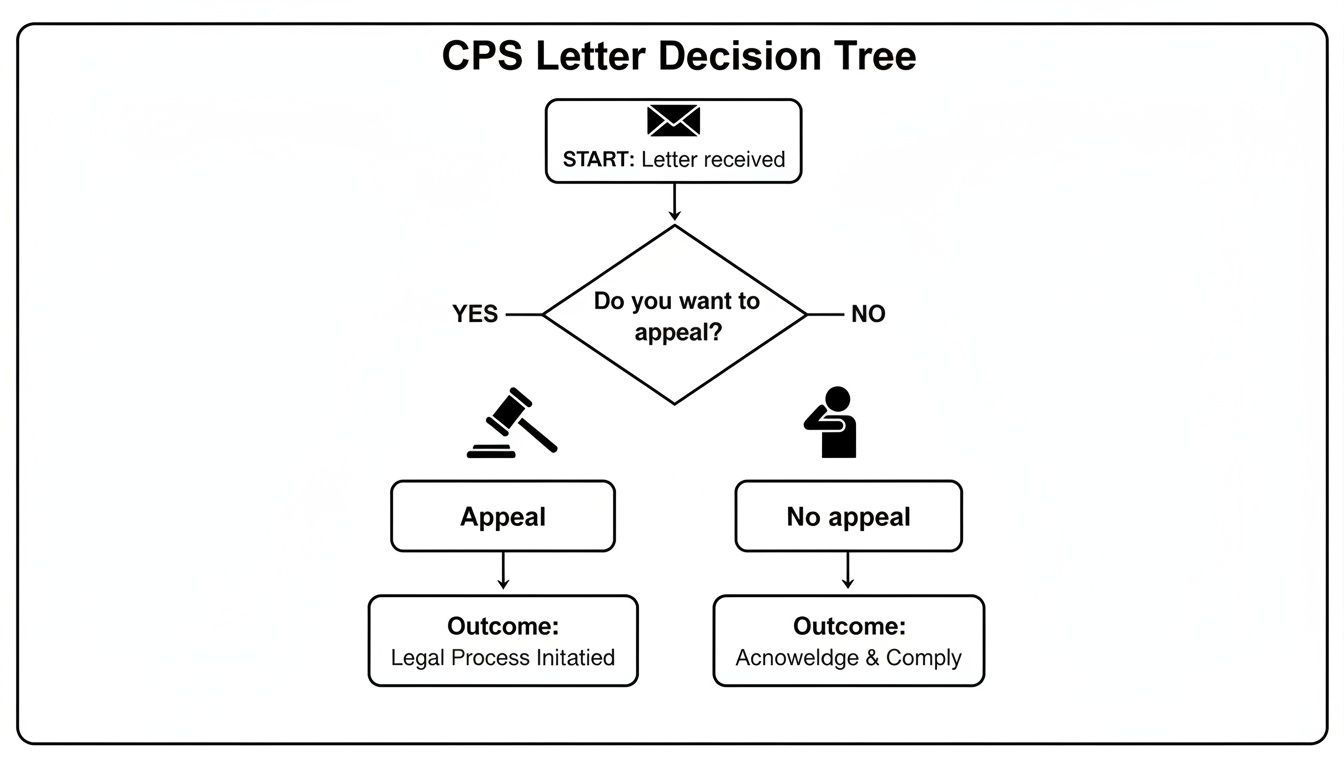
As you can see, the moment that letter arrives, you're at a fork in the road. Doing nothing is a decision in itself, while taking action to appeal opens up a completely new legal path.
The Judicial Appeal: When Your Fight Is in the Courtroom
A judicial appeal is a different animal entirely. This path is only open to you after a family court judge has already issued a final, binding order in your case—for example, an order that terminates your parental rights under Texas Family Code Chapter 161.
Unlike the ARIF, a judicial appeal doesn't re-litigate the facts of your case. You don't get a do-over. Instead, you're asking a higher court, known as an appellate court, to comb through the trial record and find legal errors made by the judge. The whole argument is that the judge misapplied the law or violated proper procedure, leading to an unjust outcome. This is a highly technical fight that requires a deep knowledge of appellate law.
To make this distinction crystal clear, here’s a real-world scenario:
A mother, Maria, is wrongly accused of neglect. CPS issues a "reason to believe" finding but never files a lawsuit to remove her kids. To clear her name and stay off the Central Registry, Maria's only correct path is the administrative appeal (ARIF).
Now, consider David. CPS took him to court, and after a full trial, a judge terminated his parental rights. To fight this devastating order, David’s only option is to file a judicial appeal with the appropriate court of appeals, arguing the judge made a critical legal mistake during the trial.
The table below breaks these two paths down side-by-side to help you see the differences at a glance. For a deeper dive, you can also explore our full guide on your legal options for a CPS appeal.
Texas CPS Appeal Paths: Administrative vs. Judicial Review
Navigating a CPS appeal means first understanding which system you're operating in. The path you take depends entirely on whether you're fighting an agency finding or a court order. This table lays out the fundamental differences.
| Feature | Administrative Appeal (ARIF) | Judicial Appeal (Court System) |
|---|---|---|
| What You're Appealing | A CPS "reason to believe" finding. | A final order from a family court judge. |
| Primary Goal | Remove your name from the Central Registry. | Overturn the court's final order. |
| Where It Happens | DFPS internal reviews and the State Office of Administrative Hearings (SOAH). | Texas Courts of Appeals and potentially the Supreme Court of Texas. |
| Who Hears the Case | An administrative law judge (ALJ). | A panel of appellate court justices. |
| Typical Deadline | 45 days from receiving the CPS notification letter. | 20 days from the date the judge signs the final order. |
| Legal Standard | Does a preponderance of evidence support the finding? | Did a legal error occur during the trial that harmed the outcome? |
Knowing this difference is non-negotiable. Missing the tight deadline for an ARIF because you mistakenly thought you needed a court order first, or trying to file an ARIF to challenge a judge's ruling, will slam the door on your chance to fight back.
Your situation dictates your path. If you've received a finding letter but haven't been to court, your world revolves around the administrative appeal. If your battle has already been lost in a courtroom, a judicial appeal is your next fight. The stakes couldn't be higher, and the timelines are unforgiving. If you are even slightly unsure which path applies to you, it is critical to get legal advice immediately.
How to Navigate the Administrative Appeal Process
When you get that letter from CPS with a "reason to believe" finding, your world can feel like it's tilting on its axis. For most Texas parents, the first and most important battleground is the administrative appeal. This isn't a dramatic courtroom scene—not yet, anyway. It's a formal, structured process to challenge the Department of Family and Protective Services (DFPS) decision head-on, with one clear goal: getting your name off the Central Registry for good.
This entire process is officially called an Administrative Review of Investigative Findings (ARIF). Think of it as your formal chance to present your side of the story and bring forward all the evidence the caseworker might have missed or just plain misinterpreted. But you have to move fast.

Taking the First Step: The Formal Request
The clock starts ticking the second you get that notification letter from CPS. From that date, you have a strict, non-negotiable 45-day deadline to formally file for your appeal. If you miss this window, the door to challenge the finding can slam shut—permanently.
Your request has to be submitted in writing, using the specific forms DFPS provides. It is absolutely critical that you follow every instruction to the letter. A vague request or a missed deadline is an easy excuse for the agency to deny your appeal before it even gets started. This is one of the first and most important actionable steps you can take.
The Two-Tiered Review and SOAH Hearing
Once your appeal request is in, the journey begins with two internal reviews by DFPS itself. Here’s where many parents get frustrated, and for good reason. The same agency that made the finding against you is now in charge of reviewing its own work. It’s an obvious conflict of interest, and a systemic issue that many are pushing to fix through legislative registry reform.
If those internal reviews uphold the original finding—which, frankly, they often do—your fight is far from over. The next, and most crucial, stage is an independent hearing at the State Office of Administrative Hearings (SOAH). This is a real, formal hearing in front of a neutral Administrative Law Judge (ALJ), where both you and CPS will present evidence and call witnesses.
This SOAH hearing is your best opportunity for a fair outcome. The ALJ isn't a DFPS employee and is required to make an independent decision based only on the facts and evidence presented.
Gathering Your Evidence to Build a Strong Case
Winning at a SOAH hearing boils down to the strength of your evidence. The legal burden is on CPS to prove by a "preponderance of the evidence" that the abuse or neglect happened. But you can't just sit back; you need to be ready to dismantle their case with credible, compelling proof of your own.
Here’s the kind of evidence that can completely turn a case around:
- Communication Records: Save every single text, email, and voicemail from the CPS caseworker. These records can reveal major inconsistencies in their story or prove that you were cooperative all along.
- School and Medical Records: Official attendance records, report cards, and letters from doctors can directly contradict allegations of neglect.
- Photos and Videos: Visuals are powerful. Photos and videos showing a safe, clean home and happy, well-cared-for children can make a huge impact on a judge.
- Proof of Compliance: If CPS recommended classes, therapy, or drug tests, document your attendance and completion. This shows you’re proactive and taking their concerns seriously.
Real-World Example: We worked with a mother accused of educational neglect after her child missed a string of school days. CPS slapped her with a "reason to believe" finding. At her SOAH hearing, she presented two things: the school's own attendance records showing most absences were excused, and a detailed letter from her child's doctor explaining the unexcused days were due to a severe, documented asthma attack. The judge overturned the finding, ruling it was a medical issue, not neglect.
Preparing Your Witnesses
Witnesses who can speak to your character and parenting skills are invaluable. And don't just rely on family members—credible, third-party witnesses often carry much more weight with a judge.
Think about who sees you and your children in your daily life:
- A long-time neighbor who sees the kids playing outside.
- A teacher or school counselor.
- A sports coach or daycare provider.
- A pastor or other leader from your place of worship.
Make sure to prepare them for the hearing. They need to be ready to speak honestly and give specific examples of your relationship with your children and their firsthand observations of your parenting. A well-prepped witness provides the human element that documents just can't capture. For a more detailed walkthrough, you can review our guide on how to file a CPS case appeal.
Fighting an administrative appeal is demanding, but it is absolutely winnable. It takes organization, persistence, and a smart, strategic approach to telling your side of the story.
When Your CPS Case Goes to Family Court
If CPS decides their investigation warrants more than just a finding, they can file a lawsuit to take custody of your children. This is where everything changes. Your fight shifts from an administrative issue with a state agency to a full-blown family court case, and the stakes couldn't be higher. A judge is now involved, and the entire process is strictly controlled by the Texas Family Code, specifically Chapters 262 and 263.
The moment you're served with court papers is often a blur of shock and fear. Suddenly, you're not just disputing an investigator's conclusion—you're fighting to keep your family from being permanently torn apart. The threat of having your parental rights terminated under Chapter 161 becomes terrifyingly real.

Key Court Hearings You Will Face
The court process isn’t a single event but a series of hearings, each with a specific job to do. It typically kicks off with an emergency removal, which leads directly to the first and most critical court date: the Adversary Hearing. According to Texas Family Code Chapter 262, this must happen within 14 days of your child being taken from your home.
This hearing is your first chance to stand before a judge and challenge CPS's reasons for removal. The burden is on them to present evidence showing there’s an ongoing danger to your child. We cover this in much more detail in our guide to the Adversary Hearing in a Texas CPS case.
After that initial hearing, the case moves through several other stages:
- Status Hearings: Think of these as regular check-ins with the judge, usually every 60 days, to see how everyone is progressing on their court-ordered plans.
- Permanency Hearings: These hearings, guided by Texas Family Code Chapter 263, are all about the long-term plan for your child. The goal could be reunification with you, placement with a family member, or even adoption.
- Final Trial: If the case can't be resolved, it all comes down to a final trial. Here, a judge or a jury makes the ultimate decision: either your child comes home, or your parental rights are terminated under the strict standards of Texas Family Code Chapter 161.
The Importance of Your Service Plan
Very early in the court case, the judge will order you to follow a Family Service Plan. This is essentially a to-do list created by CPS, filled with tasks like counseling, parenting classes, or drug testing, designed to fix the problems that brought them to your door.
Here’s the hard truth: even if you believe the allegations are completely false, compliance is not optional. Refusing to participate in the service plan is almost always interpreted by the judge as an admission of guilt or a sign that you aren't willing to do what it takes to be a safe parent. Your most powerful actionable advice here is to comply fully and document everything.
I’ve seen it happen time and again. A parent is falsely accused of substance abuse. Out of frustration and principle, they refuse to submit to a drug test. In court, the CPS attorney will turn to the judge and say, "Your Honor, the parent refused a drug test. What are we supposed to conclude from that?" That refusal ends up looking far worse than the original, unproven allegation.
Your best defense is to meticulously document everything. Keep records of every class you attend, every clean drug test, and every meeting you have. This paper trail becomes your most powerful weapon in court, proving to the judge that you are a proactive and responsible parent.
Appealing a Final Court Order
If the worst happens and a judge terminates your parental rights after a trial, your last resort is a judicial appeal. This is a whole different ballgame from the administrative appeal we talked about earlier. You’re no longer arguing with CPS; you are challenging the judge's final decision in a higher court.
Filing a judicial CPS appeal in Texas is an extremely technical legal battle with unforgiving deadlines. You must file a Notice of Appeal within 20 days of the judge signing the final order. If you miss this window, your right to appeal is gone for good.
An appeal is not a do-over. The appellate court won't hear from new witnesses or look at new evidence. Their only job is to comb through the trial transcript and records to find legal errors the judge might have made. A skilled appellate lawyer has to pinpoint a mistake—like allowing evidence that should have been excluded or misinterpreting the law—that was serious enough to have changed the outcome of your case.
It’s a tough, uphill battle, but for many parents, it’s the last line of defense in the fight for their child. It highlights just how critical it is to have an experienced attorney on your side from the moment your case enters the courthouse.
Building a Winning Defense Case: Evidence and Strategy
When you get that finding letter from CPS, it’s easy to feel like the fight is already lost. But here’s the truth: winning an appeal in Texas isn’t about luck. It’s about building a rock-solid defense, piece by piece, with hard evidence that dismantles the story CPS has told about your family.
This isn't just a matter of collecting a few papers. You're crafting a new narrative—the true one—that addresses every single allegation head-on.

The work starts the moment that letter arrives. You have to become a meticulous collector of facts, pulling together everything that proves your side of the story—the facts the investigator might have glossed over, misinterpreted, or simply missed.
Your Evidence-Gathering Game Plan
Your mission is to build an undeniable record that proves your fitness as a parent and knocks down the specific claims made against you. Don't put this off; start gathering these documents immediately. This actionable step is crucial.
- School and Medical Records: These are often your secret weapon. A perfect attendance record from your child's school can single-handedly disprove a claim of educational neglect. Likewise, a clean bill of health from a pediatrician is powerful evidence against physical neglect allegations.
- The Communication Trail: Keep every text, email, and voicemail you have with the CPS caseworker. This paper trail can be gold, showing your cooperation, documenting requests they ignored, or even catching inconsistencies in their own statements over time.
- Proof of a Stable Home: You need to paint a clear picture of stability. Gather your pay stubs to show consistent employment, your lease or mortgage statements, and records of utility bills paid on time.
- Character Reference Letters: A good letter from a credible source—think teachers, coaches, neighbors, or faith leaders—can be incredibly persuasive. The key is that these letters shouldn't be generic; they need to offer specific, real-world examples of your parenting and your child's well-being.
As you collect these items, organize them so that each piece of evidence directly counters a specific allegation. If CPS says "neglect," you respond with doctor's reports and school records.
Crafting a Winning Legal Argument
Simply presenting facts isn't always enough. A truly strong appeal hinges on smart legal arguments. It’s not just about saying, "that didn't happen." Sometimes, the most powerful strategy is to prove that CPS themselves didn't follow the law.
A couple of common legal arguments can be game-changers in a CPS appeal in Texas:
- Violation of Due Process: CPS has to play by the rules. If they failed to give you proper notice, denied you the opportunity to be heard, or built their case on flimsy, unreliable information, they may have violated your constitutional rights.
- Failure to Provide Reasonable Efforts: Under Texas Family Code Chapter 262, if your child was removed, CPS has a legal duty to make "reasonable efforts" to help you get them back. If they dropped the ball and failed to offer the services you needed to comply, that's a major point in your favor.
A shocking number of parents don't realize they have a strong case. Statistics show that while over 1 in 3 challenged CPS cases are overturned upon appeal, a mere 3% of "reason to believe" cases are appealed each year. This suggests many families either don't know their rights or lack the resources to fight back. Learn more about these systemic issues and reform efforts in Texas at the Texas Public Policy Foundation.
This highlights a critical truth: challenging the system works, but you have to be willing to take that first step.
The Power of Witness Testimony
Finally, never underestimate the human element. Documents are vital, but a credible witness can make your case come alive in a way paper never can. A good witness isn't just providing a character reference; they're offering a firsthand, factual account that backs up your story.
Think about a real-world scenario: CPS accuses a parent of leaving a young child unsupervised. The parent denies it, but it's their word against the caseworker's. Now, bring in a neighbor who can testify, "I was in my yard the whole time, and I saw her right there with her child." That impartial testimony from a third party can be the single most persuasive piece of evidence you have.
Preparing your witnesses is absolutely essential. They need to understand what to expect in a formal hearing and be ready to answer questions calmly and honestly—from both your attorney and the attorney for CPS. A well-prepared witness can be the key to turning the tide in your favor.
Common Questions About a Texas CPS Appeal
When you're staring down a CPS finding, your head is probably spinning with a thousand questions. The whole process is confusing and frankly, terrifying. Getting straight answers from someone who's been in the trenches is the first step to getting back on solid ground. Let’s tackle some of the most pressing concerns we hear from Texas parents every day.
How Long Do I Have to File a CPS Appeal in Texas?
This is where the clock starts ticking, and you absolutely cannot afford to be late. The deadlines for a CPS appeal in Texas are set in stone, and missing one means you could lose your chance to fight back for good.
It all boils down to which type of appeal you're filing.
- For an Administrative Appeal (ARIF), which is what you'll use to challenge a "reason to believe" finding and get your name off the Central Registry, you generally have 45 days. That countdown starts from the date on your official notification letter.
- If you're challenging a final court order, like one terminating your parental rights, you're looking at a much shorter window. You must file a Notice of Appeal within just 20 days of the judge signing that order.
There are no extensions or do-overs here. You have to move fast to protect your rights.
Can I Represent Myself in a CPS Appeal Hearing?
Legally, yes, you can. But as an attorney who has seen what happens in these hearings, I have to tell you it's a massive gamble. A CPS appeal isn't a simple disagreement; it's a full-blown legal battle with its own complicated rules for evidence and procedure.
Think about it this way: CPS isn't sending a social worker to the hearing alone. They'll have their own lawyers—attorneys who do this day in and day out—ready to make their case against you. Walking in by yourself is like stepping into the ring with a professional fighter.
An attorney who specializes in Texas CPS cases knows the system, the judges, and the arguments that actually work. When your family's future is on the line, going it alone is a risk you shouldn't have to take.
What Happens if I Win My CPS Appeal?
Winning is more than just a victory; it’s a fresh start. It provides immediate relief and tangible benefits that can get your life back on track.
If you win an administrative (ARIF) appeal at a SOAH hearing, the "reason to believe" finding is completely wiped out. The judge will order DFPS to take your name off the Central Registry, clearing your record. This removes those huge roadblocks to working or volunteering with kids.
If you win a judicial appeal, the higher court can overturn the family court's decision entirely. This might mean the case gets sent back for a whole new trial, giving you a vital second chance to fight for your children and work toward reunification.
What Is the Texas Central Registry and Why Is It So Serious?
The Texas CPS Central Registry is a confidential state database that lists people with confirmed findings of child abuse or neglect. A "reason to believe" finding is all it takes to land you on it, and the consequences hit hard and fast.
Being on this registry can kill your career. It can bar you from any job or volunteer position that involves children—think schools, daycares, coaching, or even healthcare roles. It can also be used against you in future custody battles and tarnish your reputation for years.
Critically, in Texas, your name can be added to the registry while your appeal is still in progress. This makes it absolutely essential to launch your CPS appeal the moment you have the chance.
The path through a CPS appeal is filled with legal traps and emotional stress, but it's not a journey you have to take by yourself. At The Law Office of Bryan Fagan, we know that behind every case file is a family fighting for its future. Our experienced and compassionate attorneys are here to protect your rights, stand with you against the state, and guide you through every step of this difficult process. We are committed to helping you clear your name and keep your family together.
Don't let fear or confusion stop you from fighting for your children. Contact us today for a free, confidential consultation to discuss your case and learn how we can help. Visit us at https://texascpslawyer.net.