Skip to content
When you get that first call or see a caseworker at your door, a CPS case against a father in Texas officially begins. In that single moment, your world can feel like it’s spinning completely out of control. It’s a moment of pure panic for any dad, filled with a storm of confusion and fear about what happens next for you and your children. The feeling of being accused and powerless is overwhelming.
But here's what you need to remember: this is a journey you don't have to walk alone. You have rights, and how you act right now can set the entire tone for the investigation. This guide is here to provide the clear, practical advice you need to protect your family.
What To Do When CPS First Contacts You

That first interaction with Child Protective Services (CPS) is the most critical phase of your case. It all starts with a report—which could be anything from a simple misunderstanding at school to a completely false, malicious allegation—that triggers an investigation. The caseworker's one and only goal is to assess your child's immediate safety.
This first contact, whether it's a phone call or an unannounced visit, is often designed to be disarming. How you respond matters more than you can imagine. Panic is a totally natural reaction, but it’s the last thing that will help you. Your goal is to stay calm, be respectful, and understand the new legal territory you've just stepped into. The first 24-48 hours are crucial.
Your Rights During the Initial Contact
Thanks to some recent and much-needed legal reforms, parents in Texas now have more clearly defined protections. One of the most important is House Bill 730, which now requires CPS caseworkers to inform you of your rights before an interview, a lot like a Miranda warning. This is a huge shift, specifically designed to stop parents from unknowingly giving up their rights in a moment of panic.
As outlined in the Texas Family Code, you have the right to:
- Know the Allegations: The caseworker must tell you the nature of the complaint. While they won't reveal who made the report, they have to explain the concerns that brought them to your door.
- Refuse Entry Without a Warrant: You are not legally required to let a caseworker inside your home unless they have a court order. You can politely say you want to speak with an attorney before allowing a visit. You can get more details in our guide on how to handle a CPS home visit in Texas.
- Remain Silent: You can decline to answer their questions until you've talked to a lawyer. A simple, "I'm happy to cooperate, but I need to speak with my attorney first," is both powerful and appropriate.
These rights aren't just legal formalities; they are your first line of defense. Asserting them calmly and respectfully doesn't make you look guilty—it shows you understand just how serious this situation is.
Priority One Investigations and What They Mean
CPS sorts investigations by how urgent they are. A 'Priority One' investigation is the most serious and means there are allegations of immediate danger to a child. This requires a caseworker to try and see your child face-to-face within 24 hours, and it often involves law enforcement.
While the whole system can feel crushing, it's important to know that Texas has made real progress in reforming its child welfare system. Recent changes have put a much stronger focus on keeping families together and cutting down on unnecessary child removals.
This pro-family shift has actually led to a 55% reduction in removals and a 53% drop in child deaths from abuse and neglect. You can dig into the full report on these changes at the Family Freedom Project. These reforms show that the state is committed to avoiding the kind of overreach that has historically torn families apart, especially fathers trying to clear their names.
Understanding Common Allegations Against Fathers
When CPS gets involved, the allegations can feel completely out of left field. While any number of claims can trigger an investigation, one in particular comes up again and again for fathers: neglect.
For many dads, especially single fathers or those working long hours just to keep the lights on, the everyday grind of parenting can be twisted by an outsider into a formal charge of "neglectful supervision." It’s a deeply frustrating reality. But understanding what neglect actually means under the Texas Family Code is your first line of defense.
How Everyday Parenting Can Be Misconstrued
Let's be honest: life as a parent is messy. Financial stress, demanding jobs, and the general chaos of family life can create situations that, to a nosy neighbor or a misinformed observer, might look like neglect. These are the exact scenarios that often become battlegrounds in a CPS case against a father.
Consider this all-too-common scenario:
- The Single Dad Scenario: A father works two jobs to make ends meet. He arranges for his responsible 14-year-old to watch a younger sibling for a couple of hours after school. A neighbor, seeing the kids alone, calls the CPS hotline to report a lack of supervision.
This dad is doing everything he can to provide for his family, but one phone call turns his best efforts into a potential neglect case. Other common examples we see include a messy house after a recent move, a child having hygiene issues because of a temporary plumbing problem, or even a child missing school due to car trouble. These are life challenges, not parental failures.
The key takeaway is this: CPS often gets involved not because a parent has malicious intent, but because of circumstances tied to poverty or the immense stress of raising a family. This distinction is critical to your defense.
A New, Narrower Definition of Neglect
Thankfully, Texas lawmakers finally recognized that good families were being torn apart simply for being poor. A landmark change came with House Bill 567, which significantly narrowed the legal definition of neglect. This was a direct response to seeing families penalized for things like unstable housing, a temporarily empty fridge, or other struggles caused by financial hardship.
Under the new law, an action (or inaction) can only be considered neglect if it poses a genuine, provable danger to a child’s physical or mental well-being. This is a game-changer for fathers, because it raises the bar for what CPS has to prove. The focus has shifted from penalizing poverty to identifying actual, tangible harm.
This legal update means that a CPS case against you cannot be sustained simply because:
- Your housing isn't perfect.
- You rely on a responsible older child for temporary care.
- Your family is struggling financially.
Understanding this change is absolutely crucial. It gives your attorney a powerful tool to argue that your circumstances do not meet the high legal threshold for neglect. It allows you to pivot the conversation from defending your financial situation to demonstrating your commitment as a loving, protective father. This is a foundational piece of a successful defense strategy.
Navigating the Texas CPS Court Process
When a CPS caseworker decides the risk to your child is simply too high, the situation can escalate from an investigation into a full-blown lawsuit in the blink of an eye. This is where the initial shock gives way to a whole new level of fear and confusion. Suddenly, you're no longer just dealing with CPS; you're standing against the full power of the Texas court system.
But taking a deep breath and understanding the road ahead—the hearings, the tight deadlines, and who you'll be facing in the courtroom—is the first step to regaining some control.
Once the Department of Family and Protective Services (DFPS) files a lawsuit against you, a legal clock starts ticking. The Texas Family Code has strict, non-negotiable deadlines designed to move these cases forward quickly. The court’s primary goal is to provide a stable, permanent home for the child as soon as possible, which means things move much faster than you might expect.
The First Hearing and Beyond
The court process truly begins with the Adversary Hearing. This is your first—and arguably most critical—chance to tell your side of the story to a judge, and it must happen within 14 days of CPS taking emergency custody of your child, as mandated by Texas Family Code Chapter 262. At this hearing, the judge’s only job is to decide if CPS had enough reason to remove your child and if there's enough evidence to keep your child in the state's temporary custody.
Think of a dad—we'll call him Mark—whose ex-partner called CPS with a false drug use allegation after a nasty fight. At the Adversary Hearing, CPS might present the report and their initial concerns. But Mark, with his attorney, is right there to push back, presenting clean drug tests and letters from his employer and family vouching for his character. This single hearing can set the tone for the entire case.
From that first hearing, a series of other court dates will be set, each with its own purpose and strict timeline. This timeline gives you a bird's-eye view of how a case can progress.
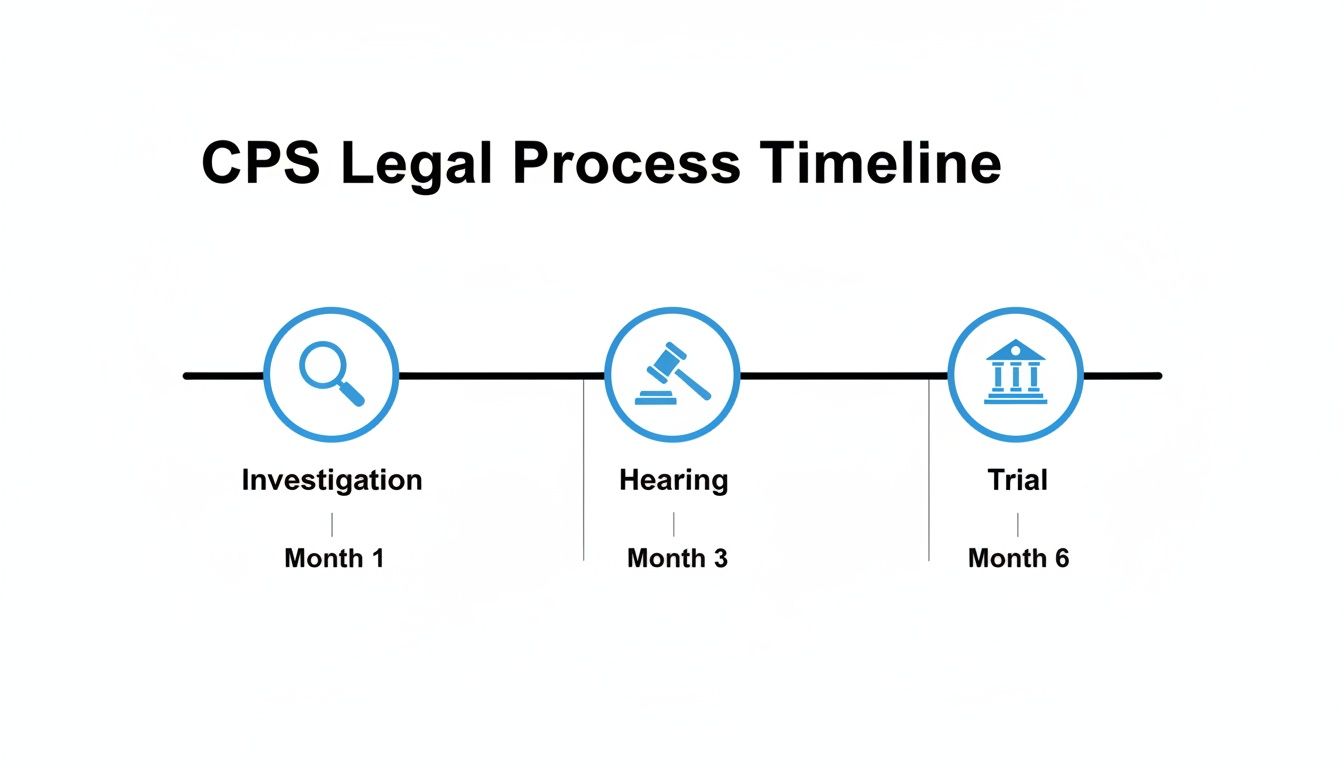
As you can see, the law mandates a compressed timeframe, moving a case from the initial investigation toward a final trial much faster than other types of lawsuits.
Understanding Key Legal Terms in Your Case
As you get deeper into the court process, you’re going to be hit with a lot of legal jargon. It can feel like learning a new language, but getting a handle on these key terms is essential for being an active participant in your own defense.
- Conservatorship: This is just the Texas legal word for custody. CPS will be asking the judge for “Temporary Managing Conservatorship,” giving them the power to decide where your child lives, what doctors they see, and other major life decisions.
- Service Plan: If the court sides with CPS at the first hearing, you’ll be ordered to complete a “Family Plan of Service.” Think of it as a to-do list from the court—a set of tasks like parenting classes, counseling sessions, or drug assessments that you must finish to prove you’re ready to have your child back.
- Ad Litem Attorney: The court will appoint a separate lawyer, called an attorney ad litem, whose only job is to represent your child’s best interests. This lawyer doesn’t work for you, and they don’t work for CPS. Their one and only client is your child.
The court process in a CPS case against a father in Texas is not something to face alone. With strict deadlines and complex legal standards, having skilled legal representation is not a luxury—it is an absolute necessity for protecting your parental rights. You can learn more about the specifics of what happens in CPS court in Texas in our detailed guide.
The Texas Family Code, especially Chapters 262 and 263, dictates that these cases must be resolved, one way or another, in about a year. This means every hearing, every report, and every deadline matters. The earlier you get an experienced attorney in your corner, the more prepared you'll be to navigate this difficult process and work toward getting your child home.
Facing a CPS lawsuit is a tough fight, but it’s not an impossible one. With the right legal team guiding you, you can meet the court’s expectations and prove that you are the safe, capable, and loving father your child needs.
Building Your Defense Strategy to Protect Your Rights
When you're staring down a CPS case as a father in Texas, it's easy to feel like you're constantly on the back foot. The most powerful thing you can do right now is to stop playing defense and start building your own offense. It’s time to move past just reacting to what CPS does and start building a rock-solid case that proves you are the loving, capable father your child needs. This is how you fight back effectively and protect your rights as a dad.
A strong case is built on a foundation of undeniable proof. You need to become your own best investigator, meticulously documenting every single thing that paints an accurate, positive picture of your life and your parenting. The goal is simple: to bury any negative story with a mountain of truth.
Gathering Your Evidence
Think of yourself as the lead detective in your own case. While your attorney will be your guide, you're the one on the ground, living this every day. Start gathering everything that backs up your story and demonstrates your fitness as a parent.
Your evidence collection should zero in on a few key areas:
- Communications: Save everything. Every text, every email, every social media message between you and your child's other parent, the caseworker, or anyone else involved. These records can become gold, proving a pattern of harassment, exposing false claims, or simply showing your own cooperative spirit.
- Proof of a Safe Home: Grab your phone and take clear, well-lit photos and videos of your home. Get shots of your child’s bedroom, a kitchen stocked with food, and clean, safe living areas. This is your direct counter-punch to any accusations of a dirty or hazardous environment.
- Your Child’s Well-Being: This is where you bring in the professionals. Collect school records, report cards, attendance sheets, and any notes from teachers. Get copies of medical records showing regular doctor visits. This kind of documentation from neutral, third-party sources is incredibly powerful proof that your child is doing well under your care.
- Credible Witnesses: Start a list of people who can speak to your character and your parenting. Think about family, friends, neighbors, teachers, sports coaches, or people from your church or community group. Your lawyer can work with you later to get formal statements from them.
It is never too early to start gathering this information. The second you get that first call or knock on the door from CPS, your defense begins. Every positive piece of evidence you save is another brick in the wall that protects your relationship with your child.
The Lasting Impact of a 'Reason to Believe' Finding
Here’s something many fathers don’t realize: even if CPS never removes your child and eventually closes the case, the agency can still issue a finding of “Reason to Believe” (RTB) that abuse or neglect happened. That RTB finding goes on your permanent record and can be used against you down the road. If you ever end up in a custody battle, an ex-partner can pull out that RTB finding to argue you're an unfit parent.
This is exactly why you have to fight every allegation from day one, no matter how minor it seems. Challenging a wrongful RTB finding is a crucial part of a complete defense. In fact, the way family law and criminal law can overlap is a major risk for fathers in Texas. A CPS investigation for neglect—which accounts for about 74.8% of all investigations—can directly fuel a custody fight, even if a child is never removed.
And if you’re dealing with harassment or false claims that could sabotage your case, it's vital to know what legal actions you can take. For example, you may need to learn how to prepare and serve a Cease and Desist Letter Texas to put a stop to baseless attacks.
Proactive Steps and When to Call a Criminal Lawyer
Your best defense is a great offense. Don't just wait for CPS to hand you a list of demands. Get ahead of their service plan by proactively enrolling in parenting classes or seeking counseling on your own. This sends a powerful message to the court: you are serious about being the best father possible, with or without CPS telling you to be.
There are also situations where a CPS case can spill over into the criminal justice system. If the allegations involve any kind of physical harm, drug use, or other criminal activity, you could find yourself fighting on two fronts at once. If this happens, you absolutely must hire a separate criminal defense attorney immediately. The family court and the criminal court are two different worlds with different rules. You need an expert in each corner fighting for you. Something you say to a CPS caseworker could potentially be used against you in a criminal case, which makes having legal counsel non-negotiable.
Ultimately, your goal is to present a consistent, compelling story of who you are: a responsible, loving, and dedicated father. By meticulously gathering your evidence, proactively addressing any perceived problems, and understanding the entire legal field you’re on, you build the powerful defense needed to protect the most important relationship in your life—the one with your child.
The Path to Reunification and Bringing Your Child Home

When CPS removes your child, your world shrinks. Every quiet room, every unused toy, every empty seat at the dinner table is a constant, gut-wrenching reminder of what you’re fighting for. For a father navigating a CPS case in Texas, nothing matters more than reunification—getting your child back home, safe and sound.
The road back can feel impossibly long and complicated, but it’s a journey you can absolutely complete. It takes a clear head, a solid plan, and the right legal team in your corner.
It all starts with a document called the Family Plan of Service, or just the service plan. This isn't just a list of chores from the court. Think of it as your personalized roadmap back to your child. Completing it isn’t about just checking boxes; it’s your chance to prove to the court, to CPS, and most importantly, to your kid, that you’re all in.
Understanding Your Service Plan Requirements
No two service plans are exactly alike. The court tailors them to address the specific allegations that brought CPS to your door. For fathers, these plans often focus on building parenting skills and tackling the root problems that triggered the investigation.
Let's take a dad we'll call David. His kids were removed after a neighbor called CPS with concerns about potential substance use. David’s service plan was intense: weekly counseling, random drug tests, and a parenting skills course. But instead of seeing it as a punishment, he and his attorney saw it for what it was—an opportunity.
David didn't just complete every task. He documented everything. He kept a detailed log, saved every certificate of completion, and filed away every single negative drug test result. He built a mountain of evidence showing his commitment. That’s exactly what a judge needs to see. Your service plan is your single best chance to demonstrate real change.
Here’s a look at what you might find in a typical service plan.
Common CPS Service Plan Requirements for Fathers
| Service Requirement | What It Involves | Pro Tip for Success |
|---|---|---|
| Parenting Classes | Attending group or individual sessions to learn about child development, discipline techniques, and communication. | Ask questions and actively participate. Get a certificate of completion and save it. |
| Counseling/Therapy | Individual or family therapy to address issues like anger management, trauma, or mental health concerns. | Be honest with your therapist. Consistent attendance is key—never miss a session without a documented reason. |
| Substance Abuse Treatment | May include assessments, outpatient programs (like AA/NA), inpatient rehab, and regular drug/alcohol testing. | Get a sponsor if you're in a 12-step program. Keep records of every clean test and every meeting attended. |
| Stable Housing & Employment | Proving you have a safe, stable home and a consistent source of income to support your child. | Keep copies of your lease, utility bills in your name, and recent pay stubs. Take photos of your clean, child-proofed home. |
| Supervised Visitation | Scheduled, monitored visits with your child at a CPS office or another approved location. | Be on time, every time. Come prepared with a simple game or book and focus 100% on your child. Stay positive. |
Treating this plan as your guide to success, rather than a list of punishments, is the first step toward getting your family back together.
The Critical Role of Visitation
While you’re working through that service plan, your time with your child is gold. Those CPS-supervised visits might be the only contact you get, and you have to make every minute count. These visits are more than just a chance to see your child’s face; they’re a chance to prove your bond and show your parenting skills in real-time.
Always show up on time. Bring an age-appropriate toy or a favorite book. Put your phone away and give your child your complete, undivided attention. It’s vital to stay positive, avoid talking about the case or blaming anyone, and just make the visit a safe, loving moment for them.
Believe me, the caseworker is watching. Your consistency and positive attitude during these visits are documented and reported directly to the judge. Every good visit is another piece of evidence in your favor.
A critical part of navigating a CPS case against a father in Texas is showing the court that you are an engaged, loving, and reliable parent, even under the most stressful circumstances. Your actions speak louder than any words in a courtroom.
Demonstrating your commitment to the service plan and maintaining a strong connection with your child are the cornerstones of a successful reunification strategy. You can explore our detailed guide for more information on the Texas CPS reunification process.
Think of it as a two-front battle: you handle the personal work of completing the plan, and your attorney handles the legal fight in court. It’s a powerful combination.
It’s a tough road, there's no doubt about it. But bringing your child home is an achievable goal. With every class you finish, every clean drug screen you pass, and every positive visit you share with your child, you’re taking one more step toward that reunion. This isn’t just about getting your child back; it’s about rebuilding your family, stronger than ever before.
Frequently Asked Questions from Fathers in a CPS Fight
When you’re a dad fighting a CPS case in Texas, your mind is probably spinning with a hundred different questions. The unknown is terrifying, and it’s easy to feel overwhelmed by stress and anxiety. Getting clear, solid answers is one of the best ways to get your feet back under you and find the confidence to face what’s ahead.
Here are our answers to some of the most urgent questions we hear from fathers dealing with CPS.
Can CPS Make Me Take a Drug Test Without a Court Order?
This is one of the first questions dads ask, and the answer is simple: No, CPS cannot force you to take a drug test without a court order.
A caseworker might show up and ask you to take one "voluntarily." They might even hint that saying no will make you look guilty. Don't buy into this pressure tactic.
Your best move is to politely but firmly say, "I'm willing to cooperate, but I won't be taking any tests or signing anything until I've spoken with my attorney." This protects your rights without starting a fight. If a judge orders a test later on, you’ll have to comply, but you should never "volunteer" for one without getting legal advice first.
What if My Ex Is Lying to CPS to Hurt Me?
It’s a heartbreaking and all-too-common situation. A messy breakup or a heated custody battle suddenly spills over into the CPS system with one parent making false claims to gain an edge. If you think your child's other parent is using CPS as a weapon, you have to take it seriously and act strategically.
First things first, stay calm. Don’t get into screaming matches with your ex. Your energy is better spent on gathering evidence to prove the allegations are false.
- Document Everything: Save every text, email, and voicemail. These messages can often expose the other parent’s real motives.
- Line Up Your Witnesses: Get statements from neutral people—teachers, coaches, neighbors, family friends—who can vouch for your character and your parenting.
- Stick to the Facts: When you talk to the caseworker or your lawyer, focus on the facts. Avoid getting pulled into emotional drama or slinging mud. Just present a clear, evidence-based story of what’s really happening.
Your attorney can take this evidence and use it to show the court what’s going on, protecting not just your parental rights but your reputation, too.
False allegations are an abuse of the system, and judges do not take kindly to a parent who is caught using CPS as a weapon in a family dispute. Your job is to calmly and methodically bring the truth to light.
Can I Refuse to Let a Caseworker in My House?
Yes, you can absolutely refuse to let a CPS caseworker into your home if they don't have a court order. Your home is protected by the Fourth Amendment, which guards against unreasonable searches.
When a caseworker knocks on your door, you can step outside to talk, close the door behind you, and politely tell them they cannot come in without a warrant.
You can say something like, "I'm happy to schedule a visit for another time when my lawyer can be here." This isn't an admission of guilt—it’s you wisely using your constitutional rights. If they come back with a court order, you have to let them in, but you always have the right to read it carefully first.
How Long Does a CPS Case in Texas Usually Last?
The Texas Family Code puts a pretty strict clock on CPS cases that go to court. The law is designed to get kids into a permanent, stable home as quickly as possible, whether that’s back with a parent or somewhere else.
A judge is generally required to make a final ruling within 12 months from the day CPS was given temporary custody of your child, a deadline specified in Texas Family Code Chapter 263. This deadline can be extended for up to six more months, but only if the judge finds there are "extraordinary circumstances."
This means a typical CPS court case against a father in Texas wraps up in about a year. That aggressive timeline shows just how important it is to act fast, follow your service plan to the letter, and have an attorney who is pushing your case toward reunification. Every single day counts.
Navigating a CPS case is one of the hardest fights a father can go through, but you don't have to do it by yourself. We know the fear and uncertainty you're feeling, and we are here to help you find your footing and fight for your family. The right legal team can make all the difference in protecting your rights and bringing your child home where they belong. The experienced attorneys at the Law Office of Bryan Fagan, PLLC have built their careers defending Texas families with compassion and strength. For a free, confidential consultation to talk about your case, contact us today at https://texascpslawyer.net. We are ready to listen and stand by your side.