Skip to content
When CPS shows up at your door, most parents do not think in legal standards. They think, “Are they taking my child today?” They think about who called, what was said, and whether one bad conversation could spiral into a court case by the end of the week.
That fear is real. So is the confusion. A report can start with a bruise a teacher misunderstood, a tense argument a neighbor overheard, or a medical issue that someone interpreted as neglect. Good parents get reported. Loving homes get investigated. A CPS case is serious, but it is not the same thing as proof.
If you are searching for cps dismissal texas, the most important shift is this: do not wait for CPS to define your case. Start building your dismissal strategy immediately. In Texas, the law has moved toward keeping families together, and parents who act early, stay organized, and get legal guidance often put themselves in a much stronger position.
The Knock on the Door Understanding Your New Reality
A mother answers the door after work. A CPS investigator says there has been a report. The allegation sounds distorted, incomplete, and alarming. Her child is inside doing homework. She has never dealt with CPS before. She is scared to say too much, scared to say too little, and scared that if she asks for a lawyer she will look guilty.
That situation is common.

Sometimes the report comes from a school. Sometimes from a hospital. Sometimes from a former partner during a custody fight. The details vary, but the first emotional hit is usually the same. Parents feel ambushed.
There is real reason for hope. Texas has reduced child removals by 55%, from 20,685 in 2018 to 9,220 in 2024, reflecting a legislative shift toward family preservation (familyfreedomproject.org on Texas CPS removals). That matters because it means the system is not supposed to treat removal as the default answer.
What that means for your family
A CPS investigation does not automatically mean your child will be removed.
It also does not mean you should relax. A better mindset is controlled urgency. Treat the case seriously from the first contact, but do not assume the outcome is already decided.
Many parents make one of two mistakes in the first day:
- Panic and overshare: They talk too much, guess at facts, or agree to things they do not understand.
- Explode and shut down: They slam the door, argue, or create a record that makes CPS think there is more to uncover.
Neither helps.
Key takeaway: The beginning of a CPS case is not the end of your family’s story. It is the point where strategy starts.
A dismissal becomes more realistic when a parent stops reacting emotionally and starts documenting, organizing, and forcing CPS to meet its legal burden.
Your Rights and Strategy During the First 48 Hours
The first two days matter because they shape the file CPS builds. Notes written in that window often follow the case into staffing meetings, safety plans, and sometimes court.
You need two things at once. You need to protect your rights, and you need to avoid looking chaotic.
Stay calm and get basic facts
When the investigator first contacts you, ask for:
- Their full name
- Their office and contact information
- The general nature of the allegations
- Whether they are asking for interviews, a home visit, or immediate access to the child
Write it down. Use your phone notes, a paper notebook, or both. Start a dedicated log immediately.
Your tone matters. Calm, short, and respectful beats angry or chatty every time.
Useful phrases include:
- “I want to cooperate, but I want to understand the allegation clearly.”
- “I am willing to provide information after I speak with counsel.”
- “Please give me your card and tell me exactly what you are requesting.”
- “I do not consent to any search beyond what the law requires.”
Know your rights without turning the meeting into a fight
Parents often assume they must answer every question on the spot. That is not a safe assumption.
In many situations, you can decline to answer detailed questions until you have legal advice. You also do not have to treat every request as automatically mandatory. If an investigator asks to enter your home or inspect private areas, the legal answer may depend on whether they have a court order, a warrant, or exigent circumstances.
That does not mean you should be combative. It means you should be deliberate.
A better approach is measured cooperation:
| Situation | Better response | Risky response |
|---|---|---|
| Investigator asks broad questions | Ask for specifics and take notes | Start explaining everything at once |
| Investigator wants immediate statements | Request time to speak with counsel | Refuse all communication angrily |
| Investigator pressures you verbally | Stay polite and repeat your position | Argue, insult, or make threats |
Why organization helps more than emotion
You may be dealing with a caseworker under serious pressure. Texas CPS turnover reached nearly 1 in 3 employees leaving in fiscal year 2022, which means many parents are dealing with overworked investigators carrying heavy caseloads (Texas Tribune reporting on CPS caseworker turnover).
That does not excuse mistakes. It does explain why a disorganized, emotional interaction can go badly fast.
An overwhelmed investigator often relies on quick impressions. If you provide clear names, dates, records, and a concise explanation, you make it easier for them to document your side accurately. If your home is loud, tense, and everyone is talking over each other, they may write a very different narrative.
What to document immediately
Do this before the day ends:
- Create a contact log
Record every call, text, visit, voicemail, and email from CPS. - Write your timeline
Put down what happened before the report, including medical visits, school contacts, arguments, accidents, or police involvement. - List possible witnesses
Teachers, doctors, daycare workers, relatives, coaches, neighbors. - Preserve messages
Save texts with ex-partners, school staff, or anyone tied to the allegation. - Secure key records
Medical paperwork, school notices, prescriptions, counseling records, lease information.
What not to do in the first 48 hours
Some errors are harder to fix than others.
- Do not coach your child on what to say.
- Do not delete texts, photos, or social media posts.
- Do not sign a safety plan you do not understand.
- Do not assume a verbal promise from CPS protects you.
- Do not discuss the case with hostile relatives or the reporting party.
Practical tip: Speak as if every sentence may later appear in a court affidavit. Short, accurate, and calm answers protect you better than long explanations.
The parent who handles the first 48 hours well is not the loudest parent. It is the one who becomes the most reliable source of facts.
Building Your Proactive Case for Dismissal
Most parents wait for CPS to tell them what is wrong. That is backwards.
A stronger strategy is to build a file that shows stability, safety, and follow-through before CPS finishes shaping its own story. If your case is heading toward cps dismissal texas, your goal is simple. Make it easy for a judge, agency lawyer, or supervisor to see that the allegations do not justify continued state involvement.
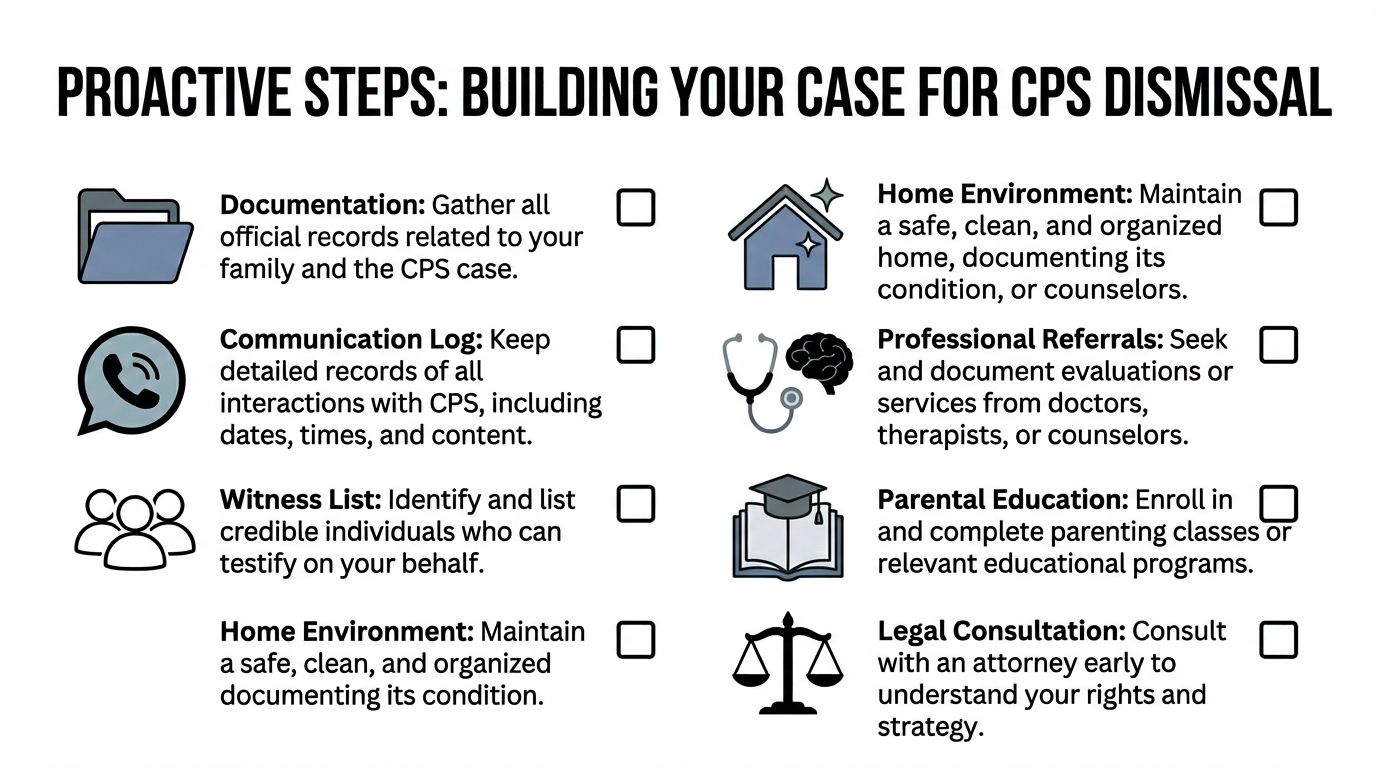
Build proof, not just explanations
Saying “my home is safe” is weak.
Showing recent photos of sleeping arrangements, food in the kitchen, working utilities, and school supplies is stronger. The same rule applies across the case. Replace verbal reassurance with documents, records, and third-party support.
Start gathering:
- Home evidence
Dated photos and short videos of bedrooms, bathrooms, kitchen, food, medication storage, and general living conditions. - School records
Attendance reports, report cards, teacher emails, behavior notes, special education documentation if relevant. - Medical records
Well-child visits, immunization records, prescription history, therapy attendance, discharge paperwork, pediatric follow-up instructions. - Parent records
Work schedule, pay stubs, lease or mortgage records, daycare plans, transportation arrangements, support network contacts. - Case-related materials
Business cards, safety plan drafts, notices, investigator messages, and every document CPS hands you.
Use witnesses the right way
A witness is not just someone who loves you. A useful witness is someone credible, specific, and connected to daily parenting.
Good witnesses often include:
- a child’s teacher who can speak to attendance and behavior
- a pediatrician familiar with routine care
- a daycare director who sees the child regularly
- a relative who helps with child care and knows the home environment
- a counselor or therapist, if one is involved
Ask them for facts, not speeches. “Can you confirm that my child attends regularly and arrives fed and prepared?” is more useful than “Can you tell CPS I’m a good parent?”
Create a parent file that tells one clear story
Your materials should point to one theme: this child is safe, cared for, and connected to a functioning support system.
A practical parent file often includes:
| Category | Examples |
|---|---|
| Daily care | Meal photos, school prep routines, medication logs |
| Stability | Lease, utility bills, work schedule, child care plan |
| Child wellbeing | Doctor visits, counseling attendance, school feedback |
| Support network | Relative contacts, emergency pick-up list, church or community support |
| Compliance | Class certificates, evaluations, appointment confirmations |
Some parents hesitate to gather this information because they think it looks defensive. It does not. It looks prepared.
Fix weak spots before CPS defines them for you
If there is a real issue, address it quickly.
If the home is cluttered, clean it. If your child missed appointments, reschedule them. If you need parenting support, enroll. If substance use is part of the allegation, talk to counsel immediately about lawful, strategic steps before volunteering to programs blindly.
The key is intention. Reactive scrambling looks different from documented improvement tied to a clear plan.
One practical resource if CPS is pressuring you into restrictions is this guide on how to dispute a Texas CPS safety plan a practical guide. Safety plans can shape the entire case, so parents need to understand what they are agreeing to before they sign.
Key takeaway: The best dismissal files are built from ordinary life. School attendance, clean clothes, medical follow-up, stable housing, and reliable adults often matter more than dramatic denials.
A relatable example
Consider a father accused of neglect after his child came to school with repeated absences and wearing the same sweatshirt several days in a row. He may feel tempted to argue that the school is overreacting.
A better move is to gather attendance explanations, proof of illness-related appointments, laundry access records, family help with transportation, and statements from the child’s doctor and grandmother. Suddenly the case looks less like neglect and more like a family dealing with a rough month while still providing care.
That shift in framing is often where dismissal starts.
The Legal Path to Dismissal in Texas Courts
A parent can walk into the first hearing feeling like the case is already decided. It is not. A CPS case in Texas runs on deadlines, proof, and procedure, and each of those can be used to push toward dismissal if you start early and stay organized.

The court does not remove or keep children out of the home just because CPS filed papers. The agency has to meet legal standards at each stage. Parents who understand that stop reacting to every demand and start building pressure points in the case.
The emergency stage and the 14-day hearing
Under Texas Family Code §262.201, the court must hold a full adversary hearing within 14 days after removal. That hearing often sets the tone for everything that follows. If CPS came into court with a thin affidavit, weak testimony, missing context, or no serious discussion of family alternatives, those problems should be exposed immediately.
Judges usually focus on a few hard questions. Was there an actual emergency? Could the child have remained safely at home with protective measures? Was a relative available? Did CPS investigate less restrictive options before asking for removal?
Those are not technical questions. They often decide whether CPS keeps control of the case or starts losing momentum.
What CPS has to prove, and where cases weaken
In practical terms, CPS usually tries to show three things:
- immediate danger to the child
- no safe alternative short of removal
- a need for continued court oversight
A parent’s strategy is to challenge each point with facts, not just denials. If the allegation involves supervision, show who was available to help. If the issue is medical neglect, get records and provider explanations. If the investigator ignored a grandparent, aunt, or adult sibling who could step in, make that omission part of the court record.
Caseworker turnover can also create openings. It happens often. A new worker may know the file only through notes, may not understand the original allegation, and may be less prepared to defend earlier decisions. A disciplined parent and attorney can use that weakness by forcing CPS to tie its current position to actual evidence rather than recycled conclusions.
Procedure shapes outcomes
Many parents focus on testimony and overlook the paper trail. That is a mistake.
Affidavits, notices, service returns, proposed orders, visitation records, and status reports influence what the judge sees before anyone speaks. If you are handling any part of the process yourself, even temporarily, mistakes in filing or service can create delays and confusion that help CPS more than they help you. This practical guide on filing court documents correctly explains the mechanics.
For a more detailed walkthrough of hearings and courtroom procedure, this page on what happens at CPS court in Texas is a useful companion.
A short overview can also help parents understand what those hearings feel like in practice:
How dismissal happens in real courtrooms
Dismissal usually comes through one of several paths. The strongest cases often use more than one.
| Path | What it looks like |
|---|---|
| Early evidentiary challenge | CPS cannot justify removal or continued separation at the first major hearing |
| Negotiated dismissal | The parent’s records, witnesses, and progress make continued litigation hard to defend |
| Deadline pressure | CPS runs into statutory limits and still lacks proof for final relief |
| Narrow issue resolved | The original concern is addressed, and court supervision no longer has a legal basis |
The strategic point is simple. Do not treat each hearing as a separate event. Build a record for dismissal from the first court date forward. Every clean drug test, school record, counseling discharge, relative affidavit, and corrected factual error should move the case toward one argument: continued state intervention is no longer justified.
Chapter 263 deadlines can work in your favor
Texas Family Code Chapter 263 puts these cases on a clock. Courts are not supposed to let them drift without a lawful reason. That time pressure helps parents who stay focused.
A parent who shows steady progress, keeps appointments, preserves documents, and avoids new allegations forces CPS into a harder position over time. The agency has to explain why the case still needs court control. If the answer becomes vague, repetitive, or disconnected from current conditions, dismissal becomes much more realistic.
This systemic pressure also creates room for targeted requests. If CPS is stalling, changing workers, or failing to move a relative placement forward, those failures should be raised clearly and repeatedly. Delay is not neutral in these cases. Delay can become part of your argument that the agency is not managing the case in a way that justifies continued interference with your family.
What a motion to dismiss usually argues
A motion to dismiss works only when it is tied to a specific legal defect. Judges want a clear reason rooted in the record.
Common arguments include:
Insufficient evidence
CPS has suspicions or secondhand claims, but not proof that meets the legal standard.No immediate danger
The facts may show stress, poverty, or conflict, but not grounds for state removal or ongoing supervision.Less restrictive options were available
A relative placement, temporary caregiver, or in-home safety arrangement was available and ignored.Procedural failure
Required notice, service, findings, or statutory deadlines were not handled correctly.
Courtroom reality: Judges usually respond to organized records, credible witnesses, and arguments tied to the Family Code. Anger alone rarely helps.
The legal path to dismissal is rarely automatic. It is built. Parents who understand the court’s pressure points, document carefully, and force CPS to defend each step give themselves a far better chance at bringing the case to an end.
Why an Experienced Attorney is Your Most Powerful Ally
Parents can do a lot on their own. They can document, stay calm, gather records, and avoid common mistakes. But there is a point where self-help stops being enough.
An experienced CPS lawyer does not just “go to court.” That lawyer controls communications, frames the facts inside the right legal standard, and keeps a frightened parent from making concessions that become evidence later.

Kinship placement can change the entire case
One of the most underused strategies in CPS litigation is immediate pressure for kinship placement.
DFPS often fails to place children with relatives, even when family members are available, and an attorney can push for a Family Team Meeting and argue that judges should consider kinship as a less restrictive alternative (ABC News reporting on a Texas family’s lawsuit over removal and relative placement issues). That matters because a child placed with family is often in a better position emotionally and legally than a child sent into foster care.
A lawyer knows how to do more than say, “Grandma is available.” The lawyer develops the argument. Who is the relative? What is the sleeping arrangement? Can that person pass background review? Can they supervise contact? Why is this safer and less disruptive than foster placement?
Lawyers identify advantageous points parents miss
A parent hears accusations.
A seasoned attorney hears issues like:
- the affidavit does not state an emergency
- the allegation is too vague
- CPS skipped a less restrictive option
- the timeline in the report does not match the records
- the medical interpretation needs independent review
- the “cooperation problem” is really a rights issue, not a safety issue
That difference matters.
Consider a common scenario. A parent, exhausted and intimidated, agrees to a broad safety plan that removes them from the home without understanding the consequences. Weeks later, CPS treats that agreement like proof the parent was unsafe all along. An attorney may be able to challenge how that plan was obtained, limit its damage, and shift the case back toward evidence instead of pressure.
Choosing counsel early is usually smarter than choosing counsel late
Early representation can help with:
| Stage | What counsel can do |
|---|---|
| Investigation | Manage contact, clarify allegations, protect statements |
| Safety planning | Review terms, challenge overreach, propose alternatives |
| Relative placement | Present kinship options quickly and clearly |
| Hearings | Cross-examine witnesses, challenge legal sufficiency |
| Dismissal strategy | Build a record that supports ending the case |
If you are evaluating representation, one option is to review this overview of a Texas DFPS attorney and what that role looks like in practice. The Law Office of Bryan Fagan PLLC handles CPS-related representation in Texas, including adversary hearings and defensive strategy when CPS action intersects with criminal or protective-order issues.
Practical point: The earlier a lawyer gets involved, the more likely the record can be shaped before bad assumptions harden into court findings.
Good lawyering does not guarantee a perfect outcome. It does give you a stronger chance to push back where it counts, especially when CPS is moving fast and your family is still trying to catch its breath.
Life After Dismissal Clearing Your Name and Record
A dismissed case feels like the end. Legally and practically, it may not be.
Parents are often shocked to learn that a CPS allegation can continue to affect them even after the case is dropped. The agency file, internal findings, and related court records may still create future problems. That can matter for jobs, housing, volunteer work, licensing, and peace of mind.
Ask what was dismissed and what remains
Start with precision.
Find out:
- whether the court case was dismissed
- whether any CPS finding was ruled out, unsubstantiated, or left in place
- whether your name appears in any registry or agency database in a way that can be challenged
- whether your lawyer recommends additional administrative or court action
A dismissal in court does not always mean every record tied to the case disappears automatically.
Take post-dismissal cleanup seriously
Families often focus so hard on getting through the case that they ignore the cleanup stage. That is a mistake.
You may need to pursue record-related remedies, challenge lingering findings, or ask what options exist for sealing, expunction, or limiting access depending on the type of record involved. The right approach depends on what happened in your case, not just on the fact that it ended.
Think about your digital footprint too
Even when legal records are handled properly, online court references can create separate headaches. If your case information appears on public websites, background aggregation pages, or searchable court portals, understanding the process of removing court records from the internet can help you evaluate the privacy side of moving forward.
Create a closing file
Before you try to forget the case, organize it.
Keep:
- dismissal orders
- final court paperwork
- CPS closure letters
- proof of completed services
- correspondence from your attorney
- any confirmation regarding corrected or challenged records
That file protects you if the allegation resurfaces later.
A dismissal should mean more than surviving the process. It should give your family a clean path forward.
Frequently Asked Questions About CPS Dismissals
Can I refuse to let CPS into my home
You do not have to treat every request as automatic consent. In many situations, parents can decline entry unless CPS has lawful authority such as a court order, warrant, or emergency basis recognized by law.
The smarter question is not just “Can I refuse?” It is “What happens next if I do?” A flat refusal without legal advice may escalate the case. A calm response that requests legal counsel and clarifies what authority CPS is relying on is usually safer.
If you are unsure, say you want to cooperate through proper legal channels and contact a lawyer immediately.
What if the report against me was false or malicious
False reports happen. So do exaggerated reports built on custody conflict, family resentment, or misunderstanding.
The legal focus is usually not on punishing the reporter first. It is on showing CPS lacks sufficient evidence. That means proving consistency in your records, challenging inaccuracies, and exposing missing context. If the case falls apart on the facts, dismissal becomes much more likely.
In some situations, there may be separate options related to knowingly false reporting or family court misconduct. Those options depend heavily on the evidence and should be discussed with counsel before you act.
What counts as neglect in Texas
Neglect is one of the most common and misunderstood issues in CPS cases. It can involve failure to provide necessary care, supervision, medical attention, education, or a safe environment. The problem is that real life is messy. Poverty, temporary instability, illness, and parenting under stress can be mistaken for legal neglect.
Parents protect themselves by proving care in concrete ways.
Helpful proof often includes:
- school attendance efforts
- doctor visits and follow-up care
- safe sleeping arrangements
- food in the home
- supervision plans
- transportation arrangements
- communication with teachers and medical providers
If CPS says “neglect,” do not answer with offense alone. Answer with records.
Your Family's Future is Worth Fighting For
A CPS case can make a capable parent feel powerless. That feeling is common. It is also dangerous, because passivity helps the agency more than it helps your family.
The better path is active, disciplined, and informed. Protect your rights early. Keep a clean record of every contact. Build evidence of stability before CPS finishes building its narrative. Press for less restrictive options when they exist. If the case moves into court, force the agency to prove what the law requires.
That is how parents move closer to cps dismissal texas. Not through panic, and not through blind compliance. Through strategy.
You do not have to figure this out alone, and you should not wait until the case feels out of control to get help.
If CPS has contacted you, filed a case, or removed your child, contact Law Office of Bryan Fagan PLLC for a free consultation. A lawyer can review the allegations, explain your options under Texas law, and help you build a focused plan to protect your rights and your family.