Skip to content
When CPS enters your life, the ground shifts fast. One phone call, one home visit, one court date, and suddenly you're trying to understand words like service plan, conservatorship, permanency, and mediation while worrying about where your child will sleep and what happens next.
If you've been told your case is going to mediation, you're probably carrying two reactions at once. Fear, because it sounds formal and high-stakes. Hope, because part of you wants a real chance to be heard before a judge makes decisions for your family.
That second feeling matters. In many Texas CPS cases, mediation is one of the few places where parents can do more than react. You can speak, negotiate, present progress, and work toward a plan that addresses safety concerns without handing every decision over to the court.
Your World Turned Upside Down The Call for CPS Mediation
A lot of parents first hear about mediation in the middle of an already miserable week. Maybe the caseworker mentions it after a hearing. Maybe your lawyer forwards a notice. Maybe you open an official envelope and see another date, another requirement, another step you didn't ask for.
A mother I might meet in this situation often says the same thing first. "Is this basically trial?" The short answer is no.
Mediation isn't the final courtroom fight. It's a structured settlement process where the people involved in the case sit down and try to work out a path forward. That can include visitation, services, placement issues, communication rules, or steps toward reunification.
Why the notice feels so heavy
By the time mediation is scheduled, many parents are already exhausted. You've likely dealt with home inspections, drug testing, interviews, court settings, and a service plan that feels like a second full-time job.
That makes mediation easy to misunderstand. Parents often assume it means CPS has already decided the outcome. Usually, that's not what it means.
In many cases, mediation means there is still room to shape the outcome. That's important. It may be one of the few times everyone is focused on resolution rather than argument.
You don't have to like being in mediation for it to help your case. You do have to treat it seriously.
A relatable example
Take a father accused of neglectful supervision after a late-night arrest. His child is staying with a relative. He has started services, but he's also facing a criminal charge tied to the same incident. He hears "mediation" and assumes CPS is about to force him into signing away his rights.
What usually helps him most is learning what mediation is and what it isn't.
It is a negotiation.
It is not a secret trap where you automatically lose your child.
It can be stressful. It can be emotional. But it can also be the moment where your progress starts mattering in a concrete way. If you've completed classes, tested clean, found stable housing, or stayed consistent with visits, mediation gives your attorney a place to push those facts to the front of the conversation.
A better way to think about it
Don't think of cps mediation texas as a punishment. Think of it as a decision point.
You may not control every part of the case. But in mediation, you often have more voice than you would in a contested hearing. That's why preparation, patience, and legal guidance matter so much.
Understanding the Purpose of CPS Mediation in Texas
Court and mediation are not the same thing. Court is a battlefield. Each side presents evidence, argues the law, and asks a judge to decide. Mediation is a negotiating table. The focus shifts from winning an argument to finding an agreement everyone can live with.
In Texas CPS cases, that difference matters because the case isn't just about blame. It's about child safety, permanency, and whether a family can move toward stability.
Why mediation exists
Texas family law gives courts and parties tools to resolve disputes without a full trial. In the CPS setting, that approach became especially important because child protection cases move under strict timelines and involve personal issues that don't always fit neatly into a courtroom order.
The best use of mediation is practical. It allows parents, CPS, lawyers, and child advocates to discuss specific terms that affect everyday life, such as visits, services, placement, communication, and benchmarks for progress.
If you want a broader overview of how mediation works outside the CPS setting, this explanation of general family law mediation services gives helpful context on the problem-solving approach families often prefer over trial.
For parents who are still trying to understand the agency itself, this guide to Texas CPS and its purpose helps explain why the system focuses so heavily on safety and permanency.
What Texas law is trying to accomplish
In CPS cases, Texas Family Code Chapters 262 and 263 shape much of the process after removal. Chapter 262 deals with emergency action and removal issues. Chapter 263 deals with review hearings, service plans, permanency, and the court's timeline for moving the case.
Mediation fits into that structure because it can help the parties resolve disputes while keeping the case moving.
That matters for parents because delay hurts. Delay can mean more time apart from your child, more uncertainty, and more room for frustration to grow into conflict.
Why many professionals rely on it
Texas did not adopt child protection mediation on a whim. Early pilot projects in thirteen Texas counties and three specialty child protection courts helped establish it as a practical alternative to full litigation, and complete or partial agreements were achieved in 76% of cases by the end of those pilots, according to the Texas Children's Commission report on child protection mediation.
That doesn't mean every case settles. It does mean mediation has a strong record of helping families and professionals work through hard issues in a structured setting.
What parents often miss
Many parents walk in thinking the point is to prove CPS wrong about everything. Sometimes that instinct gets in the way.
The more useful question is often this: what agreement protects your child, preserves your rights where possible, and creates a realistic road toward reunification?
That may involve compromise. It may involve accepting some services you don't love. It may involve deadlines, testing, counseling, or supervised contact before more access is restored.
Practical rule: Mediation works best when you focus less on reliving every argument from the investigation and more on showing what the next safe step should be.
Common subjects discussed in mediation
- Visitation terms that spell out when, where, and how visits happen
- Service plan progress including classes, counseling, treatment, and evaluations
- Placement concerns involving relatives, foster placement, or transitions
- Communication rules between parents, CPS, and caregivers
- Reunification steps tied to measurable progress and safety concerns
In plain language, mediation gives people a chance to solve a family crisis with more nuance than a courtroom usually allows.
The People in the Room Key Participants and Their Roles
A lot of the stress of CPS mediation comes from one simple problem. You may walk in feeling outnumbered before anyone says a word.
That reaction is normal. A CPS case brings together several people because the decisions affect your child, your rights, the agency's safety concerns, and sometimes another court problem at the same time. If you are also dealing with a DWI, assault allegation, drug charge, or probation issue, the room can feel even more intimidating because one conversation may affect another.
The good news is that each person has a lane. Once you understand those lanes, the room starts to feel less like chaos and more like a structured meeting with defined jobs.
Who's Who in Texas CPS Mediation
| Participant | Role and Objective |
|---|---|
| Parent | To protect parental rights, explain progress, and negotiate workable terms |
| Parent's attorney | To advise, object when needed, negotiate terms, and guard against harmful admissions |
| CPS caseworker | To present the agency's concerns, progress updates, and safety recommendations |
| CPS supervisor | To review case direction and bring additional authority to settlement discussions |
| CPS attorney | To represent the state's legal position and approve or reject proposed terms |
| Attorney ad litem for the child | To advocate for the child's legal interests in the case |
| Guardian ad litem or CASA, if involved | To share observations and recommendations concerning the child's welfare |
| Placement representative or caregiver voice | To address practical issues involving where the child is living and what support is needed |
| Mediator | To guide negotiations, reduce conflict, and help the parties reach an agreement |
What the mediator does
The mediator runs the process, not the outcome.
That distinction matters. The mediator does not act as the judge, and the mediator does not serve as your lawyer, CPS's lawyer, or your child's lawyer. The mediator's job is to keep discussions productive, carry offers from room to room, test whether a proposal is realistic, and help people turn broad demands into terms that can be written into an agreement.
A mediator works a lot like a traffic officer at a crowded intersection. The officer does not choose your destination. The officer keeps cars from crashing while everyone gets where they need to go.
In a CPS case, that control matters even more because fear, anger, and mistrust can derail useful discussion fast.
Why your attorney's role is different if criminal charges are also in play
Parents often focus on what they want to say. A better starting point is what can safely be said.
If you have pending criminal charges or are under investigation, your family law strategy and your criminal defense strategy need to match. A statement that sounds helpful in mediation, such as admitting you drank before driving, hit someone during an argument, or used drugs "only once," can create problems outside the CPS case. Texas mediation rules provide important confidentiality protections in many situations, but you should never assume every statement is risk-free without legal advice specific to your facts.
That is why your attorney is doing more than negotiating visitation or services. Your lawyer is also screening for landmines. In some cases, your attorney may tell you to answer briefly, avoid certain details, or let counsel speak for you on topics that overlap with a criminal case.
That is not being evasive. It is being careful.
Why training matters
Texas child protection mediators are expected to complete dispute resolution training and additional instruction focused on child protection cases. The Texas Children's Commission describes child protection mediation as a specialized process built for abuse and neglect cases, with trained mediators and participants who are trying to resolve issues affecting safety, placement, and permanency in a structured setting, as explained in its guide to child protection mediation in Texas.
That should give you some reassurance. A CPS mediation should be led by someone who understands family dynamics, trauma, conflict, and the practical realities of child welfare cases.
What each person may care about most
People in the room can sound like they are talking past each other because they are measuring different risks.
The CPS caseworker may focus on missed services, positive drug tests, home conditions, or concerns about the people around your child. The child's attorney may focus on stability, school, medical needs, and whether the adults are following through. The CPS lawyer may focus on whether the agreement can be defended in court. Your attorney should focus on protecting your rights while still working toward terms you can meet.
If criminal charges are pending, each of those roles can sharpen. CPS may want more testing, treatment, or restrictions. Your attorney may push to phrase terms carefully so you are not making unnecessary admissions. The mediator may spend extra time separating what must be addressed for child safety from what should be left to the criminal court.
That division is easy to miss when emotions are high.
How this helps you prepare
Once you know each person's job, tough questions make more sense. A question about alcohol use may be about child safety, or it may be touching a criminal issue that needs careful handling. A question about who lives in your home may relate to placement, background checks, bond conditions, or all three.
So do not treat every hard question as a personal attack.
Treat it as a signal to pause, look at who is asking, and let your attorney help you answer in a way that protects both your family case and any criminal case. Parents usually make better decisions in mediation when they stop trying to win every exchange and start recognizing what each person at the table is there to do.
A Walkthrough of the CPS Mediation Process and Timeline
At 8:45 a.m., you are sitting outside a mediation room with a CPS case on one side of your life and, for some parents, a pending criminal charge on the other. You may be wondering whether one wrong sentence could affect both. That concern is real. Mediation often moves faster than parents expect, and the decisions made there can shape visitation, services, placement, and what happens at the next court setting.
CPS mediation does not happen in a vacuum. Texas child protection cases run on court deadlines under Chapter 263 of the Family Code, so mediation usually takes place while the case clock is still ticking. If you also have a DWI, assault, drug, or family violence case pending, your lawyer has to watch two tracks at once. One track is child safety. The other is protecting you from avoidable harm in criminal court.
Before the day begins
Good preparation makes the day easier to handle.
Before mediation starts, you and your attorney should identify the issues that are in dispute. Are you arguing about where the child will stay, what services must be completed, how visits will expand, or whether a relative placement is appropriate? Those are different problems, and each one calls for different language in an agreement.
If criminal charges are pending, preparation needs another layer. Your attorney should help you separate facts that must be addressed for the child's immediate safety from statements that do not need to be spelled out in a civil agreement. A mediation room is for solving family case problems. It is not the place to make unnecessary admissions.
The five phases many parents go through
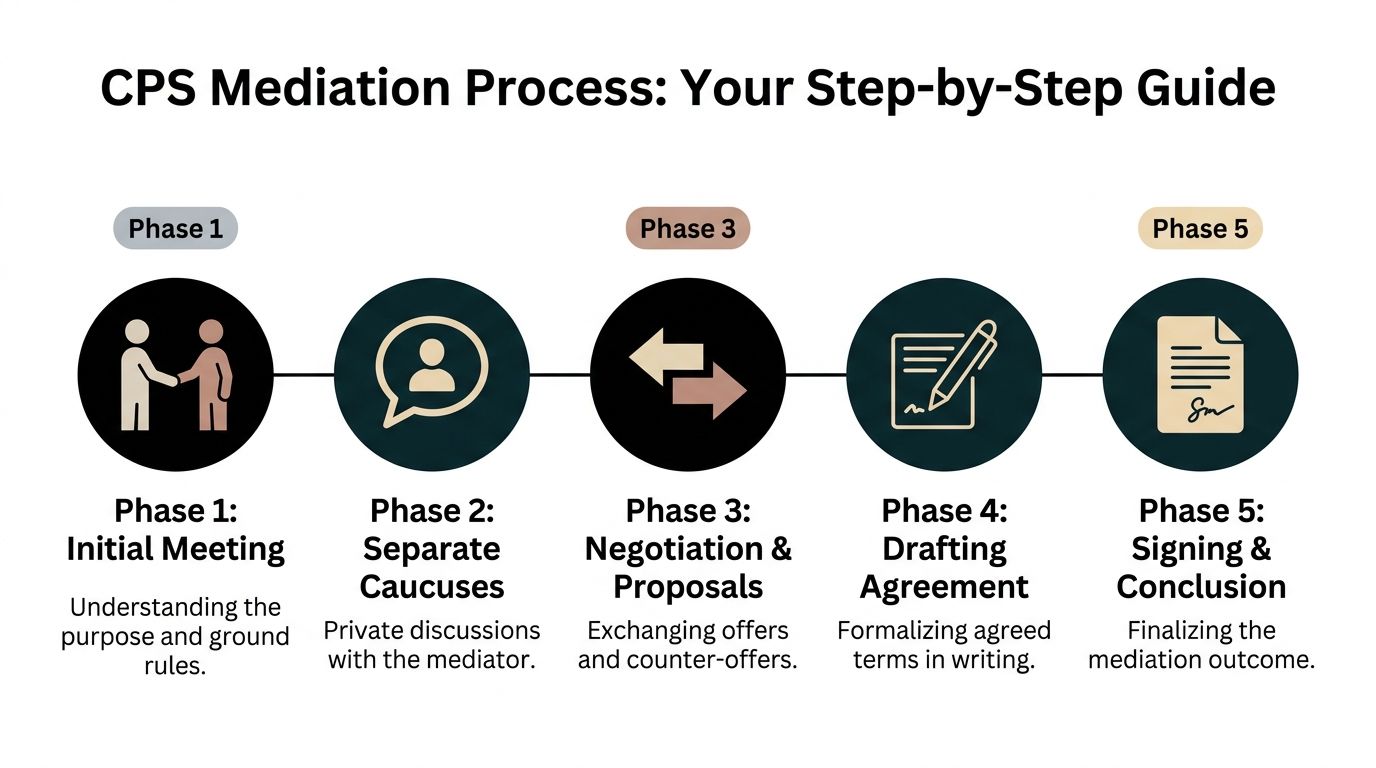
1. Opening session
The mediator starts by explaining the rules of the room. That usually includes who is present, how the process will work, and what topics are on the table.
Some counties and mediators begin with everyone together. Others place the parties in separate rooms almost immediately. If there is a protective order, a domestic violence concern, or a related criminal allegation, separate rooms are common and often wiser.
2. Private meetings with the mediator
A caucus is a private conversation between the mediator and one side.
This is often where the substantive work starts. You can ask blunt questions, raise concerns about proposed terms, and tell your lawyer what you can realistically complete. If the CPS case overlaps with a criminal case, this is also the time to slow down and test wording carefully. For example, agreeing to alcohol treatment or supervised contact may address child safety without using language that sounds like a criminal admission.
That distinction matters.
3. Offers, counteroffers, and reality testing
The mediator carries proposals back and forth. CPS may ask for drug testing, counseling, supervised visits, home checks, or a step-by-step plan for expanded possession. Your side may ask for clear deadlines, specific conditions for unsupervised visitation, transportation terms, or credit for services already completed.
Parents are often surprised by how ordinary this part looks. It is usually not dramatic. It feels more like solving a list of hard household problems under legal supervision.
If there is a criminal case in the background, some proposals need extra care. A requirement to avoid alcohol, submit to testing, stay away from a person, or complete a class may also overlap with bond conditions or defense strategy. Your attorney should check whether the family case language creates conflict with the criminal case or sets you up to fail because two courts are asking for different things.
4. Drafting the written agreement
This phase deserves patience.
A mediation agreement is only as good as its wording. Terms about visits, communication, services, school access, medical decisions, transportation, relative placements, and testing need to be specific enough that everyone knows what happens next. If a step-up plan says visits increase after "compliance," ask what compliance means. Does it mean one clean test, thirty days of clean tests, finished counseling, or something else?
Vague language causes future fights. Clear language prevents them.
5. Signing, or ending without agreement
If the parties reach acceptable terms, the document is signed. If they do not, the case returns to court and the judge decides the unresolved issues later.
Signing is the moment to be calm, not rushed. In Texas family cases, mediated settlement terms can carry very strong legal effect when they are written and signed correctly. That is why you should treat the final pages like a binding instruction manual for your next several months, not a rough draft.
What a mediation day often feels like on the clock
The timeline is rarely neat, but the pattern is familiar. You arrive, wait, meet privately with your lawyer, hear the first proposal, wait again, respond, revise, and repeat. Hours can pass before anyone puts final language on paper.
That stop-and-start rhythm is normal. A slow day does not mean a bad day. It often means people are being careful, which is usually better than forcing a quick agreement you cannot live with.
Questions to ask before signing
- What do I have to do first, and by when?
- What proof will CPS expect that I completed each requirement?
- When do visits change, and what exact event triggers that change?
- Does any sentence here overlap with bond conditions, probation terms, or a pending criminal charge?
- If transportation, testing, or counseling falls through, what happens next?
- Is every deadline clear enough that a judge could enforce it later?
Do not sign because the day has been long and you want it over. Sign only when you understand what the document requires and what risks come with it.
The timeline after mediation
Mediation is one part of the case, not the finish line.
After signing, the true measure becomes performance. You may need to attend services, test, maintain housing, keep contact with the caseworker, and show up consistently for visits. If criminal charges are pending, you also need your family law and criminal defense strategy to stay aligned. A parent can satisfy one court and accidentally create problems in the other if no one is watching both.
That is why the strongest mediation agreements are practical. They do not just sound good in the room. They give you a realistic path to follow once you walk out the door.
Your Rights and How an Attorney is Your Strongest Ally
You are not required to walk into mediation confused and silent. You have rights in this process, and you need to use them wisely.
That starts with a basic truth. Mediation is voluntary in outcome, even when attendance is ordered. You can be required to show up. You cannot be forced to sign an agreement you don't accept.
Your core rights in mediation
You have the right to have an attorney with you. You have the right to review proposed terms carefully. You have the right to ask questions. You have the right to reject language that is unclear, inaccurate, or unsafe for your family.
You also have the right to think strategically rather than emotionally.
That matters because CPS mediation isn't only about family law. In some cases, it intersects with criminal defense in ways that can change the stakes overnight.
When criminal charges complicate everything

A major problem in many guides is that they ignore overlap. Parents may be facing a DWI, assault allegation, drug possession case, or domestic violence charge at the same time the CPS case is moving forward.
That overlap changes how you should approach mediation. A source discussing this gap in Texas practice notes that concurrent criminal charges are a significant issue in major counties such as Harris and Dallas, and that procedural delays can jeopardize reunification timelines when the criminal case prolongs the CPS matter, as explained in this article on the goal of CPS mediation in Texas.
Here is a common example. A father is arrested after a family disturbance. CPS opens a case. Criminal prosecutors are reviewing assault allegations. In mediation, he may feel pressure to explain what happened in detail to look cooperative and remorseful.
That can be dangerous without counsel.
Why an attorney changes the room
A lawyer doesn't just "come with you." A lawyer filters risk.
Your attorney can help you decide:
- What should be said and what should not be said because of a pending criminal case
- Which documents help your CPS position without creating new criminal exposure
- Whether a proposed admission inside a written agreement could be used against your broader legal interests
- How to frame compliance and progress without making harmful factual concessions
If you need representation focused on this kind of overlap, information about working with a Texas CPS lawyer can help you understand what legal support should look like in these cases.
A practical scenario
Suppose you're facing a DWI charge after an incident where your child was in the car. CPS is now concerned about judgment, supervision, and substance use.
In mediation, CPS may want alcohol treatment, random testing, supervised visitation, and parenting classes. Some of those terms may be reasonable. But the wording matters.
A careless statement like "I was drunk and put my child in danger" may feel like honesty in the moment. In a criminal case, that kind of statement can create major problems. A skilled attorney can help you demonstrate accountability through actions, such as treatment, testing, and compliance, without making unnecessary admissions.
The firm as one option for coordinated help
In cases where CPS issues overlap with DWI, assault, drug, or protective-order allegations, Law Office of Bryan Fagan PLLC provides legal representation in Texas matters involving criminal charges and related CPS concerns. The key value in that setting is coordinated strategy across both systems rather than treating them as separate crises.
What your attorney should be doing for you
Before mediation
Your lawyer should review the service plan, identify pressure points, gather records, and help you define acceptable outcomes.
During mediation
Your lawyer should speak when precision matters, challenge unfair assumptions, slow down bad proposals, and protect you from signing language that creates future damage.
After mediation
Your lawyer should explain what the agreement requires, what deadlines control, and what conduct could put you at risk of noncompliance or even termination proceedings under Chapter 161.
Good legal advice in mediation isn't about sounding aggressive. It's about making sure today's compromise doesn't become tomorrow's disaster.
How to Prepare for a Successful CPS Mediation
Preparation changes the tone of mediation. A parent who walks in with documents, a timeline, and a clear goal looks different from a parent who arrives hoping to explain everything from memory.
That doesn't mean you need to be perfect. It means you need to be organized.
Start with proof, not promises

Your words matter, but your paperwork often matters more. If you completed parenting classes, bring the certificate. If you tested clean, bring the results. If you found stable housing, bring the lease or utility bill.
A helpful starting point is this guide on how to prepare for mediation, which outlines the practical mindset parents need before walking into the room.
Your preparation checklist
- Service plan documents. Bring your current service plan, proof of completed classes, counseling records, treatment updates, and evaluation reports if your lawyer says they should be included.
- Testing records. Gather negative drug or alcohol test results and keep them in date order.
- Housing proof. Bring a lease, mortgage statement, or other records that show stable living arrangements.
- Employment and income materials. Pay stubs, work schedules, or a letter from an employer can help show stability.
- Visit history. Keep records of visits, attendance, and any positive feedback from supervisors or providers.
- Communication log. Make a simple timeline of calls, emails, texts, and meetings with CPS.
- Your own timeline. Write out the major events in the case from your perspective so you don't forget important details under stress.
Know your goals before the first offer arrives
Some parents walk into mediation reacting to whatever CPS says first. That's a mistake.
Sit down with your lawyer and decide:
| Issue | Question to answer before mediation |
|---|---|
| Visitation | What change are you asking for right now? |
| Services | Which requirements have you completed, and which are still in progress? |
| Placement | Are there relatives or placement options that need to be raised? |
| Reunification | What concrete next step are you seeking? |
| Flexibility | What are you willing to compromise on, if needed? |
If you don't know your goals, every proposal feels like pressure. If you do know them, each proposal becomes something you can evaluate.
Prepare your communication style too
Mediation is not the place for speeches fueled by anger. You don't need to act fake. You do need to stay steady.
Helpful habits include:
- Use "I" statements instead of accusations
- Pause before answering when a topic makes you angry
- Let your attorney lead on legal questions
- Return to the child-focused goal when the conversation starts drifting into blame
A parent who says, "I understand the concern, and here is what I have done to address it," is usually heard more clearly than a parent who spends the day arguing over every old allegation.
Practical items people forget
Bring a notebook. Bring water. Bring any medication you may need during a long day. Eat something beforehand if stress usually shuts down your appetite.
Small preparation helps. Mediation can last for hours, and clear thinking gets harder when you're hungry, tired, or overwhelmed.
Common Outcomes and Frequently Asked Questions
Mediation usually ends in one of two ways. Either the parties reach an agreement, or they don't.
If there is an agreement, the written terms are presented to the court and typically become the framework for future orders in the case. That can affect visitation, placement, services, testing, communication, and the path toward reunification.
If there is no agreement, the case goes back to the judge. The unresolved issues are then decided through hearings or trial.
What a successful outcome may look like
A "good" outcome depends on the facts of your case. For one family, success may mean more frequent visitation. For another, it may mean a relative placement is approved. For another, it may mean a tighter, clearer roadmap for reunification instead of vague demands that keep changing.
The point is not perfection. The point is progress you can carry out.
FAQ
Is CPS mediation confidential
Texas law generally protects mediation communications from disclosure in later proceedings, with limited exceptions under the statute governing mediation confidentiality. That protection is one reason parties can negotiate more openly.
Ask your attorney to explain exactly how confidentiality applies in your case, especially if criminal allegations are also in play.
Can I be forced to sign an agreement
No. You can be ordered to attend mediation, but you cannot be forced to accept terms you do not agree to.
You should never sign just because the day is long or emotions are high.
What if I disagree with the attorney ad litem
That happens often. The child's attorney may see the facts differently than you do.
Disagreement does not mean your case is over. It means your lawyer needs to address the concern with evidence, realistic proposals, and a child-focused plan.
Can what I say in mediation hurt my criminal case
It can create risk if handled poorly, especially if you make unnecessary factual admissions. That is why coordinated legal advice matters when criminal charges and CPS issues overlap.
Silence is not always the answer. Careful strategy is.
What happens if I sign and then regret it
Regret usually is not enough to undo a properly signed mediated agreement. That is why review before signing is so important.
Slow decisions at the end of mediation are often wiser than rushed ones.
Does mediation mean CPS will stop trying to terminate my rights
Not automatically. If your case involves serious allegations, repeated noncompliance, or conditions that continue to place the child at risk, termination issues under Chapter 161 may still remain on the table.
Mediation is a chance to improve direction, not a guarantee of a particular result.
Texas CPS cases are frightening because they touch the most personal part of your life. But fear alone doesn't decide these cases. Preparation matters. Strategy matters. Clear legal advice matters.
If you're facing cps mediation texas, especially while dealing with a DWI, assault allegation, drug case, or other criminal charge, don't try to sort it out by instinct alone.
If your family is heading into CPS mediation, speak with Law Office of Bryan Fagan PLLC for a free consultation. We can help you understand your rights, prepare for mediation, and build a strategy that accounts for both the CPS case and any related criminal charges so you can make informed decisions about your family's future.