Skip to content
That knock on the door, or the unexpected phone call from a stranger asking about your children—it’s a moment that can send a wave of fear and confusion through any parent. A CPS neglect investigation in Texas doesn't just start with a report; it begins with a moment of dread, plunging you into a world of government scrutiny where it feels like everything you've built for your family is on the line.
The feeling of powerlessness can be overwhelming. Suddenly, you're facing accusations that challenge the very core of who you are as a parent. Here at the Law Office of Bryan Fagan, we've sat with countless parents who felt that same knot in their stomach. We understand that this isn't just a legal case; it's a family crisis.
This guide is meant to be your first step toward regaining control. We will walk you through the entire CPS neglect investigation Texas process, explaining the laws, your rights, and the practical steps you can take. Our goal is to replace your fear with knowledge and your confusion with a clear, actionable plan to protect your family.
From Fear to Empowerment
An investigation from Child Protective Services (CPS) does not have to end in heartbreak. With the right information and a proactive approach, you can navigate this challenge and protect your parental rights. We want to arm you with the insights our attorneys use every day to defend Texas families just like yours.

Consider a relatable scenario: A single parent is struggling financially and the electricity gets shut off for a few days during a mild week in spring. A well-meaning but uninformed neighbor reports them for neglect. The caseworker who arrives is now tasked with determining if this temporary hardship constitutes a genuine danger to the children.
Without understanding your rights or the legal definition of neglect, it's easy to feel pressured into agreeing to things that aren't in your family's best interest. A simple misunderstanding can escalate quickly. This is where knowledge becomes your most powerful shield.
This guide will cover:
- What the Texas Family Code actually defines as "neglect."
- The step-by-step investigation process and strict legal timelines under Chapter 262.
- Your constitutional rights during home visits and caseworker interviews.
- Actionable advice for responding to CPS and understanding potential outcomes, including reunification strategies if a removal occurs.
You are not alone in this fight. The Law Office of Bryan Fagan is here to provide the warm, compassionate, and legally sharp guidance you need to defend your family.
What a CPS Neglect Investigation Actually Means
Hearing a Child Protective Services (CPS) caseworker use the word "neglect" is a terrifying experience. It's a heavy, loaded term that can make you question every parenting decision you've ever made. The first step to steadying yourself is understanding that a CPS neglect investigation in Texas is a formal process governed by specific legal standards, not just a caseworker’s opinion.
An investigation begins after someone makes a report to the Department of Family and Protective Services (DFPS). The caseworker's job is to determine if there is evidence to support the allegation that a child's basic needs are not being met, putting them at risk. To get your bearings, you must first understand what "neglect" means under Texas law.
Defining Neglect Under the Texas Family Code
In Texas, neglect isn’t just about a messy house or a bad day. The Texas Family Code defines neglect as an act or failure to act by a person responsible for a child’s care that results in a “genuine danger of substantial harm” to the child’s physical or mental health. This is a high legal bar.
The law focuses on whether a parent has failed to provide essential necessities, placing the child in jeopardy. Most neglect investigations fall into a few key categories:
- Physical Neglect: Failing to provide necessities like adequate food, weather-appropriate clothing, or a safe and sanitary home.
- Medical Neglect: Failing to seek necessary medical or dental care for a child's injury, illness, or condition, resulting in harm or risk of harm.
- Negligent Supervision: Leaving a child in a situation where they face a substantial risk of harm. This could include leaving a young child unattended or with a caregiver known to be dangerous.
- Abandonment: Leaving a child without the intent to return or without arranging for necessary care.
It's crucial to understand that circumstances like poverty are not, by themselves, neglect. A parent who cannot afford adequate food, for example, is not considered neglectful if they are actively seeking help or doing their best with available resources. The law looks for a failure to act that directly endangers the child.
Real-Life Scenarios and Common Triggers
To truly grasp what a CPS neglect investigation in Texas feels like, it helps to see how these legal definitions play out in the real world. Investigations are often triggered by reports from "mandated reporters" like teachers, doctors, and counselors, but they can also come from neighbors, family members, or even ex-spouses.
Here are some common situations that can lead to a call to the CPS hotline:
| Category of Neglect | Common Scenarios & Triggers |
|---|---|
| Physical Neglect | A teacher notices a child is consistently hungry or wears dirty clothes. A neighbor reports children living in a home with no running water. |
| Medical Neglect | A parent refuses to treat a child's serious but treatable injury due to personal beliefs, and the child's health suffers. |
| Negligent Supervision | A report is made about young children being left home alone for extended periods. A child is repeatedly found wandering the neighborhood. |
| Educational Neglect | A school district reports a child for excessive, unexcused absences (truancy), indicating a failure to ensure the child attends school. |
| Abandonment | A parent leaves a child with a relative for an extended period without making contact or arranging for their long-term care. |
Let's look at a relatable example. Imagine a single dad working two jobs leaves his mature 12-year-old in charge of his 8-year-old sibling for an hour after school. A neighbor, seeing the younger child outside alone for a moment, calls CPS and alleges negligent supervision. The caseworker must then investigate the specifics: Is the 12-year-old responsible? Do they know emergency procedures? Is the home safe? The father’s explanation and the context of his work schedule are critical to showing this was a reasonable parenting choice, not neglect.
This scenario highlights how subjective an investigation can feel and why your side of the story, presented clearly and calmly, is vital. In Texas, CPS investigates thousands of neglect allegations annually. While recent Texas child welfare statistics show a drop in removals, they also indicate a concerning trend of cutting services to families where neglect was confirmed, making the initial investigation phase even more critical.
The Investigation Process from Start to Finish
That unexpected knock on the door from a Child Protective Services (CPS) caseworker can feel like the world is closing in. For any parent, it's a deeply stressful moment. Understanding the structured process of a CPS neglect investigation in Texas is the first step toward navigating it effectively.
From the moment CPS accepts a report, a legal clock starts ticking. The caseworker must determine if the allegations are credible and if your child is safe. This initiates a fast-paced process of interviews, home visits, and evidence gathering.
The Initial Contact and Interview
The investigation typically begins with a surprise home visit or phone call. The CPS caseworker will introduce themselves, state the general nature of the allegations (without revealing the reporter's identity), and ask to speak with you and see your children.
It's natural to feel defensive and anxious, but how you handle this first interaction is crucial. Calm cooperation can set a more positive tone. They will want to interview you about your family, home life, and the specific claims of neglect. Remember, everything you say is being documented and can be used to form their conclusion.
The Home Visit and Collateral Interviews
The home visit is a standard and necessary part of any CPS neglect investigation in Texas. The caseworker isn't there to judge your housekeeping but to assess basic safety and sanitation.
During this visit, they will:
- Walk through your home to identify any obvious hazards.
- Check your kitchen to ensure there is adequate food available.
- Observe where your children sleep to confirm they have appropriate bedding.
- Interview your children, often separately and away from you, to get their perspective.
In addition to speaking with your family, the caseworker is required to contact "collateral" sources—people like teachers, doctors, daycare providers, and relatives who interact with your child. Knowing what to expect during a CPS home visit in Texas can help reduce your anxiety and prepare you for the process.
Many parents worry that a messy house will be mistaken for neglect. Legally, the standard is much higher. The condition of the home must pose a genuine threat to a child’s health or safety, such as the presence of raw sewage, dangerous mold, or exposed electrical wiring.
A Real-World Scenario
Imagine your ten-year-old falls off their bike and fractures their wrist. You immediately take them to an urgent care clinic. A staff member, obligated to report any unexplained injury, misinterprets the situation and calls CPS, suggesting medical neglect.
A few days later, a caseworker visits. You calmly explain what happened, provide the urgent care records, and allow them to speak with your child, who confirms the story. They also call the school nurse, who reports that your child is always well-cared-for. Because you cooperated and provided clear evidence, the caseworker can quickly conclude this was a simple childhood accident, not neglect.
The flowchart below illustrates the basic, three-part process CPS follows after receiving a report.
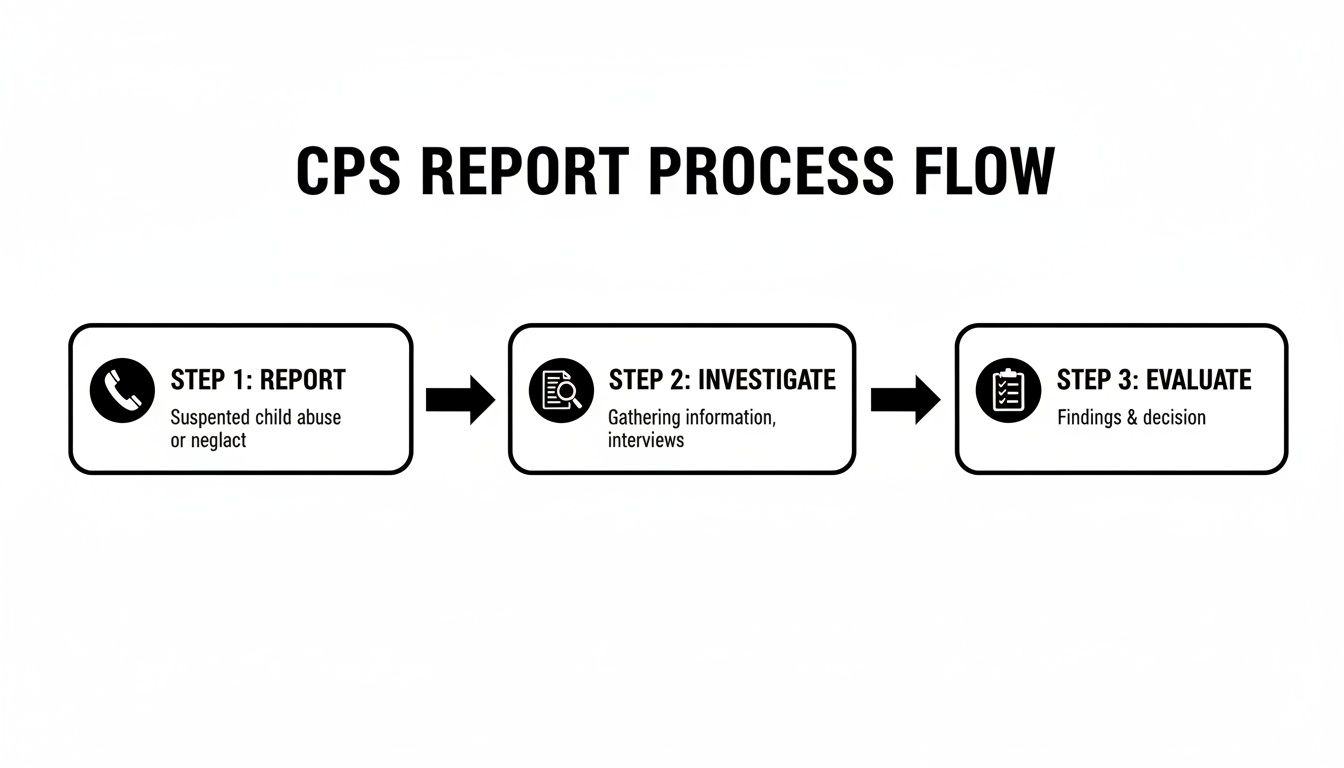
This visual breaks down the methodical steps CPS must take in every investigation.
Strict Legal Timelines
The Texas Family Code, specifically Chapter 262, imposes strict timelines to ensure investigations do not drag on indefinitely. For most cases, CPS has 45 days from the initial contact to complete the investigation and issue a finding. This can be extended to 60 days in complex cases.
This timeline provides a clear endpoint to the uncertainty. Knowing these deadlines helps you and your attorney hold the agency accountable and ensure your case progresses as required by law.
Understanding Your Rights When CPS Investigates
When a CPS caseworker is at your door, it’s easy to feel powerless. They are a government agent, and the stakes—your children and your family's future—are incredibly high. But it is vital to remember this: You have constitutional rights. These rights don't disappear during an investigation. Understanding and asserting them calmly is your first and most important line of defense during a CPS neglect investigation in Texas.
Your Right to Refuse Entry Without a Warrant
Your home is your sanctuary, protected by the Fourth Amendment against unreasonable searches. A caseworker cannot legally enter your home without your permission unless they present a court order signed by a judge.
When an investigator arrives, you have options:
- You can politely step outside to speak with them, closing the door behind you.
- You can ask if they have a court order allowing them entry.
- You can state, "I am not comfortable letting you in until I have spoken with an attorney."
Asserting your rights is not an admission of guilt. It shows that you understand the seriousness of the situation and are proceeding with the care it warrants.
Your Right to an Attorney
You have the right to have an attorney present during any and all interactions with CPS. This is a game-changer. An experienced family law attorney acts as a protective buffer between you and the investigator, ensuring your words are not misinterpreted and your rights are upheld.
Before you sign any document, answer invasive questions, or agree to any "services," you should always consult with a lawyer. Signing a "Safety Plan" under duress can have severe legal consequences that you may not recognize at the moment.
An attorney can manage all communication, prepare you for interviews, and advise you on how to respond to requests for drug tests or psychological evaluations. This protects you from making critical errors while under immense emotional stress. For a deeper dive, review this detailed guide on your rights during a CPS investigation.
Your Right to Document Everything
From the first interaction, become the primary record-keeper of your case. Start a detailed log immediately. This documentation can be invaluable if you later need to challenge the caseworker's account of events.
Your log should include:
- Date and Time: Note every interaction, including calls, texts, emails, and visits.
- People Involved: Get the caseworker's full name and title.
- Summary of Conversation: Write down what was discussed, the questions asked, and your responses.
- Documents Exchanged: Keep copies of all paperwork you are given or asked to sign.
This proactive documentation demonstrates that you are a responsible, engaged parent and creates a clear record for building a strong defense in your CPS neglect investigation in Texas.
Investigation Outcomes: What Happens Next?
After weeks of anxiety, the day the caseworker issues their finding is one of the most stressful moments a parent can endure. This final determination dictates what happens next, from CPS closing the case to the start of a court battle. It's essential to understand what each potential outcome means for your family.
The investigator will issue a formal finding that falls into one of three categories. Think of it like a traffic light: green means you're clear, yellow is a caution, and red means you must address a serious issue.
The Three Possible Findings Explained
- Ruled Out (Green Light): This is the best possible outcome. It means the investigator found no credible evidence of neglect. The report is deemed unfounded, the case is closed, and you can begin to move forward.
- Unable to Determine (Yellow Light): This is a gray area. The caseworker could not gather enough evidence to confirm the allegations but also couldn't rule them out. The case will likely be closed, but a record of the investigation remains in the CPS system and could be referenced if a future report is made.
- Reason to Believe (Red Light): This is the most serious finding. It means the caseworker concluded it is "more likely than not" (a legal standard called "preponderance of the evidence") that neglect occurred. This finding triggers further CPS involvement.
What Happens After a Reason to Believe Finding
A "Reason to Believe" (RTB) finding is frightening, but it does not automatically mean your children will be removed. In fact, removal is a last resort. Under the Texas Family Code, CPS must first attempt to work with the family to resolve safety concerns.
This often begins with a proposed "Family-Based Safety Services" (FBSS) plan or a "Safety Plan." This is a formal, written agreement outlining the steps you must take to ensure your home is safe. You should never sign this document without an attorney's review.
A safety plan might require you to:
- Attend parenting classes or counseling.
- Submit to drug and alcohol assessments or treatment.
- Prevent a specific person from having contact with your children.
- Make specific home repairs.
An RTB finding feels like a final judgment, but it is the start of a new phase. It is your chance to show your commitment to your children's safety. Your proactive response, guided by legal counsel, can be the deciding factor in keeping your family together.
Interestingly, Texas child welfare statistics show that in 2023, the state provided no services or monitoring to 63% of families with a confirmed finding of abuse or neglect. This highlights that an RTB finding, while serious, has a range of potential outcomes and requires careful legal navigation.
The Path to Court
If CPS believes the safety risks are too severe to manage with a voluntary plan, or if you refuse to comply, the agency may file a lawsuit. This can lead to a court ordering you to complete services or, in the most extreme cases, ordering the removal of your children under Chapter 262 of the Texas Family Code.
If your case heads to court, having an experienced family law attorney is no longer optional—it's a necessity. You are now in a formal legal battle to protect your parental rights under Chapters 263 (hearings and deadlines) and 161 (termination of parental rights). You need a fierce, compassionate advocate in your corner.
How a Family Law Attorney Can Protect Your Family

Facing a CPS neglect investigation in Texas can feel like you're lost at sea during a storm. You are suddenly expected to navigate a complex legal system while your family’s future hangs in the balance. This is precisely when a dedicated family law attorney becomes your family’s lifeline.
You do not have to endure this process alone. Hiring an experienced lawyer immediately shifts the dynamic. It tells CPS that you are taking this matter seriously and that your rights will be defended. Your attorney becomes your voice, your strategist, and your shield, allowing you to focus on your children while they manage the legal complexities.
Immediate and Strategic Legal Action
From the moment you hire the Law Office of Bryan Fagan, we take immediate action. Our first step is to take over all communication with the CPS caseworker. This stops the stressful, intrusive calls and ensures every exchange is handled strategically, preventing you from accidentally saying something that could be used against you.
Our legal team will also:
- Prepare You for All Interviews: We'll review the allegations with you and anticipate the caseworker's questions, helping you provide clear, truthful answers that leave no room for misinterpretation.
- Challenge False Allegations: We begin gathering evidence—witness statements, photos, school and medical records—to build a strong defense that directly refutes false or misleading claims.
- Negotiate Safety Plans: If CPS proposes a service plan, we negotiate the terms to ensure they are fair, reasonable, and genuinely aimed at family preservation, not just imposing unnecessary burdens.
A common scenario involves a terrified parent agreeing to a safety plan that forces a non-offending spouse out of the home. With an attorney's help, we can often negotiate far less disruptive alternatives, such as counseling or temporary supervision, that satisfy safety concerns without tearing the family apart.
Fierce Representation When It Matters Most
If your case proceeds to court, we become your relentless advocate. We live and breathe the Texas Family Code—including the critical Chapters 262, 263, and 161—and use this deep knowledge to defend your parental rights at every hearing. A skilled CPS lawyer in Texas can be the difference between a case dismissal and the tragedy of family separation.
With deep experience fighting for parents across Houston, Dallas, Austin, San Antonio, and beyond, our firm provides the compassionate and strategic defense your family deserves. Your family's future is too important to risk. Contact the Law Office of Bryan Fagan for a free, confidential consultation to discuss how we can begin protecting your family today.
Your Top Questions About Texas CPS Investigations Answered
When a CPS caseworker shows up, your mind races with questions and fears. We understand. Here are compassionate, straightforward answers to some of the most common questions we hear from Texas parents.
Can CPS Talk to My Child Without My Permission?
Yes, and it's a tactic that often shocks parents. Texas law allows caseworkers to interview your child at school or daycare without your prior knowledge or consent if they believe telling you first could compromise the investigation or endanger the child.
They do this to get what they consider an unfiltered account from the child. However, for any other interviews, you have the right to be present. An attorney can step in to ensure CPS does not overstep its bounds and that your child is protected during this incredibly stressful experience.
How Long Will My Name Stay in the CPS Database?
This is a major concern. If CPS issues a "Reason to Believe" finding, your name is entered into the statewide Central Registry. This record can have long-lasting consequences. How long your name remains on the list depends on the severity of the finding.
It can range from a few years to a lifetime for the most serious cases. Being on the registry can prevent you from working or volunteering in any capacity with children—from teaching to coaching. An attorney can immediately fight this by filing for an Administrative Review of the Finding (ARF), a crucial step toward clearing your name.
Fighting a "Reason to Believe" finding is not just an option; it's essential to protecting your reputation and future.
What if CPS Asks Me to Take a Drug Test?
First, breathe. You are not legally obligated to take a drug test just because a caseworker asks. They need either your informed consent or a court order. However—and this is a critical "however"—refusing is often viewed as an admission of guilt by both the caseworker and, potentially, a judge.
This is a classic "damned if you do, damned if you don't" scenario that you should not navigate alone. An attorney can assess the situation, advise you on the best path forward, and help you handle this request without making a mistake that could harm your case during a CPS neglect investigation in Texas.
Trying to handle a CPS investigation by yourself is a risk no parent should have to take. The stakes—your children, your reputation, your future—are simply too high. At The Law Office of Bryan Fagan, PLLC, our practice is dedicated to one mission: protecting your rights and keeping your family together. If CPS has contacted you, do not wait. Schedule your free consultation with our team today and let us start fighting for you.