Skip to content
When a Child Protective Services (CPS) investigator knocks on your door, a wave of fear and confusion can wash over you. In that moment, facing a stranger who holds immense power over your family’s future, it’s natural to feel alone and terrified. This is a feeling no Texas parent should ever have to experience without support.
One of the first documents you may encounter is a CPS safety plan in Texas. It’s crucial to understand that this is a voluntary agreement between you and CPS, designed to manage immediate safety concerns while an investigation is active. It is not a court order, nor is it an admission of guilt. Think of it as a temporary roadmap intended to keep your family together and avoid the trauma of removal while CPS assesses the situation.
What a Texas CPS Safety Plan Really Means

The first thing you need to know is what a safety plan is—and, just as importantly, what it isn't. CPS uses this tool to manage what they perceive as potential risks to a child while they look into allegations of abuse or neglect. It's meant to be a preventative step, not a punishment. Understanding this distinction is the first step toward navigating the process with more confidence and less fear.
A Quick Look at a Texas CPS Safety Plan
| What a Safety Plan IS | What a Safety Plan IS NOT |
|---|---|
| A voluntary agreement you are asked to sign. | A court order you are legally forced to obey. |
| A temporary tool to address immediate safety concerns. | A permanent solution or final decision. |
| A way to keep your family together during an investigation. | An admission that you have done something wrong. |
| A set of specific, actionable rules to follow. | A punishment for alleged behavior. |
| A document that can be negotiated. | A document you must sign on the spot without legal advice. |
Having a clear picture of the plan's role is your first line of defense. It's a bridge, not a final destination.
The Core Purpose of a Safety Plan
Under the Texas Family Code, CPS has one primary mission: to keep children safe. When they receive a report, their job is to determine if a child is in immediate danger. If the caseworker believes a risk exists but it doesn't meet the high legal standard for a judge to order the child's removal, they will likely propose a safety plan.
It’s their way of creating a controlled environment so they can gather more information without taking the drastic step of placing a child into foster care.
A safety plan is all about managing perceived risk. It’s crucial for parents to understand that this is a voluntary agreement. You are not legally obligated to sign it, especially not on the spot without understanding every single word.
A Relatable Scenario: Unpacking the Safety Plan
Let's walk through a situation we've seen play out many times. Imagine a neighbor calls CPS, claiming a couple leaves their young children, ages 5 and 7, home alone. A caseworker arrives to investigate. The parents are floored—they explain that the one time this happened, they ran to the corner store for milk for ten minutes, and their 7-year-old knows how to call 911.
The caseworker, however, still has concerns about supervision. Instead of rushing to court for an emergency removal, she suggests a safety plan. The terms might look something like this:
- The parents agree not to leave the children unsupervised for any amount of time.
- A specific relative, like a grandparent, agrees to be on-call for childcare if the parents have to leave unexpectedly.
- The parents agree to enroll in a parenting class focused on age-appropriate supervision.
This plan allows the children to stay in their home while giving the family a chance to demonstrate they are committed to addressing CPS's concerns. It avoids the trauma of removal and keeps the family unit intact. To get a better feel for how these documents are put together, you can even look at general safety planning templates online.
A safety plan isn't an admission of neglect. It’s simply an agreement to follow specific rules while the investigation unfolds. But—and this is a big but—signing one without fully understanding the terms can create serious problems down the road. You have rights, and knowing them is everything. For a deeper dive, check out our guide on creating a CPS safety plan with tips for families and professionals.
The Common Terms Inside a Safety Plan

When a CPS caseworker slides a safety plan across your kitchen table, it can feel like you’re being handed a contract written in a foreign language. The terms often sound intimidating, and with the pressure of the moment, it’s tough to focus. But this is exactly when you need to slow down. Understanding what you're being asked to sign is the single most important step you can take to protect your family and your rights.
Every CPS safety plan in Texas should be tailored to the specific allegations. The goal, according to the Texas Family Code, is to address immediate safety threats without being overly broad. Let’s break down some of the most common requirements you're likely to encounter.
Common Conditions in a Safety Plan
You’ll quickly see that most plans center on specific, actionable steps. While the details can change from case to case, the core themes are usually pretty similar.
- No Contact or Supervised Contact: This is a big one. The plan might demand that a parent or someone else in the home has zero contact with the child. More often, it will require that all contact be supervised by a specific, CPS-approved person, like a grandparent or a trusted family friend.
- Service Requirements: This is a catch-all category. It can include anything from attending parenting classes and individual or family counseling to enrolling in domestic violence intervention programs.
- Substance Abuse Assessments and Testing: If drugs or alcohol are part of the allegation, you can bet the plan will require a substance abuse assessment. It will almost certainly include submitting to random drug or alcohol tests.
- Safe Home Environment: Sometimes this is vague, with language like "maintaining a clean and hazard-free home." Other times, it's very specific, like demanding that you lock up firearms or require certain individuals to leave the home.
These terms aren't just pulled out of a hat; they should directly connect to the report that brought CPS to your door in the first place. Your job is to read them with a critical eye and make sure they are reasonable and tightly focused on the actual concerns CPS has raised.
A Real-Life Example: Substance Use Allegations
Let’s look at a real-life example. Consider Maria, a single mom to an 8-year-old son. An anonymous caller told CPS they smelled marijuana coming from her apartment. A caseworker shows up and, after talking with Maria, presents a safety plan. Maria admits she sometimes uses a legal Delta-8 product for anxiety after her son is in bed, but she’s adamant it never affects her parenting.
The initial plan the caseworker presents is incredibly broad. It requires Maria to submit to weekly drug tests for a full panel of substances, attend a 12-week intensive outpatient substance abuse program, and—the real kicker—have her son live with his grandmother until the program is finished. For Maria, this feels completely out of proportion and more like a punishment than a plan.
This is a crucial moment. A safety plan should not be a one-size-fits-all punishment. It should be a narrowly focused agreement that directly addresses the specific risk alleged—in this case, the potential for a parent to be impaired while caring for a child.
Knowing this, Maria pushes back—calmly and respectfully. She explains that she can't afford an intensive program and that removing her son from her care would be deeply traumatic for him. Instead, she offers a counter-proposal. She agrees to get a substance abuse assessment to see if any treatment is even needed. She also agrees to random drug testing specifically for THC and even offers to install another smoke detector in her home.
This counter-offer is smart. It shows she’s taking the allegation seriously while refusing to sign up for overly burdensome and unnecessary conditions. This kind of negotiation is a core part of the process, and it’s a right you absolutely have. Understanding the common terms is what gives you the power to spot when a plan is reasonable and when it’s gone way too far.
Your Rights When Facing a CPS Safety Plan

The pressure to sign a CPS safety plan in Texas can feel overwhelming. A caseworker is in your living room, your heart is pounding, and your mind is flooded with worst-case scenarios. It's easy to think that just signing the document is the quickest way to make it all stop.
But this is a critical moment. You need to pause, take a breath, and understand the power you actually have.
The single most important thing to know is that a CPS safety plan is a voluntary agreement. It is not a court order. You cannot be forced to sign it, especially not on the spot. You have rights, and using them wisely can completely change the direction of your case.
You Have the Right to Refuse to Sign
Let's be direct: you can say "no." Refusing to sign a safety plan is a legitimate and often strategic decision, particularly if the terms are vague, impossible to comply with, or just plain unfair. Many parents are terrified that saying no will automatically lead to their child being removed, but that’s not always what happens.
It's true that a refusal can trigger CPS to seek a court order under Chapter 262 of the Texas Family Code. However, that isn't a foregone conclusion. Sometimes, refusing an unreasonable plan is a much better option than agreeing to conditions that set you up to fail. Signing a plan you can't follow perfectly just hands CPS more evidence to use against you down the road.
Before you decide anything, your first and most fundamental right is to seek legal counsel. You should never sign a safety plan without having an experienced family law attorney review it first.
Take your time. You are well within your rights to say, "I am not comfortable signing this document until my attorney has reviewed it." This isn't an admission of guilt; it's a responsible and legally smart move to protect your family.
You Have the Right to Negotiate the Terms
A safety plan shouldn't be a one-sided demand. Think of it as a starting point for a negotiation. The goal is to create a document that is fair, reasonable, and directly addresses the specific safety concerns that were alleged—nothing more. You have every right to push back on terms that are too broad or completely unnecessary.
Here are a few common areas where negotiation is possible:
- Supervisors: If the plan demands supervised visits, you can propose a trusted and willing supervisor, like a grandparent or a close family friend, instead of a person you or your child are uncomfortable with.
- Services: If CPS is pushing for intensive therapy or classes, you can request that a formal assessment be done first to see if those services are even necessary.
- Timelines: Make sure the plan has a clear start and end date. A safety plan should not be a never-ending commitment with no finish line in sight.
Knowing your rights gives you the power to participate in this process instead of just being subjected to it. We've put together a more detailed guide on how to dispute a Texas CPS safety plan and stand up for your family.
A Scenario Showing Negotiation in Action
Imagine a father, Mark, who was hit with a neglect allegation from his ex-partner during a heated custody fight. CPS showed up and proposed a safety plan that would have banned him from having any unsupervised contact with his daughter for 90 days. For Mark, this felt like a punishment based on a false report, and he knew it would crush his relationship with his child.
Instead of caving and signing, Mark called an attorney. With his lawyer's guidance, he made a counter-offer. He suggested that his mother—the child's grandmother, who was adored by the child and had a great relationship with everyone—could supervise his visits. He also proactively agreed to take a co-parenting class to demonstrate his commitment to working things out with his ex.
CPS agreed to the modified plan. Mark was able to keep seeing his daughter in a loving, familiar setting, and the case was eventually closed without any court involvement. This story shows that you have agency. You are not just a bystander in this process; you can and should make strategic choices to protect your family.
How the CANS Assessment Is Changing Safety Plans
There's a significant shift happening within Texas CPS, and it directly affects how they create a CPS safety plan in Texas. For families caught in the system, this change is a welcome move away from purely reactive, often punitive measures toward a more supportive, preventive model. The key to this new direction is a tool known as the Child and Adolescent Needs and Strengths (CANS) assessment.
Getting a handle on this new approach is critical because it completely changes the conversation with your caseworker. Instead of just zeroing in on what's wrong, the CANS assessment is built to identify a family's struggles and its inherent strengths. This gives the caseworker a far more balanced and human-centered picture of your family's situation.
Moving Beyond a Checklist Approach
For far too long, CPS safety plans could feel like a generic, one-size-fits-all checklist of demands. The CANS assessment is designed to put an end to that. It provides a structured, evidence-based way to truly understand a child's and family's specific circumstances.
Critically, it’s a trauma-informed tool. This means it’s built on the recognition that past trauma can deeply impact a family’s current reality. We explore this concept in-depth in our related article on the trauma-informed care in Texas Child Protective Services.
This detailed evaluation helps caseworkers pinpoint the exact support a family needs. For instance, instead of just ordering "parenting classes," a CANS assessment might reveal that a parent is struggling with overwhelming anxiety, which is impacting their parenting style. The resulting safety plan could then include targeted mental health support, which is infinitely more effective than a generic class. Understanding mental health is a powerful tool for any parent; a great resource like Anxiety University can provide comprehensive education on these topics.
The goal of the CANS assessment is to create a safety plan that is less about punishment and more about healing and support. It helps connect families with the right services to build resilience and prevent a crisis from escalating.
This more precise approach is part of a larger state initiative. By the end of Fiscal Year 2025, over 2,000 Texas children had already transitioned to services under the innovative T3C (Texas Tailored for Children) model, which uses the CANS assessment to create these individualized plans.
What This Means for Your Family
So, what does this actually look like for you and your kids? This new, data-driven method offers a real pathway to practical solutions instead of just a list of hoops to jump through.
When a caseworker uses the CANS assessment, they are looking at the whole picture—your child’s emotional and developmental needs, your family’s support system (or lack thereof), and your own personal strengths.
For parents, this means you are more likely to see a safety plan that includes things like:
- Targeted Mental Health Services: Connecting you or your child with a counselor who actually specializes in an issue identified in the assessment, not just any therapist.
- Substance Abuse Treatment: Getting you access to programs funded through the Family First Prevention Services Act, which is specifically designed to keep families together.
- Skill-Building Programs: Instead of vague classes, you might be connected with programs that teach specific, practical skills, like managing financial stress or de-escalating conflict.
This focus on family preservation is a massive and incredibly positive development. It’s a signal that the system is trying to provide genuine help before it takes the drastic and traumatic step of removing a child. While any CPS involvement is stressful, knowing that the process may be guided by a tool designed to find solutions—not just faults—can offer a small but powerful sense of hope.
Following the Plan and What Happens If You Don't
Once you've signed a CPS safety plan in Texas, the real work begins. It’s easy to think signing the paper is the hard part, but the truth is, what comes next is a marathon, not a sprint. Your job now is to follow that plan to the letter and, just as crucially, prove you’re doing it.
Think of it this way: the safety plan is a roadmap CPS has laid out for you. Every single turn, stop, and action item is there for a reason. Your full-time focus needs to be on navigating it flawlessly.
The Power of Meticulous Documentation
In the world of CPS, if it isn't written down, it didn't happen. Your word, no matter how sincere, won’t be enough to convince a caseworker or a judge that you're holding up your end of the deal. You need a solid paper trail. This isn't just a good idea; it's your best defense.
Get a binder or create a dedicated digital folder immediately. This will become your compliance bible. Here’s what you need to fill it with:
- Receipts and Certificates: Paid for a class? Keep the receipt. Finished a course? Get that certificate of completion and make copies. These are your trophies.
- Sign-In Sheets: For any group session or class, always ask for a copy of the sign-in sheet. It’s third-party proof that you were there when you said you were.
- A Detailed Log: Keep a journal. After every supervised visit, jot down the date, time, who was there, and a quick summary. Do the same for every phone call or meeting with your caseworker.
This might feel like overkill, but trust me, this binder can be the one thing that gets your case closed and your life back on track.
The Serious Consequences of Non-Compliance
CPS doesn't see these plans as friendly suggestions. The stakes are devastatingly high. I don't say this to scare you, but to show you how seriously CPS views compliance. In Fiscal Year 2025, Texas investigated 964 child fatalities. A heartbreaking 50% of the deaths confirmed to be from abuse or neglect involved a family that already had a history with CPS. You can see the official numbers yourself in the state's child maltreatment fatalities and near-fatalities report.
This history is exactly why a caseworker’s tolerance for slip-ups is incredibly low. When a parent doesn't follow the plan, CPS doesn't see a simple mistake. They see a confirmation of their worst fears about the child's safety.
A single missed therapy session, one failed drug test, or letting a person you were told to avoid see your child isn't a minor stumble. To CPS, it's proof that the plan is failing and that the child is still at risk. This can set off an immediate and severe chain reaction.
Failing to follow the plan hands CPS all the ammunition they need to escalate. They can walk into court and ask a judge for an emergency order to remove your child. If the non-compliance continues, it becomes the cornerstone of their case to terminate your parental rights under Chapter 161 of the Texas Family Code.
That’s the direct line between the paper you signed and the very real possibility of losing your child for good. Every single thing you do—or don't do—is building the case for or against you.
What Non-Compliance Looks Like in Reality
Let's talk about a real-world scenario. Imagine a dad, David, signs a safety plan. It says he has to go to anger management and can only see his son during supervised visits. He starts out strong, doing everything right. But then work gets stressful, he’s exhausted, and he skips one class. He figures he’ll just make it up next week, no big deal.
A few days later, the person who supervises his visits gets sick and cancels. David is crushed. He misses his son terribly and decides to just swing by and pick him up for an hour. Who’s going to know? But a neighbor sees them playing in the yard and makes a call.
To David, these were two understandable slips in a tough week. To CPS, it’s a clear pattern. He’s now proven he can't—or won't—follow the rules put in place to keep his son safe. The caseworker now has a strong, documented reason to file a lawsuit, which could lead to his son being formally removed from the home and the start of a long, uphill legal battle.
Common Questions About Texas CPS Safety Plans
When CPS puts a safety plan in front of you, your head is probably spinning with questions. It's a confusing and deeply stressful time, and getting straight answers can feel impossible. Let's tackle some of the most urgent questions we hear from Texas parents navigating this process.
How Long Does a CPS Safety Plan Typically Last?
This is usually the first thing parents want to know. A CPS safety plan in Texas is meant to be a temporary fix, not a permanent new reality. There's no one-size-fits-all timeline, but most plans are initially set for 30 to 90 days.
The actual length really depends on your unique situation. If the issues are minor and you can resolve them quickly, the plan might be on the shorter end. But if CPS believes more time is needed for you to complete services and show consistent change, it could be extended. The important thing is that a safety plan should always have an end date or, at a minimum, a specific date for review.
How Do I End or Change the Safety Plan?
Your main goal is to complete the plan successfully. The best way to end it is to follow every single requirement to the letter. Once you have proof that you've done everything asked of you—like a certificate from a parenting class or a discharge summary from counseling—you can formally ask CPS to close the plan.
Life happens, and sometimes things need to change. If your circumstances shift, you can ask for a modification. For instance, if the plan says your mother has to supervise visits but she gets sick, you can be proactive. Propose another trusted, capable relative to the caseworker as a replacement. The trick is to communicate openly and offer solutions, showing you're on top of things.
Remember, you need to prove that the original safety concerns are gone. A well-organized file showing your full compliance is the strongest argument you can make to get the plan terminated.
What If the Other Parent Doesn’t Follow the Plan?
This is an incredibly common and frustrating problem, especially for co-parents. If a CPS safety plan in Texas names both of you, but you're the only one doing the work, you have to document everything. Your top priority is to keep following your part of the plan perfectly.
At the same time, you must notify the caseworker about the other parent's failure to comply. Do it in writing—an email is perfect—so you have a record. List specific examples with dates if you can. This not only covers you but also shows CPS that you are the parent taking the child's safety seriously. From there, the caseworker will have to decide how to handle the non-compliant parent, which might mean escalating the case to court.
The flowchart below shows the two basic outcomes. Following the plan leads to documentation and progress. Not following it often leads to court.
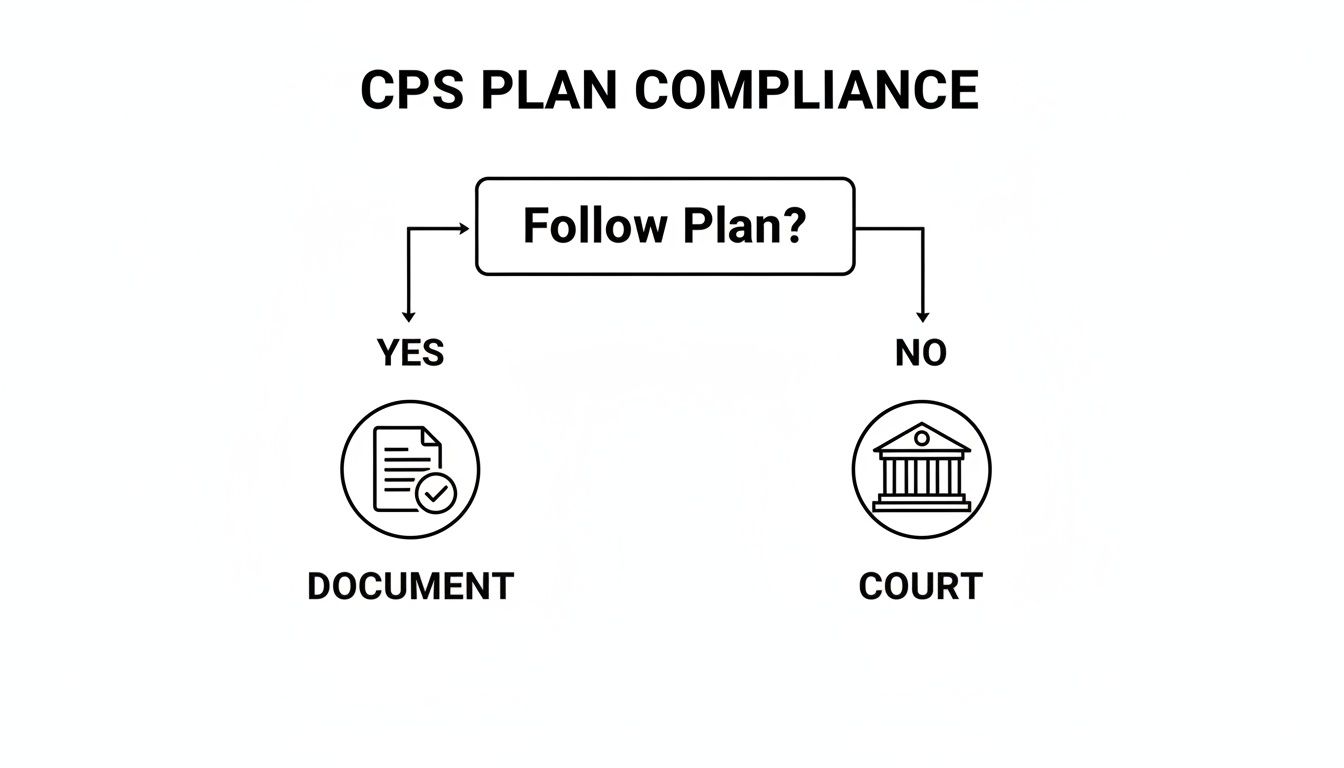
This visual highlights a simple truth: your actions are what determine whether this situation gets resolved cooperatively or ends up in front of a judge.
Does a Safety Plan Go on My Record or a Background Check?
This is a huge source of worry, and for good reason. The good news is that a voluntary CPS safety plan is an internal agency document. It will not appear on a standard criminal background check because it is not a court order or a criminal conviction.
However, the CPS investigation itself is a different story. That investigation creates a record with the Texas Department of Family and Protective Services (DFPS). If CPS makes a "reason to believe" finding of abuse or neglect, your name could be added to the central registry. That can have major consequences, affecting your ability to work with children or volunteer. This is another reason why it's so vital to handle the entire process with care and get legal advice early.
What Should I Do If CPS Asks Me to Take a Drug Test?
If the allegations involve any kind of substance use, a drug test is almost guaranteed to be part of the safety plan. It can feel like a massive invasion of privacy, but refusing a test is often seen by CPS as a silent admission of guilt, which will only make things worse.
Even a positive test for something like marijuana—which you might feel has zero impact on your parenting—can create big problems. CPS isn't judging your lifestyle; they are only focused on whether substance use creates a dangerous environment for a child. Before you agree to or refuse anything, your first call should be to an attorney to talk through the specifics of your situation.
Navigating a CPS investigation is one of the most frightening and overwhelming challenges a parent can face. But you do not have to walk this path alone. The team at the Law Office of Bryan Fagan, PLLC understands the fear and uncertainty you're experiencing. We have the experience to guide you through each step, protect your parental rights, and fight passionately for your family's future. If CPS is at your door, don't wait. Contact us for a free, confidential consultation to understand your rights and options. Visit us at https://texascpslawyer.net to get the help you need today.