Skip to content
When you're already caught in the overwhelming storm of a Child Protective Services (CPS) case, receiving a legal notice with the word "warrant" on it can feel like a lightning strike. Fear, confusion, and a wave of worst-case scenarios can instantly flood your mind. Before you let panic take over, it's critical to understand what a capias warrant is in a Texas CPS case—and just as importantly, what it isn’t. This isn't necessarily a new criminal charge; it's a legal issue that, with the right guidance, can be resolved.
What Is a Capias Warrant in Texas?
A capias warrant is a direct order from a judge, telling law enforcement to bring you into court. In the complex world of Texas CPS cases, it's typically issued when you miss a mandatory hearing or don't follow a specific court order. Think of it less as a new criminal charge and more as a powerful, non-negotiable summons from the court.

You could think of it as the court’s most serious way of saying, “We need you here, and your attendance is no longer optional.” It doesn't automatically mean you're being labeled a bad parent or have committed a separate crime. Far more often, it’s a procedural tool a judge uses to get a case back on track after a required step was missed.
The Purpose Behind the Order
The word capias comes from Latin and basically means "that you take." The purpose is exactly that: for law enforcement to take you into custody to guarantee you appear before the judge. This is a key difference from a standard arrest warrant, which is usually based on probable cause that a crime has been committed. A capias warrant almost always comes into play after court proceedings have already started.
To help clear things up, let's look at how a capias warrant differs from the arrest warrant most people are familiar with.
Capias Warrant vs Arrest Warrant at a Glance
| Feature | Capias Warrant | Arrest Warrant |
|---|---|---|
| Trigger | Usually for failing to appear in court or follow a court order. | Based on probable cause that a person has committed a specific crime. |
| Issuing Authority | A judge or clerk of the court where the case is already active. | A judge or magistrate, often at the request of law enforcement. |
| Timing | Issued after a case has begun (e.g., you've been charged or are in a lawsuit). | Often issued before formal charges are filed, to initiate the legal process. |
| Primary Purpose | To compel an individual to appear in court. | To take a suspect into custody so they can be formally charged with a crime. |
| Common CPS Context | Issued when a parent misses a required court hearing in their ongoing CPS case. | Could be issued if there's evidence of a criminal offense like child endangerment. |
This table shows that while both involve being taken into custody, their origins and goals are quite different. A capias is about enforcing the court's authority in an existing case, not starting a new one.
Why This Matters in Your CPS Case
In the context of a family law or CPS case, a judge uses a capias warrant to re-establish control and enforce the orders made under the Texas Family Code. While it is absolutely a serious matter that requires your immediate attention, it is also a problem that can be solved.
With the right legal guidance, you can address the warrant head-on, explain your situation to the judge, and get back to focusing on the most important thing: protecting your family and working toward reunification.
Why a Judge Issues a Capias Warrant in a CPS Case
When a judge issues a capias warrant in your CPS case, it’s almost never about punishment. That’s the first thing to understand. The court's primary goal is actually to get you back in the loop and ensure your case can move forward.
A judge needs your active participation to make decisions that are truly in your child’s best interest. When you're not there, the whole process grinds to a halt. A capias warrant is simply the most serious tool they have to get things moving again.
Knowing the specific reasons a judge might issue one can take a lot of the fear out of the situation. It almost always boils down to a missed step or a breakdown in communication during an already overwhelming time.
Common Triggers for a Capias in CPS Cases
In the fast-paced and confusing world of a CPS investigation, it’s easy to miss a crucial deadline or obligation. A judge will typically only resort to issuing a capias after a mandatory action has been overlooked.
Here are some of the most common real-world scenarios we see that lead to this type of warrant:
- Missing a Critical Court Hearing: Failing to show up for a mandatory hearing is a huge red flag for the court. A key example is the initial Adversary Hearing mentioned in Chapter 262 of the Texas Family Code. This is where the judge hears evidence to decide if your child should remain in state care, making your presence absolutely vital.
- Failing to Complete a Court-Ordered Service: Your service plan might require you to complete drug testing, attend counseling sessions, or participate in parenting classes. If you don't follow through with these court orders, a judge may issue a capias to bring you to court and find out why.
- Not Responding to a Subpoena: A subpoena isn't a suggestion—it's a formal court order to appear or provide documents. Ignoring it is seen as a direct challenge to the court's authority, and judges take that very seriously.
Imagine a single parent juggling a full-time job and caring for other children. Amid the chaos, they misread a notice and accidentally miss a court-ordered counseling session. The capias warrant that follows isn’t meant to label them a criminal; it’s the court’s way of ensuring they get back on track with their service plan.
The Court’s Goal: Re-establishing Contact
The entire legal foundation of a CPS case is built on parental involvement. The timelines and requirements laid out in the Texas Family Code, particularly in Chapters 262 and 263, are designed to resolve cases efficiently for the child's stability.
A capias warrant in a CPS case is fundamentally a communication tool. The judge is not trying to put you in jail; they are trying to bring you back into a critical conversation about your child's future.
When you fail to appear or comply, the case stalls. The judge can't make informed decisions with incomplete information, leaving your child's future hanging in the balance. By issuing a capias, the court is enforcing its orders and compelling you to re-engage with the process.
Addressing the warrant quickly with the help of an experienced Texas CPS defense attorney shows the court you're committed to resolving the issues and reuniting your family.
The Different Types of Capias Warrants Explained
Getting a handle on the fact that a capias warrant is basically a judge's order to appear is the first big step. The next is understanding that these warrants aren't a one-size-fits-all situation. The legal language can feel pretty intimidating, but once you break it down, you can see exactly why the court is trying to get your attention.
In most Texas CPS cases, the warrant you’re likely to run into is a capias ad respondendum. The Latin might sound fancy, but it simply means "to answer." Think of it as the court’s most powerful tool for bringing you in to answer for a missed hearing or a failure to follow an order. Its one and only purpose is to get you in front of the judge so the case can move forward.
Capias Ad Respondendum: The Order to Appear
This is the workhorse of capias warrants in family law. When a judge issues a capias ad respondendum, they aren't looking to punish you right off the bat. Their goal is simply to get you back into the courtroom and re-engaged with your case.
It’s a procedural move, designed to ensure you’re participating. The Texas Family Code requires your involvement for any decisions about your children to be considered fair, and this warrant is how the court makes that happen.
Capias Pro Fine: The Order to Pay
A less common, but still possible, warrant is the capias pro fine, which translates to "for a fine." This one pops up when someone has been ordered by the court to pay a fine, court cost, or some other fee and has simply failed to do so.
While it's not something you’d typically see at the beginning of a CPS case, it could come into play later on. For instance, if a judge orders you to pay for a specific service or evaluation and you don't make the payment, this is the tool they might use. Its purpose is purely financial—to compel you to pay a court-ordered debt.
The history behind these orders is pretty long, tracing all the way back to English common law. The original capias ad respondendum was actually used for civil debts, a practice the American colonies brought over. Texas later formalized it in its Code of Criminal Procedure in 1965 to help ensure due process. Explore more about the history of capias warrants.
Knowing which type of capias has your name on it is absolutely critical. It tells you exactly what the judge wants to talk about. Is it a missed court date? Or is it an unpaid fine? This key piece of information allows your attorney to build the right strategy to address the issue head-on. Getting that clarity is your first real step toward resolving the warrant and protecting your family.
What to Expect After a Capias Warrant Is Served
Discovering a capias warrant has been issued in your name is a deeply unsettling experience. But knowing what happens next can help replace that fear with a sense of control. The main purpose of this warrant isn't to punish you; it's simply a legal tool to get you in front of the judge who needs you there.
The warrant can be served in a few different ways. An officer might show up at your home, or it could pop up during a routine traffic stop. It's even possible for an officer to serve the warrant at your job. No matter where it happens, the immediate goal is always the same: to take you into custody so you can see the judge.
The Arrest and Booking Process
Once an officer serves the warrant, you will be arrested. While that word sounds scary, try to remember that this is a procedural step. You'll be taken to a local law enforcement facility for booking. This process usually involves taking your picture, getting your fingerprints, and recording your personal information.
This is not the moment to argue your case or resist. Staying calm and being respectful is your best move. The whole point of this is to get you to court, and booking is just a required part of that journey.
Your First Appearance Before the Judge
After the booking process is complete, you will be brought before the judge who issued the capias. This is a critical moment and your best chance to get your CPS case back on the right track. The judge isn't looking to throw the book at you; they primarily want to understand what went wrong. They'll want to know why you missed your court date or didn't complete a task they ordered.
Be ready to explain your situation honestly and directly. This is your opportunity to show the court that you're committed to your children and ready to get back on track with the legal process. What the judge is looking for is accountability and a promise to participate from here on out. To get a better feel for this type of court appearance, you can read our guide on what happens at an arraignment hearing, as it shares some similarities.
This court appearance is your opportunity to turn a negative situation into a positive one. A sincere explanation and a clear commitment to future compliance can significantly influence the judge's next decision.
Based on how you handle this appearance, the judge has a few options. They might:
- Release you with a warning, especially if they're satisfied you now understand how important it is to comply.
- Set a bond, which is a financial guarantee that you'll show up for all future court dates.
- Modify your service plan or other court orders to help you overcome whatever obstacles you're facing.
This isn't a trial about the core issues of your CPS case. It's a direct conversation with the judge to fix the non-appearance and get the case moving forward again. When you handle it responsibly, you show respect for the court and dedication to your family, which can only help you in the long run.
Your Step-by-Step Plan for Handling a Capias Warrant
Discovering there’s a warrant out for your arrest is a terrifying moment. But this is not the time to panic or hide. Taking immediate, proactive steps is the best way to protect yourself, your family, and your CPS case. Instead of waiting in fear, you can take control with a clear, strategic plan.
This is your guide to shifting from a passive, scared position to an active, empowered one. Working with a legal professional can help you negotiate a resolution that minimizes disruption to your life and gets your CPS case back on solid ground.
Step 1: Acknowledge the Warrant Calmly
The first and most important step is to accept the reality of the situation without letting fear take over. A capias warrant doesn’t mean your case is hopeless or that you are a bad parent. It is a procedural issue that can be resolved, but ignoring it will only make things much worse.
Step 2: Immediately Contact a Family Law Attorney
Your very next call should be to an experienced Texas family law attorney who understands the unique pressures of CPS cases. Please, do not try to handle this on your own. An attorney acts as your shield and your advocate, communicating with the court on your behalf and preventing missteps that could harm your case.
This is your most critical action. An attorney can immediately begin working to protect you from an unexpected and public arrest. They know the court system and can start negotiating a favorable resolution right away.
Step 3: Arrange a Voluntary Appearance
With your attorney’s guidance, you can arrange a voluntary appearance before the judge. This simple act shows the court that you are taking the matter seriously and are committed to resolving it. This proactive approach is far better than waiting to be arrested during a routine traffic stop or, worse, at your home.
In some situations, your attorney may be able to file a motion to have the warrant withdrawn or quashed without you ever being taken into custody. While a capias warrant is a civil matter in a family case, understanding how to navigate the court system is essential. If you want to learn more about the broader legal landscape, you can explore information about how to get criminal charges dropped, as many of the principles of proactive legal defense apply.
This process flow shows the typical steps after a warrant is served, highlighting why it’s so important to avoid this outcome through voluntary action.
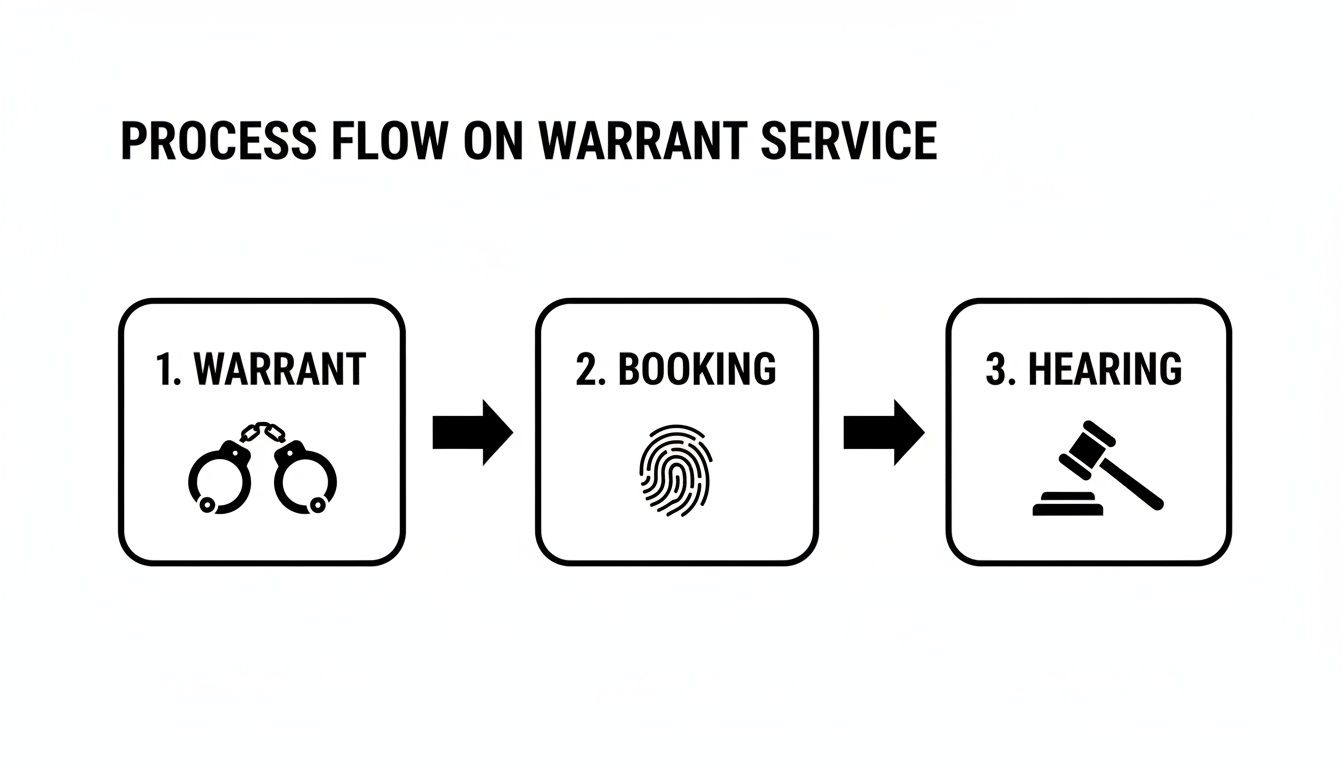
The key takeaway is that the process is designed to bring you before a judge, and managing how that happens is your best strategy.
Step 4: Gather Your Documentation
Finally, work with your attorney to collect any documents that might explain your absence from court. This is not about making excuses, but about providing context.
This could include:
- Medical records for an illness or emergency
- Car repair bills showing you were stranded
- Proof of a family emergency that required your attention
Providing a legitimate reason for your absence can make a significant difference in how the judge views your situation. It demonstrates that your failure to appear was not a willful act of defiance but a result of circumstances beyond your control.
To help you organize your response, here is a simple checklist of what to do the moment you learn about a capias warrant. Following these steps can help reduce the anxiety and get you on the path to a resolution.
Immediate Steps to Address a Capias Warrant
| Step | Action | Why It's Important |
|---|---|---|
| Acknowledge | Take a deep breath and accept the situation without panicking. | Calm, clear thinking is your best asset right now. Panic leads to poor decisions. |
| Call an Attorney | Contact a family law attorney immediately, before doing anything else. | An attorney can protect you from an immediate arrest and start negotiating with the court. |
| Arrange Appearance | Work with your lawyer to schedule a voluntary surrender or court appearance. | This shows responsibility and is viewed much more favorably by a judge than being arrested. |
| Collect Proof | Gather any documents that explain why you missed court (e.g., medical records, car trouble). | Providing a valid reason can greatly influence the judge's decision and the outcome. |
| Follow Legal Advice | Listen to your attorney’s instructions and follow them precisely. | Your lawyer understands the legal system and can guide you through the process safely. |
Taking these actions puts you back in control. It turns a frightening situation into a manageable legal process, which is exactly where you want to be.
How a Capias Warrant Impacts Your Texas CPS Case
A capias warrant isn't just a piece of paper; it sends a loud, clear, and damaging message in your ongoing Texas CPS case. In the eyes of a judge or caseworker, failing to show up for court is often seen as a sign of non-cooperation or, even worse, an attempt to dodge responsibility. This can have an immediate and destructive effect on every part of your case.
When you're working hard to prove you are a safe and committed parent, an active warrant for your arrest says the exact opposite. It can put your visitation rights in jeopardy, grind your progress on your service plan to a halt, and ultimately threaten your long-term goal of getting your kids back home, a goal governed by the strict timelines of Chapter 161 of the Texas Family Code concerning termination of parental rights.

The Ripple Effect on Your Case
The legal clock in CPS cases, especially those guided by Chapters 262 and 263 of the Texas Family Code, moves on a very strict schedule. A warrant throws a wrench in those gears and can create a lasting impression of unreliability.
Here’s how it can poison your case:
- Loss of Credibility: A judge might start to question your commitment to the process. That makes it much harder to argue your side effectively in future hearings.
- Stricter Orders: The court could impose tougher conditions on you, like only allowing supervised visitation or requiring more frequent drug tests, just to make sure you comply.
- Delayed Reunification: Every delay pushes the timeline for reuniting with your children further and further into the future.
Turning the Situation Around
While the stakes are incredibly high, there is a path forward. By addressing the capias warrant quickly and responsibly with legal help, you can often control the damage. This isn't just about avoiding an arrest; it’s a critical chance to show the court you are serious about your parental duties.
Taking swift action demonstrates accountability. It tells the judge that your failure to appear was an exception, not the rule, and that you are dedicated to successfully completing your case plan and reuniting with your children.
Capias warrants are a primary tool for courts to enforce their orders across the country. In fact, 70-80% of these warrants are triggered by something as simple as a failure to appear. Taking proactive steps with an attorney to resolve the warrant is the single most effective way to protect your rights and your family’s future. You can find out more about how courts enforce compliance through warrants to understand the bigger picture.
When you're caught in the middle of a CPS case, the last thing you need is another legal bombshell. But that's exactly what a capias warrant feels like—a sudden, frightening storm of questions and what-ifs. Let's clear the air and tackle some of the most common concerns we hear from parents in your exact situation.
Can I Be Arrested at My Child's School?
Legally, yes, it's possible. But in my experience, officers generally try to handle these situations with discretion. Their goal usually isn't to traumatize children. Still, the risk is always there, which is why dealing with the warrant proactively through an attorney is the safest, smartest move for you and your family.
Will a Capias Warrant Show Up on a Background Check?
Yes, it will. Once issued, a capias warrant is entered into law enforcement databases, so it can pop up on certain types of background checks. Even though it stems from a civil family court case, the warrant itself is a valid order for your arrest. The faster you resolve it, the better you can minimize its impact on your record.
How Much Does Resolving a Capias Warrant Cost?
The cost can vary quite a bit, depending on the circumstances. A judge might set a bond to make sure you show up for future court dates, which could range from a few hundred to several thousand dollars. On top of that, you'll have attorney fees.
But here's the bottom line: the cost of ignoring it is always far greater. You're looking at potential jail time and serious, lasting damage to your CPS case. Finding the right legal partner is the most important first step, and understanding how to choose a criminal defense attorney can give you the right perspective on making that crucial decision.
Facing a capias warrant during a CPS case can feel like your world is crumbling, but you do not have to face this challenge alone. This is a moment for calm, strategic action, not fear. The compassionate and experienced attorneys at The Law Office of Bryan Fagan understand what’s at stake—your family's future. We are here to stand with you, protect your rights, and fight for the best possible outcome.
Don't wait and let this situation get worse. Contact us today for a free, confidential consultation to discuss your case and learn how we can help. Call us now or visit us at https://texascpslawyer.net.