Skip to content
The moment you see flashing red and blue lights in your rearview mirror, a wave of panic can wash over you. For a parent, that feeling is magnified—your mind races, not just about a ticket, but about how this will affect your family. What if you’re late to pick up your child? What if this turns into something more serious? The fear and confusion can be overwhelming, especially when the officer informs you that your license is invalid. For many Texas parents, this isn't just a traffic stop; it’s the start of a legal nightmare that threatens your job, your finances, and your ability to care for your children.
The Shock of Seeing Flashing Lights in Your Mirror

It all starts with that sudden, blinding glare of red and blue lights. Your heart hammers against your ribs as you pull to the side of the road, but the real anxiety kicks in when the officer tells you your license is invalid. That news can feel like a punch to the gut, especially if you had no idea there was even a problem. For countless Texas families, this isn't just another traffic ticket; it's the beginning of a legal crisis. How will you get to work? Who will drive the kids to school or their doctor's appointments? The stability you've worked so hard to build for your family suddenly feels fragile.
You Are Not Alone in This Fight
The feeling of isolation after being charged with driving while license invalid in Texas can be crushing. You might feel embarrassed, confused, or even angry—particularly if the suspension was triggered by something as small as an old, unpaid ticket you completely forgot about.
Consider this relatable scenario: a single mom, Maria, gets pulled over for a broken taillight on her way to pick up her son from daycare. She is absolutely floored when the officer informs her that her license was suspended months ago. Why? A notice for an old speeding ticket was sent to an address she hadn't lived at for years. Suddenly, she's staring down a criminal charge, potential fines, and the terrifying prospect of losing her only way to get around. This isn't just about driving; it's about her ability to provide for her son. This kind of situation happens far more often than you might think. Many DWLI charges are tied to other underlying issues, and for some drivers, knowing how to beat a DUI charge or other serious traffic offenses is a crucial part of the puzzle.
The most important thing to remember is that a charge is not a conviction. You have rights, and there are legal pathways to protect your family and your future.
At The Law Office of Bryan Fagan, we understand the profound stress this situation brings because we help parents like Maria every single day. We know the fear that grips your heart when your ability to care for your children is on the line. There is hope, and a clear path forward exists. This guide is here to walk you through the charge, its potential consequences, and the actionable steps you can take to regain control and protect your family.
What a DWLI Charge Really Means in Texas
When a police officer tells you you're being charged with "Driving While License Invalid," or DWLI, the legal jargon can make your head spin. But what does it actually mean for you and your family?
At its core, Texas Transportation Code Section 521.457 makes it a criminal offense to get behind the wheel after the state has officially told you not to. This isn't the same as forgetting your wallet at home; it means your legal privilege to drive has been formally taken away for a specific reason.
What shocks most parents is how easily this can happen. You might not even know your license is invalid. A single, unpaid traffic ticket from years ago can quietly trigger a suspension. The warning notice gets mailed to an old address, you move on with your life, and the next thing you know, a routine traffic stop has turned into a criminal charge that jeopardizes your family’s stability.
The Four Ways Your License Can Become Invalid
To build a solid defense, the very first step is figuring out why your license is invalid in the first place. The state has four main ways of pulling your driving privileges, and each one stems from a different problem. Think of your driver's license like a subscription service for using public roads—if you break the rules, your service can be paused or shut down completely.
- Suspension: This is a temporary time-out on your driving privileges. Common reasons include getting too many points on your record from traffic tickets, a DWI arrest, or failing to pay state-mandated surcharges.
- Revocation: This is much more serious. A revocation means your license is taken away for an indefinite period. Revocations are usually tied to major offenses, like multiple DWI convictions or causing a crash that results in a death or serious injury.
- Cancellation: This happens when the state realizes you shouldn't have been given a license to begin with, perhaps due to a medical condition or false information on your application.
- Denial of Renewal: This is exactly what it sounds like. You go to renew your license, but the state says "no" because of an unresolved problem, like outstanding court fines or failing to complete a required course.
This is a surprisingly common issue. The Texas Department of Public Safety (DPS) is responsible for managing the licenses of nearly 23.7 million people. With that many drivers, it's easy for administrative errors or missed notices to slip through the cracks, landing good people with unexpected DWLI charges. You can read more in this report from the Texas Comptroller.
A Real-World DWLI Scenario
Let's look at a real-life example. Imagine a dad, David, rushing to pick up his daughter from soccer practice. He gets pulled over for not coming to a complete stop at a stop sign—a minor infraction. But then the officer drops a bombshell: his license is suspended.
After a few frantic phone calls, David discovers that an old ticket for an expired registration sticker, which he thought his ex-wife had paid, was never taken care of. Because the court sent the failure-to-pay notice to his old address, a warrant was issued, and his license was automatically suspended. David wasn't a criminal; he was a busy parent who fell into a bureaucratic trap.
This is a perfect illustration of how a driving while license invalid texas charge can happen to absolutely anyone. David's story gets to the heart of the matter: the first step in fighting your charge is digging in and finding the exact administrative mistake or legal issue that started this mess. Uncovering that root cause is the key to building your defense and getting back on the road, legally.
Understanding How DWLI Penalties Escalate
A charge for Driving While License Invalid (DWLI) in Texas isn’t just another traffic ticket—it's a criminal offense, and the consequences for your family can get serious, fast. Think of the penalty system like a staircase. A first offense might put you on the bottom step, but each subsequent charge or complicating factor moves you higher up, turning what starts as a simple fine into a charge that carries real jail time.
For most parents, hearing "Class C misdemeanor" for a first offense sounds confusing but maybe not terrifying. And that's fair. But here’s the trap: that conviction, even for a seemingly minor DWLI, sets the stage for much harsher penalties if it ever happens again.
This flowchart gives you a clear picture of what happens when you get pulled over and how having an invalid license kicks off the whole legal process.
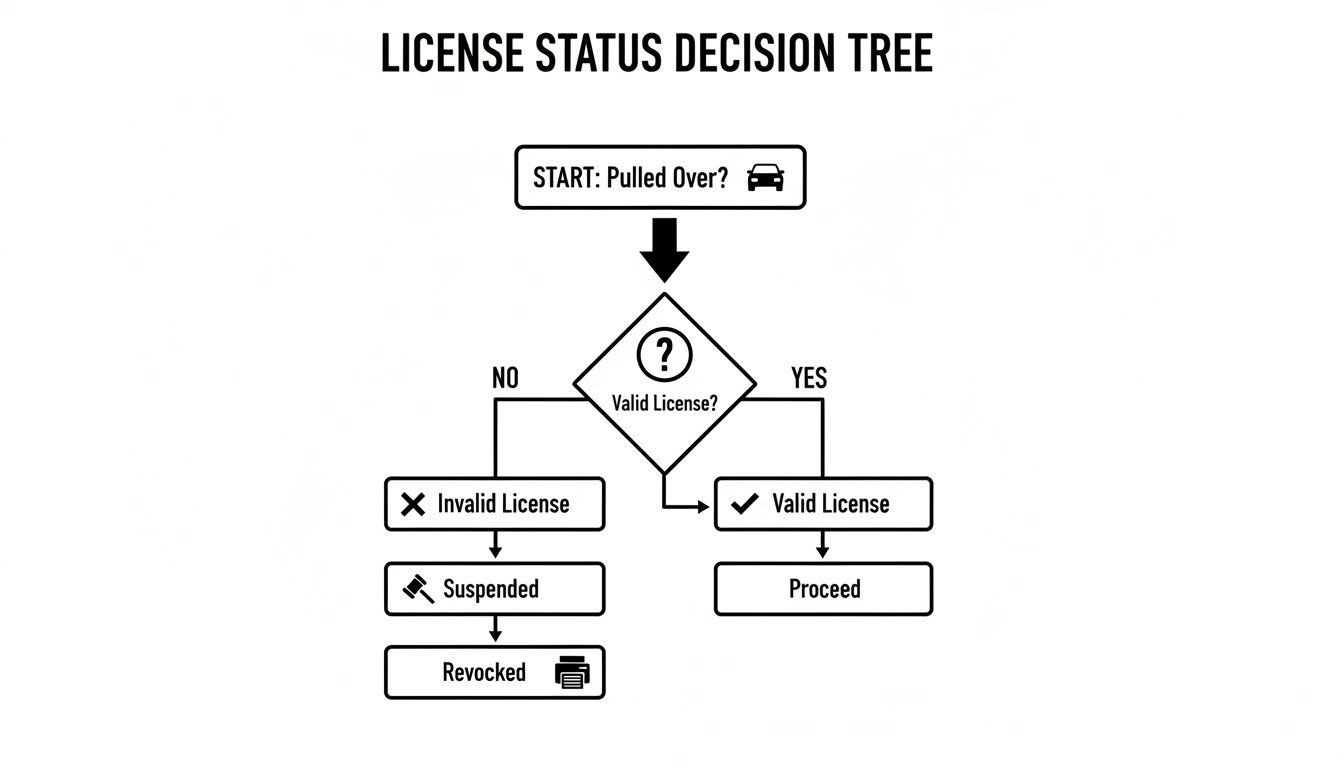
As you can see, the moment an officer discovers your license is invalid, you’re on a path with significant legal hurdles. This is why it's so important to understand the root cause of the suspension.
From a Simple Fine to Serious Jail Time
The state of Texas does not mess around with repeat offenses. If you get a second DWLI charge, it's no longer a simple fine. That charge is automatically bumped up to a Class B misdemeanor.
That's a huge leap. Suddenly, you're not just worried about your wallet; you're looking at the possibility of spending up to 180 days in the county jail. For a parent, that’s an unimaginable separation from your children.
And you don't even need a prior conviction for the stakes to get that high. If you're caught driving with an invalid license and you don't have car insurance, the charge can be enhanced to a Class B misdemeanor right away, even on your first offense.
When a DWLI Becomes a Class A Misdemeanor
The most severe classification for a typical DWLI is a Class A misdemeanor. This charge is reserved for situations that end in tragedy.
If you are driving with an invalid license, have no insurance, and are at fault in an accident that causes serious bodily injury or death to someone else, the legal system will come down on you with its full weight. A conviction at this level can lead to fines of up to $4,000 and up to a full year behind bars.
The bottom line is that Texas has a clear, tiered system for DWLI penalties. A first-time offense without other issues is usually a Class C misdemeanor, but a second offense or a first offense without insurance becomes a Class B, carrying fines up to $2,000 and up to 180 days in jail. In the worst-case scenario—an accident causing serious harm while uninsured—you're facing a Class A misdemeanor, with penalties reaching $4,000 and up to a year in jail. You can get more details by exploring these insights on Texas DWLI laws.
To help you make sense of this during what is undoubtedly a stressful time, here is a simple breakdown of what you could be facing.
Texas DWLI Penalties at a Glance
This table neatly summarizes the different classifications and potential penalties for a Driving While License Invalid conviction in Texas.
| Offense Classification | Common Circumstances | Maximum Fine | Potential Jail Time |
|---|---|---|---|
| Class C Misdemeanor | First DWLI offense with no other aggravating factors. | Up to $500 | None |
| Class B Misdemeanor | A previous DWLI conviction, or driving without insurance. | Up to $2,000 | Up to 180 days |
| Class A Misdemeanor | Causing an accident with serious injury or death while driving without insurance. | Up to $4,000 | Up to 1 year |
Keep in mind, these penalties are just the beginning. A DWLI conviction can also trigger another license suspension and force you to pay hefty annual surcharges to the Texas Department of Public Safety just to be eligible to drive again. These long-term consequences can trap your family in a cycle of debt and legal trouble that's incredibly hard to break.
Exploring Your Legal Defenses and Mitigation Strategies
Getting a ticket for Driving While License Invalid (DWLI) can feel like the final word on the matter. But a citation is just the beginning of a process, not an automatic conviction. You have rights, and more importantly, you have real, practical options. The first step is to shift your mindset from worry to action—and that starts with understanding how to defend your case.
So many of the parents we work with are completely blindsided by a DWLI charge. They had no idea their license was suspended in the first place. This shock actually points to one of the most powerful legal arguments we can make.
The "Lack of Notice" Affirmative Defense
Here’s a critical piece of information: for most DWLI charges in Texas, the prosecution has to prove you knew your license was invalid. The state usually tries to cover this by mailing a suspension letter to whatever address you have on file with the Texas Department of Public Safety (DPS).
But life gets in the way. Families move, mail disappears, and government agencies make mistakes. This is where the affirmative defense of "lack of notice" becomes your best friend.
It is an affirmative defense to prosecution… that the person did not receive actual notice of a cancellation, suspension, revocation, or prohibition order relating to the person's license.
Texas Transportation Code § 521.457(d)
What this legal language really means is that if you can show you never received that official notification, it can be a complete defense, potentially getting the whole case thrown out. This is a common and powerful tool for parents who, in the chaos of daily life, simply weren't aware of the issue.
Actionable Advice: Mitigation Strategies for Parents
Beyond building a legal defense, there are proactive steps you can take right now to dramatically improve your situation. We call this mitigation. It’s all about showing the court you’re a responsible parent who is fixing the problem. Judges and prosecutors are far more willing to work with people who demonstrate accountability.
Here are a few powerful things you can do:
- Fix the Root Problem: The single most important step is to resolve whatever caused the suspension. That might mean paying off old court fines, handling outstanding tickets, or getting current on state surcharges.
- Get Your License Back: If at all possible, work diligently to get your driver's license fully reinstated before you have to go to court. Walking into that courtroom with a valid license is one of the most effective moves you can make.
- Obtain an SR-22: If your suspension was tied to not having insurance, getting an SR-22 (a certificate proving you have liability insurance) shows you’re taking steps to be a responsible driver.
Taking these steps shows good faith and can completely change the tone of negotiations. An attorney can often use your proactive efforts to argue for a better outcome, like a full dismissal. Sometimes, this can even open the door to options like deferred adjudication, which keeps a conviction off your permanent record entirely. You can learn more by reading our guide explaining what deferred adjudication is in Texas. These strategies turn you into an active participant in your own defense.
Immediate Steps to Take After a DWLI Citation

The minutes after getting a ticket for Driving While License Invalid feel like a blur. It’s enough to make any parent feel powerless and overwhelmed. But this is a critical moment. The actions you take right now can set the stage for a much better outcome. It’s not about panicking; it’s about taking control with a clear, proactive plan.
First things first: stop driving. This might sound obvious, but it’s the single most important step you can take. Getting behind the wheel again after a DWLI citation is like pouring gasoline on a fire. Each new traffic stop is a new charge, and it can quickly escalate a simple ticket into a Class B misdemeanor with the real possibility of jail time. Call a friend, use a rideshare—do whatever it takes to get home without driving. Your freedom and your ability to provide for your family hinge on this.
Gather Your Facts and Get Organized
Once you're home, it's time to put on your detective hat. Start by gathering every document you have related to the traffic stop, especially the citation itself. Dig through your files for any old tickets, suspension notices from DPS, or letters from the court. You need the complete picture.
With these documents in hand, your next stop is the official Texas Department of Public Safety (DPS) website. It’s time to confirm your license status directly from the source.
You absolutely have to know why your license is invalid. Was it an unpaid surcharge? An old ticket that fell through the cracks? Pinpointing the root cause is the only way you can start to fix it.
This step isn't just about gathering information; it’s about arming yourself with the same facts the state will use against you. It's the foundation of your defense.
Don't Try to Handle This Alone
Now that you have your information, your first instinct might be to call the court clerk and try to sort it out yourself. Please, resist that urge. Anything you say to a prosecutor or court staff can—and likely will—be used against you.
Your single most important move at this stage is to contact an experienced criminal defense attorney before your first court date. A compassionate lawyer acts as your shield. They will dive into the details of your case, scrutinize the state's evidence, and walk you through all of your legal options. Whether it’s arguing a "lack of notice" defense or negotiating with the prosecutor, an attorney is your best shot at protecting your record and your family's future.
Here’s a quick checklist of what to do as soon as you get a DWLI citation:
- Stop Driving Immediately: Protect yourself and your family from more serious charges.
- Verify Your License Status: Go to the Texas DPS website to find out the exact reason your license is invalid.
- Collect All Documents: Gather your new citation, old tickets, and any notices you've received.
- Resolve the Underlying Issue: If you can, start the process of paying old fines or surcharges to get your license back in good standing.
- Contact an Attorney: Never go to court by yourself. Get legal help right away to protect your rights. Our team can explain what happens at an arraignment hearing and guide you through every step of this process with empathy and expertise.
How a Conviction Can Impact Your Family's Future

When you're convicted of Driving While License Invalid, the impact doesn't stop when you walk out of the courtroom. It creates a shockwave that travels far beyond paying a fine. The consequences can seep into every corner of your family's life, creating long-term instability that’s incredibly tough to escape.
Suddenly, the simple things you took for granted become monumental hurdles. How do you get the kids to school or soccer practice? How do you make it to that doctor's appointment across town? Most importantly, how do you get to work to earn the money your family depends on? Losing your driving privileges feels like losing your independence, forcing you to rely on others and completely upending your family’s daily rhythm.
This isn't just an inconvenience. A DWLI conviction can fundamentally threaten your family's financial security and well-being.
The Lasting Financial Strain on Your Family
The financial fallout from a DWLI conviction goes way beyond the initial court fines. A criminal record can make it significantly harder to find a new job—or even keep the one you have—especially if driving is part of your duties. Most employers run background checks, and a misdemeanor conviction can be an automatic "no" for certain positions.
Then there’s your car insurance. With a DWLI on your record, you’re now officially a high-risk driver in their eyes.
When your policy is up for renewal, you can bet your premiums are going to skyrocket. For many families already on a tight budget, this added cost can be the breaking point, forcing you to make impossible choices between paying for insurance and covering other essential needs.
It all adds up to a vicious cycle of financial stress. You’re trying to pay off old fines and surcharges just to get your license back, but your insurance costs have doubled, and your job options have shrunk. That’s a heavy burden for any parent to carry.
Understanding the Public Safety Concerns
It's also important to understand—with some compassion—why these laws are enforced so strictly. From the state's perspective, this is all about public safety. The data shows a clear and tragic link between unlicensed drivers and serious accidents.
Recent reports revealed that Texas has the highest number of drivers without a valid license involved in deadly crashes in the entire country, with 6,617 such incidents over a documented period. That staggering figure is exactly why the state cracks down so hard on DWLI offenses. You can learn more about these Texas road safety statistics.
While that context helps explain the "why" behind the harsh penalties, it doesn't change the devastating impact a conviction can have on your family. The stakes are incredibly high, involving not just your freedom but your ability to provide a stable, secure home for your children. This is why facing a driving while license invalid Texas charge requires more than just a defense—it demands a strategy to protect your entire family’s future.
Answering Your Top Questions About Texas DWLI Charges
When you're facing a charge for Driving While License Invalid in Texas, a million questions probably start racing through your mind. It's a stressful situation, especially when your family relies on you. Let's cut through the noise and get you the clear, straightforward answers you need right now.
How Is DWLI Different From Driving Without a License?
This is a really important distinction that often trips people up. Driving without a license usually means you're an eligible driver who just doesn't have their physical license on them, or maybe you never got around to applying for one in the first place. It's typically a much less severe traffic offense.
A DWLI charge, on the other hand, is a whole different ballgame. This means the State of Texas has actively stripped you of your legal right to drive—your license has been suspended, revoked, or canceled. Because you're legally forbidden from being behind the wheel, it's a criminal charge, not just a simple ticket.
Can I Get an Occupational License After a DWLI Charge?
Yes, in many cases, this is a real possibility. An occupational driver's license (ODL) is a special, restricted license that allows you to drive for essential purposes, like getting to work, taking your kids to school, or going to doctor's appointments.
Eligibility isn't automatic; it often depends on why your license was suspended. A compassionate attorney can help you petition the court for an ODL. For many families, it's a critical lifeline that lets you keep your job and manage your daily life while your case is being resolved.
How Can Resolving My Original Ticket Help My DWLI Case?
Tackling the root cause of the suspension is one of the most powerful moves you can make. If your license was suspended over something like an old, unpaid ticket, paying it off and getting your license fully reinstated before your court date for the DWLI is a game-changer.
Taking this step shows the prosecutor and the judge that you're taking responsibility for the situation. This single action can dramatically improve your odds of getting the DWLI charge dismissed or knocked down to a much less serious offense, which is huge for protecting your criminal record and your family's future.
Will a DWLI Conviction Stay On My Record Forever?
Yes, if you are convicted of DWLI, it creates a permanent criminal record. That kind of mark on your background can create serious hurdles with job applications, housing, and even your insurance rates for years to come.
But a conviction isn't a foregone conclusion. If your case is handled strategically from the start, it's often possible to achieve an outcome—like a dismissal or deferred adjudication—that makes you eligible to get your record cleared through an expunction or an order of nondisclosure later on. Protecting your family's future is always the number one goal.
The fear and uncertainty that come with a DWLI charge can feel completely overwhelming, but you do not have to face this challenge alone. At The Law Office of Bryan Fagan, we understand what’s at stake for your family. We are here to listen with compassion, answer your questions with honesty, and fight tirelessly to protect your rights and your future. You are more than a case number to us; you are a parent trying to do what’s best for your children. Contact us today for a free, confidential consultation to discuss your case by visiting https://texascpslawyer.net. Let us help you find the path forward.