Skip to content
When you see those red and blue lights flashing in your rearview mirror, your stomach drops. The fear and confusion that come with being pulled over for suspected drunk driving are intense, and the legal jargon just makes everything feel worse. For a parent, this fear is magnified tenfold. A single mistake can feel like it threatens not just your freedom, but the stability and future of your entire family. Here in Texas, people often use "DUI" and "DWI" interchangeably, but they are two very different charges with serious implications for your life and your children. Understanding that difference is the first step toward protecting what matters most.
The most important distinction boils down to one simple factor: age. DWI (Driving While Intoxicated) is the charge for adults, while DUI (Driving Under the Influence) is a specific offense aimed at minors.
Understanding the Core Differences in Texas Law
Facing an intoxicated driving charge can feel like your entire world is tilting on its axis, especially if you have a family depending on you. The immediate aftermath is a storm of questions and anxieties. What does this mean for my job? My license? My kids? A DWI or DUI charge can even trigger an investigation from Child Protective Services (CPS), adding a layer of terror that many parents aren't prepared for. The first and most critical step is to get a clear picture of exactly what you're up against.
In Texas, the legal system draws a hard line based on the driver's age. This single detail shapes everything that comes next, from the evidence the state needs for a conviction to the penalties you could face. Nailing down this distinction from the very beginning is fundamental to building a solid defense.
DWI: Driving While Intoxicated for Adults
For anyone 21 years of age or older, the charge is Driving While Intoxicated (DWI). An adult can be charged with a DWI in two main ways:
- Per Se DWI: This is based purely on the numbers. If your blood alcohol concentration (BAC) is 0.08% or higher, you can be charged, regardless of whether you feel impaired.
- Impairment DWI: This is based on observation. If you have lost the "normal use of mental or physical faculties" because of alcohol or drugs, you can be charged—even if your BAC is below 0.08%.
This gives prosecutors two different paths to a conviction. They can use a chemical test result or rely on the arresting officer’s testimony about your driving, your speech, and how you performed on field sobriety tests.
DUI: Driving Under the Influence for Minors
For anyone under the age of 21, Texas has a strict zero-tolerance policy. The charge is Driving Under the Influence (DUI), and it applies if a minor is caught driving with any detectable amount of alcohol in their system. It’s not about being "drunk"; it's about the mere presence of alcohol.
This is a massive difference. A single beer at a party could easily lead to a DUI charge for a teenager, a charge that brings its own set of serious, life-altering consequences.
Key Takeaway: The single most important factor determining whether you face a DWI or a DUI charge in Texas is your age. Adults face DWI charges based on a 0.08% BAC or proven impairment, while minors face DUI charges for having any trace of alcohol in their system.
This simple decision tree helps visualize how Texas law distinguishes between a DUI and a DWI charge from the moment a stop is made.
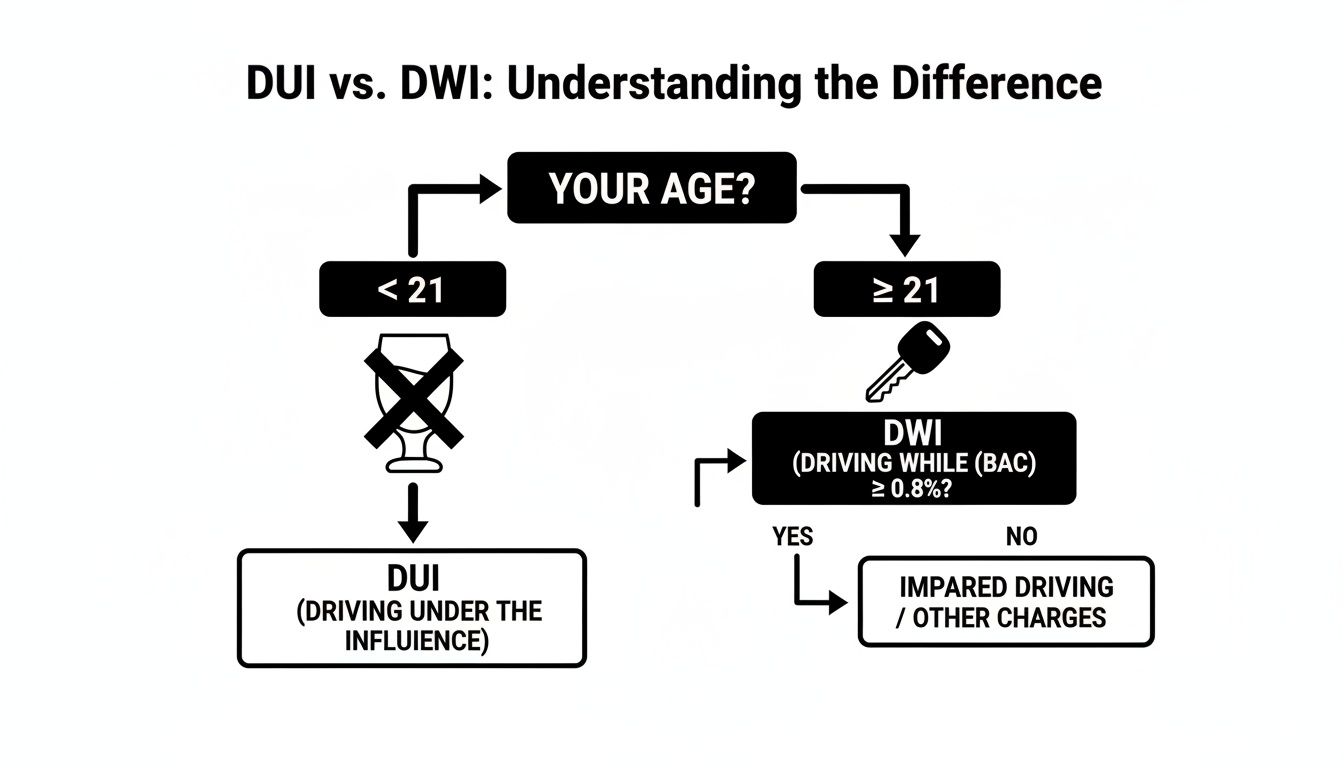
As the flowchart shows, the legal path splits immediately based on whether the driver is over or under 21. While many people use the terms as if they're the same, Texas law is incredibly specific—a fact you can explore further by reading about how Texas DWI laws are structured at lawcommentary.com.
To make the comparison even clearer, here’s a quick breakdown of the core differences.
Quick Comparison: Texas DUI vs. DWI at a Glance
This table sums up the fundamental differences between the two charges for easy reference.
| Criteria | DWI (Driving While Intoxicated) | DUI (Driving Under the Influence) |
|---|---|---|
| Applicable Age | 21 years and older | Under 21 years old |
| Legal Standard | BAC of 0.08% or higher, OR loss of normal faculties | Any detectable amount of alcohol in the system |
| Primary Basis | Intoxication and impairment | Zero-tolerance policy for minors |
| Common Scenario | An adult fails a breathalyzer after a night out with friends. | A teenager has one drink at a party and gets pulled over. |
While both charges are serious, the legal standards, evidence required, and potential penalties are worlds apart. Knowing which one applies to your situation is the first step in a long and complicated journey.
Navigating a DWI Charge as an Adult in Texas
For any adult in Texas, especially a parent juggling family and a career, getting charged with Driving While Intoxicated (DWI) can feel like a nightmare. It’s not just a legal headache; it's a direct threat to your job, your reputation, and your ability to provide for your family. The uncertainty can be paralyzing, but the first step toward taking back control is understanding exactly what the state has to prove to convict you.

Unlike a DUI charge for a minor, a DWI for someone over 21 is all about the legal definition of "intoxication." The prosecutor's entire case is built on proving this single element beyond a reasonable doubt, and they have two very different ways to get there.
The Two Paths to a DWI Conviction
In Texas, the state doesn't have to prove you were "drunk" in the way most of us use the word. They just need to establish one of two legal conditions to secure a conviction:
- "Per Se" Intoxication: This is the most direct route for the prosecution. If a chemical test—whether it’s breath, blood, or urine—shows your Blood Alcohol Concentration (BAC) was 0.08% or higher when you were behind the wheel, you are legally considered intoxicated. End of story. It doesn’t matter if you felt perfectly fine or thought you were driving flawlessly.
- Impairment: This approach doesn't depend on a specific BAC number at all. Instead, the prosecutor must prove that you lost the "normal use of your mental or physical faculties" because of alcohol, drugs, or a combination of them. The evidence here usually comes from the arresting officer's observations—things like your driving pattern, how you performed on field sobriety tests, slurred speech, or other visible signs of impairment.
This two-pronged strategy means you can be arrested and hit with a DWI charge even if you refuse a breathalyzer or your BAC comes back under the 0.08% limit. An officer’s subjective opinion about your impairment can be enough to kickstart a case, which is why having a strong legal defense from the very beginning is so critical.
The Escalating Penalties for DWI
A DWI conviction brings with it severe and escalating consequences that can throw your entire life off track. The penalties get significantly harsher with each offense, creating a cycle that becomes increasingly difficult to break without an experienced attorney.
- First Offense: Even a first-time DWI is a Class B Misdemeanor. You're typically looking at fines up to $2,000, jail time anywhere from 72 hours to 180 days, and a driver's license suspension for up to a year. We cover this in more detail in our guide on a DWI in Texas first offense.
- Second Offense: A second DWI gets bumped up to a Class A Misdemeanor. The fines can reach $4,000, you could face up to a year in jail, and your license will be suspended for a longer period.
- Third or Subsequent Offense: This is where things get truly serious. A third DWI is a third-degree felony, a charge with life-altering consequences. The penalties can include fines up to $10,000 and 2 to 10 years in a state prison.
On top of all that, you’ll likely be ordered to complete mandatory DWI education classes, perform community service, and install an Ignition Interlock Device (IID) in your car at your own expense. These devices require you to blow a clean breath sample before your car will even start—a constant, costly reminder of the charge. The sheer number of these arrests is staggering. In 2020 alone, law enforcement in Texas made 83,088 DWI arrests, with most leading to formal charges.
A Real-World Scenario: Imagine a single mother, a respected professional, who has two glasses of wine at a work dinner. On her way home, she's pulled over for a minor traffic violation. The officer smells alcohol, administers field sobriety tests, and arrests her for DWI. Suddenly, she's not just facing a criminal charge—she's terrified about how a conviction could impact her professional license, her employment, and even trigger a CPS investigation into her ability to care for her children. This single mistake threatens to unravel the stable life she has built.
A Minor Mistake with Major Consequences: Understanding Texas DUI Charges
There's no phone call a parent dreads more than the one from a police station, telling you your child has been arrested for a DUI. In that single, heart-stopping moment, a storm of fear hits you—fear for their safety, their well-being, and everything you've worked to build for their future.
While adults in Texas face DWI charges, the law carves out a completely separate and much stricter set of rules for anyone under 21. It’s all built around a zero-tolerance policy, and it can turn one bad decision into a legal nightmare that shadows a young person for years.
The difference between a DUI and a DWI in Texas isn't just a technicality; it's a massive distinction. For a minor, the legal limit for alcohol is practically zero. Any detectable amount of alcohol in their system—that’s it. That’s the charge. It doesn't matter if they had a single sip of beer hours ago or felt completely fine to drive. The mere presence of alcohol is the crime, and the consequences are designed to be swift and severe.
The Zero-Tolerance Policy in Action
For adults, the law cares about a specific BAC number. For minors, it's a simple, unforgiving question: was there any alcohol in their system? This is a critical point for parents and young drivers to grasp. A teenager might not realize that the last bit of a drink from hours earlier can still register on a breathalyzer, leading directly to an arrest and a DUI charge under the Texas Alcoholic Beverage Code.
And don't mistake this for a slap on the wrist. The penalties are designed to send a powerful message.
- Driver’s License Suspension: A first-offense DUI conviction means an automatic license suspension for 60 days. A second offense bumps that up to 120 days, and a third will cost them their license for 180 days.
- Mandatory Alcohol Awareness Classes: Your child will be ordered to complete a state-approved alcohol education program, and you'll be footing the bill.
- Community Service: Courts typically hand down 20 to 40 hours of community service for a first offense, often requiring it to be related to alcohol misuse prevention.
- Fines and Court Costs: While a DUI is usually a Class C Misdemeanor, the fines can climb as high as $500, and that’s before you even factor in court costs and other administrative fees.
These are just the immediate legal consequences. The ripple effects, however, can cause far more lasting damage.
How a DUI Can Derail Your Child’s Future
A DUI conviction, even for a minor, doesn't just disappear. It creates a criminal record that can follow your child for years, slamming doors shut before they even get a chance to knock. For many parents, this is the most terrifying part—the way a single charge can alter the entire trajectory of a young life.
Consider This Real-World Scenario: "Sarah," a high school senior, has one drink at a graduation party. She feels fine, but on the way home, a police officer pulls her over for a broken taillight. The officer smells alcohol, conducts a breath test, and arrests her for DUI. Just like that, her future is thrown into chaos. The college scholarships she’s counting on have clauses about criminal convictions. Her acceptance to her dream school is suddenly at risk. And every future job application will have a box she has to check, forcing her to disclose the conviction. A single, thoughtless moment has cast a shadow over everything she—and her family—have worked so hard for.
This isn't a dramatic hypothetical; it happens all the time. A DUI on a minor's record can create massive roadblocks when it comes to:
- College Admissions: Many universities ask about criminal history right on the application.
- Scholarships and Financial Aid: Certain convictions can immediately disqualify a student from receiving scholarships or other forms of financial aid.
- Employment Opportunities: With background checks now standard for most jobs, a DUI is a huge red flag for potential employers.
- Car Insurance Rates: A DUI conviction will cause insurance premiums for the entire family to skyrocket.
The stakes couldn't be higher. Protecting your child’s future means you have to act quickly and strategically from the moment you get that phone call. The first steps you take are crucial and can make all the difference between minimizing the damage and facing a much harsher outcome.
The Urgent 15-Day License Suspension Deadline
After a DWI or DUI arrest in Texas, a clock starts ticking on something most people don’t even see coming. It’s not about the criminal charge—that comes later. This is a separate, civil process that immediately kicks off to suspend your driver’s license. It’s called the Administrative License Revocation (ALR) process, and you have only 15 days from the day you were arrested to fight it.

If you miss this deadline, your license gets automatically suspended, often long before your criminal case ever sees a courtroom. This can throw your life into chaos, making it impossible to get to work, drive your kids to school, or handle daily responsibilities. Protecting your right to drive has to be the first move you make.
Understanding The ALR Process
It's critical to understand that the ALR process is completely separate from your criminal case. The Texas Department of Public Safety (DPS) handles it, not the criminal courts. Its only purpose is to decide if your license should be suspended because you either failed or refused a chemical test (breath or blood) during your arrest.
This is a huge distinction. Even if your criminal DWI or DUI charge gets dismissed down the road, you can still lose your license through the ALR process if you don’t act fast. The only way to challenge this automatic suspension is to request a hearing within that 15-day window.
Suspension Periods For DWI vs. DUI
How long you might lose your license depends on the charge and whether you agreed to a chemical test. The rules are different for adults facing a DWI versus minors facing a DUI.
To make it clear, here’s a look at the potential suspension periods you could be facing for a first offense.
Texas License Suspension Periods for DWI and DUI
| Offense Type | Chemical Test Failed (First Offense) | Chemical Test Refused (First Offense) |
|---|---|---|
| DWI (Adult) | 90-day suspension | 180-day suspension |
| DUI (Minor) | 60-day suspension | 180-day suspension |
As you can see, refusing to provide a breath or blood sample triggers a much longer automatic suspension for both adults and minors. This is a consequence of Texas’s "implied consent" law, which basically says that by having a driver's license, you’ve already agreed to take a chemical test if you're lawfully arrested.
Securing Your Driving Privileges
If your license does get suspended, life doesn't stop. You still have to get to work and take care of your family. The good news is that it’s often possible to get an Occupational Driver's License (ODL), which lets you drive for essential needs like work, school, and household errands. Getting one, however, involves filing a petition with the court and can be a tricky process. For a deep dive, you can learn about how to get an occupational license in Texas in our detailed guide.
Why the ALR Hearing Matters: Requesting an ALR hearing does more than just pause a suspension. It gives your attorney a crucial chance to question the arresting officer under oath, gather evidence, and find weaknesses in the state's case—ammunition that can be used to defend you in your criminal proceedings.
Taking action within the first 15 days is the single most important thing you can do after an arrest. It protects your rights, safeguards your ability to drive, and lays the groundwork for a much stronger defense overall.
Building a Strong Defense Strategy for Your Case
Let's get one thing straight: an arrest is not a conviction. When you're sitting in a jail cell or at home feeling the weight of a DWI or DUI charge, that's the most important thing to remember. The prosecution has a version of events they want a judge or jury to believe, but it’s just one side of the story. A powerful defense is built by meticulously picking apart their case and finding the holes—and trust me, every case has them.
The entire process, from the moment you see flashing lights to the final chemical test, is governed by strict legal protocols. Any slip-up or shortcut taken by law enforcement can become a game-changer for your defense. Your future doesn't have to be defined by this single moment, especially when you have a skilled attorney ready to fight for you.
Was the Traffic Stop Even Legal?
The entire case against you rests on the legitimacy of the initial traffic stop. A police officer can't just pull you over on a whim or a hunch; they need reasonable suspicion that you've committed a traffic violation or are involved in criminal activity. This is your first and most fundamental line of defense.
Was the reason for the stop legitimate? Did you actually swerve out of your lane, or were you just dodging a pothole? Was a taillight truly out, or was the officer just looking for an excuse to pull someone over? If the stop itself was unlawful, any evidence gathered after that point—from field sobriety tests to breathalyzer results—can be suppressed and thrown out of court.
Picking Apart the "Evidence"
After a stop, an officer will almost always ask you to perform Standardized Field Sobriety Tests (SFSTs). These tests are notoriously subjective and are designed to be difficult for anyone to pass, sober or not. Simple things like poor lighting, uneven pavement, a medical condition, or just plain nervousness can easily lead to a "failure."
A sharp defense strategy will scrutinize exactly how these tests were conducted.
- Improper Instructions: Did the officer give you the instructions verbatim, exactly as required by their training manual?
- Environmental Factors: Were the tests done on a flat, dry, well-lit surface, away from the disorienting rush of passing cars?
- Physical Limitations: Did the officer bother to ask if you had any injuries or medical issues that could impact your balance or ability to perform?
Breathalyzer and blood tests aren't bulletproof, either. Breathalyzer devices require precise calibration and consistent maintenance. If a machine's service records show it wasn't properly cared for, the results are immediately suspect. With blood tests, the chain of custody is everything. Any mistake in how the sample was drawn, stored, or transported can contaminate the result, rendering it inadmissible in court. For parents, understanding how to get a DUI dismissed often starts with digging into these procedural details.
Legal Insight: The state has to prove more than just that they stopped you; they must establish they had probable cause for your arrest. This is a much higher legal bar than reasonable suspicion. It requires concrete facts that would lead a reasonable person to believe a crime was committed. Challenging the state's probable cause is a cornerstone of any solid DWI defense.
Understanding the Stakes and Building Your Case
The consequences of a conviction are life-altering, and it’s important to understand why law enforcement and prosecutors pursue these cases with such intensity. The impact of intoxicated driving is devastating for Texas communities. Cities like Houston and Dallas have reported hundreds of fatalities from drivers with a BAC of 0.08% or higher, making up a significant portion of all fatal accidents. For those facing these charges, expert legal counsel is the key to turning statistics back into a personal story of recovery.
Knowing this context helps you see the fight ahead, but it absolutely does not mean your case is hopeless. Every detail matters—from the officer’s first observations to the final lab report. By partnering with an attorney who knows how to dissect the prosecution's case piece by piece, you can build a defense that protects your rights, your family, and your future.
What To Do Immediately After an Arrest
It's completely normal to feel overwhelmed after an arrest, but the choices you make in the next few hours and days are absolutely critical. Your actions right now can dramatically shape the outcome of your case and protect your family’s future. Think of this as your immediate action plan to start regaining control.
Your top priority is to act quickly and strategically. This isn't a time to wait around and see what happens; it's the moment to start building your defense from the ground up. Taking the right steps ensures you don’t accidentally give up your rights or miss crucial deadlines that could sink your case before it even begins.
Your Four-Point Action Plan
Here is a straightforward checklist to guide you through these critical first steps. Focus on these four actions right away.
- Contact an Experienced Texas DWI Attorney: This is, without a doubt, the most important step you can take. Do not talk to law enforcement or prosecutors without a lawyer. An attorney is your shield—they protect your rights, challenge the state's evidence, and guide you through the maze of the legal system.
- Request Your ALR Hearing Immediately: You have only 15 days from the date of your arrest to request an Administrative License Revocation (ALR) hearing. If you miss this deadline, your driver’s license will be automatically suspended, no questions asked.
- Document Every Single Detail: As soon as you possibly can, write down everything you remember about the arrest. Jot down details about the traffic stop, what the officer said, the location, any witnesses, and how the field sobriety and chemical tests were handled. Memories fade fast, and tiny details often become game-changing evidence.
- Stay Silent: You have the right to remain silent—use it. Beyond providing basic identification, do not discuss the details of your situation with anyone except your lawyer. Anything you say can and absolutely will be used against you.
An arrest often serves as a wake-up call, prompting many to think about making significant lifestyle changes. For those looking at long-term solutions, exploring a comprehensive timeline on quitting alcohol can be a valuable resource during this period of reflection.
Key Insight: You're fighting two separate battles at once: the criminal case and the license suspension (ALR). It's entirely possible to win your criminal case but still lose your license simply because you failed to request the ALR hearing within that narrow 15-day window.
We get it. The fear and anxiety you and your family are going through is immense. The weight of a DWI or DUI charge feels crushing, but you don't have to carry it by yourself. The Law Office of Bryan Fagan is here to offer the compassionate and expert legal guidance you need to face this challenge head-on.
Your future is far too important to leave to chance. Contact us today for a free, confidential consultation to talk about your case. Let us help you understand your options and start building the strong defense you deserve.
Common Questions We Hear About Texas DWI and DUI
Getting hit with a DWI or DUI charge kicks off a tidal wave of urgent questions. Let's walk through some of the most common concerns we hear from Texas families caught in this stressful situation.
Can a DWI Be Reduced to a Lesser Charge in Texas?
Yes, it's definitely possible to get a DWI charge reduced in some cases. This is usually done through a plea bargain, but it's far from automatic. The outcome hinges on the unique details of your arrest—things like your prior criminal record, your BAC level, and whether we can find any weaknesses in the prosecutor's evidence against you.
An experienced DWI attorney will often aim to negotiate a reduction to a less severe charge, like "Obstruction of a Highway." A charge like that doesn't carry the same harsh penalties or the lifelong stigma of a DWI conviction. While there are never any guarantees, this is a top priority in our defense strategy.
How Will a DWI or DUI Conviction Mess with My Car Insurance?
Count on it—a conviction will almost certainly cause a major spike in your car insurance premiums. Insurance companies see a DWI or DUI on your record and immediately flag you as a high-risk driver. It's not uncommon to see your rates double or even triple.
On top of that, your insurer will likely require you to file an SR-22 certificate. This is basically a document proving you carry the state's minimum liability insurance. This requirement can stick around for several years, keeping your insurance costs sky-high long after your case is resolved.
Key Insight: A DWI conviction is a massive red flag for insurers. The financial pain from higher premiums can strain a family's budget for years, which makes fighting the charge from the very beginning that much more important for your financial future.
Can I Get a DWI or DUI Expunged in Texas?
Getting a DWI completely wiped from your record—a process called expunction—is pretty rare in Texas. Expunction is typically only an option if you were found not guilty at trial, your case was dismissed entirely, or you received a pardon.
For many first-time offenders who successfully complete deferred adjudication probation, a more realistic goal is an Order of Nondisclosure. This order seals the public record of your case, so it won't pop up on most background checks for jobs or housing. Law enforcement can still access it, but a nondisclosure can be a game-changer for protecting your future opportunities.
What Happens if There Was a Car Accident or Someone Got Hurt?
If your DWI arrest involved an accident with property damage, an injury, or a death, the stakes get much higher, and the charges become far more serious.
- A DWI that leads to serious bodily injury can be filed as Intoxication Assault, a third-degree felony.
- If the accident results in someone's death, the charge is elevated to Intoxication Manslaughter, a second-degree felony.
These are incredibly serious charges that come with the real possibility of lengthy prison sentences and consequences that will follow you for the rest of your life.
We know how much stress and fear you're dealing with right now. You are not alone in this, and you have options. At The Law Office of Bryan Fagan, PLLC, we are here to provide the compassionate and aggressive defense your family needs. Contact us today for a free, confidential consultation to go over your case and see how we can help protect your future.