Skip to content
The flash of red and blue lights in your rearview mirror is a moment that can change everything. One minute you’re driving home, and the next you’re facing a DWI arrest, completely overwhelmed by fear and confusion. For Texas parents and families, one of the first questions that floods your mind is almost always the same: “How much is this going to cost us?” The fear isn't just about a ticket; it's about your family's financial stability, your ability to provide, and the uncertain road ahead.
In Texas, the law sets the maximum criminal fine for a first-time DWI at $2,000. That number jumps to $4,000 for a second offense and can hit a staggering $10,000 for a third DWI, which is a felony. But if you think those numbers are the whole story, you’re only seeing the tip of the iceberg. Those figures are just the start of what a DWI truly costs, and understanding the full picture is the first step toward protecting your family.
Understanding the Full Financial Impact of a Texas DWI
The statutory DWI fines are scary enough on their own, but they rarely tell the whole story. The reality is that a conviction unleashes a wave of other expenses that can quickly dwarf the initial fine. These aren't optional fees—they are mandatory costs imposed by the courts, the state, and even your own insurance company that can strain your family's budget for years.
Getting a clear handle on this full financial picture is the first step toward navigating the tough road ahead with clarity and confidence.
Beyond the Court-Ordered Fine
When the judge’s gavel comes down, it marks the beginning—not the end—of your financial obligations. The total cost of a DWI is a painful mix of the criminal penalty and a long list of administrative fees that most people never see coming.
These hidden costs can stack up for years, creating a serious long-term financial burden that affects your entire family. The main components include:
- Statutory Criminal Fines: These are the base penalties set by Texas law, which get steeper with each prior conviction and other aggravating factors.
- Court Costs and Legal Fees: Every case comes with court fees, and you'll need to budget for hiring a skilled DWI defense lawyer to protect your rights.
- License Reinstatement Fees: After a suspension, you’ll have to pay the Texas Department of Public Safety (DPS) to get your driver’s license back.
- Annual DPS Surcharges: For years after a conviction, you can be forced to pay an annual surcharge to the DPS just to keep your license valid.
- SR-22 Insurance Costs: A DWI conviction makes you a "high-risk" driver, which means your auto insurance premiums will skyrocket. You’ll be required to file an SR-22 certificate to prove you have the required coverage.
All of these expenses add up, creating a financial strain that lasts much longer than the conviction itself. In fact, many people are still paying for a DWI long after their probation is over. For a deeper look at the long-term consequences, you can learn more about how long a DWI stays on your record in Texas. Facing these challenges requires a smart, proactive approach from day one.
What a First DWI Offense in Texas Really Looks Like
The sudden, jarring reality of a DWI arrest is an experience that throws your entire world off-kilter, especially if you’ve never had a serious run-in with the law. Consider this scenario: a parent is out celebrating a long-awaited promotion with colleagues. They have one more drink than they should have, feeling the pull to get home to their family. On the drive home, a simple traffic stop for a broken taillight spirals into flashing lights, field sobriety tests, and a night in a jail cell. It’s a situation that plays out far too often, leaving good, hardworking people feeling ashamed, lost, and absolutely terrified about what comes next for their family.
For most, a first-time DWI is their first real, unwelcome introduction to the Texas criminal justice system. The process is confusing and overwhelming. The first question that pops into your head is, "How much is this going to cost me?" But it's not just about the money; it's the cost to your reputation, your family, and your freedom. The emotional weight can feel just as crushing as the legal penalties.
The Starting Point: Understanding the Base Penalties
In Texas, a standard first DWI is classified as a Class B Misdemeanor. Don't let the word "misdemeanor" fool you—this charge packs a serious punch. It can land you in jail for up to 180 days and comes with a maximum criminal fine of $2,000. While that $2,000 figure is enough to make anyone's stomach drop, it’s really just the tip of the iceberg. It's the starting line for the financial marathon you’re about to run.
However, certain details of your arrest can immediately escalate the charge and the penalties that come with it. The state takes a very close look at exactly how intoxicated a driver was at the time of the arrest.
A DWI conviction isn't just a one-and-done fine. It’s the beginning of a multi-year financial burden that stacks up with court costs, probation fees, license surcharges, and sky-high insurance rates. Protecting your record is one of the most important steps you can take to protect your family’s financial future.
When a First Offense Gets Twice as Expensive
One of the single most important factors in any DWI case is your Blood Alcohol Concentration (BAC). While the legal limit is 0.08, Texas law comes down much harder on drivers who are significantly over that line.
If your BAC comes back at 0.15 or higher, the charge is automatically bumped up from a Class B to a Class A Misdemeanor. This is a major enhancement, and it happens even if it’s your very first offense.
This single change has a huge and immediate impact on the potential financial hit:
- The maximum fine doubles from $2,000 to a staggering $4,000.
- The potential jail time shoots up to a maximum of one full year.
- An Ignition Interlock Device (IID) becomes mandatory, not just for probation but as a condition of getting out of jail on bond.
Think about being pulled over after a night out and blowing just over the legal limit. What hits you first isn't just the shock of the arrest, but the gut punch of a potential $2,000 fine. Now, imagine if your BAC clocks in at 0.15%—that fine can suddenly jump to $4,000. It's this kind of tough stance that has helped keep Texas's DUI rates well below the national average, a topic you can explore further by checking out insights on DWI laws and national rates on lawcommentary.com.
The Hidden Costs: Financial Consequences Beyond the Court Fine
That statutory fine—whether it’s $2,000 or $4,000—is just the number you see on the court papers. The true cost of a first-time DWI conviction is buried in all the other financial burdens that inevitably follow. These aren't optional fees; they can easily pile thousands more onto your total bill.
For example, a conviction almost guarantees your driver's license will be suspended. Getting it back means paying reinstatement fees. On top of that, you’ll be forced to get SR-22 insurance, a special type of high-risk policy that can cause your car insurance premiums to triple or even quadruple for years. If the court orders an Ignition Interlock Device, you’re on the hook for installation, monthly monitoring, and removal—costs that can easily top $1,000 a year. When you see all these costs adding up, it becomes clear that hiring a strong defense attorney isn't just an expense; it's an investment in your financial future.
When a DWI Charge Becomes a Repeat or Felony Offense
Getting a call about a DWI is terrifying. But when it’s not the first time, that fear hits on a whole different level. The Texas justice system is built to come down harder and harder on repeat offenses, quickly turning what was a misdemeanor into a life-altering felony.
It’s a steep, slippery slope. For families, the news of a second or third DWI can feel like a punch to the gut, bringing a fresh wave of anxiety about financial ruin, a lost driver's license, and even prison time. The legal ground shifts under your feet, and the path forward gets a lot more complicated. Understanding exactly how these penalties escalate is the first step toward building a defense and protecting your family's future.
The Jump from a First to a Second DWI
A second DWI conviction in Texas bumps the charge up to a Class A Misdemeanor. This is where the consequences really start to stack up, creating a much deeper crisis for you and your loved ones.
The maximum criminal fine immediately doubles, jumping to $4,000. But that's just the beginning of the financial strain. A second conviction also brings:
- Serious Jail Time: You’re looking at anywhere from 30 days to one full year in county jail.
- A Longer License Suspension: Your driver’s license can be taken away for up to two years, making it incredibly difficult to get to work, take care of kids, and manage daily life.
- Mandatory Ignition Interlock: An ignition interlock device (IID) becomes almost a certainty. This adds hundreds or even thousands of dollars in installation and monthly monitoring fees throughout your probation.
When a Third DWI Becomes a Felony
A third DWI charge is the critical turning point. At this stage, it’s no longer a misdemeanor—it becomes a third-degree felony. This escalation brings the full weight of the Texas felony justice system down on you, with penalties that can permanently change the course of your life.
A conviction for a third DWI carries a staggering fine of up to $10,000. More importantly, it comes with a mandatory prison sentence of two to 10 years in a Texas state prison, not the local county jail. This is the kind of consequence that separates families and creates unimaginable hardship.
Texas has a long history of cracking down on repeat offenders. Decades ago, state data showed a sharp rise in repeat DWI offenses, which led directly to the tougher penalties we see today. The evolution of DWI fines into a powerful deterrent reflects this history, with the current $10,000 fine for a third offense designed to send an unmistakable message. You can read the full research about these historical trends in DWI cases to understand how the current laws were shaped.
Other Ways a DWI Becomes a Felony
Repeat offenses aren't the only way to face a felony charge. Certain situations can elevate even a first-time DWI to a felony, triggering the most severe financial and personal consequences from the very start. Prosecutors and judges take these cases extremely seriously.
A felony DWI conviction does more than just drain your bank account and take away your freedom. It strips you of fundamental rights, like the right to vote and own a firearm, creating a permanent barrier to rebuilding your life and providing for your family.
Here are the key situations that can lead to an immediate felony charge:
- DWI with a Child Passenger: If you are arrested for DWI with a child under the age of 15 in the vehicle, you will face a state jail felony. This charge carries up to two years in a state jail and a fine of up to $10,000. This provision is found in the Texas Penal Code and is designed to protect children from incredibly dangerous situations.
- Intoxication Assault: If you cause serious bodily injury to another person while driving intoxicated, you will be charged with Intoxication Assault, a third-degree felony.
- Intoxication Manslaughter: If a DWI results in the death of another person, it leads to a charge of Intoxication Manslaughter. This is a second-degree felony, punishable by two to 20 years in prison.
Uncovering The Hidden Financial Burdens Of A DWI
The fine a judge hands down—whether it's $2,000 or $10,000—often feels like the final gut punch. But in reality, it’s just the opening act. For most families, the real financial shockwave comes from the tidal wave of administrative fees, surcharges, and other mandatory expenses that hit you long after the gavel falls.
Think of the criminal fine as the price of admission to a complicated and brutally expensive system. Once you're through the door, a whole new stack of bills is waiting. These are the “hidden costs” that keep draining your bank account for years, putting immense pressure on your family’s budget. Knowing what’s coming is the only way to prepare for the road ahead.
This chart shows how the base criminal fines climb with each offense, but remember, this is just the foundation for all the other costs.
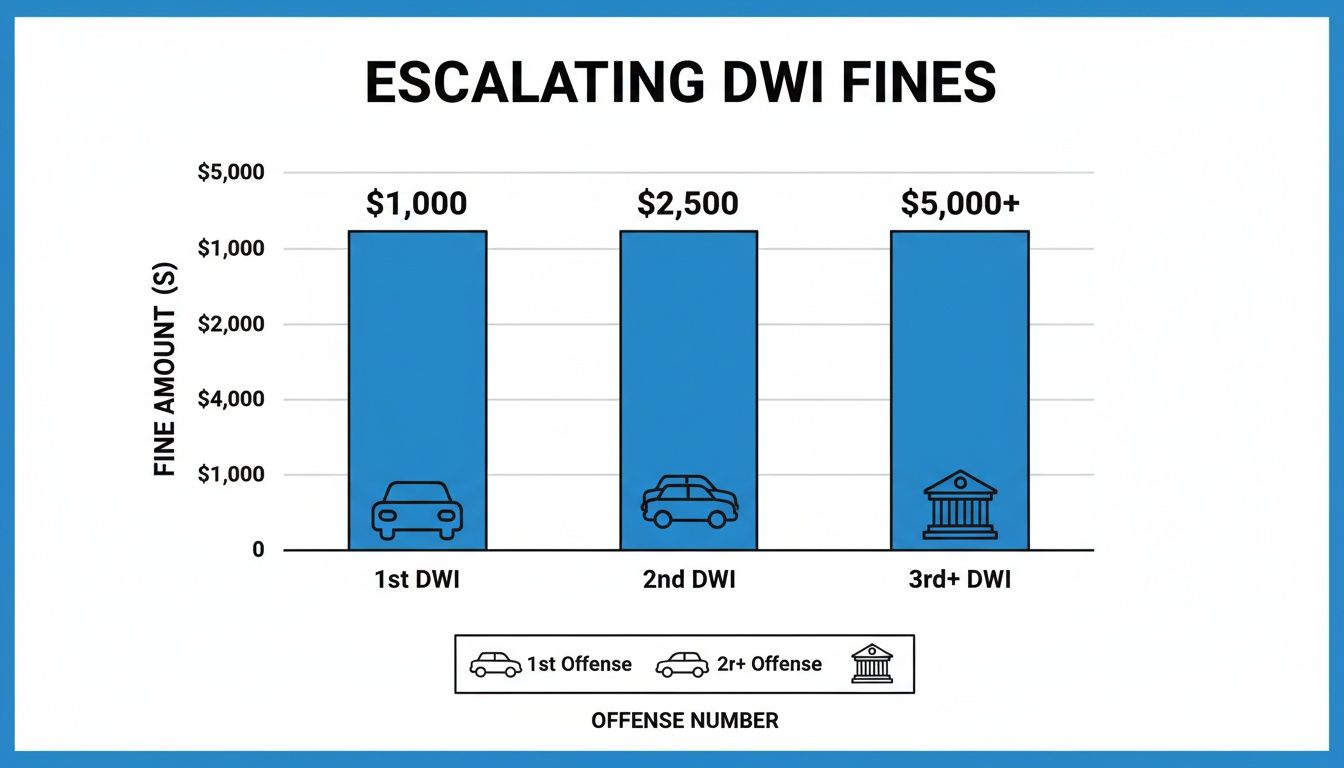
As you can see, the state doesn't mess around. The penalties get significantly more severe for repeat offenses, reflecting a system designed to deter this incredibly dangerous behavior.
The True Price Tag: Annual Surcharges and SR-22 Insurance
One of the biggest financial headaches used to be the Texas Driver Responsibility Program, which slapped drivers with massive annual surcharges for DWI convictions. Thankfully, that program was repealed in 2019. But don't celebrate just yet. The real financial pain for most people today comes from one place: your insurance company.
After a DWI, you will be required to get an SR-22 certificate. This isn't a type of insurance. It's a piece of paper your insurance company files with the state to prove you have the minimum liability coverage. The consequences are immediate and painful:
- Skyrocketing Premiums: Your status as a "high-risk" driver will cause your auto insurance rates to double, triple, or even quadruple overnight.
- Long-Term Costs: You have to maintain that SR-22 insurance for at least two years after your conviction, meaning you’ll be stuck paying those inflated premiums for a long, long time.
This isn’t a one-time fee. It's a relentless financial burden that turns a once-manageable monthly bill into a major obstacle for your family's budget.
The Growing List Of Mandatory DWI Expenses
Beyond insurance, a DWI conviction triggers a whole cascade of other required expenses. Every single one is a mandatory part of the process. If you fail to pay, you could end up in even more legal trouble, like a probation violation.
The total financial impact of a DWI often exceeds $10,000 to $15,000 when you factor in all the hidden costs. This is why a strong legal defense aimed at avoiding a conviction is not just about protecting your freedom—it's about safeguarding your family's financial stability.
Here are just a few of the common expenses you can expect to face:
- Ignition Interlock Device (IID): If the court orders it, you’ll pay for the installation (around $100-$200) and monthly monitoring fees (typically $70-$100 per month). Over a year, this can easily add another $1,000 or more to your tab.
- Mandatory DWI Education Programs: You'll have to complete a state-approved DWI education or intervention program, and you'll be paying for it out-of-pocket.
- Probation Fees: If you get probation, you'll owe a monthly supervision fee to the county, which usually runs between $60 to $100 per month.
The financial fallout doesn't stop with court-ordered fees. A DWI can introduce a host of other administrative and vehicle-related costs. For example, keeping your car on the road means staying current with Texas State Vehicle Inspection requirements, which can get more complicated if you have a mandated device like an ignition interlock. These penalties exist for a tragic reason: the devastating human cost of drunk driving. In 2016 alone, Texas saw 987 fatalities from these incidents, a stark reminder of why the state’s enforcement is so stringent.
Estimated Hidden Costs After a Texas DWI Conviction
The breakdown below shows common expenses that go far beyond the criminal fine, illustrating the total long-term financial impact you could be facing.
| Expense Category | Estimated Cost Range |
|---|---|
| Legal Fees | $2,500 – $25,000+ |
| Court Costs & Admin Fees | $300 – $600 |
| Probation Supervision | $720 – $2,400 (for 1-2 years) |
| SR-22 Insurance Increase | $1,500 – $4,000 (per year) |
| Ignition Interlock Device | $1,000 – $2,500 (per year) |
| DWI Education/Intervention | $100 – $500 |
| License Reinstatement Fees | $125+ |
| Towing & Impound Fees | $250 – $1,000 |
As the table makes clear, the court-ordered fine is often just one piece of a much larger, more expensive puzzle. These ongoing costs are what make a DWI financially devastating for years to come.
What to Do Right After a DWI Arrest

The moments after a DWI arrest are a blur of confusion and anxiety. It can feel like your world is spinning out of control, but this is the most critical time to take deliberate, protective steps. What you do in the first few hours and days can make a huge difference in the outcome of your case, your finances, and your ability to drive.
Feeling overwhelmed is completely normal, but you are not powerless. By focusing on a few key priorities, you can start to regain a sense of control and build the foundation for a strong defense. Understanding the procedures and initial steps after an arrest is crucial for anyone facing a DWI charge.
The clock starts ticking the second you are arrested. Your most urgent task? Protecting your driver's license.
The 15-Day Deadline You Cannot Afford to Miss
In Texas, a DWI arrest kicks off two separate legal battles: the criminal case and an administrative case against your driver’s license. After your arrest, the law gives you exactly 15 days to request an Administrative License Revocation (ALR) hearing.
If you blow past this deadline, your license gets suspended automatically. No questions asked. Requesting the ALR hearing is your only shot at challenging this suspension and fighting to keep your driving privileges. This isn't just about convenience; losing your license can threaten your job and your family’s stability. For many, figuring out how to get an occupational license in Texas becomes a backup plan, but the main goal should always be to prevent the suspension in the first place.
The 15-day ALR deadline is one of the most unforgiving timelines in Texas DWI law. Missing it means forfeiting your right to challenge the automatic suspension of your license, putting you at an immediate and significant disadvantage.
Actionable Advice for Parents: Protecting Your Rights and Your Future
While the ALR deadline is the most immediate fire to put out, other actions are just as vital. Here are your top priorities for navigating this difficult time:
-
Document Everything You Remember: As soon as you can, write down every single detail of your arrest. What were you doing before you got in the car? Why did the officer pull you over? What did they say to you? How were the field sobriety tests handled? Memories fade fast, and these small details can become invaluable to your attorney later.
-
Exercise Your Right to Remain Silent: It’s important to be polite and cooperative with law enforcement, but you are not obligated to answer questions about where you were, what you drank, or other details that could incriminate you. Don’t discuss your case with anyone—not even family or friends—until you've spoken with a lawyer.
-
Hire an Experienced DWI Attorney Immediately: This is the single most important step you can take. A skilled DWI defense lawyer will immediately get to work requesting your ALR hearing, investigating your case from every angle, and advising you on how to handle every part of the process, ensuring your family's future is protected.
Facing a DWI charge is daunting, but you don't have to navigate it alone. Taking these immediate, actionable steps can help minimize the potential damage—including the steep DWI fines in Texas—and put you in the strongest possible position to defend your future.
How a Skilled Attorney Can Reduce Fines and Penalties
Facing the Texas criminal justice system by yourself can feel like you're caught in a storm without a compass. The stakes are incredibly high. A conviction can unleash staggering fines, jail time, and a criminal record that shadows your family for years to come.
This is exactly where a skilled DWI defense attorney becomes your most important ally. They step in to guard your rights and fight tooth and nail for the best possible outcome for you and your family.
An experienced lawyer does far more than just show up for your court date; they meticulously deconstruct the prosecution's entire case. They start by examining the very foundation of the charge, questioning every single detail to find the cracks and weaknesses that can be used to your advantage. A powerful legal defense isn't just about damage control—it's about proactively challenging the evidence from every angle.
Strategic Defense Right from the Start
Often, the first line of defense begins with the traffic stop itself. A police officer can't just pull you over on a whim; they need reasonable suspicion that a crime has been committed. Your attorney will scrutinize the officer’s reason for the stop. Was it a legitimate traffic violation, or was it an unlawful stop based on nothing more than a hunch? If the stop was illegal, any evidence they collected afterward could get thrown right out of court.
From there, the focus shifts to how the field sobriety and chemical tests were handled. Your lawyer will dig into whether:
- The Field Sobriety Tests were administered correctly, following the standardized national procedures.
- The Breathalyzer or blood testing equipment was properly calibrated, maintained, and in good working order.
- The officer who ran the tests was actually trained and certified to do so.
- Your own medical history or other innocent factors could have skewed the test results.
Any procedural mistake, no matter how small, can become a powerful tool for your defense.
A DWI charge is not a conviction. It is an accusation that the state must prove beyond a reasonable doubt. A skilled attorney's job is to create that doubt by exposing every flaw, inconsistency, and procedural misstep in the case against you.
Negotiation and Alternative Paths Forward
Beyond just challenging the evidence, a knowledgeable attorney excels at negotiating with prosecutors. They can often use weaknesses in the state’s case to argue for a reduction in charges, potentially to a non-DWI offense like reckless driving. This alone could mean avoiding the harshest penalties, including those steep DWI fines in Texas.
Your lawyer will also explore alternative outcomes that can help you avoid a conviction entirely. Options like deferred adjudication or pretrial diversion programs might be on the table, especially for a first offense. Successfully completing one of these programs can lead to your charges being dismissed, protecting your record and your future. For more on building a strong defense, our firm offers numerous resources on Texas family law and criminal defense strategies.
Ultimately, hiring an experienced attorney is an investment in your family's financial stability and peace of mind. They provide the strategic guidance needed to navigate this complicated process, making sure your rights are protected every step of the way.
Frequently Asked Questions About Texas DWI Fines
Getting through a DWI arrest brings up a tidal wave of questions, and most of them revolve around money. The financial unknown can be a massive source of stress for any family. Here are some straightforward answers to the questions we hear most often about Texas DWI fines.
Can DWI Fines Be Reduced or Forgiven?
Yes, it's often possible to chip away at the financial penalties of a DWI, but this almost always happens as a result of a smart legal defense. A good attorney can open a dialogue with prosecutors, which can sometimes lead to a plea bargain for a less serious charge that carries a much smaller fine.
Another route is through community service. In certain situations, a judge might let you trade some of the fine amount for a set number of community service hours. This is never a sure thing; it really comes down to the unique details of your case and what the judge decides.
What Happens If I Can't Afford to Pay My Fines?
If you honestly can't afford to pay your DWI fines, the worst possible thing you can do is ignore the problem. Failing to pay will trigger a warrant for your arrest and get your driver’s license suspended. It makes a bad situation much, much worse.
The key is to talk to the court. A judge is often willing to set up a payment plan, letting you pay off the fines and court costs in more manageable monthly chunks. In some cases, if you can prove a genuine financial hardship, the court might even consider alternatives like more community service.
Texas courts get it—not everyone can write a check for thousands of dollars on the spot. But you have to be the one to speak up. Having an open conversation about your finances with your lawyer and the court is the only way to find options like payment plans and steer clear of even bigger problems.
Do I Still Have to Pay Fines If My Case Gets Dismissed?
No. If your DWI case is thrown out and completely dismissed, you are off the hook for the criminal fine tied to that charge. A dismissal means you weren't convicted, so that penalty vanishes. This is the absolute best-case scenario and shows just how critical a strong defense is.
But keep in mind, you'll likely still be on the hook for other administrative costs from the arrest itself. Think about things like what you paid for a bail bond or the fees to get your car out of the tow impound lot. And of course, you will have paid your own lawyer's fees. While they aren't fines from the court, they're still part of the financial hit from an arrest, even one that doesn't end in a conviction.
The financial stress of a DWI charge is overwhelming, and the fear of the unknown can be paralyzing for your family. But you don’t have to face this alone. At the Law Office of Bryan Fagan, we understand what’s at stake—not just your freedom, but your family's stability and future. We are here to provide the compassionate, authoritative guidance you need to navigate this process. We will look at every single option to minimize the fines and penalties you're up against. Contact us today for a free, confidential consultation to discuss your case by visiting us at https://texascpslawyer.net.