Skip to content
When a Texas parent is arrested for a DWI, the immediate fear isn't just about fines or jail time. It's about your family. The thought that Child Protective Services (CPS) could get involved is a terrifying reality that turns a legal problem into a potential family crisis. How could this affect your kids? Could you lose custody? These are the questions that keep you up at night, and the fear, confusion, and anxiety can feel overwhelming.
At The Law Office of Bryan Fagan, we understand that a DWI charge is rarely just about one person—it’s about the family that depends on them. You're not just fighting a legal battle; you're fighting to protect your children and your future together. This guide is written for you, the Texas parent who needs clear, compassionate guidance through one of life's most challenging moments.

A DWI charge in Texas isn't a single issue; it's a two-front war. On one side, you face the criminal justice system. On the other, you must protect your driver's license just to keep your family's life moving. Understanding how both of these battles work is the first crucial step toward taking back control.
The Two Cases Against You
From the moment of arrest, the state launches two separate legal actions against you. Each has its own rules, its own courtroom, and its own consequences for your family.
- The Criminal Case: This is the fight in criminal court that determines your guilt or innocence. A conviction here leads to criminal penalties like jail time, heavy fines, probation, and a permanent criminal record that can impact your ability to be a parent volunteer or chaperone. The prosecutor must prove "beyond a reasonable doubt" that you were intoxicated while driving.
- The Administrative Case (ALR): This is a civil case run by the Texas Department of Public Safety (DPS) focused entirely on suspending your driver's license. It's called the Administrative License Revocation (ALR) process, and it moves much faster than the criminal case.
You have only 15 days from the date of your arrest to request an ALR hearing and fight the automatic suspension of your driver's license. If you miss this deadline, you forfeit your right to challenge it, and the suspension goes into effect, making it harder to get your children to school and appointments.
A Scenario That Hits Close to Home
Imagine this: a father is driving home after a single beer at a friend’s barbecue. He’s tired after a long week and momentarily swerves within his lane. An officer pulls him over, smells alcohol, and initiates a DWI investigation. The father is arrested, and his world is turned upside down.
His first thought isn’t about the fine. It's panic. Will CPS be called? Will they try to take my kids? How will I get them to school without a license? This is the reality for countless good parents across Texas. They aren't criminals; they are loving parents caught in a terrifying situation. This guide will provide the clear, actionable advice you need to navigate this process and protect what matters most: your family.
Unpacking DWI Penalties: From Misdemeanors to Felonies
In Texas, the penalties for a DWI are structured like a ladder, with each step up representing a more severe consequence. Understanding this system is crucial because a conviction can have a direct impact on your family life and any potential CPS involvement. The state classifies these offenses from misdemeanors to felonies, and where your charge falls dictates everything that comes next.
A conviction doesn't just mean legal trouble; it can be used by CPS as evidence of an environment that poses a danger to your children. Grasping the difference between a Class B Misdemeanor and a third-degree felony is the first critical step for any parent facing a DWI.
First DWI Offense: A Class B Misdemeanor
For most people, a first-time DWI is a Class B Misdemeanor, assuming no other aggravating factors are present. While it's the lowest-level DWI charge, the penalties are a serious wake-up call for any parent.
A conviction for a first DWI can bring:
- Jail Time: A mandatory minimum of 72 hours, with a maximum of up to 180 days in a county jail.
- Fines: A fine that can climb as high as $2,000.
- License Suspension: Your driver's license can be suspended for a period of 90 days up to a full year.
Even at this first stage, the disruption to your family is immense. The combination of potential jail time, hefty fines, and losing your ability to drive can jeopardize your job, your financial stability, and your ability to care for your children.
Second DWI Offense: A Class A Misdemeanor
If you are arrested for a second DWI, the stakes get much higher, both legally and for your family. The charge is elevated to a Class A Misdemeanor, the most serious type of misdemeanor in Texas. A second offense can signal a pattern of behavior that will be of great concern to CPS.
For a second DWI conviction, you’re looking at:
- Jail Time: A minimum of 30 days and up to one year behind bars in a county jail.
- Fines: The maximum fine doubles to $4,000.
- License Suspension: The suspension period gets much longer, ranging from 180 days up to two full years.
A second conviction often comes with mandatory alcohol treatment programs and the required installation of an ignition interlock device. For a parent, this is a critical moment where fighting the charge becomes essential to protecting not just your freedom, but your relationship with your children. As you consider your options, it's vital to understand your rights, including if you can refuse a breathalyzer test.
Third DWI Offense: A Third-Degree Felony
A third DWI arrest marks a terrifying shift into felony territory. A third-degree felony conviction means you could face time in a state prison, not just a county jail, and will be permanently branded a convicted felon. For a parent, this is a devastating outcome that can severely impact custody rights.
The consequences are life-changing:
- Prison Time: A sentence of 2 to 10 years in the Texas Department of Criminal Justice.
- Fines: A fine of up to $10,000.
- License Suspension: A suspension of up to two years.
Being a convicted felon can lead to the loss of your right to vote and own a firearm, and it creates lifelong barriers to employment and housing. Most importantly, under Chapter 161 of the Texas Family Code, a felony conviction that results in imprisonment can be grounds for the termination of parental rights.
The leap from a Class A Misdemeanor for a second offense to a third-degree felony for a third is one of the most significant penalty jumps in Texas criminal law. It’s a clear message about the state’s zero-tolerance stance on repeat DWI offenders.
To help put these differences into perspective, here’s a straightforward comparison of the penalties at each level.
Texas DWI Penalties by Offense Level
| Penalty Type | First DWI Offense (Class B Misdemeanor) | Second DWI Offense (Class A Misdemeanor) | Third DWI Offense (Felony) |
|---|---|---|---|
| Incarceration | 72 hours up to 180 days in county jail | 30 days up to 1 year in county jail | 2 to 10 years in state prison |
| Maximum Fine | Up to $2,000 | Up to $4,000 | Up to $10,000 |
| License Suspension | 90 days up to 1 year | 180 days up to 2 years | 180 days up to 2 years |
As you can see, the consequences build rapidly. What starts as a serious misdemeanor can quickly escalate into a felony that threatens the very foundation of your family.
When DWI Penalties Get More Severe: Aggravating Factors
While the standard DWI penalties follow a clear progression, certain circumstances—known as "aggravating factors"—can instantly raise the stakes. For a parent, these are the situations that are most likely to trigger an immediate CPS investigation and pose a direct threat to your parental rights.
These factors change the entire legal equation, potentially turning a first-offense misdemeanor into an immediate felony and putting your family in crisis mode.
High BAC: A Class A Misdemeanor
One of the most common enhancements occurs when a driver's Blood Alcohol Concentration (BAC) is particularly high. In Texas, if your breath or blood test shows a BAC of 0.15 or higher, a first-time DWI charge is automatically elevated from a Class B to a Class A Misdemeanor.
This puts you on the same legal footing as someone on their second DWI, with penalties to match:
- Fines can climb to a maximum of $4,000.
- Jail time can extend up to one full year.
From a family law perspective, a high BAC can be interpreted by CPS as evidence of a more serious substance abuse issue, increasing the likelihood of their intervention.
DWI with a Child Passenger: A State Jail Felony
This is the scenario that is every parent's worst nightmare. Under Texas Penal Code § 49.045, driving while intoxicated with a passenger younger than 15 years old is an automatic State Jail Felony.
This is one of the most severe escalations in DWI law. It doesn't matter if it's your first offense. The presence of a child immediately elevates the crime to a felony and almost guarantees a call to CPS. A conviction carries penalties like:
- 180 days to 2 years in a state jail facility.
- A fine of up to $10,000.
- Driver's license suspension for up to two years.
A conviction for DWI with a Child Passenger creates a presumption under the Texas Family Code that you have endangered a child. This can be used as grounds to remove your children from your care and can ultimately lead to the termination of parental rights under Chapter 161.
The flowchart below shows just how quickly these penalties can stack up.
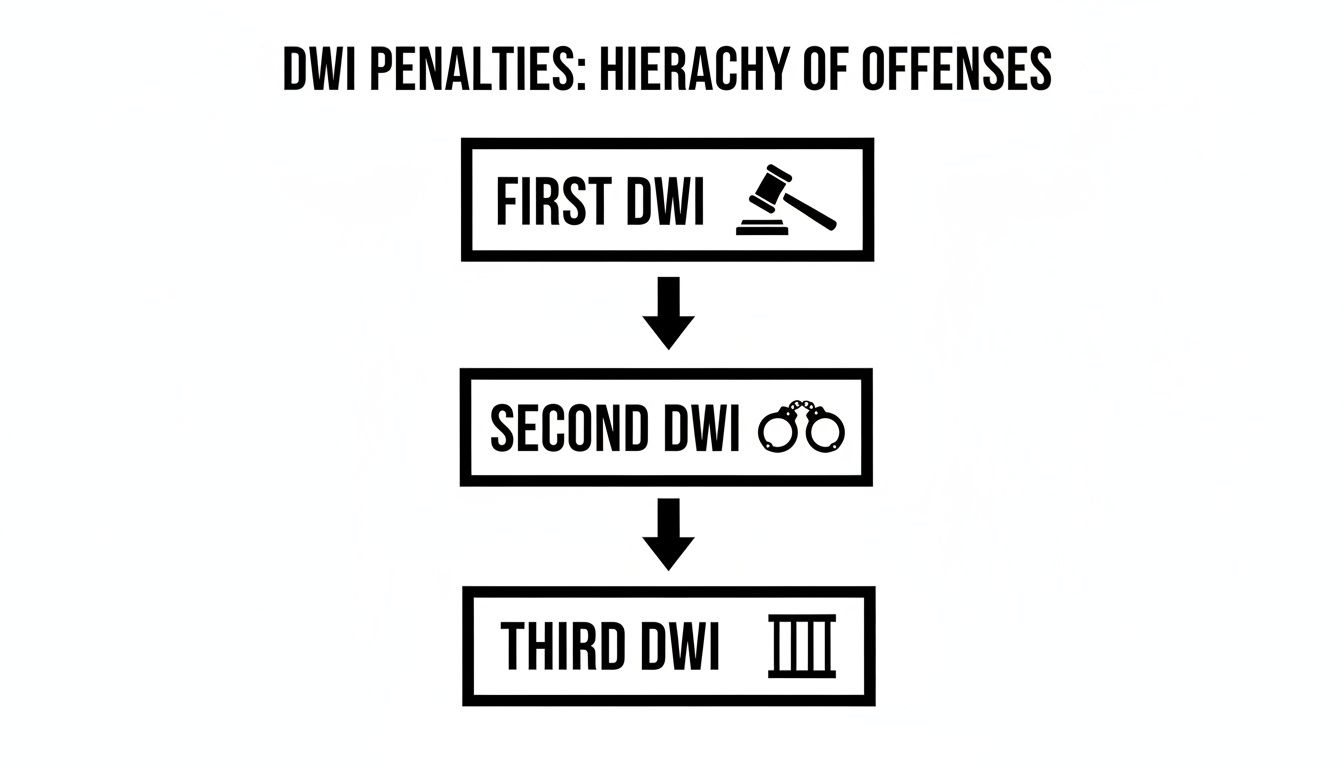
This visual makes it clear: Texas uses a tiered system where every subsequent offense or aggravating factor leads to much tougher legal consequences that can devastate a family.
Intoxication Assault and Intoxication Manslaughter
The consequences become absolutely tragic when a DWI leads to injury or death. These charges are about the devastating outcome of an accident caused by an intoxicated driver and will result in intense scrutiny from CPS.
- Intoxication Assault: If you cause an accident while intoxicated that results in serious bodily injury, you will be charged with Intoxication Assault, a third-degree felony punishable by 2 to 10 years in prison.
- Intoxication Manslaughter: If that same accident results in someone's death, the charge becomes Intoxication Manslaughter, a second-degree felony carrying a potential prison sentence of 2 to 20 years.
The human cost of drunk driving in Texas is staggering. Data reveals that impaired driving was a factor in 37% of all traffic fatalities between 2014 and 2023, tragically ending 14,389 lives. You can dig deeper into the impact of these crashes with these sobering statistics on impaired driving in Texas. For a parent, a conviction for either of these offenses will almost certainly lead to a lengthy prison sentence and a CPS case aimed at terminating parental rights.
The Hidden Financial Burden of a DWI Conviction
The judge's sentence is only the beginning of the financial nightmare a DWI conviction can create for a family. Beyond the court-ordered fines, a conviction triggers a cascade of hidden fees, surcharges, and costs that can strain your family’s budget for years. It's a relentless financial pressure that many parents are completely unprepared for.

Understanding this long-term financial burden is critical. It’s not just one payment; it’s a series of recurring expenses that can add up to a staggering amount, taking resources away from your children's needs.
State-Imposed Civil Fees and Surcharges
On top of criminal fines, Texas imposes steep civil fees. The old Driver Responsibility Program was repealed in 2019, but it was replaced by a new system of fines paid directly to the state.
The structure is a gut punch for any family budget:
- $3,000 for a first DWI conviction within a 36-month period.
- $4,500 for any subsequent conviction within that same 36-month window.
- $6,000 if your breath or blood sample showed an alcohol concentration of 0.15 or more.
This fee is completely separate from your criminal fine. It's paid to the Texas Department of Public Safety, and if you don't pay it, you can't keep your license. For a closer look at these numbers, our firm has created a detailed breakdown of DWI fines in Texas.
The Ripple Effect of Additional Costs
The financial pain doesn't stop there. A DWI conviction sets off a chain reaction of other expenses that add to the growing burden on your family.
Imagine a single parent in Houston convicted of a first-time DWI. On top of the civil fee and criminal fine, they now face a wave of new bills. Their probation officer requires a monthly supervision fee, typically around $60. The court mandates an alcohol education program, which can cost several hundred dollars more.
The total cost of a first-time DWI in Texas can easily exceed $10,000 when you factor in all the hidden fees, insurance hikes, and associated expenses. This figure doesn't even account for lost wages from court dates or potential job loss.
If the judge requires an ignition interlock device in their car, they must pay for installation (around $100-$200) plus a monthly monitoring fee (another $70-$100). These costs continue for the entire duration of their probation, which could be one or two years.
Finally, there's the SR-22 insurance requirement. An SR-22 is a certificate proving you have liability coverage. The moment you need one, your insurance company labels you a high-risk driver. Your auto insurance premiums can easily double or even triple, costing your family thousands more over several years. This long-term financial strain is why investing in a skilled defense attorney—who can fight to minimize or eliminate these crushing costs—is so critical for your family's stability.
Protecting Your Driving Privileges After an Arrest
For a parent, the single most terrifying aspect of a DWI arrest is often the loss of a driver's license. Your ability to drive is the lifeline that holds your family's daily routine together. How will you get to work to provide for your kids? How will you take them to school, daycare, or the doctor?
This section is about the urgent, separate battle you must fight to stay on the road for your family.
The fight for your license happens in a separate civil proceeding called the Administrative License Revocation (ALR) process. It moves at lightning speed compared to the criminal courts, and you must act fast.
The Critical 15-Day Deadline
The moment you are arrested for DWI, a clock starts ticking. You have exactly 15 days to request an ALR hearing with the Texas Department of Public Safety (DPS). This is the single most critical deadline in your entire case.
If you miss it, you automatically lose your right to challenge the suspension. Your license will be suspended on the 40th day after your arrest, regardless of whether you are ultimately found guilty in your criminal case.
Think of it like this: the ALR process and your criminal DWI charge are two separate legal battles running on parallel tracks. Winning your criminal case doesn't automatically save your license, and losing the ALR hearing doesn't mean you'll be convicted of DWI. You have to fight both independently.
How the ALR Suspension Works
The ALR process is triggered if you either fail a chemical test (BAC of 0.08 or higher) or refuse to provide a sample. The length of the suspension depends on your record:
- Failing a Chemical Test: For a first offense, you face a 90-day suspension.
- Refusing a Chemical Test: A first-time refusal triggers a much harsher 180-day suspension.
These suspensions are longer if you have prior alcohol-related incidents. This is an aggressive administrative action designed to get drivers off the road quickly, long before a criminal trial begins.
A Practical Lifeline: The Occupational Driver's License
Losing your license doesn't have to mean losing your ability to care for your family. Even if your license is suspended, you may be eligible for an Occupational Driver's License (ODL). This restricted license is a true lifeline for parents.
An ODL is a court order that allows you to drive for essential, necessary purposes to maintain your family's life. You can use it for:
- Driving to and from work.
- Getting your kids to and from school or daycare.
- Attending required classes or job training.
- Taking care of essential household duties, like grocery shopping or going to medical appointments.
Obtaining an ODL involves petitioning the court, providing proof of SR-22 insurance, and possibly installing an ignition interlock device. The process has several steps, but it is an absolutely vital tool to maintain normalcy for your children and meet your obligations while the DWI case proceeds. Understanding all the steps is key, which is why resources on how to reinstate a suspended license can offer much-needed clarity during this tough time.
Your Next Steps Building a Strong DWI Defense
The feeling of helplessness after a DWI arrest is completely normal, especially when you are worried about your children. But the hours and days that follow are your best opportunity to take back control. This is the moment to shift from shock to action.
Your top priority is to protect your rights and your family. You have the right to remain silent and the right to an attorney—use them. Do not try to explain your side of the story to law enforcement. Anything you say can be used against you in both your criminal case and any potential CPS case.
Your Immediate Action Plan
To give your defense the strongest possible start, you need to act quickly and methodically. Here is your priority checklist to protect your family:
- Write Everything Down: As soon as you can, document every detail you can remember. Where were you pulled over? What did the officer say? What tests did you perform? Were there witnesses? These details are crucial for your defense.
- Preserve Potential Evidence: Find receipts from where you were before driving. Get contact information for anyone who can verify your activities. This information helps build a clear timeline.
- Calendar the ALR Deadline: This is critical. Find a calendar and circle the date that is 15 days from your arrest. This is your non-negotiable deadline to request an ALR hearing to fight for your driver's license.
- Prepare for a CPS Call: If your children were in the car or if other factors might trigger a report, be prepared for contact from CPS. Do not speak with a caseworker or allow them into your home without first consulting an attorney who understands the complexities of CPS cases.
Secure Legal Representation Without Delay
The single most important step you can take right now is to contact an experienced Texas DWI defense attorney, preferably one who also understands family law and CPS defense. While the context is different, understanding the general principles of choosing a personal injury attorney can offer helpful insights into what makes for effective legal representation.
An attorney can immediately intervene on your behalf, request the ALR hearing to protect your license, and begin scrutinizing the state's evidence for weaknesses. Don't wait to make this call; your family's future is at stake.
A lawyer will guide you through the maze of the legal system, protect you from common mistakes that could harm your family, and start building a defense strategy tailored to the specific facts of your case. Taking this step helps you move from feeling like a victim of circumstance to becoming an active participant in your own defense.
Common Questions About DWI Texas Penalties
When you're a parent facing a DWI arrest, your mind is racing with questions about how this will impact your family. The fear and uncertainty can be paralyzing, but getting clear answers is the first step toward regaining control. Here, we address some of the most pressing concerns parents have about DWI penalties in Texas.
Can I Refuse a Breathalyzer Test in Texas?
Yes, you have the right to refuse a breath or blood test. However, this decision has immediate consequences due to Texas's "implied consent" law. By driving on a Texas road, you have legally consented to a chemical test if lawfully arrested for DWI.
Refusing the test triggers an automatic Administrative License Revocation (ALR). For a first-time refusal, your driver's license will be suspended for 180 days. While the prosecutor won't have a specific BAC number to use against you, they will use your refusal as evidence of guilt. For a parent, the loss of a license for six months can be devastating. An experienced attorney is crucial to challenge the ALR suspension and navigate this complex decision.
Is It Possible to Get My DWI Charge Dismissed?
A dismissal is absolutely a possible outcome, and it’s the goal every skilled defense attorney strives for. Whether a dismissal is possible depends entirely on the specific evidence in your case.
A dedicated defense attorney will investigate every detail of your arrest, including:
- The Legality of the Traffic Stop: Did the officer have a valid reason to pull you over? If not, all evidence that follows could be thrown out.
- Administration of Sobriety Tests: Were the field sobriety tests conducted according to standardized procedures? Officer errors are common.
- Equipment Maintenance: Was the breathalyzer machine properly calibrated? These devices are not infallible.
If your constitutional rights were violated, we can file a Motion to Suppress evidence. A successful motion can weaken the prosecutor's case, often leading to a dismissal or a significantly reduced charge, which is a much better outcome for your family.
How Will a DWI Conviction Affect My Career?
A DWI conviction can have profound and lasting consequences on your career, which directly impacts your ability to provide for your family. If you hold a professional license as a nurse, pilot, lawyer, or teacher, you will likely have to report the conviction to your state licensing board, which could lead to disciplinary action. For anyone with a Commercial Driver's License (CDL), a DWI is often a career-ending event.
Many employers run background checks, and a DWI on your record could disqualify you from job opportunities or even lead to termination. This is why it is so important to address any court-mandated requirements proactively; understanding effective ways to get sober can be a key part of showing the court and CPS that you are taking the situation seriously. Protecting your livelihood is one of the most powerful reasons to fight a DWI charge from day one.
A DWI charge can feel like your world is falling apart, especially when you have children depending on you. But it does not have to define your future. At the Law Office of Bryan Fagan, we know the fear and anxiety you're facing. We are here to provide the compassionate guidance and aggressive defense you need to protect your rights, your family, and your livelihood. You don't have to face this alone. Call us today for a free, confidential consultation to discuss your case and learn how we can help you and your family navigate this crisis. https://texascpslawyer.net