Skip to content
The knock on the door from Child Protective Services (CPS) is a sound that stops a parent’s heart. The announcement that they are there for an emergency removal of your child plunges you into a world of pure chaos and terror. In that moment, it feels like everything is spinning out of control. They might be telling you there’s an immediate danger to your child's physical health or safety, but all you can feel is the crushing fear of your family being torn apart.
Your mind races, panic sets in, and every instinct screams to protect your child. But what you do in these first few, critical moments can fundamentally alter the course of your case. This guide is here to provide the clear, practical guidance you need to navigate this nightmare, assert your rights, and begin the fight to bring your child home.
The First Moments: Your Action Plan for a CPS Removal
When a CPS investigator, often accompanied by a police officer, stands at your doorstep, they are not there for a casual chat. They are there with a single purpose: to remove your child. It is a moment of profound crisis, but it is not the time to fight or become hostile. It is the time to be calm, strategic, and informed.

While you likely cannot stop an emergency removal from happening right then and there, you can immediately begin building your defense and protecting your family’s future. Your composure and knowledge of your rights are your most powerful tools.
Asserting Your Rights at the Doorstep
It's easy to feel completely powerless facing a caseworker and law enforcement. But you have rights, and asserting them politely but firmly is essential.
- Ask for Identification. Get the name, title, and badge number of every single person present. Write this information down immediately.
- Request the Paperwork. If they have a court order, you have the right to see it. However, you must understand that under Texas law, an emergency removal can happen without a prior court order if CPS claims there is "imminent danger."
- Do Not Consent to a Search. You are not legally required to let CPS inside your home unless they have a warrant signed by a judge. You can step outside to talk with them, closing the door behind you.
This isn't about being difficult; it's about setting crucial legal boundaries. A calm, controlled response in the face of terror sends a clear message that you understand the gravity of the situation and your legal standing.
Document Everything
Your memory of this traumatic event will be a blur of stress and fear. You need to start documenting everything from the second they arrive. This information will be invaluable to your attorney.
Key Takeaway: Start a new note on your phone or grab a notebook. Write down the date, the exact time they arrived, who was present, and a detailed play-by-play of what was said and done. If you can do so safely, record the interaction on your phone. Texas is a one-party consent state, meaning you can legally record conversations you are a part of.
This record is your version of the truth. It will serve as your shield against potential inaccuracies and misinterpretations in the caseworker's official report. Every single detail matters.
A Real-World Scenario: Protecting Your Case from the Start
Imagine a father, Mark, is home with his children when CPS and the police arrive. An anonymous tip alleged he was using drugs in the home. The caseworker announces they are there for an emergency removal due to immediate danger.
Instead of panicking or arguing, Mark steps outside, closing the door. He calmly asks for everyone's name and badge number and writes them down. When the caseworker asks to come inside to "look around," Mark politely refuses. "Without a warrant, I am not comfortable with you entering my home, but I am happy to talk to you out here."
The caseworker begins asking leading questions about his past. Mark stops them. "I understand you have a job to do, but I will not answer any more questions until I have spoken with my attorney." He provides his phone number and asks for the caseworker's business card.
Even though CPS proceeded with the removal based on the initial allegation, Mark's calm, rights-asserting approach was brilliant. He did not provide them with any statements to twist or use against him. By doing this, he immediately put himself in a stronger legal position for the fight ahead.
Navigating the First 24 Hours After Your Child Is Taken
Once your child is gone, the silence in your home is deafening. Every second that ticks by feels like an eternity filled with fear and a thousand unanswered questions. That feeling can be paralyzing, but what you do in these first 24 hours can set the entire tone for your case.
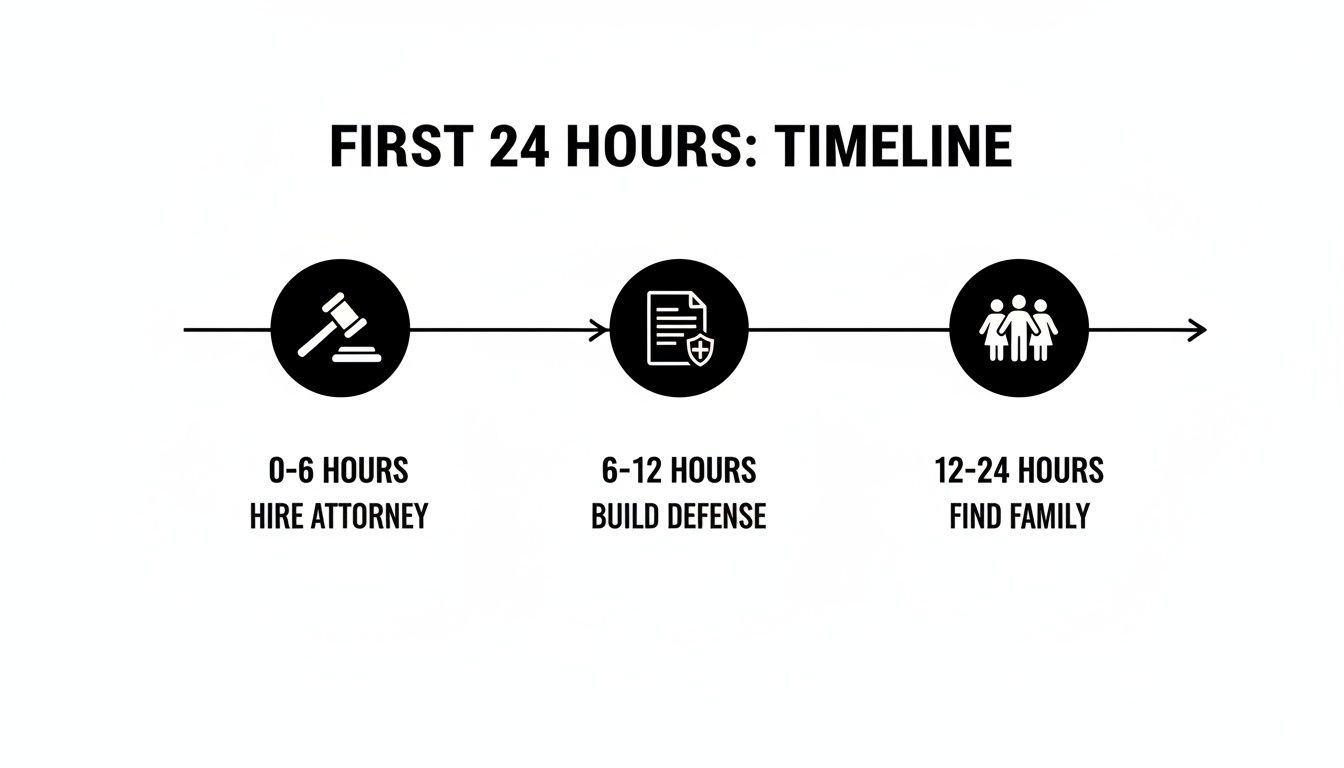
Your first move, before anything else, is to find and hire an experienced family law attorney who specializes in CPS defense. Do not put this off. The state has its legal team ready, and you need a fierce advocate in your corner from day one.
Start Building Your Defense Immediately
While calling attorneys, you must also start laying the groundwork for your defense. Don't wait for CPS or a judge to give you a to-do list. Taking the initiative sends a powerful message to the court that you are serious about getting your child back.
First, create a detailed timeline of what happened. What did the caseworker say? Who was there? What were the specific allegations? Be painstakingly specific. This document will be pure gold for your attorney.
Next, start a list of potential witnesses—people who know you as a parent and can vouch for the care your child receives. Think of teachers, neighbors, pastors, close friends, or family. Get their names and contact information. These are the people who will help you push back against the narrative CPS is creating.
Identify Family for Temporary Placement
One of the most urgent battles is keeping your child out of the foster care system. Texas Family Code Chapter 262 strongly prefers placing children with family members over strangers. CPS is supposed to look for relatives, but you cannot trust them to do so with the urgency your child deserves.
Actionable Advice: You need to take charge. Immediately make a list of every relative—grandparents, aunts, uncles, even close family friends—who would be willing and able to care for your child. Provide this list, with names and phone numbers, to both your attorney and the caseworker as soon as possible.
Initiating this process yourself can be the difference between your child staying with a loving grandparent or being placed in the uncertainty of a stranger's home.
Understanding "Reasonable Efforts" and Documentation
The Texas Family Code requires CPS to make “reasonable efforts” to prevent removal and to make it possible for a child to return home. From day one, you and your attorney must hold them to this standard. The way you do that is by documenting everything.
Start a binder or a digital folder. Log every phone call, email, and text message with the caseworker. Keep track of every appointment, every class, and every request you make. This isn't just about checking boxes; it's about building a mountain of evidence that proves your unwavering commitment to your family.
So many removals stem from allegations of neglect. A look at the statewide data is sobering; in 2021 alone, Texas saw 16,028 children removed from their homes, with neglect-based allegations being a primary driver. You can see the details in this comprehensive Texas workforce analysis. This number underscores how vital it is to fight back against any hint of neglect by proving you provide a safe, stable home. Your records are your proof.
Your Guide to the Texas CPS Court Process
After the initial shock of an emergency removal, you are thrust into a legal labyrinth with its own rules, language, and a terrifyingly fast clock. The Texas Family Code, particularly Chapter 262, outlines a strict series of court hearings that will decide your family's future. Understanding this process is the first step toward reclaiming your life.
This is not a journey you should ever take alone. The courtroom is an intimidating place where state attorneys will argue why your child should not be with you. Your job, alongside your attorney, is to methodically dismantle their arguments and prove to the judge that your child belongs at home.
The All-Important 14-Day Adversary Hearing
Under Chapter 262 of the Texas Family Code, the state must schedule a critical hearing within 14 days of taking your child. This is known as the Adversary Hearing, and it is your first and best chance to get your child back quickly.
The sole purpose of this hearing is for a judge to decide if CPS had sufficient reason to remove your child. CPS carries the burden of proof; they must show there was an “imminent danger” to your child's physical health or safety and that it was not possible for them to remain safely in the home. You and your lawyer will face off against the CPS caseworker, their attorney, and an attorney appointed for your child (an ad litem). This is your moment to challenge the state’s evidence.
Challenging the “Imminent Danger” Claim
Let's walk through a relatable scenario. A single mom, Sarah, gets a horrifying call from her toddler's daycare: he fell and broke his arm. She rushes to the hospital, only to find a CPS investigator waiting. The investigator questions the daycare’s account and implies the injury happened at home. Citing an old, unrelated domestic dispute in Sarah's past, CPS declares "imminent danger" and removes her son.
Key Insight: At the Adversary Hearing, Sarah’s attorney doesn't just deny the claim. They come prepared. They have the daycare director testify, present medical records confirming the injury is a classic "toddler fall," and provide character statements from Sarah's boss and neighbors. They systematically prove that CPS acted on flimsy assumptions, not facts.
This is how you fight back. You and your attorney gather every piece of evidence that contradicts the CPS affidavit—the sworn statement explaining the removal. The judge is legally obligated to weigh all evidence and determine what is truly in the “best interest of the child.” In complex cases, testimony from medico-legal experts can be crucial for interpreting medical evidence correctly.
A Look Ahead at Key CPS Court Hearings
If the judge agrees at the Adversary Hearing that CPS did not prove its case, your child can be ordered home right then. But if the judge sides with CPS, the case continues down a path with more hearings and strict deadlines under Chapter 263 of the Texas Family Code.
| Hearing Type | Deadline After Removal | Primary Purpose | Key Focus for Parents |
|---|---|---|---|
| Adversary Hearing | Within 14 days | To determine if CPS had sufficient cause for removal. | Presenting evidence to challenge the "imminent danger" claim. |
| Status Hearing | Within 60 days of the Adversary Hearing | To review the parents' progress on the court-ordered service plan. | Showing active and consistent compliance with all services. |
| Initial Permanency Hearing | Within 180 days | To establish a permanent plan for the child (reunification, relative placement, etc.). | Demonstrating stability and a safe home environment for reunification. |
These dates arrive quickly. To learn more about what each hearing entails, learn more about Texas CPS court hearings and timelines in our guide. Knowing the road ahead allows you to work with your lawyer to build a proactive case for reunification.
Building Your Case to Bring Your Children Home
The moment CPS removes your child, your entire world shrinks to one goal: getting them back. It’s a paralyzing feeling, but waiting and hoping the system works is a gamble you cannot afford. The fight to bring your children home starts now, and it requires you to actively build your case from the ground up.
Your mission is to prove to the judge and everyone involved that you are a safe, capable, and dedicated parent. It will take everything you have, but remember that Texas law is ultimately designed to keep families together. Your job is to make reunification the only logical outcome.
Tackle Your Service Plan Immediately
Soon after your first court hearings, CPS will give you a "service plan." This is a court-ordered list of tasks you must complete. It might include:
- Parenting classes
- Individual or family counseling
- Drug and alcohol evaluations and testing
- Anger management courses
- Home safety improvements
This list can feel overwhelming and punitive. Instead, see it as your roadmap home. Your attitude toward this plan is critical. Attack every item on that list with focus and aim to complete it faster than expected.
Become a Master of Documentation
In a CPS case, it often feels like your word against the caseworker's. You level the playing field with proof. Become an expert record-keeper, documenting everything you do to comply with your service plan.
Actionable Advice: Get a three-ring binder. We call it a "Reunification Binder," and it will be your most powerful tool. Organize it with dividers for every aspect of your case.
Here’s what goes in your binder:
- Certificates: Every certificate of completion from every class or course.
- Test Results: Copies of every clean drug test. This is undeniable proof of sobriety.
- Attendance Records: Proof you attended every counseling session and meeting.
- Communication Log: A detailed log of every call, text, and email with your caseworker, noting the date, time, and a summary.
This binder gives your attorney hard evidence for court and keeps CPS accountable by creating a paper trail of your commitment.
Show, Don’t Just Tell, That You’re a Committed Parent
Your conduct matters. Every hearing is an opportunity to show the judge you are responsible, respectful, and focused on your child’s needs. Arrive early, dress professionally, and speak calmly. Let your attorney handle the arguments.
Your actions outside the courtroom are just as critical. I worked with a father, David, facing neglect allegations due to a messy home. He didn't just clean up; he deep-cleaned, organized his entire house, and took photos to document the transformation. He also enrolled himself in a parenting class before the judge ordered it and brought the completion certificate to his first hearing.
This proactive approach showed the judge he was serious and part of the solution. A dedicated Austin child custody lawyer can help guide these strategic actions. It’s not about begrudgingly doing what you’re told—it’s about leading the charge to put your family back together. For more strategies, read our guide on how to get your child back from CPS.
The good news is that Texas law prioritizes family reunification. Following major reforms in 2017, removals plummeted by 52% by 2022. This shift gives your attorney real leverage to hold CPS accountable. When you combine your hard work with a smart legal strategy, you can turn this situation around.
How Our Firm Fights for Your Family's Future
When CPS takes your child, it feels like the world stops. An emergency removal CPS Texas case is isolating and terrifying. It’s easy to feel like you’re standing alone against a massive state agency.
We're here to tell you it's not over. You have rights, and you should never face this battle by yourself.
At the Law Office of Bryan Fagan, we see a family in crisis and a future that needs a champion. We’ve stood with families in courtrooms across Texas, armed with a deep understanding of the Texas Family Code and an unwavering passion for keeping families together.
Our Approach to Defending Your Family
The moment you hire us, we become a shield between you and the pressure from CPS. We take over communications, manage deadlines, and protect your constitutional rights from day one.
Our defense is proactive, built on a solid foundation of evidence and a sharp understanding of Chapters 262, 263, and 161 of the Texas Family Code. We guide you by:
- Challenging the Removal: We meticulously analyze the caseworker’s affidavit, searching for weaknesses in the state’s claim of "imminent danger."
- Building Your Proactive Case: We help you get ahead of the CPS service plan, showing the judge your undeniable commitment before they even ask.
- Advocating for Family Placement: We immediately work to identify and promote suitable family members to the court, fighting to keep your child out of the foster care system.
- Fighting for You in Court: We ensure your side of the story is told with the clarity and conviction it deserves, backed by powerful, evidence-based arguments.
Navigating the Maze of Overlapping Legal Issues
Many CPS cases are tangled with other legal problems—a DWI, a drug charge, or accusations of domestic violence. This is where our firm’s comprehensive experience becomes your greatest asset.
A Relatable Example: A father is accused of neglect after a DWI arrest, triggering an emergency removal. A typical family lawyer might be lost on the criminal side, while a criminal defense lawyer may not grasp CPS court nuances. We handle both. We build one unified strategy that protects your rights in both family and criminal courts, ensuring one case doesn't destroy the other.
This integrated defense is a strategic necessity. Our deep background in both family and criminal defense gives you the comprehensive legal shield you need. Sadly, the system isn't always fair. A study of Texas DFPS data revealed that Black children were removed at a higher rate than White or Hispanic children. You can explore more about these findings on racial differences in removal rates here. These disparities highlight the critical need for a vigilant legal defense to challenge any hint of bias.
The journey is draining, but you are not alone. We offer compassionate support and aggressive advocacy. Your future is worth fighting for, and the fight starts now.
Common Questions About Texas CPS Removals
When your world is turned upside down, your mind is a whirlwind of urgent questions. You need clear, direct answers. Having walked this path with countless parents, we know your most pressing concerns.
Can I Get My Child Back at the First Court Hearing?
Yes, it is absolutely possible to get your child back at the 14-day Adversary Hearing. This is often your best and fastest opportunity.
Your focus must be on convincing the judge that either there was no "imminent danger" or the problem has already been fixed. This requires solid proof. For example, if the removal was over suspected drug use, walking in with a clean drug test and proof of enrollment in a substance abuse assessment is far more powerful than a simple denial. An experienced attorney is crucial for gathering the right evidence and making the strongest possible first impression.
Will My Child Be Placed with a Relative Instead of in Foster Care?
Texas law strongly prefers placing children with family members. However, don't assume it will happen automatically. CPS must conduct background checks and a home study, which takes time.
Practical Advice: The second your child is removed, make a list of every willing and suitable relative—grandparents, aunts, uncles, even close family friends. Get their contact information to your attorney immediately so they can formally push these options with CPS and the court. Being proactive can be the difference between your child sleeping in a relative's house or a stranger's home.
What if I'm Also Facing Criminal Charges?
This scenario makes an already dangerous situation more complex. When an emergency removal CPS Texas case is tangled with criminal allegations like a DWI or family violence, you are fighting a war on two fronts. Anything you say in your CPS case can be used against you in your criminal case, and vice versa.
It is essential to have a law firm experienced in both family law and criminal defense. A coordinated strategy is a necessity to protect your parental rights and your freedom.
How Long Will My CPS Case Last?
While some cases resolve quickly, you should prepare for the reality that most CPS cases last for several months, and some can stretch for a year or longer. The timeline is guided by Chapter 263 of the Texas Family Code.
The biggest factor you control is your progress on the service plan. The faster and more thoroughly you complete your services—parenting classes, counseling, etc.—the stronger your argument becomes for a swift reunification. Your attorney's job is to use your progress to constantly push the case forward and advocate for your child's return at every hearing.
The path to bringing your child home is difficult, but you do not have to walk it alone. The attorneys at the Law Office of Bryan Fagan, PLLC understand the fear and uncertainty you are facing. We are here to provide the compassionate support and aggressive legal defense your family deserves. If CPS has become involved in your life, contact us today for a free and confidential consultation to begin building your defense. Visit us online at https://texascpslawyer.net to learn how we can fight for your family's future.