Skip to content
An old arrest record can feel like a permanent stain, something that follows you around and affects everything from your job prospects to whether you can volunteer at your child's school. For Texas parents, this isn't just an inconvenience; it can feel like a constant threat to the life you're trying to build for your family. The fear that a past mistake could surface during a CPS investigation or a custody dispute is a heavy burden to carry.
In Texas, the legal process of expunging a criminal record offers a way out. It doesn't just hide the record—it permanently destroys it, allowing you to legally deny the arrest ever happened. It's a genuine clean slate for you and your family.
How a Clean Slate Can Change Your Family's Future
An old arrest, even for a case that was dismissed years ago, can cast a long shadow over your family’s life. It becomes a source of constant anxiety, creating barriers that seem to pop up at the worst possible moments. We see this every day with parents who are working hard to build a stable, secure life for their kids, only to be held back by one past mistake—a mistake that could be devastating if a CPS investigation were ever opened.
This guide is for you—the Texas parent who knows that a single poor choice or a simple misunderstanding from years ago shouldn't define your entire future. Here at The Law Office of Bryan Fagan, we firmly believe in second chances and the power of a fresh start.
A Story We Hear All Too Often
Picture a single mom—let's call her Sarah—who was arrested for shoplifting a decade ago while going through a tough time. The charges were dismissed, and she moved on with her life. Now, her son is in elementary school, and she wants to chaperone his class field trip. But when the school runs the required background check, that old arrest pops up.
Suddenly, she's facing embarrassing questions and the real possibility of being told she can't participate in her own child's life. Now imagine if Sarah was also dealing with a difficult ex-spouse who threatened to call CPS on her. That same dismissed charge could be twisted and used against her in an investigation, causing immense fear and confusion. This is a heavy weight that, frankly, many Texas parents carry around for no good reason.
The True Impact of an Arrest Record
An arrest record, no matter how the case ended, can do more than just complicate your job search. It creates significant obstacles in areas of life that are absolutely crucial for providing for your family.
- Housing Applications: Landlords almost always run background checks. An arrest record—even without a conviction—can lead to an automatic denial, shrinking your family’s housing options.
- Professional Licenses: Many careers require state licenses. A past arrest can complicate or even prevent you from getting the credentials you need to move forward professionally.
- Volunteer Opportunities: Just like in Sarah's case, schools, youth sports leagues, and community groups often require background checks for volunteers, potentially shutting you out of important family activities.
An expunction is more than just a legal procedure. It's a tool for restoring your reputation and removing the roadblocks that stand between you and being the parent and provider you want to be.
Successfully expunging a criminal record in Texas means those records are legally obliterated. They aren't just hidden; they’re gone for good. This allows you to move forward with confidence, knowing a past event won't unfairly penalize you or your family anymore. To make the most of this fresh start, it's also a good idea to explore resources offering general career and job search advice to see how you can leverage your newly cleaned background in the job market.
Reclaiming your future isn't just a possibility—it's your right. The journey to a clean slate begins with understanding your options. At The Law Office of Bryan Fagan, we are here to provide the clear, compassionate guidance you need. We invite you to contact us for a free consultation to discuss your specific situation and learn how we can help you and your family finally move forward.
So, Can You Actually Get an Expunction in Texas?

This is the first, and most important, question we need to answer. It’s a common belief among Texans that if a case was dismissed, the record just… goes away. I wish it were that simple. The hard truth is that the arrest record sticks around, visible to the public, unless you take specific legal steps to have it destroyed. For parents, this is especially frightening, as that lingering record could become a weapon in a CPS case or custody dispute.
But here’s the good news: Texas law offers a clear way forward for people who were arrested but were never actually convicted of a crime. An expunction is designed for exactly these situations—where the legal system never found you guilty. It's a powerful legal tool that can completely wipe the slate clean, as if the event never happened.
The Golden Rules of Expunction Eligibility
In Texas, you generally have a right to an expunction if your case fits into one of these specific scenarios. Think of this as the initial checklist to see if you can even start the process.
- You went to trial and were found "not guilty" (acquitted) by a judge or jury.
- The prosecutor dismissed the charges, and the time limit for them to refile (the statute of limitations) has run out.
- You were arrested, but the District Attorney's office never formally filed charges against you (this also requires a waiting period).
- You received a pardon from the Governor of Texas or the President of the United States.
The whole reason this process exists is because our justice system acknowledges a fundamental truth: an arrest is not a conviction. Yet, countless Texans are held back by the shadow of a non-conviction on their record.
In Texas, it's estimated that over 4 million people are eligible to have their criminal records expunged, mostly because their cases were dismissed or never prosecuted. This shows just how many everyday folks are haunted by records that don't reflect a finding of guilt.
Don't Forget the Mandatory Waiting Periods
Even if your case was dismissed, you can't just walk into the courthouse the next day and file for an expunction. The law requires you to wait for a specific period, tied to the statute of limitations for that particular offense. This waiting period is there to make sure the state can’t change its mind and refile the charges against you.
Here are the standard waiting periods you need to know:
- Class C Misdemeanors:180 days from the date of the arrest.
- Class A & B Misdemeanors:1 year from the date of the arrest.
- Felonies:3 years from the date of the arrest.
Once that clock has run out and your case is still dismissed, you're in the clear to file your Petition for Expunction. This is a critical detail that often trips people up when they try to go it alone.
A Common Sticking Point: Deferred Adjudication
One of the most frequent questions we get is about deferred adjudication. It’s a huge point of confusion. Many people complete their deferred probation, see their case is "dismissed," and naturally assume they qualify for an expunction.
This is a crucial misunderstanding.
When you accept deferred adjudication, you enter a plea of "guilty" or "no contest," even though you aren't formally convicted. That plea is what makes you ineligible for an expunction in most situations. Instead, successfully finishing deferred adjudication might make you eligible for an Order of Nondisclosure, which seals your record from the public but doesn't destroy it like an expunction does. You can learn more about deferred adjudication in Texas to fully grasp how it affects your options.
The only real exception is for Class C misdemeanors. If you successfully completed deferred adjudication for a simple Class C offense, you might still be able to get an expunction. For any parent navigating the complexities of expunging a criminal record in Texas, getting this right is everything. It’s the difference between a hidden record and one that’s gone for good.
When you start looking into clearing your name in Texas, you’ll quickly run into two important legal terms: expunction and nondisclosure. They might sound similar, and people mix them up all the time, but they are worlds apart in what they actually accomplish for your future.
Getting this difference right is probably the single most important step in the whole process. It sets the right expectations from the very beginning.
This isn’t just about legal jargon; it's about what you need to truly move on with your life. Do you need the record completely wiped out, as if it never happened? Or is just sealing it from public view enough to open up the doors you need opened? For many Texas families, especially those worried about potential CPS scrutiny, the answer to that question changes everything.
What is a Texas Expunction?
An expunction is the gold standard—the most complete form of relief you can get. Think of it as a legal reset button. When a judge grants your petition for expunction, every government agency holding a record of your arrest is ordered to physically destroy it.
That’s right: destroy it. This means you can legally deny, even under oath, that the arrest ever happened. It’s gone. Poof.
What is an Order of Nondisclosure?
A nondisclosure, on the other hand, is more like putting the record in a locked file cabinet that only a few people have the key to. It effectively seals the record from the general public, including most potential employers, landlords, and nosy neighbors.
However, law enforcement and certain state licensing agencies—including CPS—can still pull that file out and look at it if they have a legitimate reason. The record still exists; it's just hidden from most eyes.
Texas Expunction vs. Nondisclosure at a Glance
Sometimes the easiest way to grasp the distinction is to see the two options side-by-side. The paths to get them are different, the eligibility rules are different, and the final outcomes are very different.
| Feature | Expunction (Record Destruction) | Nondisclosure (Record Sealing) |
|---|---|---|
| What Happens | The record of your arrest is physically destroyed and removed from all government databases. | The record is sealed from public view but remains accessible to law enforcement agencies and CPS. |
| Who Qualifies | Primarily for arrests that did not result in a conviction (e.g., dismissal, acquittal, etc.). | Often for those who successfully completed deferred adjudication for certain offenses. |
| What You Can Say | You can legally deny the arrest ever occurred in almost all situations. | You can deny the arrest on most job applications but must disclose it in certain specific contexts. |
| Who Can See It | No one. The record is gone for good. | Law enforcement, prosecutors, CPS, and specific government and licensing agencies can still see it. |
| The End Goal | To completely erase the event as if it never happened. | To limit the negative impact on your life by hiding it from most public inquiries. |
As you can see, these are not just two flavors of the same thing. They are fundamentally different legal remedies with very different results for your life and your family.
A Real-World Example That Hits Home
Let’s imagine two parents, both hoping to volunteer for their child's school field trip.
Parent A once had a theft charge that was completely dismissed. They went through the process and got a full expunction. When the school district runs its background check, nothing comes up. The record simply doesn't exist anymore. They are approved to chaperone without a single question asked.
Parent B successfully completed deferred adjudication for a similar offense and obtained an order of nondisclosure. A standard background check for a regular job would likely come back clear. But a more thorough check by a school district—a governmental entity—might still reveal the sealed record. The school would then have to decide if that sealed offense disqualifies them from volunteering. If CPS were ever involved with Parent B's family, they would also see this sealed record.
This scenario really brings the difference to life. If Parent B had assumed their nondisclosure was the same as an expunction, they would have been blindsided and embarrassed. To get a deeper look at the nuances, you can explore what an order of nondisclosure in Texas really means for your future and understand its specific limitations and benefits.
For a Texas parent, the choice between expunction and nondisclosure can mean the difference between a truly clean slate and a past that can still surface at the most inconvenient times.
Ultimately, while both are powerful tools for expunging a criminal record in Texas, only a true expunction offers total erasure. The first step is figuring out which one you qualify for. Our team at The Law Office of Bryan Fagan can evaluate the specific details of your case, determine your eligibility, and make sure you pursue the best possible outcome for your family.
The Texas Expunction Process from Start to Finish
Knowing you might be eligible for an expunction is a huge relief, but that’s just the first hurdle. The journey from filing a petition to getting a judge's final order can feel like navigating a maze of legal paperwork, deadlines, and procedures. We’re here to walk you through it, breaking down the process of expunging a criminal record in Texas into clear, manageable phases.
The whole process is designed to be meticulous, making sure every single government agency holding a record of your arrest is properly notified and legally required to destroy it. It demands precision and attention to detail, but with the right guidance, it's a path you can absolutely navigate.
Gathering Your Essential Documents
Before you can even think about drafting the legal paperwork, you need to collect all the necessary information about your case. Think of this as the foundation of your petition—getting it right from the start prevents major delays down the road.
You'll need to gather:
- Arrest Records: This includes the exact date of the arrest, the name of the arresting agency, and the specific offense you were charged with.
- Court Case Information: You’ll need the case number, the court where the case was heard (e.g., County Court at Law #5), and the final disposition—was it a dismissal, an acquittal, or something else?
- Personal Identifiers: This means your full legal name, date of birth, driver's license number, and social security number.
These details are non-negotiable for drafting a legally sufficient Petition for Expunction. Missing even one piece of information can get your petition rejected by the court clerk or challenged by the District Attorney’s office. It’s also crucial to send these records securely. For more on protecting sensitive information, you might find guidance on secure online faxing for sensitive legal documents helpful.
Drafting and Filing the Petition for Expunction
Once you have all your information lined up, the next step is drafting the "Petition for Expunction." This isn’t just a simple form you fill out; it’s a formal legal document filed with the district court in the county where you were arrested. It’s a sworn statement that lays out the legal reasons why you are entitled to have your record destroyed under Texas law.
One of the most common places people make mistakes is failing to list every single government agency that might have a record of your arrest. It’s not just the police department that arrested you and the county court.
The list needs to include:
- The Texas Department of Public Safety (DPS)
- The District Attorney's Office
- The County or District Clerk
- Any other city or state agency that may have accessed your record.
After filing, each of these agencies must be formally served with a copy of the petition. This gives them legal notice of the action, and it's a step you absolutely cannot skip.
This visual below helps clarify the two main paths for clearing a record in Texas and their very different outcomes.
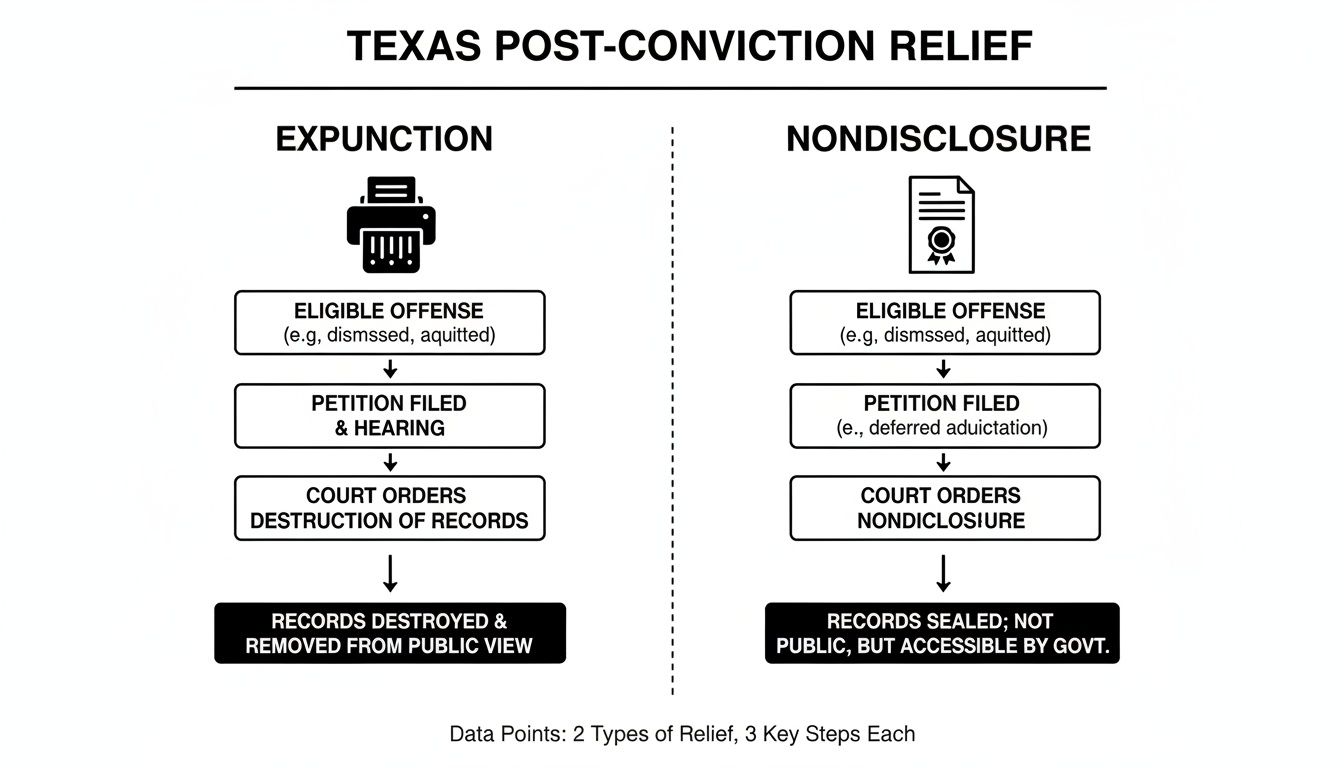
The key takeaway is that an expunction means your record is completely destroyed. A nondisclosure, on the other hand, only seals it from the public’s view.
The Hearing and Final Order
After all the agencies have been notified, the court will typically set a hearing date, usually about 30 to 60 days after you file the petition. In many straightforward cases, if no agency files an objection, the judge may sign the "Order of Expunction" without you ever stepping foot in a courtroom.
However, if an agency like the District Attorney's office objects to your petition, a hearing is guaranteed. This is where having an experienced attorney becomes invaluable. They will argue on your behalf, presenting evidence and legal arguments to convince the judge that you meet all the statutory requirements for an expunction.
A common reason for an objection is a belief that the waiting period hasn't been met or that there's a related charge that makes you ineligible. An attorney can preemptively address these issues to keep your case on track.
If the judge sides with you, they will sign the Final Order of Expunction. This is a powerful court order that legally compels every agency to destroy their records of your arrest. The agencies then have a specific timeframe to comply and must send confirmation back to the court.
The entire process, from filing to the final destruction of records, can take anywhere from three to six months, depending on the county and the complexity of the case. While this might seem like a long time, the lifelong benefits are immeasurable.
Of course, the financial investment is a key consideration for most families. You can learn more by exploring the cost of expungement in Texas to get a better handle on the associated fees.
Common Mistakes That Can Derail Your Expunction
The path to expunging a criminal record in Texas is full of good intentions. Unfortunately, it's also loaded with potential traps that can delay or completely sink your case. A simple clerical error, something that seems minor, can be enough for a judge to deny your petition. When that happens, you're forced to start all over again.
As attorneys who walk Texas families through this every single day, we’ve seen the same handful of mistakes turn a straightforward process into a nightmare of frustration. Knowing what these errors are is the first step to avoiding them. The goal here is to get it right the first time, giving your family the clean slate you need without hitting unnecessary roadblocks.
Let’s get into the most common missteps we see and how you can sidestep them.
Misunderstanding Your Eligibility
This is the most heartbreaking mistake of all: filing for an expunction when you were never eligible to begin with. We often see this with parents who successfully finished deferred adjudication for a felony or a Class A/B misdemeanor. They look at their court record, see the word "dismissal," and naturally assume an expunction is the next step.
But as we've covered, that specific type of dismissal usually only makes you eligible for an order of nondisclosure—sealing your record, not destroying it. Filing the wrong petition is a surefire way to waste your time, your money, and your emotional energy. Always confirm your eligibility before you spend a single dime on filing fees.
Another classic eligibility error is filing too early. If you forget to wait for the mandatory statute of limitations to expire, your petition will be denied automatically. No exceptions.
- Class A & B Misdemeanors: You must wait one year from the date of your arrest.
- Felonies: You have to wait three years from the arrest date.
Jumping the gun, even by a few days, will get your petition tossed out of court.
Failing to Notify All Necessary Agencies
When you file for an expunction in Texas, the law says you must list and formally notify every single government agency that could possibly have a copy of your arrest record. A lot of people mistakenly believe this just means the police department that arrested them and the court that heard their case.
A successful expunction petition is comprehensive. It must include every local, county, and state agency that holds a piece of your record, from the DPS in Austin to the small-town sheriff's office where the arrest occurred.
If you forget even one agency, their record of your arrest stays right where it is, completely defeating the purpose of the expunction. This is one of the most detail-heavy parts of the whole process, and it’s where professional guidance can make all the difference. An experienced attorney knows the full, exhaustive list of agencies that need to be notified, ensuring no stone is left unturned.
The Problem with Multiple Arrests
Things get a lot more complicated if you have multiple arrests on your record, especially if they happened in different Texas counties. Each arrest has to be handled on its own, and a problem with one case can easily throw a wrench into your eligibility for another.
For example, let's say you have one arrest that’s eligible for expunction, but another arrest in a different county ended in a conviction. Suddenly, the process is far more complex. You have to navigate the rules across different jurisdictions and make sure each petition is filed perfectly. Trying to manage all of that on your own can get overwhelming fast and often leads to critical mistakes.
This is precisely why a legal process like expunction is so important. It’s a defined statutory remedy, not like asking for a discretionary pardon, which has become almost impossible to get in Texas. The state's expunction reforms represent a major shift, especially when you consider that the Board of Pardons and Paroles recommended clemency in just 3 out of 81 applications in FY24—a massive drop from previous years. You can read more about this and understand why expunction offers a more reliable path than pardons.
Avoiding these common mistakes is the key to a smooth and successful expunction. Investing in an experienced attorney from The Law Office of Bryan Fagan ensures every detail is handled correctly, preventing costly errors and giving your family the confidence that your future is in good hands.
Common Questions About Clearing a Criminal Record in Texas
Even after reading a guide, it's natural to have more questions. The Texas expunction process has a lot of moving parts, and we know the stakes are incredibly high for you and your family. Below, we've tackled some of the most common questions we hear from parents in your shoes, offering straightforward answers to give you some clarity.
Our goal here is to pull back the curtain on the legal jargon and give you the confidence to move forward. While every family's story is different, these questions get to the heart of what most people worry about.
How Long Does the Expunction Process Take?
This is usually the first thing parents ask. From the day we file the Petition for Expunction, the entire process typically takes about three to six months. Of course, this timeline can shift depending on which county you're in and how backed up the court's calendar is.
A few things can slow things down:
- The Court's Caseload: Some Texas counties are just busier than others, and a packed docket means waiting longer for a hearing date.
- Agency Responses: Every government agency we notify has a window to respond or object. While objections are rare, a challenge from the District Attorney’s office can add time.
- Paperwork Hiccups: Any mistake on the initial petition—even a small one—will cause a delay, as it has to be fixed and refiled correctly.
It’s definitely not an overnight process, but the permanent benefit of a completely clear record is worth the wait.
Can I Handle the Expunction Process Myself?
Legally speaking, you absolutely can file for an expunction on your own—this is known as filing pro se. But I have to be honest: we strongly advise against it. The process is a minefield of procedural rules and legal details that are incredibly easy to get wrong if you don't do this every day.
One simple error, like notifying the wrong list of agencies or miscalculating a statutory waiting period, can get your petition thrown out by the judge. That means you’re back to square one, having wasted months and your filing fees. Hiring an attorney who knows the ropes ensures it gets done right the first time.
What Happens If My Expunction Petition Is Denied?
Getting a denial from the judge is tough, but it doesn't always mean it's over. The first thing we need to figure out is why it was denied. Was it a minor clerical error that we can easily fix? Or was it denied for a bigger reason, like you weren't actually eligible to begin with?
If it was a technical mistake, we can often correct the petition and refile. But if the denial was based on ineligibility, your options get much narrower. This is a moment where having an attorney is critical. We can analyze the judge's ruling and tell you if there are any other paths forward.
I can't tell you how many denials happen simply because someone filed too early. The statutory waiting periods are strict and non-negotiable. It's one of the most common—and most avoidable—mistakes we see.
Will an Expunged Record Show Up on a Background Check?
No, it will not. This is the magic of a true expunction. Once the judge signs the Order of Expunction and all the government agencies have complied, the record is completely destroyed. It vanishes. It won't show up on background checks for jobs, apartments, school applications, or anything else.
This is the key difference between an expunction and an order of nondisclosure (record sealing). With an expunction, you can legally and truthfully say the arrest never happened. It gives you a genuine clean slate to build a better life for your family.
How Does an Expunction Affect a Family Law Case?
In a child custody battle or a CPS case, a criminal record can be a powerful tool for the other side to use against you, painting you as an unfit parent. Once that record is expunged, however, it is legally gone. For all intents and purposes, it never existed.
This means it generally cannot be brought up or used against you in family court. Getting an expunction takes away a major piece of ammunition that an ex-spouse or opposing attorney might try to use to damage your character. It forces the court to focus on who you are as a parent today, not a mistake from your past.
The road to a clean record can seem complicated, but you don't have to figure it out alone. At The Law Office of Bryan Fagan PLLC, we get what's on the line for Texas families. We’re here to offer the skilled, compassionate guidance you need to get through the expunction process and on with your life. Contact us today for a free consultation to talk about your situation and see how we can help you get the fresh start you deserve.