Skip to content
When you're facing a criminal charge in Texas, the fear and uncertainty can be overwhelming, especially when you have a family depending on you. The thought of being separated from your children, losing your job, and the stigma of a criminal record is a heavy weight to bear. In these moments, understanding your options is the first step toward regaining control. For many, community supervision—what most people call probation—offers a path forward, a way to stay with your family and in your community instead of being incarcerated.
Understanding Community supervision and its Impact on Your Family
In Texas, community supervision is a court-ordered sentence that serves as an alternative to jail or prison. It allows you to serve your sentence in the community, but under a strict set of rules and regular monitoring by a probation officer. This gives you a chance to keep your job, stay with your family, and continue being a parent while fulfilling your legal obligations.
You can think of it as a second chance, but it's one that comes with serious strings attached. The system is designed for situations where rehabilitation and public safety are better served by keeping people connected to their support systems. Instead of removing you from your life, the court lays out conditions to guide you toward a law-abiding future.
A Relatable Scenario for Texas Parents
Picture a single mother who, after a heated argument with her ex-partner, is charged with a misdemeanor assault. The most terrifying thought for her isn't the fine or the classes; it's the possibility of being taken away from her children. A Child Protective Services (CPS) case could even be opened, adding another layer of fear. In a situation like this, a judge might grant community supervision, allowing her to:
- Continue working and providing for her children.
- Attend required anger management classes to develop healthier coping skills.
- Check in regularly with a probation officer.
- Meet all court requirements without her family being torn apart.
This example gets to the heart of what probation is all about: finding a balance between accountability and the chance for rehabilitation, all while minimizing the traumatic impact on children and families.
Community supervision is not a "get out of jail free" card. It is an active sentence you serve in the community, and whether you succeed depends entirely on your commitment to following every single court-ordered condition, without any exceptions.

The legal process that leads to sentencing starts long before you ever stand in front of a judge. It's critical to understand what happens at every stage, including the very first court appearances. For example, the arraignment hearing is a key first step where the charges are formally read to you. Learning more about what happens at an arraignment hearing can help you feel more prepared for the road ahead. Knowing how probation works in Texas is the first step toward getting through it successfully.
Understanding Straight Probation vs Deferred Adjudication in Texas
When a court in Texas offers community supervision, it's not a one-size-fits-all deal. The path you end up on can completely change your future, and the two main roads are straight probation and deferred adjudication. Getting a handle on the difference between them is one of the most critical steps you can take to protect yourself and your family down the line.
Here’s a simple way to think about it: straight probation is basically a suspended jail sentence. The court finds you guilty, and that guilty verdict—the conviction—becomes a permanent part of your criminal record. But instead of sending you to jail, the judge "suspends" that sentence and lets you serve it out in the community, under very strict rules.
Deferred adjudication, on the other hand, works more like a contract with the court. You plead "guilty" or "no contest," but the judge holds off on making a final decision. They defer, or postpone, finding you guilty and place you on community supervision instead. If you follow all the rules and complete the probation term successfully, the judge dismisses the case. You are never formally convicted of the crime.
Why This Difference is a Game-Changer
That distinction between a conviction and a dismissal can be life-altering. A final conviction from straight probation can throw up major roadblocks for the rest of your life. It can make it incredibly difficult to:
- Get a job, since most employers run background checks.
- Find housing, as landlords often deny applicants with convictions.
- Obtain professional licenses or certifications.
- Own a firearm, especially if it’s a felony case.
For parents, a conviction can have even deeper consequences, potentially impacting custody arrangements or complicating matters in a CPS case. Deferred adjudication gives you a chance to sidestep that permanent stain. While the arrest will still be on your record, successfully finishing your probation means you can honestly say you haven't been convicted of that crime. That's a huge advantage for your future. You can learn more about the specifics in our detailed guide on what deferred adjudication is in Texas.
Understanding the Long-Term Consequences
It’s crucial to know that deferred adjudication isn’t a "get out of jail free" card. If you mess up and violate the terms, the fallout can be much worse. Because you were never given a specific sentence upfront, a judge can revoke your probation and hit you with anything up to the maximum punishment for the original offense. That could mean serious jail or prison time.
With straight probation, if you violate the terms, the judge can only sentence you for up to the length of the original suspended sentence. It’s still a serious situation, but at least the maximum penalty is already set.
The choice between straight probation and deferred adjudication is one of the most critical junctures in a criminal case. It directly impacts your ability to move forward with your life after the case is closed.
Regular Probation vs. Deferred Adjudication at a Glance
To make this even clearer, let's break down the key differences between these two paths. This table will help you see how each one could impact your future in very different ways.
| Feature | Regular (Straight) Probation | Deferred Adjudication Probation |
|---|---|---|
| Finding of Guilt | Yes. The court finds you guilty, and a conviction is entered on your record immediately. | No. The judge defers finding you guilty. No conviction is entered if you succeed. |
| Criminal Record | A permanent conviction that shows up on background checks for life. | No conviction if completed. The arrest remains, but the case is dismissed. May be eligible for an order of non-disclosure. |
| Consequence of Violation | The judge can impose the original suspended sentence. The maximum penalty is known. | The judge can impose any sentence within the full range of punishment for the crime. |
| Answering "Have you been convicted?" | You must answer "Yes." | You can honestly answer "No." |
| Best For | Cases where deferred is not an option or the risks of violating deferred are too high. | Individuals, especially first-time offenders, who want to avoid a permanent conviction. |
As you can see, the long-term stakes are incredibly high. The right choice depends entirely on your specific circumstances, the nature of the charge, and your ability to comply with the court's conditions.
Probation is a massive part of the Texas justice system, serving as the main alternative to putting people behind bars. As of January 2023, around 141,671 adults were on felony community supervision in the state, and that number is projected to climb to nearly 148,000 by 2025.
The state relies heavily on this system because it's far more cost-effective—supervising someone in the community costs just $4.69 per day, a fraction of the $86.50 it costs to house an inmate. You can see the full data in these Texas population projections. This widespread use is exactly why understanding which type of probation you’re facing is so important. Your eligibility for either path depends heavily on the offense and your past record, making a candid conversation with your attorney absolutely essential.
Understanding Your Conditions of Probation
When a judge sentences you to community supervision, they're not just sending you home. They're handing you a very specific set of rules to live by. Think of these rules—known as your conditions of probation—as the roadmap you absolutely must follow to finish your term and finally put this whole chapter behind you.
Knowing these conditions inside and out is the single most important thing you can do. One accidental misstep could put your freedom on the line, so from day one, you need to understand exactly what’s expected of you. While every person's probation plan is tailored to their specific case, there are several standard requirements that show up in almost every single one.
The plea you take sets the stage for what kind of probation you might get, which in turn affects your future. One path leads to a final conviction on your record, while the other offers a chance to have the case dismissed entirely.
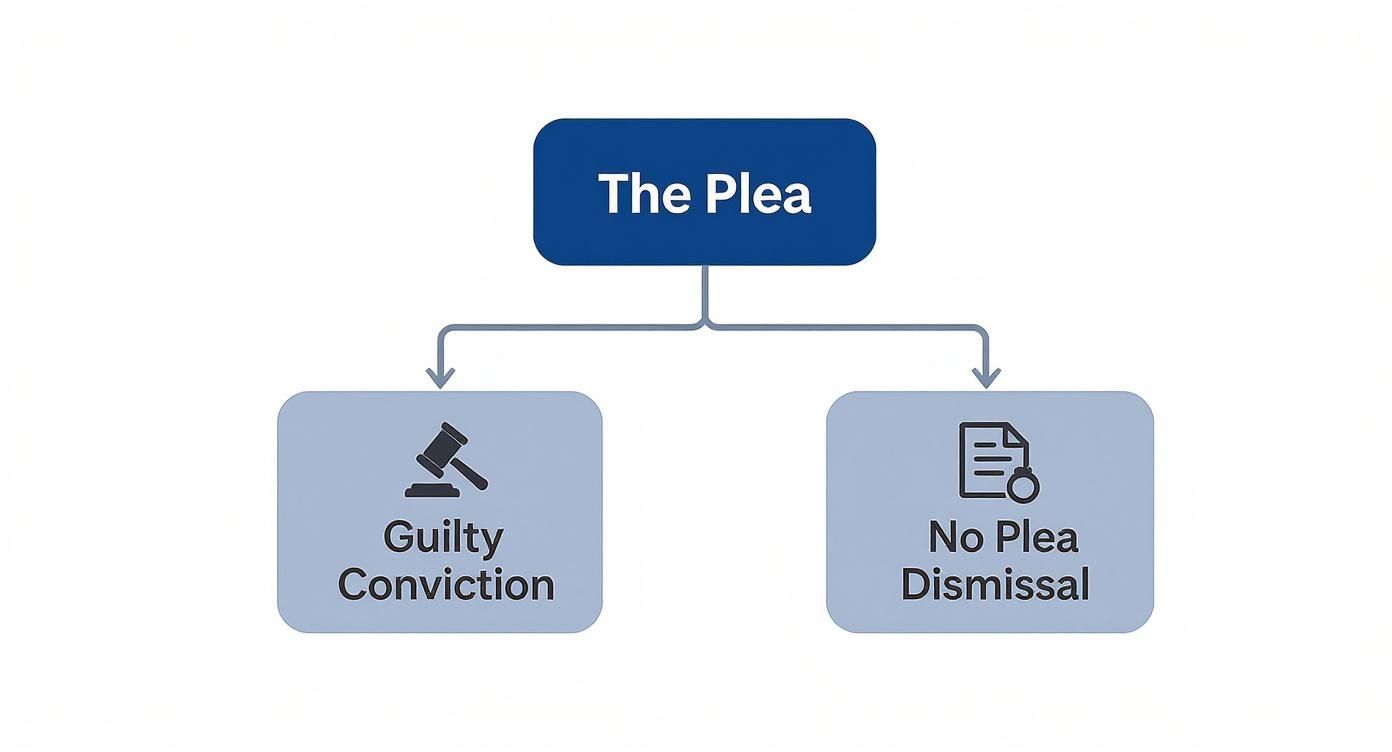
As you can see, the outcome of your plea directly impacts the long-term consequences, making your choice at this stage incredibly important.
Standard Probation Conditions You Can Expect
Every case is different, but the Texas Code of Criminal Procedure sets out a baseline of conditions you’ll almost certainly see. These are the non-negotiables designed to keep you accountable and on the right track.
You can pretty much count on being required to:
- Report Regularly: You’ll be assigned a Community Supervision Officer (CSO), or probation officer. You must meet with them exactly as scheduled—whether that’s weekly or monthly—without fail.
- Maintain Employment: The court expects you to hold down a legitimate job. If you’re out of work, you’ll need to prove you're actively job hunting.
- Pay Fines and Fees: Every sentence comes with court costs, fines, and monthly supervision fees. Falling behind on these payments is a critical violation.
- Stay Out of Trouble: This one is huge. You cannot commit any new crimes. A new arrest, even for something minor, is the quickest way to get your probation revoked.
- Remain in the County: You’re usually required to stay within your county unless you get explicit, written permission from your probation officer to travel.
These standard rules are the backbone of your probation. Following them to the letter is your primary job.
Specific Conditions Tailored to Your Case
On top of the standard rules, the judge will add conditions based on the specifics of your alleged offense. The idea is to address whatever behavior led to your arrest in the first place, focusing on rehabilitation and public safety.
For instance, let’s say a father is put on probation for an assault charge stemming from a domestic dispute. The judge’s primary goal, and likely that of CPS if they are involved, is to ensure the family environment is safe and stable.
In a situation like that, his specific conditions might include:
- Battering Intervention and Prevention Program (BIPP): He’d have to enroll in and complete a state-approved BIPP course.
- No Contact with the Victim: A judge would likely issue a protective order, preventing any contact with the other parent outside of court-approved channels for child visitation.
- Parenting Classes: He might also be ordered to complete parenting courses to learn constructive ways to handle stress and conflict.
Other common case-specific conditions include:
- Drug and Alcohol Testing: Random, frequent testing is standard, especially in cases involving any kind of substance use.
- Counseling or Treatment: This could be anything from substance abuse treatment to specialized therapy sessions.
- Ignition Interlock Device: For DWI offenses, you’ll almost certainly be required to install a device in your car that checks your breath for alcohol before it will start.
Staying organized is your best defense against an accidental violation. Keep a calendar with all your appointments, payment due dates, and class schedules. Document everything, and never be afraid to ask your probation officer for clarification.
Understanding how does probation work in Texas means seeing these conditions not as a list of punishments, but as a structured plan for your success and your family's well-being. By carefully following every single one, you are actively proving to the court that you can be a responsible, law-abiding member of the community. It’s your path forward to a future free from legal trouble.
What Happens If You Violate Probation in Texas

Living on community supervision can feel like walking a tightrope. For parents, the constant fear that one wrong move—even an honest mistake—could mean being separated from your children is a heavy burden to carry. This section is here to cut through that anxiety and explain exactly what happens when you’re accused of violating probation in Texas.
Technical Violations vs. New Law Violations
First things first, it's critical to understand that the court views violations in two very different ways. Not all slip-ups are created equal.
- Technical Violation: This is when you break one of the specific rules of your probation that isn't a new crime. Think of things like missing a meeting with your officer, failing a drug test, getting behind on your fines, or traveling out of the county without getting permission first. These are serious, but they are violations of your probation conditions.
- New Law Violation: This is just what it sounds like—you get arrested and charged with a brand-new criminal offense while on probation. This is, without a doubt, the most severe type of violation and brings the harshest consequences.
The Motion to Revoke Probation
When your probation officer believes you’ve violated your conditions, they don’t just have the authority to send you to jail on the spot. They must first file a formal document with the court called a Motion to Revoke Probation (MTRP). This is a legal petition that spells out exactly how the state believes you failed to follow the rules.
Once that MTRP is filed, the judge will almost always sign a warrant for your arrest. You'll be taken into custody and will likely stay in jail until your hearing, though in some situations, a bond might be set.
This scenario is far too common. Texas has one of the largest probation populations in the country, with around 334,000 people on community supervision at the end of 2020. With caseloads that massive, even small missteps can trigger major consequences. For example, some counties like Bexar have notoriously high revocation rates, often for minor technical violations. You can find more insights on the scope of probation in Texas to better grasp the challenges thousands are facing.
The Revocation Hearing
After an arrest, you are entitled to a revocation hearing. It’s important to know that this is not a new criminal trial. The state doesn't have to prove your guilt "beyond a reasonable doubt."
Instead, the standard of proof is much, much lower. The prosecutor only has to show by a "preponderance of the evidence" that you likely violated a condition. In plain English, this just means they have to prove it’s more likely than not that you broke a rule.
A probation violation does not automatically mean you are going to jail. The judge has a wide range of options, and the outcome often depends on the quality of your legal defense.
Possible Outcomes of a Violation
Facing a violation is terrifying, but it's crucial to know that jail time is not the only outcome. The judge has several tools at their disposal, and the final decision will hinge on the type of violation, your overall track record on probation, and the arguments your attorney makes.
Possible outcomes include:
- Reinstatement: The judge could decide to give you another chance and simply put you back on probation with the same original conditions.
- Modification: The judge might let you continue probation but add tougher conditions. This could mean more frequent reporting, an ankle monitor, or mandatory inpatient treatment.
- Revocation: In the most serious cases, the judge can revoke your probation and impose a sentence. If you are on straight probation, you could serve the original suspended sentence. If you're on deferred adjudication, you could face the full range of punishment for the initial offense.
Let’s say a parent on probation for a state jail felony fails a drug test. Their attorney could show the judge that they've been a model probationer otherwise—holding down a job, finishing community service, and paying all their fees on time. The attorney might then argue for a modification, like mandatory outpatient rehab, instead of revoking their probation and separating them from their children. This kind of proactive defense can make all the difference.
Your freedom and your family are on the line. If you're facing a Motion to Revoke Probation, the single most important step you can take is to contact an experienced criminal defense attorney right away. They can fight the state's evidence, present factors in your favor, and work to keep you out of jail.
How to Successfully Complete Probation and Reunite with Your Family
Getting through your entire probation term is the ultimate goal. Nothing beats that feeling of relief when you reach the finish line and can finally close this chapter of your life and focus fully on your family. When you successfully complete probation, it means you’ve ticked every box, paid every fine, and satisfied every single condition.
And here’s some great news: in Texas, you don’t always have to ride out the sentence until the very last day. The law actually provides a pathway for early termination of probation. This gives you a clear and powerful incentive to keep a perfect record. It’s not just a distant hope; it's a very real, attainable goal for those who stay diligent.
Can You End Your Probation Early in Texas?
Yes, absolutely. Under the right circumstances, you can ask the court to end your community supervision ahead of schedule. This process is truly the light at the end of the tunnel, rewarding you for your hard work and commitment to following the rules. While the final decision always rests with a judge, Texas law is clear about who is eligible.
To even be considered for early release, you generally have to meet a few key criteria:
- Complete a Significant Portion of Your Term: Typically, you must have served at least one-third of your original probation term or two years, whichever is less.
- Fulfill All Conditions: This is non-negotiable. It means you've finished all required classes (like anger management or parenting courses), knocked out all your community service hours, and paid all fines, fees, and restitution in full.
- Maintain a Clean Record: You can’t have any pending violations or a history of messing up. A perfect track record is your single strongest asset.
Think of it like this: a mother is on a three-year deferred adjudication for a state jail felony. For an entire year, she's been a model probationer—never missed a meeting, passed every drug test, paid off her court costs, and completed her community service. Once she hits that one-year mark, she becomes eligible to ask the judge to end her probation a full two years early, allowing her to move forward with her life and family.
What Happens When Your Probation Ends?
The moment your supervision term is over is a massive milestone. What happens next really depends on the kind of probation you were on.
If you were on straight probation (also called regular community supervision), finishing the term means your sentence is done. The conviction, however, will remain a permanent part of your criminal record.
But if you were on deferred adjudication, the outcome is truly life-changing. After you successfully complete everything, the judge will dismiss the charges against you. You were never formally convicted of the crime. This is a monumental win for your future, especially for parents involved with CPS, as it removes a major barrier to reunification or closing a case. While the arrest record itself remains, having the case dismissed opens the door to potentially clearing your record even further. Learning how to get a criminal record expunged or sealed can be the critical next step to truly moving on.
Successfully completing deferred adjudication is one of the most powerful tools for protecting your future. The dismissal of the case allows you to legally and honestly state that you have not been convicted of the crime.
Petitioning the court for early termination isn’t as simple as just asking. It requires filing a formal legal motion and making a compelling case to the judge. An experienced attorney can handle this entire process for you, gathering the necessary documents from your probation officer and advocating on your behalf in court. They can highlight your perfect compliance and show the judge that continued supervision is no longer necessary, helping you finally put this challenging chapter behind you and reclaim your life.
When your child gets into trouble with the law, it feels like the ground has dropped out from under you. The fear, the confusion—it's completely overwhelming for any parent. The first thing you need to know is that the juvenile justice system in Texas operates on a totally different wavelength than the adult system. Its core purpose isn't punishment; it's rehabilitation.
Think of juvenile probation as a structured support system, not a penalty. It's designed to give your child the tools and guidance they need to find their footing again. This approach is built on the understanding that kids make mistakes, and more importantly, that they have a huge capacity for growth. The goal is to intervene and correct course now, so a youthful mistake doesn't cast a shadow over their entire life.
How Is Juvenile Probation Different?
Adult probation is mostly about monitoring and making sure someone follows the rules. Juvenile probation, on the other hand, is a team effort. It pulls together the child, the parents, the school, and a probation officer, all working toward the same goal. The conditions aren't a one-size-fits-all checklist; they’re built around a minor's life and what they specifically need to thrive.
In Texas, the conditions for a minor on probation often look something like this:
- Mandatory School Attendance: Keeping your child connected to their education is almost always the number one priority.
- Strict Curfews: The court will set firm rules about when your child needs to be home.
- Family Counseling: It's very common for the whole family to be required to attend therapy. The idea is to tackle underlying issues and help everyone communicate better.
- Community Service: This isn't just a punishment. It's about teaching responsibility and helping your child feel like a positive part of their community.
Your Role as a Parent is Crucial
Here’s the bottom line: your active involvement is the single biggest predictor of your child's success. You are their most powerful advocate and their unshakable support system. It's vital to work with your child’s probation officer, not against them. See them as a partner in helping your child, keep the lines of communication wide open, and don't be afraid to speak up if challenges pop up.
The Texas juvenile probation system is vast, managing tens of thousands of cases every year. In 2024 alone, departments handled over 50,000 referrals. The average time a child spends on adjudicated probation is about 325 days. But here’s the statistic that really matters: the system works. Nearly 88% of juvenile probation terms end successfully, with these kids moving on without any more court involvement.
These numbers prove that this isn't a dead end—it's an opportunity for a genuine turnaround. Read the full findings on juvenile probation activity in Texas to get a clearer picture of just how effective this rehabilitative approach can be.
There’s no doubt this process is intimidating, but you and your child are not in this alone. With your love, support, and active participation, what feels like a crisis right now can become a true turning point, leading to real growth and a much brighter future.
Common Questions We Hear About Texas Probation
When you're staring down the barrel of a probation sentence in Texas, your mind is probably racing with questions. The legal system can feel like a maze, but getting straight answers to what's on your mind can bring a sense of control and clarity. Let's tackle some of the most common questions we hear from people facing community supervision.
Can I Travel While on Probation in Texas?
This is easily one of the first questions people ask, and the short answer is almost always no—at least, not without permission. A standard condition of probation is that you must stay within your county of residence. You can't just pack up and go.
If you have a legitimate need to travel, whether it's for a critical work trip, a family emergency, or another important reason, you have to get explicit, written permission from your probation officer first. Just deciding to leave the county or state without that approval is a serious technical violation. It's a fast track to having the prosecutor file a motion to revoke your probation.
How Much Is This Going to Cost Me?
A lot of people are surprised to learn that probation isn't free. In fact, there are several costs you'll be required to pay, and failing to keep up with them is a common way to violate your terms. While the total amount can vary quite a bit, you should plan on paying for:
- Monthly Supervision Fees: This is a fee you pay directly to the probation department, usually somewhere between $60 and $100 a month.
- Court Costs and Fines: The judge sets these as part of your sentence, and they must be paid.
- Program Fees: If you're ordered to take any classes—like for DWI education, anger management, or substance abuse counseling—you'll have to cover the cost.
- Testing Fees: You are also responsible for the cost of any mandatory drug or alcohol tests.
Can I Own a Gun on Felony Probation?
Let's be crystal clear on this one: the answer is a firm and absolute no. Both Texas state law and federal law are very strict about this—anyone convicted of a felony is prohibited from possessing a firearm.
Because "straight" probation for a felony results in a final conviction on your record, this rule applies to you. Even if you're on deferred adjudication for a felony, possessing a firearm is almost always a direct violation of your probation conditions. Getting caught could lead to immediate revocation of your probation and could even trigger new federal charges.
What’s the Difference Between Probation and Parole?
People mix these two up all the time, but they are fundamentally different concepts in the criminal justice system. The main distinction is when they happen.
Probation is a sentence you serve out in the community instead of going to jail or prison. Parole, on the other hand, is an early, supervised release from prison after you've already served part of your sentence.
Think of it this way: probation is an alternative to being locked up in the first place. Parole is what can happen after you've already been incarcerated.
Navigating the rules of community supervision while trying to protect your family is a heavy burden to carry alone. The fear of making a mistake that could separate you from your children is real, but you don't have to face it by yourself. The experienced and compassionate attorneys at The Law Office of Bryan Fagan understand what's at stake. We are here to protect your rights, guide you through every step, and fight to keep your family together. For a free, confidential consultation to discuss your case, contact us today.