Skip to content
The moment you are charged with a crime, especially when you have children and a family to protect, fear and confusion can be overwhelming. The best way to avoid jail time for a misdemeanor is to act strategically and immediately right after an arrest. Your actions in the first 48 hours—like remaining silent and contacting an experienced attorney—lay the groundwork for protecting your family and your future. This is what dramatically boosts your chances of finding alternatives to incarceration.
Your First Steps After a Texas Misdemeanor Arrest

The moments after the handcuffs click are a blur. Your mind races with questions. What happens now? What does this mean for my job, my children, my future? It’s completely human to feel overwhelmed, but the decisions you make in this high-pressure window are absolutely critical. The path to avoiding jail for a misdemeanor in Texas, and protecting your family from devastating consequences, starts the second you interact with law enforcement.
Your most powerful tool is your constitutional right to remain silent. It's not just a line from a TV show; it’s a vital shield. Police officers are trained to ask questions that sound casual but are designed to get you to admit to something—admissions that can be used against you in court.
Politely but firmly stating, "I choose to remain silent and I would like to speak with my attorney," is the smartest and safest thing you can do for your family. Period.
Understanding the Process and What’s at Stake
After your arrest, you’ll be taken for booking and then to an arraignment. At the arraignment, a judge will formally read the charges and set your bail. This is your first official court appearance, and it happens fast—often within 24 to 48 hours. Having an attorney by your side at this stage can make a huge difference in getting a reasonable bond and getting you back home to your family quickly.
Many people underestimate the seriousness of a misdemeanor. A conviction, even for something that seems minor, can have life-altering consequences, including potential involvement from Child Protective Services (CPS) if the charge involves family violence or endangerment. A criminal charge can trigger a CPS investigation under Chapter 262 of the Texas Family Code, threatening your parental rights. Pleading guilty without talking to a lawyer is often a fast track to conviction—studies show it happens in roughly 80% of cases where the person doesn't have representation. You can explore more data on misdemeanor justice outcomes to get the bigger picture.
A Relatable Scenario for Texas Parents
Imagine a stressful evening: you and your spouse have a heated argument. A neighbor hears the shouting and calls the police. Before you know it, you are arrested for Assault Family Violence—a Class A misdemeanor in Texas. You were just arguing, but now you're facing jail time and, worse, a potential CPS case that could remove your children from your home.
In the heat of the moment, you might be tempted to "just explain" your side of the story. Don't. Every word can be used against you. Your focus should be on two things only: invoking your right to silence and making that one phone call to an attorney who understands both criminal defense and family law. That single move can shift the trajectory from a likely conviction and CPS intervention to one where a dismissal or alternatives to jail are on the table.
The most common mistake parents make is thinking a misdemeanor won't affect their family. The reality is that the legal system is complex, and a conviction can be used by CPS as grounds for action under the Texas Family Code. An attorney’s job is to protect your freedom and your family.
Your actions now set the stage. By understanding the different misdemeanor levels, you and your attorney can build a strong defense.
- Class C Misdemeanor: Punishable by a fine up to $500. No jail time.
- Class B Misdemeanor: Punishable by up to 180 days in county jail and/or a fine up to $2,000.
- Class A Misdemeanor: Punishable by up to one year in county jail and/or a fine up to $4,000.
Facing these possibilities alone, with your family's future at stake, is terrifying. The path to a better outcome starts with getting professional legal help on your side.
Why a Defense Attorney Is Your Strongest Advocate
When you're facing a misdemeanor charge, it feels like you're standing alone against a powerful system. It’s easy to think, "It's just a misdemeanor, I can handle this." But that thinking misses a critical truth, especially for parents: the prosecutor's job is to get a conviction, and they are not concerned with how that conviction might impact your family or a CPS case.
An experienced attorney, on the other hand, has only one job: to protect you, your rights, and your future with your children. Having the right lawyer is about more than just showing up in court; it’s about leveling a very uneven playing field. They become your investigator, your strategist, and your negotiator, working to dismantle the prosecution's case.
Scrutinizing Every Detail of Your Case
From the moment an attorney takes your case, they start digging. They’ll meticulously review every police report, witness statement, and piece of evidence. For Texas parents, this is crucial. An attorney will look for details that could be misinterpreted by CPS, such as exaggerated claims in a police report that could unfairly paint you as a risk to your children.
They are trained to spot inconsistencies, procedural slip-ups, and constitutional violations. Did the officer have a valid reason to arrest you? Were you read your rights correctly? Was evidence collected legally? These aren’t minor details; they are turning points that can get evidence thrown out and sometimes get the entire case dismissed, which is the best outcome for preventing CPS involvement.
Challenging Law Enforcement and Procedural Mistakes
Police officers are human; they make mistakes. A sharp attorney knows how to find those errors and use them to your advantage. A key strategy is filing a motion to suppress, a formal request asking the court to forbid the prosecutor from using certain evidence against you.
Imagine a scenario with a Class A assault charge. The police report looks damning. But your attorney discovers the police entered your home and seized evidence without a proper search warrant. By filing a motion to suppress, your lawyer argues this evidence was obtained illegally, violating your Fourth Amendment rights. If the judge agrees, that evidence is out. The prosecutor's case might crumble, forcing them to offer a better deal or dismiss the case—a result that protects both your freedom and your family. This is how strategic action can completely change your reality.
Negotiating from a Position of Strength
Most cases are resolved through negotiations. Trying to negotiate on your own puts you at a severe disadvantage. Prosecutors know the law and how to pressure you to take a deal—often, a bad one that could have unforeseen consequences for your parental rights.
A defense attorney evens the odds. They understand the strengths and weaknesses of your case and use them as leverage.
Having a lawyer transforms your situation from a one-sided accusation into a two-sided negotiation. It signals to the prosecutor that you are serious about defending your rights and will not simply accept an offer that jeopardizes your family.
This is where an attorney's value becomes clear. Research consistently shows that hiring a skilled defense attorney dramatically reduces the likelihood of jail time. While a Texas Class A misdemeanor can carry up to a year in jail, with experienced counsel, outcomes like probation or fines often replace incarceration. These alternatives are vital for parents needing to maintain employment and stability for their children. Unrepresented conviction rates are high, whereas attorneys can often secure diversion programs that prevent a conviction that CPS could later use against you. You can read more about trends in misdemeanor sentencing to understand the impact of legal representation.
Ultimately, an attorney is your shield and your sword. They protect you from the system's complexities while fighting for the best resolution for you and your children. Hiring one is the single most important step you can take to stay out of jail.
Exploring Pretrial Options to Get Your Case Dismissed
The best way to sidestep jail time is to avoid a conviction altogether. For many Texans, the real fight is won long before a trial. This is where pretrial options become your most powerful tools. Think of them as strategic pathways that can lead to a complete dismissal of your charges, keeping your record clean and away from the eyes of CPS.
The legal system isn't always just about guilt or innocence; it’s about second chances. Texas law provides programs for people—especially first-time offenders—who made a mistake but don’t deserve a permanent criminal record that could impact their family. These are structured programs you have to earn your way through. But the reward is priceless: a dismissal.
The flowchart below shows that critical fork in the road right after an arrest. You'll see how getting the right legal help can open doors to these kinds of alternative resolutions.
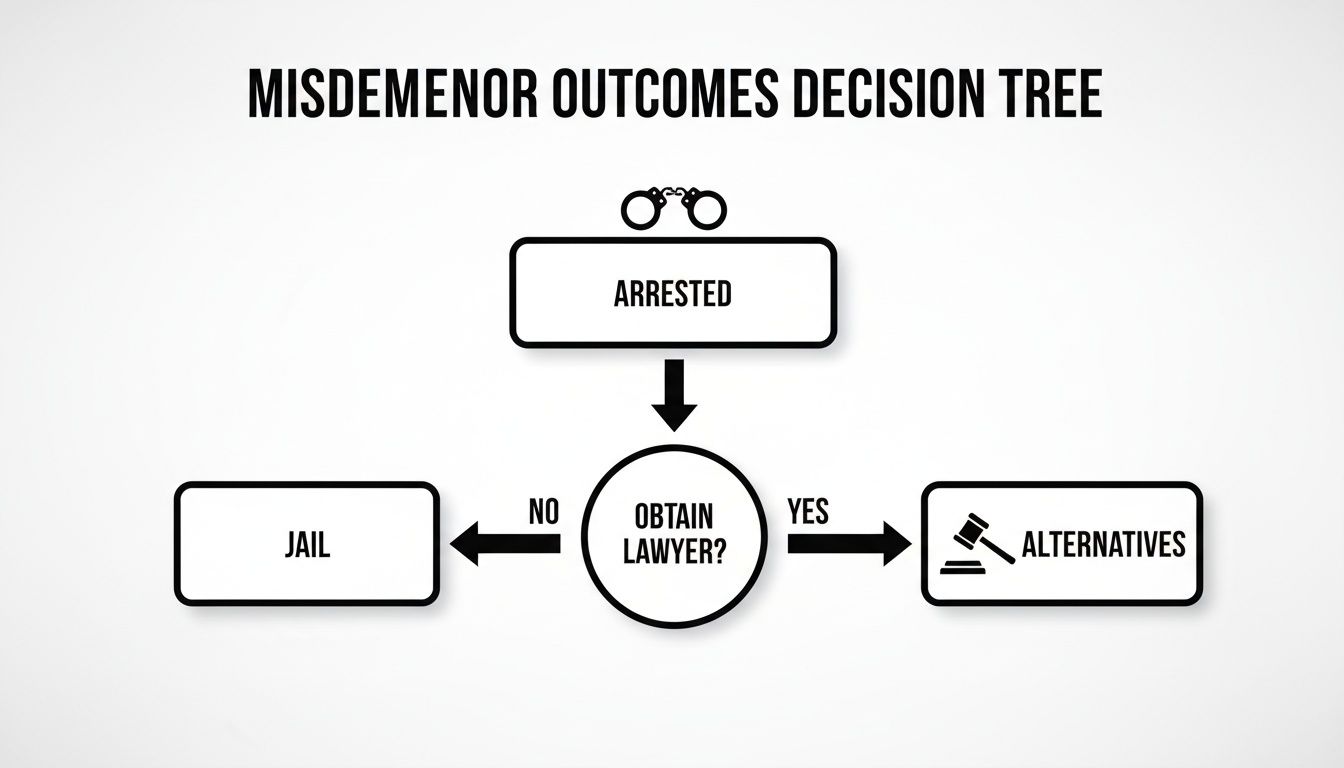
As you can see, hiring an attorney dramatically expands your options beyond a simple guilty or not-guilty plea, pointing you directly toward alternatives that keep you out of jail and help you maintain a stable home for your children.
Understanding Your Pretrial Options in Texas
When your lawyer sits down with the prosecutor, they argue the facts but also discuss whether you’d be a good fit for a pretrial diversion program. While each county has its own programs, they generally fall into two main categories.
- Pretrial Intervention (PTI) or Diversion Programs: This is a formal deal with the prosecutor’s office. You agree to complete a list of conditions over a set period, typically 6-12 months. If you succeed, the prosecutor dismisses your case.
- Deferred Adjudication: This involves pleading "guilty" or "no contest," but the judge doesn't find you guilty. Instead, the judge "defers" that finding and places you on a form of probation. Complete it successfully, and the case is dismissed, meaning you avoid a final conviction. Our firm has a detailed guide if you want to learn more about how deferred adjudication works in Texas.
These options are a lifeline, but they aren’t automatic. Your eligibility often hinges on the specific charge, your criminal history, and local county policies. For parents, successfully completing such a program is a powerful way to demonstrate stability and responsibility, which is crucial in any family law or CPS matter.
The goal of a pretrial program is twofold: it gives you a path to redemption without the lifelong stain of a criminal record, and it allows the justice system to focus on more serious offenses. It’s a constructive solution that helps keep families together.
A Real-Life Example of a Second Chance
Consider a young mother we’ll call Maria. After a shoplifting incident—a Class B misdemeanor—she was terrified. A conviction could mean jail time, losing her job, and potentially triggering a CPS investigation into her ability to care for her child.
Scared and feeling hopeless, her family hired an attorney. We immediately saw that Maria, a single parent with a clean record who made a desperate mistake, was the perfect candidate for a pretrial diversion program.
We negotiated with the prosecutor and got Maria accepted. For the next year, she had a checklist:
- Complete an anti-theft education course.
- Perform 40 hours of community service.
- Pay restitution for the stolen items.
- Stay out of trouble and avoid any new arrests.
It wasn't easy, but Maria was determined to protect her family. She completed every requirement. At her final court date, the prosecutor formally dismissed the charge. Maria walked out of that courthouse with no conviction, no jail time, and a clean slate. Her one mistake didn't define her future as a mother because she was given a chance to prove it was just that—a mistake. That’s the power of these pretrial resolutions.
Negotiating Powerful Alternatives to Incarceration
When a complete dismissal is off the table, the fear of jail can be all-consuming. It’s easy to feel like the walls are closing in, especially if this isn't your first brush with the law. But this is exactly where the real fight often begins. The focus shifts from getting the case thrown out to creatively negotiating for your freedom.
The new goal is to prove to the prosecutor and the judge that you are more than just the charge against you. We work to show that a constructive alternative—one that keeps you working, with your family, and out of jail—is a better solution for everyone involved. This is about humanizing your situation and making a compelling case for rehabilitation over punishment, especially when children are involved.
Building Your Case for Mitigation
"Mitigation" is the legal term for presenting evidence about your character and circumstances to lessen a potential sentence. It’s our opportunity to paint a full picture of your life, highlighting your responsibilities as a parent and your value to your family and community.
An effective mitigation strategy includes tangible proof of your stability:
- Proof of Employment: A letter from your boss about your work ethic and how your absence would impact your family's financial stability.
- Family Responsibilities: Statements from loved ones explaining your critical role as a caregiver for your children or elderly parents.
- Proactive Rehabilitation: Documentation showing you've already enrolled in counseling, like parenting classes or anger management, before a judge orders it. This is extremely powerful.
- Letters of Support: Character references from friends, teachers, or community leaders who can speak to your character as a parent and person.
By pulling this together, we build a strong argument that sending you to jail would cause far more harm than good, disrupting a stable home and punishing innocent children who depend on you.
A Real-World Example: A Second DWI Charge
Imagine a father—we’ll call him Mark—arrested for his second DWI, a Class A misdemeanor. Jail time feels almost inevitable. The prosecutor’s first offer includes a lengthy jail sentence, and Mark is terrified of losing his job and being separated from his children.
Instead of accepting this, we got to work. We gathered evidence showing Mark was the sole provider for his two young kids. We presented pay stubs and a letter from his boss of ten years, praising his dedication and confirming he’d be fired if he were incarcerated, leaving his family with no support.
Most importantly, we showed the judge that Mark had already taken responsibility. He had enrolled himself in an intensive outpatient alcohol treatment program. He wasn’t waiting to be told what to do; he was already doing the work to be a better father.
By presenting Mark as a committed father and a proactive individual serious about getting help, we completely changed the conversation. The focus shifted from punishment to finding a practical solution that allowed him to keep his job, support his family, and continue his treatment.
In the end, the judge agreed to sentence Mark to probation instead of jail. He kept his life on track while being held accountable. That’s the power of strategic negotiation—it can turn a seemingly hopeless situation into a second chance for your family.
Common Alternatives to Jail in Texas
When we negotiate with prosecutors, we have a toolbox of options to propose instead of jail. The most common is community supervision, or probation. This lets you serve your sentence in the community under strict conditions. If you're wondering about the specifics, you can learn more about how probation works in Texas in our detailed guide.
Other powerful alternatives include:
- Substantial Fines: Agreeing to a higher fine in exchange for no jail time.
- Specialized Counseling: Attending mandatory courses for parenting, anger management, or substance abuse.
- Community Service: Completing hours working for a non-profit organization.
These alternatives are more common than you might think. For a Class B misdemeanor, the maximum penalty is 180 days in jail. However, data shows that over 60% of these cases are resolved without any jail time when an attorney negotiates effectively. Most people who do serve time serve 30 days or less—and many serve none at all because of these alternatives.
Clearing Your Record and Reclaiming Your Future
Getting through your misdemeanor case without jail time is a huge victory for your family. But the battle isn't over. A criminal record can cast a long shadow, creating invisible walls that block you from jobs, housing, and even volunteering at your child's school.
This is the next fight: ensuring one mistake doesn't define the rest of your life. The good news is that Texas law provides powerful tools to help you wipe the slate clean. The goal isn’t just to put the case behind you—it’s to make it like it never happened, protecting your family from future consequences.
Expunction vs. Nondisclosure in Texas
Two legal paths can help you get your future back: expunction and an order of nondisclosure. They sound similar, but they apply to different situations and have different results.
- Expunction: This is the ultimate fresh start. An expunction results in the physical destruction of all records related to your arrest. Legally, it's as if it never occurred.
- Order of Nondisclosure: This process seals your record from the public. This means most private employers, landlords, and anyone running a typical background check won't see the charge. However, law enforcement and certain government agencies, including CPS, can still access the sealed information.
Figuring out which one you qualify for is critical, and it depends on how your case was resolved. Generally, you can pursue an expunction if your case was dismissed, you were found not guilty, or you completed a pretrial intervention program. Nondisclosure is usually the path for those who successfully completed deferred adjudication.
A Real-World Story of Sealing a Record
Let's talk about a real-life example. A young professional, we'll call her Sarah, was charged with a Class B misdemeanor. It was a one-time incident, but the charge was a direct threat to her career and her ability to adopt a child in the future.
We negotiated a deferred adjudication plea for her. Sarah did everything she was supposed to—completed probation, paid fines, and kept a clean record. Once finished, the case was officially dismissed. But the arrest record was still visible.
That’s when the real work began. We filed a petition for an order of nondisclosure. The judge granted it, and her record was sealed. A few months later, she applied for her dream job, which required an exhaustive background check. She passed with flying colors. Sarah's story is a perfect example of why the process doesn't end with a dismissal; it ends when your future is truly yours again.
An arrest record, even without a conviction, can feel like a life sentence. Expunctions and nondisclosures are the legal equivalent of a pardon—they give you back the future you and your family deserve.
Once you’ve handled the legal side, it’s smart to understand exactly what shows up on a background check for employment. Knowing this helps you take the right steps.
The process of clearing your name is technical and demands precise legal filings. If you think you might be eligible, you need to act. You can learn more about how to expunge a misdemeanor in Texas in our detailed guide. Taking this final step isn't just paperwork; it's about reclaiming your name and ensuring your past doesn't limit your family's future.
Common Questions We Hear About Texas Misdemeanors
When you're thrown into the criminal justice system, your mind races. The "what-ifs" pile up, and the uncertainty can be crushing, especially when you're worried about your children. Here are some of the most common questions we get from parents in your exact situation.
Do I Really Have to Show Up for Every Single Court Date?
Yes. One hundred percent. Attending every scheduled court appearance is non-negotiable. Missing a date, even for what feels like a minor charge, creates a much bigger problem. The judge will almost certainly issue a warrant for your arrest.
What started as a simple misdemeanor can quickly become a nightmare. Once arrested on that warrant, you’re back in jail, and the judge won't be in a forgiving mood. It tells the court you’re not taking this seriously, which can destroy your chances of getting a good outcome and may even be used against you in a CPS case to show instability.
Is My Boss Going to Find Out About This Misdemeanor Charge?
It’s possible, but not guaranteed. If you have to miss work for court, you'll need an explanation. More directly, an arrest is a public record. If your employer runs a background check or a local news outlet publishes arrest logs, the information is out there.
The best approach is to get ahead of it. A lawyer can walk you through your rights and advise if you must disclose an arrest to your employer. Our main goal is always to resolve your case in a way that opens the door for an expunction or nondisclosure, sealing the record from most future background checks and protecting your livelihood.
So many parents' first worry is about their job and providing for their family. It's a valid concern, and the most effective way to protect your career is to focus on the long-term goal: getting your record cleared for good.
Can I Really Go to Jail for a First Offense?
Yes, it is possible to face jail time for a first-time misdemeanor in Texas, particularly for Class A and Class B charges. A first-offense DWI (Class B) carries a potential jail sentence of up to 180 days. A first-offense assault causing bodily injury (Class A) can mean up to one year behind bars.
However, "possible" doesn't mean "probable," especially with a solid defense. For first-time offenders, judges are often more willing to consider alternatives, such as:
- Pretrial Intervention (PTI): A program that results in a full dismissal.
- Deferred Adjudication: A form of probation that keeps a final conviction off your record.
- Community Supervision: Standard probation served in the community instead of a jail cell.
An experienced attorney's job is to build a strong case showing you're a good candidate for these options. We highlight your clean record, your ties to the community, and your role as a parent to show that this was a one-time mistake. We fight to make sure a single error in judgment doesn't lead to jail time and a permanent conviction that could harm your family.
Facing a misdemeanor charge is serious, but you don't have to navigate this frightening time alone. The attorneys at The Law Office of Bryan Fagan, PLLC have the experience and compassion to protect your rights, your freedom, and your family. If you are worried about how to avoid jail time for a misdemeanor and the impact it could have on your children, call us today for a free, confidential consultation. Let us help you find the best path forward. Visit us at https://texascpslawyer.net.