Skip to content
The moment you see flashing lights in your rearview mirror, your world can feel like it’s grinding to a halt. If you’re a parent, the fear isn’t just for yourself; it’s for your family. A charge of Driving While Intoxicated (DWI) in Texas can feel like a direct threat to your ability to provide, to be present for your children, and to maintain the life you’ve built. The confusion and anxiety can be overwhelming, but it's in this critical moment that your first actions can lay the groundwork for a successful defense. You are not just a case number; you are a parent fighting for your future, and getting your case dismissed starts now.
Your First Moves After a Texas DWI Arrest
A DWI arrest can plunge you into a legal nightmare, especially when your primary concern is the well-being of your children. The flood of questions is immediate: What happens to my job? How will I get my kids to school? Could this affect my custody rights? This fear is real and justified. However, it's crucial to understand that an arrest is not a conviction. The path forward begins with protecting your rights and taking swift, decisive action.

The minutes and hours after a DWI arrest are a blur. Your mind is probably racing with worries about your job, your reputation, and how this will all impact your kids. It’s an incredibly heavy burden, and the legal system can feel like an impossible maze. The most important thing to remember is that you don't have to figure this out alone, and the choices you make right now truly matter.
Protecting Your Rights from the Start
Your number one priority should be protecting your constitutional rights. Police officers are trained to gather evidence against you, and anything you say can and will be used to build their case. It is essential that you exercise your right to remain silent.
You can do this respectfully. Simply state, "Officer, I am choosing to remain silent and I would like to speak with an attorney." This isn't an admission of guilt; it's a smart, legal protection that you are entitled to. Whatever you do, don't try to explain yourself or talk your way out of it on the side of the road. Those conversations almost never help and often just give the prosecution more ammunition.
The Two Battles You Must Fight
Here’s something most people don’t realize: a DWI charge in Texas kicks off two separate legal battles at the same time. Focusing only on the criminal charge is a common and costly mistake, one that can lead to you losing your license before your case even gets to court.
- The Criminal Case: This is what most people think of—the State of Texas prosecuting you for Driving While Intoxicated. The penalties can range from hefty fines and probation to mandatory classes and even jail time.
- The Administrative License Revocation (ALR) Case: This is a civil case brought by the Texas Department of Public Safety (DPS) to suspend your driver's license. If you don't act fast, this happens automatically.
You have only 15 days from the date of your arrest to request an ALR hearing. If you miss this deadline, your license will be automatically suspended, no matter what happens in your criminal case.
This deadline is strict and non-negotiable. Requesting the ALR hearing does more than just give you a chance to save your license. It's also an invaluable opportunity for your lawyer to question the arresting officer under oath, which can uncover evidence and testimony that can be used to dismantle the criminal case. Getting a handle on what's involved in a DWI in Texas for a first offense can give you much-needed context during this incredibly stressful time.
Imagine a single dad, let's call him Mark, who was pulled over for a minor traffic violation after having two beers with dinner. Worried and flustered, he remembered a piece of advice: stay calm and say as little as possible. He politely declined the roadside tests and invoked his right to an attorney. The next day, he hired a lawyer who immediately filed the ALR hearing request. By taking these quick, informed steps, Mark kept his license, allowing him to continue driving to work and taking his daughter to school. More importantly, he gave his legal team a crucial head start in building a defense aimed at getting the entire case dismissed.
Building a Defense to Get Your DWI Dismissed
Getting hit with a DWI charge feels like a ton of bricks just landed on you. But here's the first thing you need to remember: it's an accusation, not a conviction. The State of Texas has the massive burden of proving its case beyond a reasonable doubt, and that's often harder than they make it seem.
Building a powerful defense isn't about one magic bullet. It’s about a methodical, piece-by-piece breakdown of the prosecution's evidence. We hunt for the procedural mistakes and weaknesses that can unravel their entire case and pave the way for a dismissal.
Many folks we work with assume the evidence is rock-solid. That's almost never the case. Every single step of a DWI investigation—from the moment those blue lights flash in your rearview mirror to the final breath or blood test—is governed by strict legal rules. When an officer messes up, it creates an opportunity.
Questioning the Initial Traffic Stop
The entire case lives or dies on the legality of that initial traffic stop. An officer can't just pull you over because they have a "hunch." They need reasonable suspicion—a legitimate, factual reason to believe you've broken a traffic law or are involved in something illegal. Without that, everything that happens next can be thrown out of court.
So, what counts as reasonable suspicion? It could be something obvious like speeding or running a red light. But it can also be as minor as a broken taillight. The key is whether the officer's reason was legitimate or just a flimsy excuse. A momentary drift inside your own lane, for instance, might not be enough. A good DWI lawyer will immediately get their hands on the police report and any available dashcam footage to see if the officer's story actually holds water.
The Unreliability of Field Sobriety Tests
After the stop, the officer will likely ask you to perform a series of "tests" on the side of the road. These Standardized Field Sobriety Tests (SFSTs) are notoriously difficult, often administered in the worst possible conditions—dark, uneven ground, with traffic whizzing by. Let's be honest: they are designed for you to fail.
Their subjectivity and potential for error are huge weak points for the prosecution. Several factors can make these tests completely unreliable, giving us strong grounds for a defense:
- Environmental Conditions: Poor lighting, sloped surfaces, and bad weather can trip up even the most sober person.
- Medical Issues: Do you have inner ear problems? A bad back? Are you overweight? Any of these things can make it physically impossible to "pass" the walk-and-turn or one-leg stand tests.
- Improper Instructions: Officers are required to give instructions exactly as laid out by the National Highway Traffic Safety Administration (NHTSA). If they mess up the script, the test results are invalid.
This is where the officer’s own camera footage becomes our best friend. It can expose sloppy instructions or show that you performed far better than what the police report claims.
Real-World Scenario: We once represented a father who was arrested after an officer claimed he "failed" the walk-and-turn test. The dashcam video told a different story. It clearly showed our client performing the test on a steeply sloped shoulder next to speeding traffic. We argued the conditions made a fair test impossible, and the judge agreed to suppress the FST evidence, significantly weakening the prosecutor's case.
Challenging Breath and Blood Test Results
Chemical tests, like breathalyzers or blood draws, seem scientific and foolproof. They aren't. Their accuracy is completely dependent on perfect procedures, from machine maintenance to sample handling. One mistake anywhere along the line can make the results inadmissible in court.
For a breath test, your attorney will dig into the details:
- Machine Maintenance: Was the Intoxilyzer machine recently and properly calibrated? We demand to see the maintenance logs.
- Operator Certification: Was the officer even certified to use that specific device?
- Observation Period: Did the officer watch you for the required 15-minute period before the test? This is to ensure you didn't burp or bring up any mouth alcohol, which can artificially inflate the reading.
With a blood test, the "chain of custody" is everything. Was the blood drawn by a qualified phlebotomist? Was the vial properly sealed, labeled, and stored? Was there any chance of contamination or tampering as it was transported to the lab? Any break in this chain makes the result suspect. To get a better sense of these strategies, you can learn more about how to beat a DWI charge.
Skilled legal representation makes a world of difference. An experienced lawyer knows exactly where to look for weaknesses, like challenging breathalyzer accuracy or showing how a medical condition skewed a sobriety test. A DWI charge is a complex legal puzzle. By carefully taking apart each piece—the stop, the field tests, and the chemical evidence—a sharp attorney can find the flaws needed to dismantle the prosecution's case and fight for the dismissal you and your family deserve.
Navigating the Legal System to Find Dismissal Opportunities
When you’re facing a DWI charge, the court system can feel like a foreign country with its own language and rules. But here’s something the prosecution doesn’t want you to know: every single stage of that process is an opportunity for a skilled attorney to challenge their case against you. A strong defense doesn’t just sit back and wait for trial. It starts looking for weaknesses from day one.
The journey through the Texas DWI legal system isn’t quick or simple, but it’s during these pre-trial phases that the most important work often gets done. It's where we lay the groundwork to get your case thrown out.
The flowchart below gives you a bird's-eye view of how a DWI encounter unfolds, from the moment those blue and red lights flash in your rearview mirror to the chemical tests that follow.
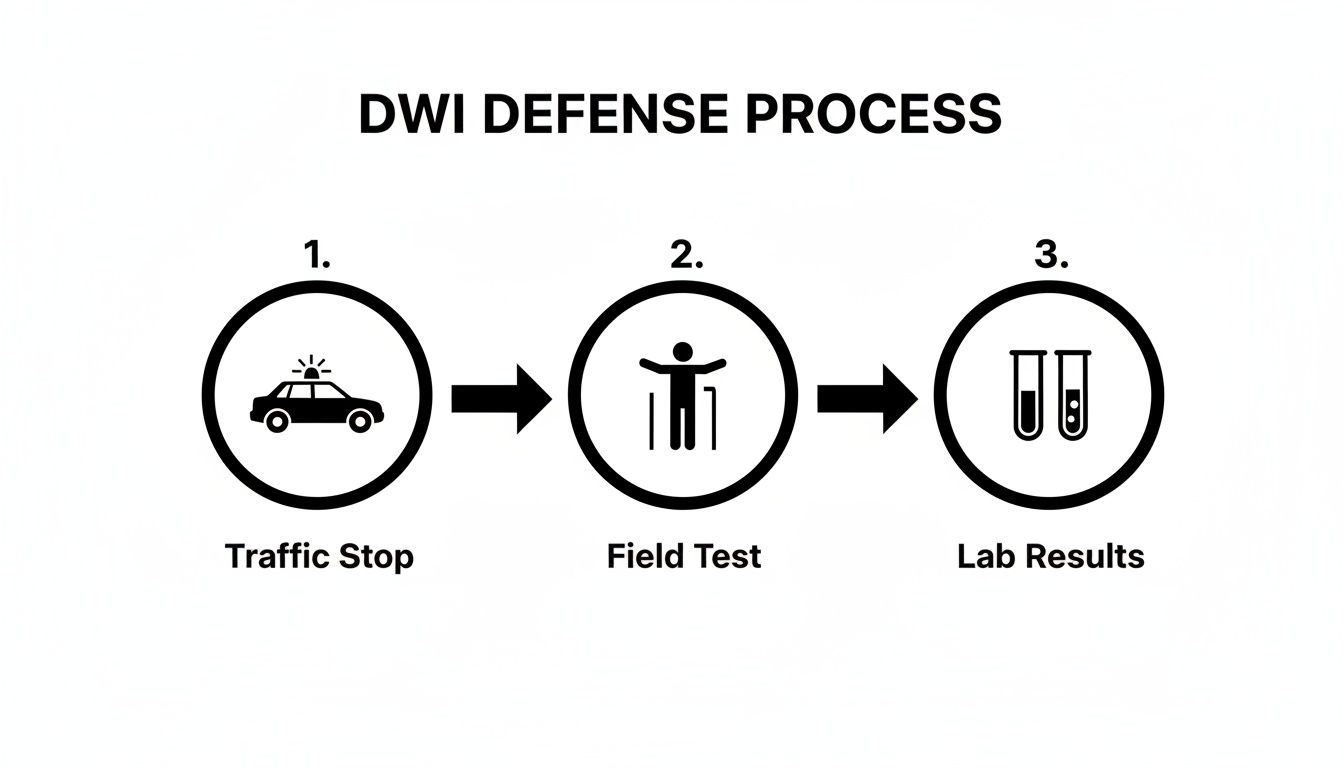
Think of this as a roadmap. Every step is a potential misstep for law enforcement, and an experienced lawyer knows exactly what to look for.
The table below breaks down the key legal stages and shows where we can strategically push for a dismissal.
Key Procedural Milestones and Dismissal Opportunities
This table outlines the typical stages of a Texas DWI case and highlights the specific actions a defense attorney can take at each point to work towards a dismissal.
| Legal Stage | Primary Purpose | Dismissal Opportunity |
|---|---|---|
| Arraignment | To formally hear the charges and enter a plea. | Challenge the probable cause for the arrest from the outset. |
| Discovery Phase | To obtain all evidence from the prosecution. | Find inconsistencies in police reports, contradictory video, or procedural errors. |
| Pre-Trial Motions | To ask the court to rule on legal issues before trial. | File a Motion to Suppress illegally obtained evidence, which can cripple the DA's case. |
| Plea Negotiations | To discuss potential resolutions with the prosecutor. | Leverage weaknesses found in discovery to negotiate for a dismissal or a reduced charge. |
| Trial | To present evidence and arguments to a judge or jury. | Expose reasonable doubt through cross-examination and expert testimony, leading to a "not guilty" verdict. |
| Post-Conviction | To address errors after a conviction. | Appeal legal errors made during the trial or seek to have the record cleared later. |
Each of these milestones represents a critical juncture where a well-prepared defense can turn the tables on the prosecution.
The Power of the Discovery Phase
Right after an arrest, the legal battle truly begins with "discovery." This is where your attorney formally demands that the prosecutor hand over all the evidence they have against you. This isn’t a friendly request; it’s your constitutional right.
This evidence packet is a treasure trove for your defense. It usually includes:
- The arresting officer's sworn police report.
- All body camera and dashcam footage from the incident.
- The full results of any breath or blood tests, plus the maintenance and calibration logs for the machines.
- Any statements taken from witnesses.
This is where your defense team goes on the offensive. We don't just skim the police report. We tear it apart, looking for every inconsistency, procedural screw-up, and violation of your rights. Does the video show you walking perfectly fine, even though the officer wrote you were stumbling? Was the breathalyzer machine last serviced a year ago? These are the details that can sink the state’s case. If you're curious about how procedural issues can lead to charges being dropped in other contexts, some general guides on how to get a traffic ticket dismissed offer similar insights.
Using Pre-Trial Motions to Exclude Evidence
Based on what we uncover during discovery, your attorney can file powerful legal arguments called "pre-trial motions." Think of these as strategic strikes that ask the judge to make a ruling before a trial even starts. The most critical weapon in our arsenal is the Motion to Suppress Evidence.
A Motion to Suppress is a formal request asking the court to throw out certain evidence because it was obtained illegally. If the judge grants this motion, it's often a knockout blow for the prosecution.
The goal is to prove to the judge that the police violated your constitutional rights. If the initial traffic stop was illegal, the field sobriety tests were administered incorrectly, or the blood draw was invalid, none of that evidence should be allowed in court. Without their key evidence, the prosecutor is often left with no choice but to dismiss the charges.
This isn't about finding a "loophole." It’s about holding the police and the prosecution to the strict constitutional standards they are sworn to follow. Every move they make is an opportunity for an error, and every one of their errors is an opportunity for your defense. By systematically attacking the state’s evidence, an experienced lawyer builds a powerful case for getting your DWI dismissed long before a jury is ever selected.
Exploring Alternatives to a DWI Trial
A full dismissal is always the primary goal, but it's not the only way to safeguard your family's future. For most people facing a DWI charge, the thought of a courtroom battle is absolutely terrifying. The good news? A trial isn't always necessary. There are other strategic paths that can lead to a positive outcome and keep a permanent DWI conviction off your record.

When the evidence against you is flimsy, an experienced attorney will push aggressively for a dismissal. But even when the state’s case seems solid, there are still avenues that offer hope and a way forward. These alternatives exist because the system recognizes that good people make mistakes and deserve a chance to move on without a lifelong black mark on their record.
Plea Bargaining for a Lesser Charge
One of the most common and effective alternatives is negotiating with the prosecutor for a plea bargain to a lesser offense. This isn't about "giving in"; it's a calculated legal move to lock in a better result than you might get by rolling the dice at trial. In Texas, a common objective is to get a DWI reduced to a charge like Obstruction of a Highway.
While still a serious charge, it comes with a huge advantage: it's not an alcohol-related driving offense. This means you can sidestep the harsh, automatic penalties of a DWI conviction, like a long driver's license suspension and crippling insurance premiums. For a parent who needs to drive to work or get their kids to school, this can be an absolute lifeline. While your case is ongoing, it's also smart to learn how to get an occupational license in Texas.
The reality is that many DWI cases don't end in a dramatic trial or a complete dismissal. They are often resolved through smart, tough negotiation that minimizes the long-term damage to your life and livelihood.
The chances of securing a reduced charge depend heavily on the strength of your legal representation and the specific facts of your case. A skilled attorney who finds weaknesses in the prosecutor's evidence can use that leverage to negotiate a much better outcome for you and your family.
Diversion Programs as a Path to Dismissal
For many first-time offenders, pre-trial diversion programs are an incredible opportunity. These programs aren't offered in every Texas county and the eligibility rules can be strict, but they essentially function as a second chance. Instead of battling it out in court, you agree to complete a set of requirements over a certain period.
These requirements are meant to be more rehabilitative than punitive and usually include things like:
- Completing an alcohol awareness or education course.
- Putting in a set number of community service hours.
- Paying program fees and court costs.
- Staying out of trouble and avoiding any new arrests during the program.
Real-World Scenario: Picture a young mother, just starting her career, who makes a mistake one night and is arrested for a first-time DWI. She’s panicked that this one error will destroy everything she's worked for and impact her ability to care for her child. Her attorney discovers she’s eligible for the county's diversion program. For the next year, she diligently attends her classes, finishes her community service, and stays out of trouble.
Once she successfully completes all the requirements, the prosecutor dismisses the DWI charge completely. Because the case was dismissed, she can later petition the court for an expunction, which permanently destroys every record of the arrest. For her, and countless others in her shoes, a diversion program is more than just a legal option—it's the key to a clean slate and a future that isn't defined by one bad night.
Why a Texas DWI Lawyer Is Your Strongest Ally
When you're facing a DWI charge in Texas, it can feel like the whole world is against you. It's a lonely, powerless feeling, and the reality is, the state has a team of experienced prosecutors whose entire job is to secure a conviction. Trying to go it alone against that kind of machinery is a monumental risk—not just to your freedom, but to your family’s stability and your entire future.
This is where a seasoned DWI lawyer steps in. They're not just a legal representative; they become your advocate, your guide, and your most committed defender. But let’s be clear: simply having any lawyer isn't enough. You need someone who lives and breathes Texas DWI defense.
Beyond the Basics: What a DWI Specialist Really Does
Hiring a true DWI attorney goes far beyond having someone show up to court for you. A specialist digs into the intricate, often-missed details of your case, performing a forensic-level analysis that a general practice lawyer simply wouldn't know to do. Their job is to aggressively challenge the state’s case at every single turn.
It’s a meticulous, deep-dive process:
- Deconstructing the Arrest: They get their hands on every shred of evidence—police reports, body camera footage, dispatch logs—and scrutinize them for inconsistencies, procedural errors, or violations of your rights.
- Challenging the Evidence: They don't just accept the state's evidence at face value. They investigate the maintenance records of the Intoxilyzer machine, question the qualifications of the blood technician, and meticulously track the "chain of custody" of your blood sample to look for contamination or mishandling.
- Filing Strategic Motions: Armed with this information, they file powerful pre-trial motions to suppress illegally obtained evidence. A successful motion can dismantle the prosecutor's case before you ever see a courtroom.
An experienced DWI lawyer knows that the state's evidence is rarely as bulletproof as it seems. Their job is to find the cracks in the prosecution's foundation and use them to build your defense.
This specialized knowledge is absolutely critical. For a parent whose job depends on their driver's license, an attorney's skill in navigating the complex Administrative License Revocation (ALR) hearing is just as crucial as their work on the criminal side.
Leveraging Relationships and Local Court Knowledge
Justice doesn’t happen in a vacuum. It plays out in real courtrooms, with real prosecutors and judges who have their own tendencies, workloads, and professional relationships. An attorney who is a regular in a specific county courthouse knows the key players. They have a feel for which arguments resonate with certain judges and what kind of plea offers a particular prosecutor might be open to.
This local insight is an invaluable, unspoken advantage. Your attorney’s reputation and professional rapport can open doors to negotiations that might otherwise be slammed shut. They can leverage weaknesses in the state’s case to negotiate for a reduction to a non-alcohol-related offense, like Obstruction of a Highway, or push for entry into a diversion program that ultimately leads to a full dismissal.
Here’s how that plays out in the real world: Imagine a father facing a borderline DWI case. The breath test result is just a hair over the legal limit, and the dashcam video of the sobriety tests is ambiguous at best. A lawyer who doesn’t know the local prosecutor might dig in their heels and prepare for a risky, all-or-nothing trial.
But an attorney who has worked with that prosecutor for years knows they are reasonable and don't like taking uncertain cases to a jury. Leveraging that established professional trust, the attorney presents the video's weaknesses and highlights their client's clean record and family responsibilities. The prosecutor, trusting the attorney's assessment, agrees to reduce the charge. This single conversation saves the father from a DWI conviction that could have cost him his job and devastated his family.
Trying to figure out how to get a DWI dismissed is not a journey you should ever take by yourself. The stakes—your reputation, your career, and your family's well-being—are simply too high. A dedicated DWI attorney does more than just represent you; they stand with you, fighting to protect everything you've worked so hard to build.
Answering Your Most Urgent Questions
When you’re staring down a DWI charge, your mind is probably racing with a million questions. The fear of what this means for your job, your license, and your family can be completely overwhelming. It's the uncertainty that hits the hardest.
Let's cut through the noise. Here are some direct, clear answers to the questions we hear most often from Texas families going through this exact situation.
What Are My Real Chances of Getting a DWI Dismissed?
This is usually the very first question people ask, and the honest answer is: it all comes down to the specific facts of your case. There is no magic number that applies to everyone.
A dismissal isn't about getting lucky. It’s about a skilled attorney digging into the details and finding the weak spots in the state's case. Maybe the traffic stop wasn't legal. Maybe the field sobriety tests were administered improperly. Or maybe the breath or blood test evidence is faulty. Your chances improve dramatically when you have an expert actively hunting for these flaws and building a defense based on the law and the facts.
Can a First-Time DWI Be Dismissed?
Absolutely. In fact, a first-time offense often presents more opportunities for a positive outcome. Prosecutors and judges are sometimes more willing to consider alternatives for someone with an otherwise clean record.
This could open the door to things like a pre-trial diversion program, where completing certain requirements leads to a dismissal. It might also mean negotiating a plea deal for a lesser, non-alcohol-related offense, like Obstruction of a Highway. A dismissal is never a given, but for a first offense, the pathways to protecting your record are often wider.
The single most important factor in any DWI case, especially a first-time charge, is a proactive defense. Just waiting around to see what the prosecutor offers isn't a strategy. Building a strong case for dismissal from day one—that's a strategy.
How Long Will This DWI Case Take?
Brace yourself, because a DWI case in Texas is definitely not a quick process. While every situation is unique, it's pretty common for a case to last anywhere from six months to well over a year.
Several things can affect the timeline, like how backed up the court dockets are in your county, the complexity of the evidence (especially if it involves a blood test), and the specific legal strategies we decide to use. I know that sounds like a long time, but that time can actually be your friend. It gives your attorney the breathing room needed to conduct a thorough investigation, file all the necessary legal motions, and negotiate from a position of strength, not desperation.
If My Case Is Dismissed Can I Clear My Record?
Yes, and this is a final step you absolutely cannot skip. A dismissal is great—it means you weren't convicted. However, the record of your arrest doesn't just vanish. It still exists and can pop up on background checks for jobs, housing, and loans.
To truly wipe the slate clean, you have to pursue an expunction. This is a separate legal action where we go back to court and get a judge to sign an order that forces all government agencies to permanently destroy the records of your arrest. An expunction is the only way you can legally deny that the arrest ever even happened. It’s how you get your life completely back on track.
The weight of a DWI charge can feel crushing, but you do not have to carry it alone. At The Law Office of Bryan Fagan, we understand what’s at stake for you and your family. We see the person behind the charge—the parent, the provider, the community member. We are here to offer the compassionate guidance and aggressive defense you need to fight for the best possible outcome. Your family's future is our priority.
Contact us today for a free, confidential consultation to discuss your case. Let us help you understand your options and begin building the strong defense you deserve.
Learn more about your options by visiting https://texascpslawyer.net.