Skip to content
The moment you hear the word "mediation" in a Texas CPS case, a wave of fear and confusion can hit you. It feels like another legal hurdle in a journey that's already emotionally exhausting. But I want you to see it differently. Think of mediation as your first real opportunity to have a powerful voice in your family's future, a structured negotiation designed to find a path forward. Preparing for this day is the single most important factor in whether you walk away with a positive, family-focused outcome.
Getting ready comes down to a few critical actions: you need to gather all your documents, sit down with your attorney to define clear goals, learn how to manage your emotions for effective communication, and understand the role of every single person in that room.
Why Preparation Is Your Strongest Tool in CPS Mediation
Facing mediation in a CPS case is, frankly, terrifying. The uncertainty, the fear for your kids, and the sheer weight of the legal process can feel paralyzing. But I need you to see mediation for what it really is: an opportunity.
Unlike a courtroom where a judge you've never met makes the final call, mediation puts you in the driver's seat. It allows you to negotiate a resolution that actually works for your family. This is your chance to show the progress you've made, advocate for your children, and help shape the path toward reunification.
I remember a client, we'll call her Maria. When CPS first got involved, she felt completely lost, consumed by confusion and fear. When mediation was scheduled, her anxiety went through the roof. But by working closely with her attorney, she was able to shift her focus from fear to action. They spent weeks getting ready, turning her feeling of being overwhelmed into a clear, strategic plan. That preparation empowered her to walk into the mediation not as a victim, but as an informed, prepared advocate for her family.
Understanding the Stakes and Your Role
The Texas Family Code, particularly chapters like 262 and 263 which govern CPS investigations and timelines, provides the legal framework for all of this. A Mediated Settlement Agreement (MSA) reached in this process is legally binding and—this is critical—irrevocable once signed.
That finality is exactly why knowing how to prepare for mediation isn't just helpful—it's absolutely essential. Your preparation directly impacts the terms of an agreement that will define your family's life for months, or even years, to come.
Your most critical first step? Securing experienced legal counsel. An attorney who specializes in Texas CPS cases can guide you through the legal maze and help you build a strong, persuasive case. If you're just starting this process, figuring out how to find a CPS lawyer near you is a foundational piece of your preparation puzzle.
Your attorney is more than just a legal representative; they are your strategist, your advocate, and your guide. Leaning on their expertise allows you to focus on what matters most: demonstrating your commitment to providing a safe and stable home for your children.
Ultimately, solid preparation transforms mediation from a daunting legal hurdle into a constructive conversation. It replaces anxiety with confidence, allowing you to present your case clearly and negotiate from a position of strength—just like Maria did.
The Law Office of Bryan Fagan understands the immense pressure you are under. You don't have to face this alone. Our team is here to provide the compassionate and authoritative guidance you need to prepare effectively for your CPS mediation. Contact us today for a free consultation to discuss your case and learn how we can help you fight for your family's future.
Gathering Your Essential Documents and Evidence

A strong case in mediation isn’t built on emotion or promises—it’s built on a foundation of clear, organized evidence. Think of your documents as the building blocks of your story. Each one proves a point, shows your progress, and knocks down old, incorrect claims.
The goal here is to create a factual narrative that paints a clear picture: you are a capable, committed parent who provides a safe home. It can feel like a mountain of work, but this is one of the most powerful and proactive things you can do for your case.
Telling Your Story Through Paperwork
Every document you collect has one single, vital job: to prove you’re meeting the requirements set by CPS and the court. Under the Texas Family Code, especially Chapters 262 and 263, the entire focus is on child safety and a parent’s progress. Your evidence needs to speak directly to those issues.
Let me give you a real-world example. I once worked with a father—we’ll call him James—who was headed into mediation. The initial CPS reports painted him as unstable, all based on an incident that happened months ago. But that wasn’t his reality anymore.
James had moved into a new apartment, landed a stable job, and completed every single service on his plan. Before mediation, we put together a binder. Inside, we had his signed lease, three months of pay stubs, photos of his kid’s clean and safe bedroom, and certificates from his parenting and anger management classes.
When the CPS attorney started talking about the old problems, I just opened the binder. Page by page, we presented the evidence of his current, stable life. That single act shifted the entire conversation from past mistakes to present-day facts. We walked out with a favorable agreement.
Creating Your Mediation Binder
Your attorney will help you pinpoint the exact documents your specific case needs, but a well-organized binder (or a digital folder) is an absolute game-changer. It gives you and your lawyer instant access to crucial information when you’re in the thick of negotiations.
This isn't just busywork. It's about creating an undeniable record of your commitment.
Start by gathering these key categories of documents:
- CPS-Related Documents: This is the heart of your file. Make sure you have every piece of paper from CPS, including your official Family Service Plan and any safety plans you’ve signed.
- Proof of Completed Services: Get those certificates. Collect letters of completion or attendance records for every single class or program on your service plan—parenting classes, counseling, substance abuse treatment, you name it.
- Evidence of a Safe Home Environment: Show, don't just tell. Include your current lease or mortgage statement, recent utility bills, and clear photos of your home, paying special attention to your child's bedroom and the main living areas.
- Financial Stability Records: You need to demonstrate you can provide for your child. Recent pay stubs, a letter from your boss confirming your job, or your tax returns work perfectly.
- Records of Communication: Keep a log. Print out important emails or text message threads with your caseworker that show you’re being cooperative and proactive.
- Child-Related Documents: Gather your child's recent report cards, school attendance records, and any positive notes from teachers or doctors showing that they are doing well.
Key Takeaway: Your document binder is much more than just a stack of paper. It's a tangible, organized display of your progress. It gives your attorney the tools to fight for you and gives the mediator a clear, factual picture of your dedication.
This kind of organization is invaluable for mediation, but it will also serve you at every other stage of your case. For example, this same evidence is what you'll need when you prepare for a Texas CPS status hearing in front of a judge.
When you methodically assemble this proof, you turn abstract claims of "making progress" into concrete facts. You’re no longer just saying you’ve changed—you’re showing it, page by page. This is the cornerstone of successful mediation prep.
Defining Your Goals and Negotiation Strategy
Walking into mediation without a clear goal is like setting out on a road trip with no map. You'll end up somewhere, but it's probably not where you intended to go. This part of your prep work is about sitting down with your attorney and drawing that map, figuring out what a realistic, stable future for your family looks like.
This isn't just about making a wish list. It's about getting strategic. We need to move past the raw emotion of the situation and define a clear, legally sound vision that you can fight for.
Separating Wants from Non-Negotiables
In a high-stakes negotiation like a CPS case, you have to know the difference between what you want and what you absolutely need. Your attorney is there to help you sort through the noise and put your priorities into two simple buckets.
- Your Non-Negotiables: These are the hills you're willing to die on. For nearly every parent I've ever worked with, the number one non-negotiable is getting their children back home, safe and sound. This isn't just a parental instinct; it's a goal directly supported by the Texas Family Code, which always prioritizes keeping families together when it's safe to do so.
- Your Wants: Think of these as the more flexible details. They’re still important, but they are areas where you might be able to give a little to get what really matters. This could be anything from a specific visitation schedule to certain communication rules or who pays for soccer camp.
Let me give you a real-world example. I once represented a couple, let’s call them David and Sarah, whose kids were removed because of substance use concerns. Their non-negotiable was simple: get the kids back. Their wants included having the children home in time for Christmas and switching to a different counselor they felt they weren't clicking with.
By separating these, we could build a strategy. They agreed to stick with the current counselor (giving up a "want") to demonstrate their commitment and cooperation. This move helped them achieve their non-negotiable—the safe return of their children—much faster. That kind of strategic thinking is exactly how you prepare for mediation the right way.
Grounding Your Goals in Texas Law
Your goals have to be rooted in reality—specifically, the reality of what a Texas judge can and will likely order. This is where leaning on your lawyer's experience is non-negotiable in itself. They can walk you through how the standards in the Texas Family Code shape what’s possible, especially Chapter 263 (which covers case timelines) and Chapter 161 (which deals with the termination of parental rights).
For example, demanding your case be closed tomorrow when you’ve just started your service plan isn't a realistic goal. But aiming for increased visitation within 30 days, provided you have clean drug tests to show for it? That’s a concrete, measurable, and legally persuasive objective.
Your strategy has to be built on the hard realities of the legal system. When you tie your personal goals to the specific requirements of the Texas Family Code, you're not just asking for what you want—you're making a compelling legal argument that CPS and the mediator have to take seriously.
Understanding Your Best Alternative
A crucial piece of any negotiation puzzle is knowing what happens if you can't make a deal. In negotiation speak, this is your Best Alternative to a Negotiated Agreement (BATNA). It's your Plan B.
So, what does your BATNA look like here? It means the mediation ends, and you head back to the courtroom to let the judge make the final call. You and your lawyer need to have a very honest, candid conversation about what that would likely look like. What are your real chances of winning a contested hearing? What are the biggest risks?
Knowing your BATNA is a game-changer. It gives you power. It provides a clear-eyed view of the stakes and keeps you from accepting a bad deal just because you're scared or tired. If the final offer on the table is worse than what you could reasonably expect a judge to order, your BATNA gives you the strength to say "no, thank you" and walk away. The good news is that mediation is highly effective—global resolution rates often top 70%, proving that solid preparation usually leads to a solid agreement. Discover more insights about mediation trends on solveresolve.com.au.
Once you've defined your goals, grounded them in the law, and figured out your BATNA, you're no longer just showing up and hoping for the best. You're walking into that room ready to negotiate from a position of clarity, confidence, and strength.
Managing Emotions for Effective Communication
Let's be blunt: a CPS case is emotionally devastating. Walking into a mediation room to negotiate the future of your children and your family can feel like stepping into a pressure cooker. It’s completely normal to feel angry, scared, or defensive—in fact, it would be strange if you didn't.
But in that room, your greatest asset isn't your anger; it's your ability to communicate clearly and calmly. Learning to manage these powerful emotions isn't about pretending they don't exist. It's about channeling them so you can stay focused on the facts and on building the future you want for your kids. When emotions run high, it's far too easy for productive conversations to spiral into arguments, making it impossible to find any common ground.
Practical Techniques For Staying Composed
While your attorney will do most of the talking, your composure is still critical. Your ability to contribute constructively, even just with your presence, can shift the dynamic in the room.
One of the most effective tools is simple but incredibly powerful: active listening. Instead of just waiting for your turn to speak or mentally rehearsing your rebuttal, truly listen to what the CPS caseworker or their attorney is saying. When you understand their stated concerns—even if you completely disagree with them—you and your attorney can address those points directly with hard evidence.
Another key technique is to frame your points using "I" statements.
- Instead of saying, "You're not being fair," which sounds like an accusation, try reframing it from your own perspective.
- For example: "I feel like my progress isn't being acknowledged, and that's frustrating."
This simple shift changes the focus from blame to your own experience. It’s far less likely to provoke a defensive reaction and much more likely to open the door to a productive dialogue.
This infographic breaks down the core components of a solid negotiation strategy, which is always easier to execute when you have a clear head.
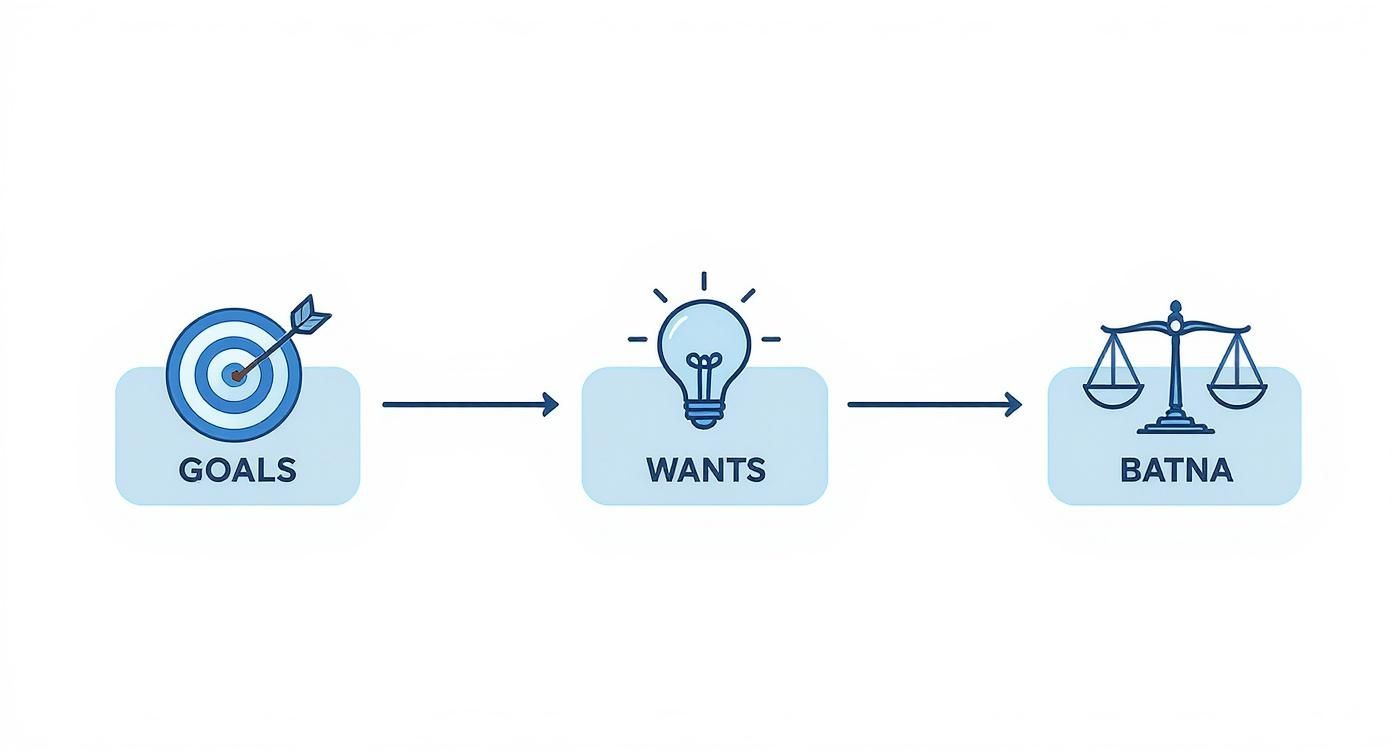
As you can see, having clear goals and understanding your non-negotiables gives you a strong foundation, making it easier to stay focused under pressure.
Your Mediator Is a Neutral Facilitator
It’s so important to remember this: the mediator is not a judge, and they do not work for CPS. Their only job is to be a neutral third party who helps everyone in the room find a way to an agreement. They are professionals trained to de-escalate conflict and guide the conversation toward a resolution.
Think of the mediator as a traffic controller for the discussion. They help translate heated statements into underlying interests and make sure everyone gets a chance to be heard in a structured way. Trusting in their neutrality can help lower the tension for everyone and create a safer space for honest negotiation.
Consider this real-world scenario: A mother named Jessica felt constantly attacked by the caseworker’s reports. Before mediation, her attorney helped her practice deep-breathing exercises and rehearsed key talking points. When a sensitive topic came up, Jessica felt her anger rise. Instead of lashing out, she paused, took a deep breath, and calmly said, "I understand that was a concern, but here is the certificate showing I completed the required counseling." Her calm, factual response completely changed the tone and moved the conversation forward.
Developing these emotional management skills isn't just for mediation day; they are crucial for your own well-being throughout this entire ordeal. Finding healthy ways to cope is a critical part of showing that you can provide a stable environment for your children.
For more guidance on staying resilient, we offer some practical self-care tips for parents under CPS investigation that can make a real difference.
To help you stay organized, we've put together a simple checklist summarizing the key preparation tasks.
Your Mediation Preparation Checklist
This table summarizes the essential tasks to complete before your mediation session, ensuring you're fully prepared to advocate for your family.
| Preparation Area | Key Actions |
|---|---|
| Document Gathering | Collect all relevant documents: service completion certificates, negative drug tests, communication logs with CPS, and any evidence disproving allegations. |
| Goal Setting | Clearly define your "must-haves" (non-negotiables) and "wants" (flexible items). Know what a successful outcome looks like for you. |
| Emotional Management | Practice calming techniques like deep breathing. Rehearse "I" statements to communicate your feelings without escalating conflict. |
| Strategy with Counsel | Meet with your attorney to review your goals, discuss your BATNA (Best Alternative to a Negotiated Agreement), and align on negotiation strategy. |
| Understand the Mediator | Remember the mediator is a neutral facilitator, not an adversary. Their role is to guide the conversation, not to judge or take sides. |
Using this checklist can help you walk into mediation feeling more in control and ready to focus on achieving the best possible outcome for your children.
What to Expect on Mediation Day

After weeks of prep work, mediation day can feel like the final exam you never wanted to take. It's completely normal to feel intimidated. But knowing what the day will actually look like can take a huge weight off your shoulders and put you back in the driver's seat.
This isn't a chaotic shouting match; it's a highly structured process designed to find a resolution. Every single person in that room has a specific, defined role. Once you can visualize the flow of the day, you can shift your focus from anxiety to advocacy. You've done the work to get here—now it's time to see it through.
The Key Players in the Room
When you walk into the mediation, you’ll see a few familiar faces and probably some new ones. Knowing who’s who and what they’re there to do is critical. It cuts down on confusion and helps you understand where different perspectives are coming from.
Here’s a quick rundown of who you can expect to see:
- You and Your Attorney: You are the heart of the case. Your attorney is your voice, your legal advisor, and your strategist. They’ll do most of the talking and guide you through every offer and decision.
- The CPS Caseworker and Their Attorney: The caseworker is there to represent the agency's position on your case. Their lawyer, usually an Assistant District Attorney or similar counsel, is there to protect CPS's legal interests.
- The Attorney Ad Litem for Your Children: This is a court-appointed lawyer whose only job is to represent the best interests of your children. Their opinion carries a lot of weight and they are a crucial voice in the negotiation.
- The Mediator: This is the neutral third party hired to guide the negotiation. They don’t work for CPS, they don’t take sides, and they don’t make any decisions for you. Their only goal is to help everyone find a middle ground and reach an agreement.
The Structure of the Day
While no two mediations are exactly alike, most follow a predictable pattern. The day almost always kicks off with everyone together in one room for the mediator’s opening statement. They'll introduce everyone, explain their role as a neutral facilitator, and lay out the ground rules for the day.
The most important rule? Confidentiality.
Once the introductions are done, the groups will break out into separate rooms. You and your attorney will be in one room, and the CPS team will be in another. This is where the real negotiation starts. The mediator will then shuttle back and forth between the rooms, carrying offers, messages, and counteroffers. These private sessions are called "caucuses."
A caucus is your private space to talk openly with your attorney and the mediator. You can hash out your concerns, analyze offers, and plan your next move without the other side listening in. This setup is specifically designed to encourage honest conversation and keep the negotiation moving forward.
For example, the mediator might come into your room and explain that "CPS is proposing X." You and your lawyer then get to discuss that offer in complete privacy. You might say, "There's no way I can agree to that, but I would be willing to do Y instead." Your attorney will help you shape that into a formal counteroffer, and the mediator will take it back to the other room.
This back-and-forth can take hours, so settle in for a long day. It demands a lot of patience, but it’s often the most effective way to work through the complicated details of a CPS case and find a resolution you can live with.
The Shield of Confidentiality
One of the most powerful—and reassuring—parts of mediation is that it's 100% confidential. This isn't just a gentleman's agreement; it's a protection guaranteed under the Texas Civil Practice and Remedies Code.
What this means is that anything said during the negotiation—every offer made, every concern raised, every potential compromise—is legally inadmissible. It cannot be brought up in court if you don't reach a deal.
This legal shield is what makes mediation work. It creates a safe space where you can negotiate freely and explore solutions without worrying that your words will be twisted and used against you later. It’s what allows for the real, honest bargaining that’s necessary to resolve these incredibly sensitive cases.
Common Questions About CPS Mediation in Texas
Heading into mediation can feel like you’re trying to navigate a maze of legal rules and personal anxieties. Even with the best preparation, it's completely normal to have lingering questions that create doubt and fear. You are definitely not alone in feeling this way.
This section is all about answering some of the most common, practical questions Texas parents have when they're getting ready for mediation. My goal here is to replace that uncertainty with clarity, giving you the confidence to face the day head-on, fully informed and ready to advocate for your family.
What Happens if We Don’t Reach an Agreement in Mediation?
This is often the biggest fear parents have: "What if this doesn't work?" First, take a deep breath. If you don't reach a full agreement, known as a Mediated Settlement Agreement (MSA), your case simply proceeds to the next scheduled court hearing or trial.
The judge will then be the one to make decisions about your case, based on the evidence and testimony presented in the courtroom. It’s absolutely crucial to remember that because mediation is completely confidential, nothing discussed during the session—no offers, no admissions, no arguments—can be used against you in court.
All the effort you poured into preparing for mediation is not wasted. In fact, it's the exact same work you need to do to prepare for trial. Your organized documents, clear goals, and strategic discussions with your attorney have only made your case stronger for whatever comes next.
Can I Bring a Family Member for Support?
It's natural to want a trusted loved one by your side during such a stressful experience. However, to maintain the strict confidentiality that makes mediation so effective, only the official parties to the case and their legal representatives are typically allowed in the room.
This means you, your attorney, the CPS representatives, and the children's attorney ad litem are usually the only ones present. Including a support person, like a parent or a spouse who isn't a party to the case, requires the advance agreement of every single person involved, which I can tell you from experience is extremely rare.
Your best source of support in that room is your attorney. They are there not just as your legal advocate but as your guide and confidant. Lean on them, and be sure to discuss any anxieties you have with them beforehand.
Your attorney is your shield and your strategist during mediation. They understand the legal nuances and the emotional weight of the day. Rely on their experience to navigate the process and provide the steadfast support you need.
What Is the Best Way to Dress and What Should I Bring?
How you present yourself matters. It sends a non-verbal message that you are taking this process seriously and respect its importance for your family's future.
- Attire: You should dress as if you were going to a court appearance. Business casual is a safe and appropriate choice—think slacks or a skirt with a nice shirt or blouse.
- Essentials to Bring: Your organized binder or folder of documents is non-negotiable. Also, bring a notepad and pen for taking notes, a list of prepared questions for your attorney, and any other materials they have advised you to have on hand.
Mediations can be long, often lasting a full day. It's a smart idea to bring a bottle of water and a quiet snack, as breaks may be infrequent. Being physically comfortable helps you stay mentally sharp when it counts.
Is the Mediated Agreement Legally Binding?
Yes, and this is the most critical point to understand about the entire process. If you reach an agreement, it will be written into a document called a Mediated Settlement Agreement (MSA). The Texas Family Code is very clear on this.
Once that MSA is signed by you, the other parties, and all the attorneys, it is legally binding and cannot be revoked. You cannot go back the next day and change your mind.
After the MSA is signed, it is submitted to the judge, who will then sign a formal court order based on its terms. That order has the full force of law. The finality of the MSA is what makes it so powerful—and it's precisely why your preparation is so important. You must be completely sure about the terms before you put your signature on that page.
Navigating the complexities of a CPS case and preparing for mediation can feel overwhelming, but you do not have to do it alone. The experienced and compassionate attorneys at The Law Office of Bryan Fagan are here to provide the guidance and strong advocacy your family deserves. We understand what is at stake and are committed to helping you fight for the best possible outcome. For a free, confidential consultation to discuss your case, please contact us today.