Skip to content
Facing a CPS investigation is one of the most terrifying experiences a parent can go through. That gnawing fear—that a single mistake from your past could be used as a weapon to unravel your family's future—is completely overwhelming. We talk to so many Texas parents who are terrified that a criminal charge from years ago, something they've long since put behind them, will jeopardize their parental rights and the stable, loving life they’ve worked so hard to build for their kids.
But you need to know there's a path forward. When you need to seal a criminal record in Texas, the official route is filing what’s called a Petition for an Order of Nondisclosure with the court. This is a legal path typically open to folks who have successfully wrapped up a deferred adjudication probation program. Think of it this way: an Order of Nondisclosure doesn't erase your record, but it pulls a curtain over it, limiting public access from prying eyes like potential employers, landlords, and the general public.
This guide is here to walk you through how sealing works, who qualifies, and what it all means for protecting your kids. We’re cutting through the legal jargon to give you clear, practical guidance so you can face this process with confidence and hope.
A Fresh Start for Your Family Through Record Sealing
Sealing a criminal record isn’t about trying to find some sneaky legal loophole. It's about using a legal process that was specifically designed to acknowledge rehabilitation and give people a second chance. It is a formal way for the court to say, "You've paid your debt, and you deserve to move on without this one error forever casting a shadow over your life." For a parent caught in the crosshairs of a CPS case, this step can be a powerful demonstration of your stability and commitment to your children.
Understanding Nondisclosure vs. Expunction
It’s really important to get the terms right here, because sealing a record is very different from expunging it. They might sound the same, but the outcome for your family is worlds apart, especially in the context of a CPS investigation governed by the Texas Family Code.
-
Sealing (Nondisclosure): This process essentially locks your criminal record away from public view. The record itself still exists, but most private companies—like employers conducting background checks, apartment complexes, and even your kid's school—won't be able to see it. However, government and law enforcement agencies, including CPS, can still access these sealed records as permitted under state law.
-
Expunction (Expungement): This is the clean slate option. An expunction results in the physical destruction of your records. It's legally as if the arrest never even happened. As you can imagine, the eligibility requirements for an expunction are much, much stricter and are usually only an option for cases that were outright dismissed or ended in an acquittal.
Let's put this into a relatable scenario. Imagine a mother who, a decade ago, completed deferred adjudication for a misdemeanor theft charge. Now, a CPS investigator is at her door due to a false report from a disgruntled neighbor. While CPS can see the sealed record, her attorney can present the Order of Nondisclosure as proof of rehabilitation. It shows she took responsibility and that a judge officially recognized her ability to move forward productively. This reframes the narrative from a past mistake to a current strength. If you're interested in the specifics of completely destroying a record, you can learn more about the expungement process in Texas in our detailed guide.
At The Law Office of Bryan Fagan, we know the stakes couldn't be higher when your family is on the line. The thought that a past charge could threaten your rights under Texas Family Code Chapter 262 (Procedures in Suit by Governmental Entity) is paralyzing. Our goal is to empower you with the knowledge you need to take back control. We firmly believe every parent deserves the chance to prove they are capable and loving, and sealing an old record can be a powerful first step in doing just that.
Figuring Out if You Qualify for Record Sealing in Texas
Before you even think about filing paperwork, the first and most critical step is figuring out if you actually qualify to seal your criminal record under Texas law. This process, officially known as an Order of Nondisclosure, isn't a free-for-all; it's not available for every case or every person. Getting this right from the start is the foundation for everything that follows, saving you time, money, and the gut-punch of a denied petition.
The most common way people become eligible is by successfully finishing a special kind of probation called deferred adjudication. If you held up your end of the bargain, completed all the probation requirements, and the judge dismissed your case, you're likely a strong candidate to seal that record. It's the legal system's way of saying you fulfilled your obligations and earned a chance to move on without that mistake shadowing you forever.
The Deferred Adjudication Requirement
Think of deferred adjudication as a contract with the court. You plead "guilty" or "no contest," but instead of finding you guilty right then and there, the judge puts that finding on hold. You’re placed on community supervision (probation) with a list of things you have to do.
If you check every single box—pay your fines, go to the required classes, and report to your officer like clockwork—the judge will dismiss the charge. That dismissal is the golden ticket that unlocks the door to sealing your record.
Let's use a real-life example. Imagine a young Houston father, drowning in financial stress, gets charged with misdemeanor theft. He's offered deferred adjudication and completes it over the next year without a single slip-up. Five years later, he has a steady job and wants to coach his son's Little League team. But the mandatory background check brings up that old arrest, and his application gets denied. Because his case was dismissed after deferred adjudication, he is in a perfect spot to ask the court to seal that record, clearing the path for him to be the dad he wants to be.
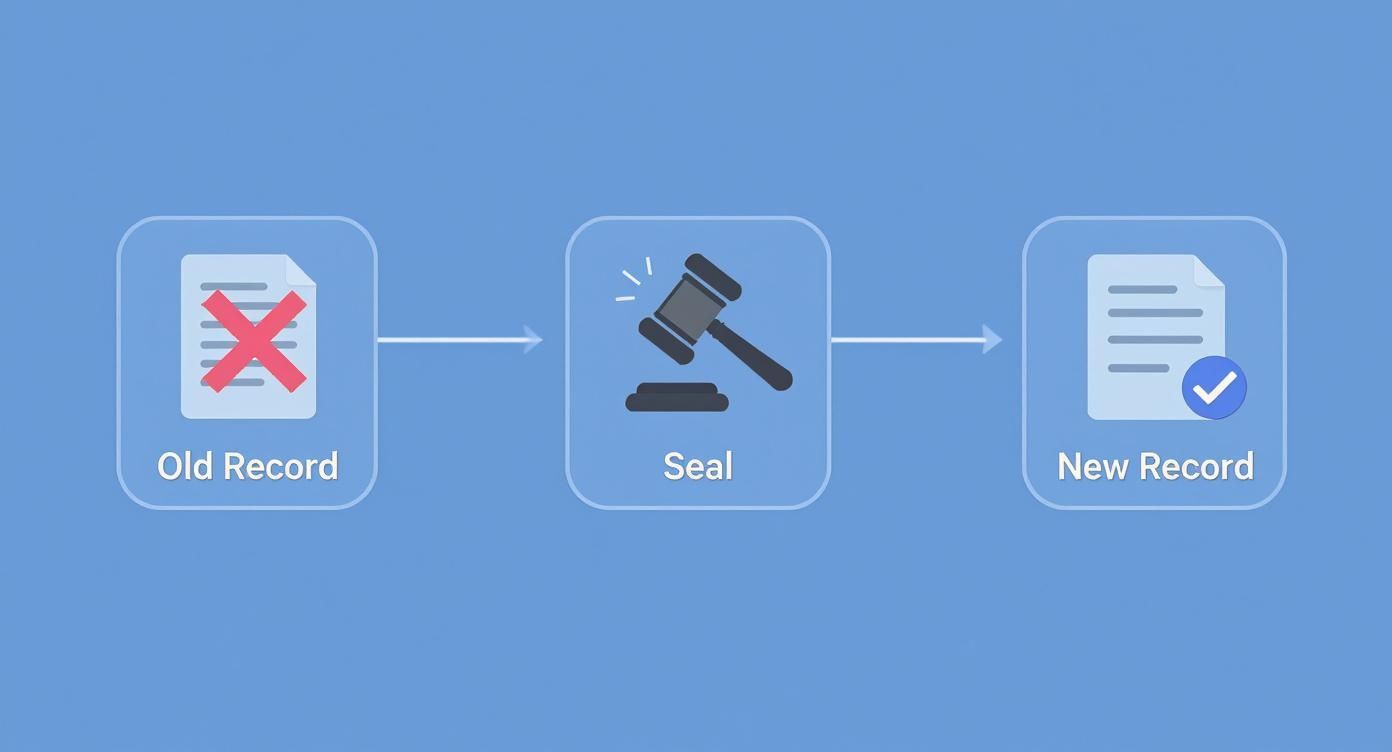
As you can see, the legal process of sealing effectively takes a public, problematic record and shields it from the general public's view, opening up opportunities that were once closed off.
Sometimes, it’s easier to see the difference between sealing a record and destroying it side-by-side. Here’s a quick breakdown to help you understand where your case might fit.
Quick Guide: Nondisclosure vs. Expunction in Texas
| Feature | Order of Nondisclosure (Sealing) | Expunction (Destroying) |
|---|---|---|
| What Happens to the Record? | The record is hidden from the public but still visible to law enforcement and certain government agencies. | The record is physically destroyed. It’s as if the arrest never happened. |
| Who is Eligible? | Primarily for those who successfully completed deferred adjudication probation and had their case dismissed. | Primarily for those who were arrested but never charged, had their case dismissed outright (not deferred), or were found not guilty at trial. |
| Effect on Background Checks | Private employers will not see the sealed record on a standard background check. | The record will not appear on any background check, public or private. |
| Your Legal Obligation | You do not have to disclose the arrest or sealed record on most job or housing applications. | You can legally deny the arrest ever occurred. |
This table should give you a clearer picture of whether nondisclosure is the right path for you. Expunction is the ultimate fresh start, but it’s much harder to qualify for. For most people whose cases were dismissed after probation, nondisclosure is the realistic and powerful option available.
Offenses That Can Never Be Sealed
Now for the hard truth. While many offenses can be sealed, Texas law draws a hard line on others. It's vital to know these exclusions before you get your hopes up. If your case involved any of the following, an Order of Nondisclosure is, unfortunately, off the table:
- Any offense that requires you to register as a sex offender
- Offenses involving a finding of family violence
- Murder, capital murder, or aggravated kidnapping
- Trafficking of persons or injury to a child, elderly individual, or disabled person
These are serious crimes where the state has decided public safety outweighs an individual's right to privacy. This is a key reason why understanding the specific charge against you, like what constitutes a Class A misdemeanor in Texas, is so critical from the moment a case begins.
Statutory Waiting Periods Are Mandatory
Even if your case is eligible, you can't just run down to the courthouse the day after your probation ends. Texas law makes you wait. These waiting periods are mandatory, and the clock doesn't start ticking until the day your case is officially dismissed.
- For most misdemeanors, you have to wait two years from the dismissal date.
- For most felonies, the wait is five years from the dismissal date.
Trying to file your petition even one day early is a surefire way to get an automatic denial from the court. Patience isn't just a virtue here; it's a legal requirement.
Think of this waiting period as a "prove it" phase. The state wants to see a clean record for a few years before granting the powerful benefit of sealing your record. Determining your eligibility is a detailed process. It requires a hard look at your specific case history, the exact offense, and how the court ultimately handled it. The first practical step is often tracking down your old court records from the district clerk's office. If you're feeling lost in the legal jargon and timelines, you're not alone. A quick consultation with an experienced attorney can clear up the confusion and get you started on the right path.
Navigating the Nondisclosure Process in Texas
Taking the first step to seal your criminal record can feel like you're standing at the base of a mountain. The legal process might seem complicated and even a little intimidating, but we're here to guide you through it, one step at a time. The whole journey starts with a single, critical document: a Petition for an Order of Nondisclosure. This is the formal request you file with the same court that originally handled your criminal case, asking a judge to legally seal your record from the public eye.

This petition isn’t just some simple form you fill out in five minutes. It's a legal document where precision is everything. Every single detail has to be perfectly accurate—from your name and date of birth to the specific case number and the date of the offense. One mistake can lead to delays or, even worse, a denial that forces you to start all over again.
Gathering Your Information and Filing the Petition
Before you can even think about filing, you need to get all your ducks in a row with the correct information. Your first stop will probably be the district or county clerk’s office where your case was originally heard. You'll need to track down your original case file to pull the exact details for your petition. This is not the time for guesswork; the information must match the court's official records to a T.
Here’s a quick checklist of the must-have information for your petition:
- Your full legal name and personal identifiers (like your date of birth and driver's license number).
- The specific offense that led to your deferred adjudication.
- The date of the offense and the date you were arrested.
- The name and court number of the court that handled your case.
- The correct case number assigned to your original charge.
Once your petition is meticulously filled out, you’ll file it with the clerk of that same court. This is what officially kicks off the legal process and gets your request on the court's radar.
Notifying the State and Understanding Waiting Periods
After filing, your job isn't quite done. The next crucial step is to formally notify the State of Texas that you're seeking to seal your record. This means the prosecutor’s office that handled your original case has to receive a copy of your filed petition. This gives them a chance to review your request and decide if they want to object to it.
This is also where those mandatory waiting periods come into play. As we’ve discussed, you can't just file your petition the day after your case is dismissed. Texas law requires a "cooling-off" period to make sure you've stayed on the right side of the law.
Remember, the clock for the waiting period starts on the day your case is officially dismissed by the judge—not the day you finish your probation. Filing even a single day too early will result in an automatic rejection.
For most misdemeanors, this waiting period is two years. For eligible felonies, it extends to five years. These timelines are set in stone by statute and aren't negotiable.
Preparing for a Potential Court Hearing
In a lot of nondisclosure cases, if everything is filed correctly and there are no objections from the State, a judge might sign the order without you ever needing to step foot in a courtroom. The whole thing can be handled through paperwork. That's the ideal scenario, and it’s what we always aim for.
However, you have to be ready for the possibility of a hearing. This usually happens if the prosecutor’s office objects to your petition. They might argue that sealing your record is not in the "best interest of justice."
If the State does object, the court will schedule a hearing. At this hearing, your attorney would present arguments on your behalf, explaining why you meet all the legal requirements and why justice would be served by granting your petition. The prosecutor then gets their chance to present their objections. Ultimately, the judge will listen to both sides and make the final call.
This is a moment where having an experienced attorney in your corner is invaluable. We understand the arguments prosecutors are likely to make and know exactly how to counter them effectively. Our goal is to present a compelling case that shows you’ve been rehabilitated and deserve this second chance. If you have concerns about a past case that was dismissed but not through deferred adjudication, exploring how to get criminal charges dropped can offer additional insight into different case outcomes.
From filing the initial paperwork to the incredible relief of receiving a judge's signed order, each step in the nondisclosure process is manageable when you know what to expect. While the journey requires patience and attention to detail, the outcome—a fresh start for you and your family—is well worth the effort.
How a Sealed Record Can Change Your Future
Going through the legal process to seal a criminal record is about so much more than just filing paperwork and showing up for court dates. It’s about taking back control of your future. A successful Order of Nondisclosure offers a real, tangible second chance, changing everything from the career you can build to how you can show up for your own kids.
This isn't a small issue. It’s a powerful statement that your past doesn’t get to define your family’s tomorrow.

The scale of criminal records in the U.S. is almost hard to comprehend—roughly 74 million people have some kind of record. Even a minor offense from years ago can feel like what some call a "civil death," creating roadblocks to getting a good job, a safe place to live, or even educational opportunities.
Research has shown that even old misdemeanor convictions can tank your chances of getting a callback for a job, creating a frustrating cycle of missed opportunities that you just can't seem to break.
Unlocking New Employment and Housing Opportunities
For most parents I work with, the biggest and most immediate impact of sealing a record is on their job prospects. Once you have that signed Order of Nondisclosure, you can legally deny the arrest and prosecution on most job applications. Think about that.
That one change can be the difference between getting your resume tossed by an automated background check and landing an interview for a career that can actually support your family. If you're curious about what employers are looking for, it's worth understanding the scope of criminal record checks for employers.
But the benefits ripple out far beyond just your paycheck. A sealed record can open doors to:
- Securing Better Housing: Landlords and apartment managers almost always run background checks. A nondisclosure order stops them from seeing that old offense, dramatically improving your odds of getting approved for a safe home in a neighborhood where you want your kids to grow up.
- Obtaining Professional Licenses: Many careers, from nursing to real estate and beyond, require a state license. That process involves a deep-dive background check, and sealing a record can remove a huge barrier to pursuing your chosen profession.
- Volunteering at Your Child's School: This one hits home for a lot of parents. The simple joy of chaperoning a field trip or helping out in the classroom is often off-limits if you have a record. Sealing it clears the way for you to be an active, present part of your child's education.
A Powerful Tool in a CPS Case
It's absolutely critical for parents to understand that government agencies, including the Texas Department of Family and Protective Services (CPS), can still see sealed records. A nondisclosure order doesn't make the record completely invisible to them.
Even so, having a sealed record is incredibly valuable if you ever find yourself in a CPS investigation. It shows the court and the caseworker that you took proactive, responsible steps to deal with your past. It’s an actionable step that demonstrates your commitment to being a fit parent, which is a key factor in any case proceeding under Texas Family Code Chapter 263 (Review of Placement of Children Under Care of Department).
Instead of being on the defensive about an old mistake, you can hand them a judge’s order that officially recognizes your rehabilitation. It completely reframes the conversation from one of past error to one of present responsibility.
Here’s a real-world example: A mother here in Houston had an old misdemeanor shoplifting charge from when she was in college. Years later, she dreamed of becoming a foster parent, but that old charge, though minor and long in the past, was an automatic disqualifier. After we successfully petitioned the court to seal her record, she was able to pass the state's extensive background checks. Today, she provides a loving, stable home for children in need—a dream she once thought was impossible.
Who Can Still See Your Sealed Record
Transparency is key, so you need to have the full picture. While most of the world will be blocked from viewing your record, the law carves out exceptions for certain entities. They retain access.
These typically include:
- Law enforcement agencies (local, state, and federal)
- State licensing and regulatory boards
- School districts, charter schools, and private schools
- The Texas Department of Family and Protective Services (CPS)
Knowing this upfront allows you to be prepared. While a sealed record provides immense relief in 99% of your daily life, an experienced attorney can help you understand exactly how to address it if it ever comes up in one of these specific contexts. The goal is to move forward with confidence, and sealing your record is a monumental step in that direction.
Common Mistakes That Can Derail Your Nondisclosure Petition
The path to sealing a criminal record is paved with good intentions, but it's also loaded with procedural landmines that can easily blow up your efforts. A simple mistake on a form or a missed deadline can lead to frustrating delays or even an outright denial of your petition. Knowing what these common pitfalls are ahead of time is the best way to make sure your journey to a fresh start is as smooth as possible.
We see it all the time—well-meaning parents trying to handle this process on their own to save a little money, only to get tangled in a web of legal red tape. The Texas legal system is incredibly particular, and what looks like a minor oversight to you can have major consequences in court.
Filing Before You're Legally Allowed
One of the most frequent—and completely avoidable—errors is filing your petition too early. Texas law is crystal clear about its mandatory waiting periods. You have to wait two years for most misdemeanors and five years for most felonies after your case is dismissed. There's no wiggle room here; the court has no discretion. If you file even one day early, your petition will be automatically rejected.
This isn't just some administrative rule; it's a fundamental requirement. Think of the waiting period as a kind of probationary window. The court wants to see a clean track record for a set period before it will grant the powerful benefit of nondisclosure.
Inaccurate or Incomplete Paperwork
Your Petition for an Order of Nondisclosure has to be perfect. And I’m not exaggerating. Every single piece of information, from the spelling of your name to the exact case number and the date of the offense, must precisely match the court's official records.
Some of the most common paperwork mistakes we see are:
- Using the wrong case number. This simple typo can send your petition to the wrong court or get it dismissed outright for being incorrect.
- Listing an incorrect offense date. When details don't match up, it creates confusion and can lead the prosecutor to question the validity of your entire petition.
- Omitting required personal information. If you forget to include your driver's license number or date of birth, the clerk will likely reject the filing on the spot.
A petition is a formal legal request, and courts demand absolute accuracy. A small typo can be enough to get your case thrown out, forcing you to start the entire process over from scratch.
Failure to Properly Notify Everyone Involved
Just filing the petition with the court clerk isn’t enough. You are also legally required to formally "serve" notice to the prosecutor’s office. This gives the State a chance to review your case and decide if they want to object to your request.
A real-life scenario we handled recently involved a father whose petition was initially denied. He had filled out all the paperwork correctly and waited the full five years, but he completely missed the step of properly notifying the Department of Public Safety (DPS). This simple procedural oversight forced him to refile everything, costing him months of valuable time and hundreds in additional filing fees.
This issue of rehabilitation and getting a second chance isn't just a local concern; it’s a global one. Prison systems around the world are under immense strain. With a global prison population of 11.7 million people, more than 60% of countries operate their prisons beyond 100% capacity, making any real rehabilitation efforts incredibly difficult. These conditions really underscore why effective record-clearing policies are so vital for helping people successfully re-enter society. You can discover more about these global prison trends on the UNODC website.
Navigating these procedural hurdles is exactly where professional legal guidance becomes so important. An experienced attorney doesn't just fill out forms for you. We anticipate potential objections from the prosecutor, ensure every single legal requirement is met down to the letter, and advocate on your behalf if the State decides to raise a challenge. Our goal is to turn a stressful, complicated process into a confident and straightforward one.
Clearing Your Texas Records: Top Sealing Questions Answered
https://www.youtube.com/embed/PGrsqFr0MVI
When you're trying to move on from a past mistake, the legal system can feel like a maze. It’s natural to have a lot of questions, especially when sealing a criminal record feels like the key to unlocking a better future for your family. We get it. We’ve guided countless Texas parents through this exact process, and we’ve heard all the same concerns you probably have right now. Let’s get you some clear, straightforward answers.
How Much Does It Cost to Seal a Criminal Record in Texas?
This is usually the first question on everyone's mind, and the honest answer is: it varies. You’ll have court filing fees, which can run a few hundred dollars right off the bat, depending on which county you're in. Then, you have the cost of hiring an attorney to handle the case.
While going it alone—what we call "pro se"—might look like a good way to save money, it's a huge gamble. A single mistake in the paperwork or a missed deadline can get your petition thrown out. If that happens, you’re not just back at square one; you've also lost those filing fees and have to pay them all over again to refile.
Hiring a knowledgeable attorney is about getting it done right the first time. During a free consultation with our office, we'll give you a clear, upfront breakdown of every potential cost so you can make a smart financial decision for your family.
How Long Does the Nondisclosure Process Usually Take?
You’ll need to be patient here, as the legal system doesn’t move quickly. Once your petition is filed correctly, you can generally expect the process to take anywhere from three to six months. This timeframe gives the prosecutor's office the chance to review your request and, if there are no objections, for the judge to review and sign the final order.
Now, if the State decides to object to your petition, a hearing will be scheduled, and that can definitely extend the timeline. This is another area where an experienced lawyer makes all the difference—we work to prevent unnecessary delays by making sure every document is filed correctly, on time, and without any procedural errors that could give the State a reason to object.
Actionable Advice: One of the best ways to keep your case moving is to gather all your case documents—the dismissal order, probation completion paperwork, and original charge information—before you even start. Having this ready for your attorney can shave weeks off the initial preparation time.
Can CPS Still See My Record If It Is Sealed?
Yes, they can, and this is a critical point for every parent to understand. Certain state agencies, including the Texas Department of Family and Protective Services (better known as CPS), have a legal right to access sealed records when they are conducting an investigation. This is written directly into the Texas Family Code.
However, that doesn't mean sealing your record isn't worth it. Far from it. Taking this step is incredibly beneficial because it shows you've responsibly addressed your past. Should it ever come up in a CPS matter, an attorney can help you frame this proactive step in a positive light, as proof of your commitment to providing a stable home. It becomes a piece of evidence for you, not against you.
What Happens If My Nondisclosure Petition Is Denied?
If your petition gets denied, the first thing we have to do is figure out why. Sometimes, a denial is based on a simple clerical or procedural error, like not giving the prosecutor proper notice. In those cases, the fix is often as simple as correcting the mistake and refiling the petition.
The real problem arises if the denial is because you were never legally eligible in the first place—for instance, if the offense itself is one that Texas law explicitly says cannot be sealed. This is precisely why confirming your eligibility with an attorney before you ever file is so important. It saves you from wasting time, money, and hope on a petition that was doomed from the start.
If you've already had a petition denied, give us a call. We can review the judge's order with you and explore what options, if any, you might still have.
Your past doesn’t get to define your family's future. Taking the initiative to seal a criminal record is a powerful move toward protecting your opportunities and providing the stability your children need and deserve. The legal road can be tricky, but you don't have to walk it by yourself. The dedicated attorneys at the Law Office of Bryan Fagan understand what's at stake for Texas families, and we are here to guide you with compassion and expertise.
If you're ready to learn more about how to seal criminal records and start your next chapter with confidence, contact us today for a free, confidential consultation. Let us help you take back control and protect the family you've worked so hard to build.