Skip to content
Receiving a notice that Child Protective Services (CPS) intends to terminate your parental rights feels like the ground has vanished from beneath your feet. It’s a moment packed with overwhelming fear, confusion, and a deep sense of helplessness. The legal language is cold and intimidating, and the thought of losing your child forever is a nightmare no parent should ever face.
You might be a good parent who’s hit a rough patch, made a mistake, or been completely misunderstood by the system. Now, you're facing the most profound loss imaginable. Please know this: you are not alone in this fight, and an accusation is not a final verdict.

This guide was created by The Law Office of Bryan Fagan to be your first step toward getting your feet back on solid ground. We understand the Texas Family Code, especially the critical chapters like 161, 262, and 263 that govern these cases. Our goal is to translate dense legal statutes into clear, understandable information that empowers you to take action and protect your family. We will walk you through the process with the compassion and legal accuracy you deserve.
What You Will Learn in This Guide
We will walk you through every critical stage of the process, giving you the knowledge you need to protect your family. We are here to offer reassuring guidance and practical advice for parents who find themselves in this terrifying situation. You will get a clear handle on:
- The Legal Grounds for Termination: We'll break down the specific reasons listed in the Texas Family Code that CPS must prove to terminate your rights.
- The Court Process and Timeline: We’ll map out the key hearings and deadlines you’ll face, from the first day your child is removed to the final trial.
- Your Rights and Defenses: You have rights in this process. We will show you how to start building a strong defense for your family.
- Actionable Steps for Reunification: We will provide practical advice on how to work your service plan and show the court you are a safe, committed parent.
The core principle in any termination case is the "best interest of the child." While CPS focuses on this, it's crucial to remember that keeping families together is often what is truly best for a child. Your actions from this point forward can significantly influence the court's decision.
Imagine a single mother, Maria, who lost her job and was struggling with depression. In a moment of sheer desperation, she left her young kids with a neighbor who wasn’t a safe choice, leading to a CPS report. When CPS got involved, they saw an unstable home environment and immediately started termination proceedings.
Maria felt hopeless. But by immediately engaging with a lawyer, getting into therapy as part of her court-ordered services, finding stable housing, and documenting every bit of her progress, she proved her commitment to the court. Her story, like many others, shows that a path forward really does exist.
This guide is designed to give you that same sense of direction. The journey starts with understanding what happens when a child is removed by Texas CPS. From there, we will break down each step, bringing clarity and hope along the way.
What Termination of Parental Rights Actually Means
When you hear the words "termination of parental rights," it’s easy to feel a pit in your stomach. The legal jargon only makes it sound more intimidating. In the simplest terms, termination is a court order that permanently and irreversibly severs the legal bond between a parent and a child. This isn't about temporary custody or losing visitation for a while; it's a final order that ends all your rights and responsibilities as a parent.
Once a judge signs that order, it’s as if the legal relationship that made you a parent never existed. You no longer have the right to see your child, make decisions about their schooling or healthcare, or even inherit from them. Because this is such a drastic and final step, Texas law sets an incredibly high bar for the state to clear before a judge can take this action.
The Two-Part Test for Termination in Texas
CPS can't just walk into a courtroom and tell a judge they think terminating your rights is a good idea. To succeed, they must prove two very specific things with what’s called "clear and convincing evidence." This is a much higher standard of proof than in other civil cases. It means the evidence must be strong enough to create a firm belief or conviction in the judge's mind that what CPS is alleging is true.
Think of it as a two-part test, and CPS has to get an A+ on both parts to win:
- Statutory Grounds: First, the state has to prove that your actions meet at least one of the specific grounds for termination laid out in Texas Family Code § 161.001. These grounds are very specific and include things like endangerment, neglect, or abandonment.
- Best Interest of the Child: But that's not enough. Even if they prove a statutory ground, they must also prove that terminating your parental rights is in the best interest of the child.
The court will look at a whole host of factors to figure out what's in a child's best interest. This is often where your actions, your progress, and your commitment to change can make the single biggest difference in your case.
This two-part legal standard is the foundation of every termination case in Texas. Before a judge can even consider severing the parent-child bond, CPS must present compelling evidence to satisfy both requirements. The table below breaks down what each part means for you as a parent.
The Two-Part Legal Standard for Termination in Texas
| Legal Requirement | What It Means for Parents |
|---|---|
| Grounds for Termination | The state must prove your conduct falls into at least one of the 19 specific categories listed in the Texas Family Code. This is about your past actions. |
| Best Interest of the Child | The state must also prove that permanently ending your rights is the best possible outcome for your child's future well-being, safety, and stability. |
Understanding this dual requirement is crucial. Proving a past mistake isn't enough for the state; they must also convince the court that your child's future is better off without you in it legally. This is where you can build a strong defense by showing your commitment to being a safe and stable parent now.
A Real-World Example: What Is at Stake
Let's look at a real-world scenario. Imagine a father, David, who is struggling with substance abuse. CPS removes his daughter, Emily, after finding her in a home with unsafe conditions directly related to his drug use. From there, CPS files a petition to terminate his parental rights.
In court, CPS will first try to satisfy part one of the test. They'll argue that David’s substance abuse created an environment that endangered Emily’s physical and emotional well-being—a specific ground for termination. They will bring evidence like police reports, failed drug tests, and testimony about the state of his home.
Next, they’ll move to part two. They will argue that terminating his rights is in Emily's best interest. They might claim she needs the stability and safety of a permanent home, free from the chaos of addiction, which they'll argue he cannot provide.
For David, the path forward isn’t just about getting sober. It’s about actively proving to the court that he is a safe and capable parent. This means jumping into his court-ordered services immediately, attending every single class, passing every drug test, and showing that Emily’s best interest is, in fact, to be with her father.
This example shows how a parent's actions are filtered through the legal lens of that two-part test. It’s not just about the mistake that brought CPS into your life; it’s about your present actions and the future you can create for your child. Getting a handle on this framework is the first, most important step in building a powerful defense and fighting to keep your family whole.
Understanding the Legal Grounds for Termination in Texas
Before CPS can even begin the process of terminating your parental rights, they have to point to a specific reason—or what the law calls a “ground.” These aren’t just vague concerns a caseworker has; they are specific actions or situations laid out in Texas Family Code § 161.001.
Think of this section of the law as the state's official rulebook for when it's allowed to take the drastic step of permanently severing a parent-child relationship.
The state’s attorneys must prove, with clear and convincing evidence, that at least one of these grounds exists in your case. This is a very high legal bar to clear. It means the evidence they present has to be so strong that it creates a firm belief in the judge's mind that the accusation is true. A caseworker's opinion or a simple suspicion isn't nearly enough—they need solid facts to back it up.
Common Grounds for Involuntary Termination
The Texas Family Code lists nearly 20 different grounds for termination, but in reality, a handful of them show up in cases far more often than others. Getting familiar with these common allegations helps you understand what CPS is trying to prove and gives you and your lawyer a starting point for building your defense.
Here are a few of the most frequent grounds, broken down in simple terms:
- Endangerment: This is one of the most common and broad grounds. It means you knowingly put your child in conditions or situations that endanger their physical or emotional well-being. This could mean exposing them to domestic violence, ongoing drug use in the home, or letting a person with a history of abuse have access to them.
- Neglect: This is about failing to provide for a child's basic needs—food, clothing, shelter, or necessary medical care. It can also mean putting a child in a situation where they are at a major risk of harm.
- Abandonment: This ground comes into play if you’ve voluntarily left your child with someone else without providing adequate support and have stayed away for a certain amount of time.
- Failure to Comply with a Court-Ordered Service Plan: This is a big one. If a judge has ordered you to do certain things to get your child back (like attending therapy, parenting classes, or submitting to drug tests) and you don’t follow through, that failure itself can become a reason to terminate your rights. This is why taking your service plan seriously is absolutely critical.
- Imprisonment: If you are sentenced to prison for two years or more, and your time behind bars will directly interfere with your ability to be a parent, this can be used as a ground for termination.
A Real-Life Example of Endangerment
Imagine a mom lets her new boyfriend, who has a documented history of violence, move into the family home. Even if he never lays a hand on the child, the very act of knowingly exposing her child to a potentially violent person can be seen by a court as endangerment. The risk of harm is often just as important as the harm itself.
The High Burden of Proof on the State
It's so important to remember this: the burden of proof is 100% on the state. You don't have to prove you're a good parent; CPS has to prove you're not, according to the strict definitions in the law.
The "clear and convincing evidence" standard is the second-highest legal bar in Texas, just a step below the "beyond a reasonable doubt" standard used in criminal trials.
A caseworker simply saying they believe something isn't evidence. They have to bring concrete proof to court, which might include:
- Testimony from teachers, doctors, or caseworkers
- Police reports and medical records
- Results from drug tests
- Your own words or admissions
Knowing the exact grounds you're up against is the first step in fighting the state's case. Your attorney will dig into the evidence CPS has and work to demonstrate why it doesn't meet that high "clear and convincing" standard.
The Urgency of the Texas System
The child welfare system in Texas often moves with alarming speed toward termination, which makes your immediate action even more important. Nearly half of the cases reviewed in one federal oversight report had completed the termination of parental rights even before a permanent placement for the child was finalized. This highlights how quickly the situation can escalate. Furthermore, children aged 1 to 5 are the most frequent victims of maltreatment and have the highest rates of repeated abuse, with this age group accounting for 42% of all recurring maltreatment cases. You can explore more data on these challenges and findings within the child welfare system.
Navigating the CPS Termination Court Process Step by Step
The CPS court process can feel like you’ve been dropped into a maze without a map, especially when the stakes are this high. Feeling scared and confused is completely normal, but understanding the path ahead can give you back a sense of control. A termination of parental rights case in Texas follows a strict timeline laid out in Texas Family Code Chapters 262 and 263, with specific hearings that each serve a critical purpose.
Knowing what to expect at each stage is your best defense. The system moves fast, and every single deadline is crucial. Missing a step or failing to grasp its importance can have devastating consequences for your family’s future.
The Initial 14-Day Hearing
The clock starts ticking the second CPS removes your child from your home. The very first critical event is the Initial Removal Hearing, often called the 14-day hearing because, under Texas Family Code § 262.201, it must happen within 14 days of the removal. This isn't the final trial, but it is an incredibly important first step.
At this hearing, the judge has one main job: to decide if there was a true, urgent need to remove your child and if it's safe for them to go home right now. CPS has to present evidence to convince the judge that a "continuing danger" exists in the home. You and your lawyer have the right to tell your side of the story and argue for your child's immediate return.
Key Hearings in a CPS Case
If the judge decides your child can’t return home immediately, the case officially enters a series of hearings laid out by the Texas Family Code. These hearings are designed to track progress, review service plans, and push the case toward a permanent, stable solution for your child—all within a very specific timeframe. The sheer volume of documentation in these cases is immense, and keeping the record straight often relies on professionals whose efficiency can be influenced by factors like court reporters' capabilities.
Here are the key stages you’ll go through:
- Adversary Hearing: This hearing must occur within 60 days of the removal. It’s a deeper dive where the judge looks at the evidence again to decide if your child should stay in foster care. This is also where the court will officially approve your Family Service Plan.
- Status Hearings: These happen every few months. Think of them as check-ins. The judge wants to know how everyone is doing—if you are making progress on your service plan and if CPS is giving you the resources you need to succeed.
- Permanency Hearings: These hearings are all about finding a permanent, stable home for your child. The first one is scheduled within six months, and they continue every 120 days after that. The judge will decide if the goal should stay as reunification with you or if it needs to change to something else, like adoption.
Getting a firm grasp on the purpose and timeline of each court date is essential. To help you prepare, we’ve put together a detailed guide on Texas CPS court hearings and their timelines.
The infographic below shows the most common reasons CPS will start a termination case. These are often the exact issues at the center of every court hearing.
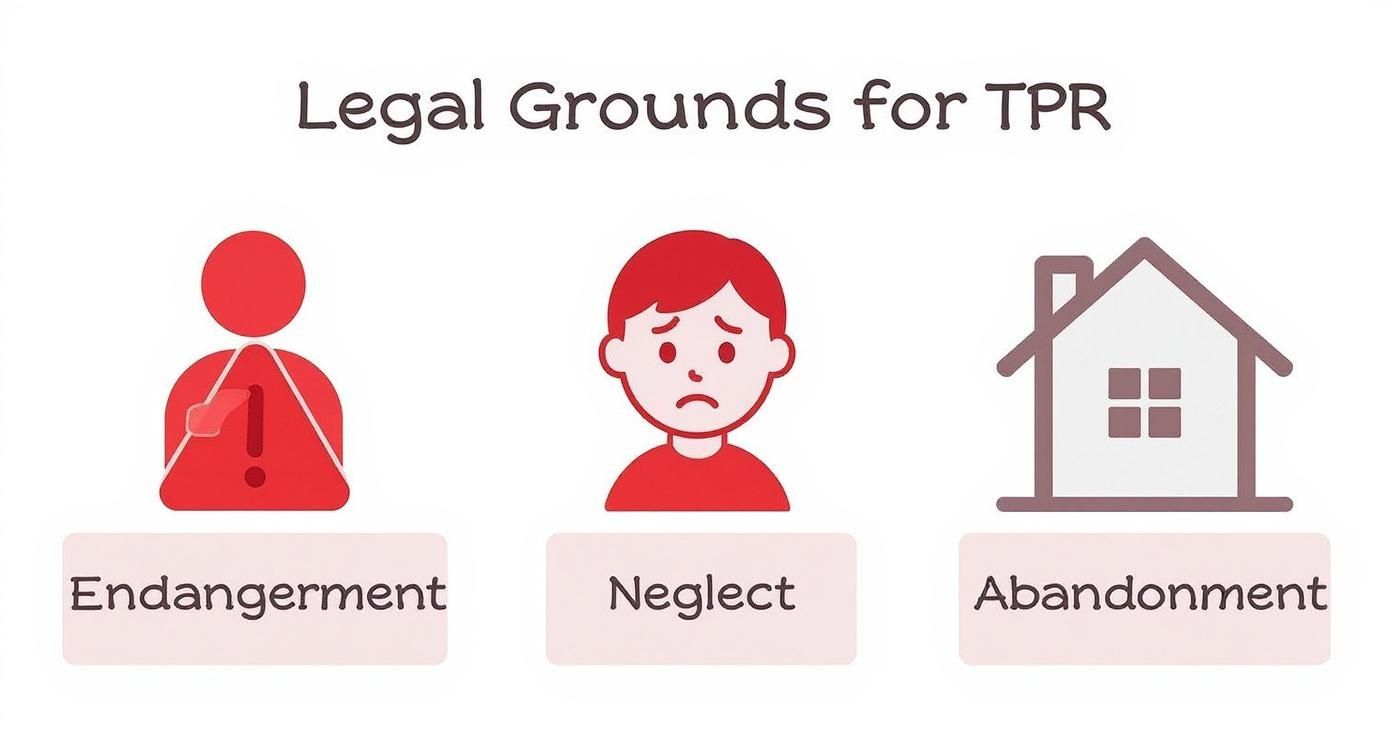
As you can see, the core allegations—endangerment, neglect, and abandonment—are what the state has to prove with clear and convincing evidence to have any chance of moving forward with termination.
The Aggressive Timeline of Texas CPS Cases
Texas has a well-earned reputation for moving cases toward termination quickly. This isn’t just a feeling; it’s backed by statewide data. Since 2006, Texas has terminated parental rights for 91,589 children, which is the highest number of any state in the U.S. This aggressive approach is often driven by a state policy from the Department of Family and Protective Services (DFPS) that prioritizes finding permanent placements for children, sometimes leading them to push for termination very early in a case.
The takeaway for parents is crystal clear: you must start working on your service plan immediately. Do not wait. Every class you finish, every clean drug test, and every stable paycheck is powerful evidence you can bring to each hearing to prove to the court that you are a safe, committed parent who is fighting for reunification.
The journey through a CPS court case is incredibly tough, but it's not impossible. With the right legal help and a proactive, dedicated approach to your service plan, you can meet every deadline fully prepared. You can show the court that your child’s best interest is to be back home with you.
How to Build a Strong Defense for Your Family
Facing a CPS investigation or a petition to terminate your parental rights feels like being caught in a legal hurricane. The storm of notices, court dates, and caseworker visits can leave any parent feeling overwhelmed and powerless. But remember this: you have fundamental, constitutionally protected rights.
Knowing your rights isn't just a small comfort; it's the very foundation of your defense. You have the right to be notified of every single court hearing. You have the right to see the evidence CPS has gathered against you. Most importantly, you have the right to an attorney who will fight for you—and if you cannot afford one, the court must appoint one for you.

This is not a battle you should ever wage alone. An experienced attorney can translate the dense legal language, stand up for you in court, and help you craft a powerful strategy. Taking a moment to understand what a juvenile dependency lawyer does for Texas families is a crucial first step in building your team.
Proactive Steps to Protect Your Family
Building a strong defense isn't about one dramatic moment in a courtroom. It's about a series of consistent, deliberate actions that begin the moment CPS gets involved. Your behavior becomes the most compelling evidence you can present. The goal is to show the court, through your actions, that you are a safe, committed, and capable parent.
Here are some actionable steps you can take immediately:
- Document Everything Meticulously: Keep a detailed journal of every interaction with CPS. Note the date, time, who you spoke with, and what was discussed. Save every email, text, and voicemail. This log can become an invaluable resource for your attorney.
- Engage Genuinely with Your Service Plan: Your court-ordered service plan is your roadmap to reunification. Don't treat it like a checklist. Actively participate in every class and therapy session. Ask questions, do the work, and show you are learning and growing from the process.
- Maintain Stability Wherever Possible: Do your best to maintain a stable home and employment. Consistency shows the judge that you can provide a reliable environment for your child. If you're struggling, be proactive about seeking resources and show the court you are trying.
- Always Be Respectful but Firm: Interact with caseworkers, lawyers, and court staff professionally and calmly, even when you feel frustrated or angry. Your composure in these high-stress situations speaks volumes.
Demonstrating Progress Is Your Strongest Argument
CPS carries the burden of proving that termination is in your child’s best interest. Your most powerful counterargument is to demonstrate—with your own clear evidence—that your child’s best interest is to be with you. Consistent progress is undeniable.
Think of your case like a story you are telling the judge. Every passed drug test, every certificate from a parenting class, and every positive report from a therapist is a new chapter that proves the state’s narrative about you is wrong. This consistent effort can often outweigh the initial incident that brought CPS into your life.
This is especially important in the current Texas landscape. In 2024, Texas removed 9,220 children from their homes. While this number represents a significant 55% drop in removals since 2018, it also shows that CPS still holds immense power to act swiftly when it perceives a risk. The system is complex and challenging.
By taking control of your actions and meticulously documenting your journey, you shift from being a passive subject of an investigation to an active participant in your own defense. This proactive stance empowers you and gives your attorney the tools they need to effectively fight for your family’s future.
Life After the Verdict: Exploring Appeals and Next Steps
Hearing a judge issue a final order to terminate your parental rights is a devastating moment. It’s natural to feel like all hope is lost, but you need to know that a final order isn't always the final word. The legal journey doesn't have to end in that trial courtroom; there are still paths you can explore and actions you can take.
https://www.youtube.com/embed/gwTN69GI7sg
Your most immediate option is to file an appeal. An appeal is not a do-over trial where you present new evidence. Instead, it’s a formal request for a higher court to meticulously review the trial record for significant legal or procedural errors that could have changed the outcome.
This is a highly technical process that moves at lightning speed. You have very strict, non-negotiable deadlines. Often, you have as little as 20 days to file a Notice of Appeal. This is why you must speak with an attorney who specializes in these types of appeals the moment you walk out of that courtroom.
Grounds for an Appeal
An appeal in a parental rights in Texas termination case must be built on specific legal mistakes. Some of the most common grounds for a successful appeal include:
- Insufficient Evidence: This is a powerful argument. You're essentially stating that CPS failed to meet the incredibly high legal bar of "clear and convincing evidence" needed to prove both a statutory ground for termination and that it was in the child’s best interest.
- Procedural Errors: This could be anything from the court improperly allowing or excluding critical evidence to a serious violation of your due process rights during the trial.
- Incorrect Application of Law: This argument focuses on showing that the judge misunderstood or wrongly applied a specific provision of the Texas Family Code when they made their final ruling.
An appeal is an uphill battle, but it is a critical right. Its entire purpose is to ensure the law was followed to the letter, which is essential given the permanent and severe nature of severing a parent-child relationship.
Exploring Other Paths
While an appeal is being considered, other outcomes might still be on the table. Sometimes, it’s possible to negotiate for a less permanent solution, like a monitored return, where your child comes home under a period of CPS supervision.
Another powerful alternative is assigning Permanent Managing Conservatorship (PMC) to a relative. This allows a trusted family member, like a grandparent or an aunt, to have legal custody. This arrangement keeps your child within the family circle and preserves your legal relationship with them, even if your rights are temporarily limited.
The road after a verdict is incredibly difficult and demands immediate, strategic legal action. Taking the time to understand your options for an appeal and exploring these alternative permanency goals can provide a much-needed sense of hope and a clear path forward during an unimaginably challenging time.
Common Questions About Parental Rights Termination
When you're facing the possibility of losing your parental rights, your mind is likely racing with a thousand terrifying questions. The uncertainty can be overwhelming. Let's get straight to the answers you need. Here are some of the most common questions we hear from parents in your shoes.
Can I Voluntarily Give Up My Parental Rights in Texas?
Yes, a parent can voluntarily relinquish their rights, but it’s not as simple as just signing a piece of paper. The court has the final say and will only approve a voluntary termination if it is absolutely in the best interest of the child.
This usually only happens in specific scenarios, most often when someone else, like a stepparent, is ready and waiting to adopt the child. The court won't let a parent just walk away from their responsibilities—especially child support—without a stable, permanent plan already in place for that child.
Will I Still Owe Child Support if My Rights Are Terminated?
A termination order cuts off all future child support obligations because the legal relationship is over. However, you are still responsible for any unpaid child support (arrears) that accrued before the judge signed the final order.
It's critical to understand this: a court will almost never grant a termination just because a parent wants to dodge their child support payments. The child's best interest is the one and only thing that matters.
Is a Termination Order Truly Permanent?
Yes. An order terminating parental rights is final and permanent. It is designed to create a stable future for the child. While you can appeal the judge's decision if you believe a serious legal mistake was made during the trial, successfully overturning a termination order is an incredibly tough, uphill legal fight.
When your family's future is on the line, you cannot afford to go it alone. You need a legal team with the experience to navigate the complexities of Texas CPS law and the compassion to support you through this difficult time. The attorneys at The Law Office of Bryan Fagan, PLLC are dedicated to protecting your rights and fighting for the best possible outcome for you and your child. You have a right to a defense, and we are here to provide it. Contact us today for a free, confidential consultation to discuss your case.
Contact The Law Office of Bryan Fagan PLLC for a Free Consultation