Skip to content
When your child is caught in the middle of a Child Protective Services (CPS) case, the fear and uncertainty can be overwhelming. Life becomes a blur of meetings, demands, and court dates. Of all these milestones, the permanency hearing often looms largest—and for good reason. The anxiety you feel is completely normal. After all, your family’s entire future is on the table, and the stakes couldn't be higher.
At The Law Office of Bryan Fagan, we understand how daunting this journey is for Texas parents. We want to help you see this hearing not just as another legal battle, but as a critical opportunity—your moment to show the court how far you've come. The hearing’s purpose, laid out in the Texas Family Code, is to find a safe, stable, and permanent home for your child as quickly as possible. This isn't a surprise attack; it's a legally required review where a judge must take stock of everyone's efforts, especially yours.
Your Opportunity to Show How Far You've Come
A permanency hearing is your moment to show the court the hard work you’ve been putting in. It’s your chance to present concrete evidence of your dedication to bringing your child home and building a safe, stable life for them. Think of it as a progress report where you get to highlight every positive step you've taken and demonstrate your commitment to your service plan.
Let's picture a mother named Maria. When her children were first removed, she was completely overwhelmed by her service plan, which demanded parenting classes, individual therapy, and finding a new apartment. But over the next few months, she buckled down. She attended every single class, found a therapist she trusted, and started methodically saving for a security deposit.
At her permanency hearing, her attorney didn't just tell the judge she was trying; they showed the judge. They presented her class completion certificates, a supportive letter from her therapist, and bank statements proving her savings. This tangible evidence painted a clear picture of her commitment and was crucial in the judge's decision to keep working toward reunification.
The Permanency Plan Takes Center Stage
The heart of the hearing is the permanency plan. This is the formal roadmap that sets a specific goal for your child's future. In almost every CPS case, the initial goal is reunification—bringing your child back home to you.
During the hearing, the judge will look closely at this plan and decide if it's still the right path. They will weigh several key factors:
- Your child's safety and well-being in their current foster care or relative placement.
- Your progress and compliance with every part of your court-ordered service plan.
- The services CPS has provided to you and your child to support your family.
The judge’s responsibility is to make sure your child doesn't get stuck in the limbo of temporary foster care a day longer than necessary. When you understand the hearing’s true purpose, you can shift your mindset from fear to empowerment and use it as an opportunity to fight for your family. For more on the steps that lead to this point, you can explore the complete CPS court and timeline process.
A CPS case follows a strict, legally mandated schedule. It’s vital for parents to understand these deadlines, as each one represents a major decision point in your case. Missing a step or not being prepared for a hearing can have serious consequences.
This table breaks down the most important events and when they happen.
Key Milestones in a Texas CPS Case Timeline
| Event | Timeline After Removal | Governing Statute (Texas Family Code) | Purpose |
|---|---|---|---|
| Adversary Hearing | Within 14 days | § 262.201 | To determine if there is enough evidence for CPS to keep temporary custody of the child. |
| Status Hearing | Within 60 days | § 263.201 | To review the child’s status, placement, and the parents' service plan. |
| Initial Permanency Hearing | Within 180 days | § 263.301 | To review the permanency plan and assess progress toward a permanent home for the child. |
| Subsequent Permanency Hearings | Every 120 days | § 263.302 | To provide ongoing court oversight and ensure the case continues moving forward without delay. |
| Final Order Deadline | Within 12 months (with a possible 180-day extension) | § 263.401 | The deadline for the judge to issue a final order, such as reunification, termination, or another permanent placement. |
Understanding this sequence of events is the first step in taking control of your situation. Each hearing is a chance to present your case, show your progress, and advocate for your child’s return. Knowing what’s coming next allows you and your attorney to prepare a strong, proactive strategy.
Who Attends the Hearing and What Is the Timeline
Walking into a courtroom for a permanency hearing can be incredibly intimidating. The sheer number of unfamiliar faces, each with a specific role, often adds another layer of stress to an already overwhelming time. Our goal here is to pull back the curtain on this process, so you feel informed and prepared, ready to focus on what truly matters: your family.
The courtroom isn’t just a random gathering; it’s a structured environment where every person has a specific job. When you know who’s who and what they do, you remove the element of surprise and can concentrate on presenting your progress.
Who You Will See in the Courtroom
Think of the courtroom as a formal meeting where a team has assembled to make a critical decision about your child's future. While it’s a legal setting, each person plays a distinct part.
- The Judge: As the ultimate decision-maker, the judge presides over the entire hearing. They listen to all testimony, review the evidence presented, and will be the one to decide whether the goal of reunification continues or if the permanency plan needs to change.
- Your Attorney: This is your legal advocate, your voice in the courtroom. Their job is to represent your interests, present evidence showing your progress, challenge the arguments made by CPS, and fiercely protect your parental rights.
- The CPS Attorney: This lawyer represents the Texas Department of Family and Protective Services (DFPS). They are there to present the agency’s case, which includes reports from your caseworker and the Department's official recommendations for your child.
- The Attorney Ad Litem: This is your child's personal attorney. Their only client is your child, and their entire focus is on advocating for what they believe is in your child's best interests. They will make their own recommendations to the judge from that specific viewpoint.
- The Guardian Ad Litem or CASA Volunteer: A Court Appointed Special Advocate (CASA) is a trained volunteer assigned to your child’s case. They get to know your child, your family, and others involved to give the judge an independent, third-party report and recommendation.
The Strict Timeline for Permanency Hearings
The timing of a permanency hearing in a Texas CPS case is anything but random. It is dictated by strict legal deadlines in Texas Family Code Chapter 263 designed to keep children from getting stuck in the foster care system indefinitely. These timelines create a sense of urgency, ensuring your case keeps moving toward a final, stable resolution.
The Texas Family Code mandates this schedule to create stability for children. The law’s structure emphasizes urgency, pushing the system to make timely, permanent decisions for every child involved.
The visual timeline below breaks down this sequence of critical court dates.
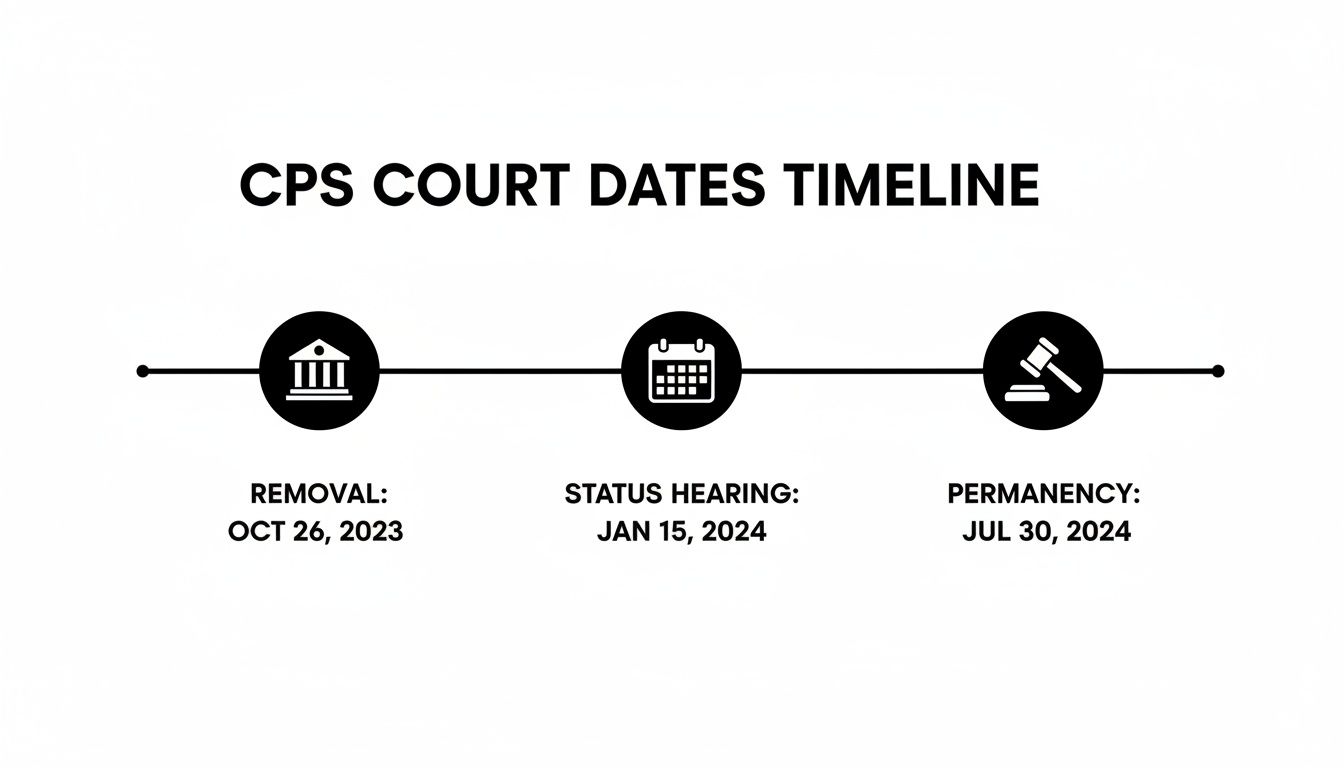
As you can see, once a child is removed, the court sets a clear rhythm of hearings to constantly monitor the case. This isn't just a list of dates; it's a structured path toward a final decision.
Under the Texas Family Code, the first permanency hearing absolutely must happen within 180 days after DFPS is named the child’s temporary managing conservator. It’s a hard deadline.
After that initial hearing, the court will schedule subsequent permanency hearings at least every 120 days. This cycle continues until a final order is signed, resolving the case one way or another.
These deadlines are firm. They exist to hold everyone involved—CPS, the lawyers, and you—accountable for making consistent, meaningful progress. Understanding this rhythm is a huge part of navigating your case successfully. For a deeper look at what to expect in these proceedings, we have an essential guide to Texas CPS court hearings and timelines.
The Possible Outcomes a Judge Can Decide
Waiting for a judge to rule on your child's future is, without a doubt, one of the most gut-wrenching experiences a parent can endure. The not-knowing can be absolutely crushing. We're going to tackle that uncertainty head-on by walking through the possible outcomes of a permanency hearing in a Texas CPS case.
Knowing what can happen is the first step toward building a solid strategy with your attorney. It empowers you to face the hearing with a clear head, not one clouded by fear of the unknown. The judge's job at this hearing is to look at the permanency plan and decide if it's still what’s best for your child, based on everything presented.

Continuing the Goal of Reunification
For most parents, the best possible result is the judge keeping the permanency goal as reunification. This decision means the court sees that you're making real, significant progress on your service plan and believes that getting your child back home is still a realistic and proper goal.
This outcome doesn’t mean the case is closed. It means you’ve earned more time to finish your services and get everything in place for your child’s return. The judge will set another permanency hearing, usually in about 120 days, to review your continued efforts.
Let’s look at a real-world example. Say a father has finished all his parenting classes and has been going to therapy without missing a session. The only thing left is securing a larger apartment that CPS has approved, but he's on a waiting list.
- Positive Progress: He can show the court his certificates for the classes and a strong letter from his therapist about his commitment.
- Remaining Hurdle: He also provides proof that he’s on the housing waitlist with a projected move-in date.
In a situation like this, the judge can see the father's dedication. He hasn’t checked every single box yet, but his progress is substantial. A judge would likely grant him more time, keep reunification as the goal, and schedule the next hearing after he’s had a chance to move. This kind of ruling validates all your hard work and gives you the runway you need to get across the finish line.
Changing the Permanency Goal to an Alternative
If the judge believes that reunification is no longer achievable in a reasonable timeframe, they have the power to change the permanency plan. This is a serious development, but it's crucial to understand it doesn't automatically mean your parental rights are being terminated.
One common alternative is shifting the goal to permanent managing conservatorship (PMC) with a relative, also known as a kinship placement. Here, a family member—like a grandparent or an aunt—is given legal custody. This path keeps your child within the family, and you can often maintain a relationship with them, as defined by the court's orders.
Another option is a Monitored Return. This is a very hopeful step where your child comes back home, but CPS stays involved to supervise the placement for a specific period. Think of it as a trial run. You get to prove you can provide a safe and stable home, and if all goes well, the case is often closed, and your family is fully restored.
A change in the permanency goal is not a final verdict against you as a parent. It reflects the court’s attempt to find the next best path to stability for your child based on the current facts. This is where a skilled attorney is vital—to argue against a premature change and advocate for more time or a less permanent solution.
Changing the Goal to Termination and Adoption
The most severe outcome, and the one every parent fears, is when a judge changes the permanency goal to termination of parental rights and adoption. This happens when the court finds that a parent has failed to comply with their service plan and there’s little or no evidence of meaningful progress.
As outlined in the Texas Family Code Chapter 161, this step is taken when the court determines it’s in the child’s best interest to find a new, permanent family through adoption. This is the "final order" that represents the end of the road in a CPS case.
Judges do not make this decision lightly. It's a last resort, usually taken after many months and multiple hearings where a parent has demonstrated they are unable or unwilling to fix the issues that brought their child into care. This is precisely why your consistent, documented effort on your service plan is your most powerful defense to prevent this outcome.
The sheer weight of these potential outcomes is why having an experienced family law attorney in your corner is not a luxury—it's a necessity. If you are facing a permanency hearing, you don't have to go through it alone. Contact The Law Office of Bryan Fagan for a free consultation. We are here to listen, explain your options, and fight for your family every step of the way.
How to Prepare for Your Permanency Hearing
Walking into a permanency hearing can feel like one of the most stressful moments of your life. We get it. The anxiety is real, but feeling prepared is the single best way to take back some control. When you walk in with a clear strategy and organized evidence, you’re not just a passive participant; you’re actively showing the judge you’re ready for your child to come home.
Let’s break down exactly what you need to do. These are the practical, actionable steps that can turn your anxiety into a powerful presentation of your progress.

Collect Your Proof of Progress
In a courtroom, what you say matters, but what you can prove is what truly counts. The most powerful way to convince a judge you’re following your service plan is to hand them a stack of documents that prove it. Work closely with your attorney to gather everything that tells the story of your hard work since your last court date.
Think of it as building a portfolio of your achievements. This file should be organized and ready to go.
- Completion Certificates: Did you finish a parenting course, anger management class, or domestic violence program? Get that certificate.
- Attendance Logs: For ongoing services like therapy or support groups, you need a signed log showing you’ve been to every single session.
- Employment and Housing Stability: Nothing speaks louder than stability. Gather recent pay stubs, a letter from your boss, or a copy of your new apartment lease.
- Test Results: If drug or alcohol testing is on your plan, you need copies of every single negative result. Don't miss any.
This collection of paperwork is your report card to the court. It turns abstract goals into concrete facts the judge can see and measure.
Identify Your Supporters and Witnesses
You don’t have to fight this battle alone. Often, the most compelling evidence of real change comes from the people who have seen it with their own eyes. Think about who in your life can speak to the positive changes you've made.
These supporters could be:
- Your therapist or counselor
- A sponsor from your recovery program
- Your employer or a trusted supervisor
- A landlord who can speak to your reliability
- A family member who has witnessed your commitment firsthand
Don’t just assume they’ll be great witnesses. You need to talk this over with your attorney. Your lawyer will help you figure out who can offer the strongest testimony and will prepare them for what to expect on the stand.
Practice and Prepare Your Testimony
Speaking in court makes almost everyone nervous. It's completely normal. The key to pushing through that fear is preparation. You and your attorney should spend time going over the questions you're likely to face—not just from your own lawyer, but from the CPS attorney and even the judge.
A father we worked with, let’s call him David, was terrified of public speaking. We spent hours in our office role-playing, going over his testimony again and again. When his hearing day came, he was able to calmly and clearly explain how he met every single goal on his service plan. He turned his fear into a confident presentation that made a real, positive impact on the judge.
Remember, the entire CPS court process is a series of structured check-ins. Before you even get to the permanency hearing in a Texas CPS case, there's the initial status hearing. Under Texas Family Code § 263.201, this must happen within 60 days after DFPS becomes the temporary managing conservator. It’s the court’s first formal chance to see how you're doing and it sets the stage for everything that follows.
Being ready for any court appearance is a complex task. You can get a better sense of the entire process by reading our in-depth guide on how to prepare for CPS court hearings. This preparation is your best tool for showing the court you are ready and able for your child to come home.
Navigating Next Steps and Potential Appeals
When the judge finally speaks, the air in the courtroom goes still. That moment—whether it brings a wave of relief or a gut-punch of devastation—is a massive turning point in your permanency hearing in a Texas CPS case. But it's almost never the final chapter. Knowing what happens next is absolutely vital for your family's future.
If the judge decides to keep reunification as the goal, take a deep breath. That's the court validating all the hard work you've put in. This isn't the time to kick back, though. It’s time to push even harder.
When Reunification Remains the Goal
A ruling in your favor means the court sees a clear path for you to bring your child home. It’s a huge vote of confidence, but you have to keep up the momentum to make it happen.
- Be Flawless with Compliance: Don't even think about skipping a single class, therapy appointment, or drug test. Your consistent, perfect compliance is the most powerful statement you can make.
- Keep Your Paper Trail Going: Continue to save every certificate, attendance sheet, and piece of paperwork that shows your progress. This isn't just clutter; it's your proof.
- Stay Connected to Your Team: Keep the lines of communication wide open with your attorney and caseworker. You need to be sure you're hitting every target before the next court date.
Think of it like the final lap of a race. You've come way too far to let up now. The dedication you show in this last stretch is what will finally close your case and bring your child home for good.
When the Decision Is Unfavorable
Hearing the judge change the goal to something like termination of parental rights is a soul-crushing blow. It's okay to feel that shock and grief, but it's critical to understand that this might not be the last word. You have the right to challenge the decision by filing an appeal, but you have to move with lightning speed.
An appeal isn't a new trial. It’s a formal request asking a higher court to look for legal mistakes made during the hearing. The deadlines for filing an appeal in a CPS case are brutally strict and offer zero wiggle room. If you miss the deadline, even by one day, you could lose your right to appeal forever.
If the judge rules against you, the very first thing you need to do—before you even leave the courthouse—is talk to your attorney about filing a Notice of Appeal. In this situation, the clock is your biggest enemy. Your only move is fast, decisive legal action.
While an individual case might feel stalled, the state is making system-wide progress. Recent Texas CPS data shows the average time to permanency has dropped to 20.5 months, with the state actually beating national standards for getting children into stable homes. You can review the full report on CPS performance and data from the Texas Department of Family and Protective Services. An appeal can be a tough, complicated road, but our firm is here to walk it with you. You can learn more by reading our guide on how to navigate and succeed in appealing Texas CPS decisions.
Answering Your Top Questions About Permanency Hearings
When you're heading toward a permanency hearing, it’s completely normal to feel a flood of urgent questions. The weight of what's at stake is immense, and it can feel like you're navigating a storm alone. At The Law Office of Bryan Fagan, we know that getting clear, straight answers is the first step toward finding solid ground again. Let's walk through some of the most common and pressing concerns we hear from parents in your exact situation.
What If I Disagree with the Caseworker’s Report?
It's a terrifying and unfortunately common scenario: you finally get to read the caseworker's report, and your heart sinks. You feel it misrepresents your hard work or, worse, contains information that is just plain false. You are not powerless in this situation. This is exactly why having a seasoned attorney in your corner is so critical.
Your lawyer can formally object to the report in court, but more importantly, they will challenge its contents with real evidence. This isn't just about saying the report is wrong; it's about proving it. We do this by:
- Presenting your documents: We submit the certificates from classes you've completed, letters of support, and clean drug test results you’ve worked so hard to get.
- Calling witnesses: We can put your therapist, sponsor, or employer on the stand to give the judge a firsthand account of your progress and character.
- Cross-examining the caseworker: Your attorney will question the caseworker directly about their findings, pointing out inconsistencies, biases, or a lack of thorough investigation.
Your side of the story deserves to be told. With a strong legal strategy, we can make sure the judge sees the full, accurate picture of your commitment to your family.
Will My Child Have to Testify in Court?
This question comes from a place of deep parental anxiety. The very thought of your child having to speak in a formal, intimidating courtroom is heartbreaking for any parent. The good news is that in most permanency hearings in Texas, judges go to great lengths to avoid this.
Instead of putting a child on the witness stand, the judge will typically rely on other trusted sources to understand your child's perspective:
- The Attorney Ad Litem: Your child has their own lawyer, whose job is to speak with them and then report their wishes and feelings to the court.
- A CASA Volunteer: If a Court Appointed Special Advocate is on your case, their report will include details from their conversations and time spent with your child.
- An interview in chambers: For older children, a judge might choose to speak with them privately in their office. This is a much less formal setting, and usually, only the attorneys are present.
The entire system is structured to shield children from the potential trauma of testifying whenever possible.
A critical fear for many parents is that they will lose their children forever at the very first permanency hearing. It’s important to understand that the termination of parental rights is the final step in a long and difficult legal process, governed by Texas Family Code Chapter 161. It is a last resort, not a first move.
Losing your parental rights at the initial permanency hearing is extremely unlikely, especially if you have been making a good-faith effort to work your service plan. The court's primary goal at this stage isn't to punish, but to assess progress and determine if reunification is still a realistic goal. This hearing is your chance to show the judge you are on that path and just need more time to get home.
Facing a permanency hearing is one of the toughest fights a parent can go through, but you absolutely do not have to face it by yourself. The attorneys at The Law Office of Bryan Fagan have the experience and compassion to protect your rights and fight for your family's future. We understand the fear and confusion you're experiencing, and we are here to provide the practical, reassuring guidance you deserve. Click here to connect with us today for a free, confidential consultation to discuss your case.