Skip to content
When Child Protective Services (CPS) gets involved in your life because of a criminal accusation, the world can feel like it's closing in. The fear is overwhelming. One moment you're dealing with a legal charge, and the next, you're terrified you might lose your children. The first major decision you face is about legal representation: should you use a court-appointed public defender or hire a private lawyer? This choice feels like a trade-off between cost and control, but for a Texas parent, it’s about so much more—it’s about protecting your family.
There is no single right answer for everyone. It comes down to your financial reality and, most importantly, the specific threat your case poses to your parental rights.
Your Constitutional Right to Legal Counsel in a Texas CPS Case
Receiving a call from a CPS investigator or being arrested is a profoundly destabilizing experience. Your freedom, your job, and your family's future suddenly hang in the balance. In the middle of all that fear and confusion, hold onto one fundamental truth: you have the right to a lawyer.
This isn't just a courtesy; it's a right guaranteed by the Sixth Amendment of the U.S. Constitution, and it’s a bedrock principle of the Texas justice system. In Texas, this right also extends to parents in CPS cases, especially when the state is trying to terminate your parental rights under Texas Family Code Chapter 161.
What this means is that if you can't afford to hire an attorney, the state must provide one for you. This could be a public defender or a court-appointed attorney. Their job is to ensure your financial situation doesn't prevent you from having a legal defense. Understanding this right is the first step toward regaining control.

Key Differences at a Glance
For most Texas parents, the immediate question is a practical one: what really separates these two options? Both are licensed attorneys held to the same professional standards, but their resources, approach, and the relationship you'll have with them can be worlds apart, especially when a CPS case is running parallel to a criminal one. This choice can set the tone for your entire future.
To help you see the differences clearly, here’s a quick rundown of the two paths available for your defense.
At-a-Glance Comparison: Public Defender vs. Private Lawyer
This table offers a high-level summary of the key distinctions to give you an immediate understanding of your legal defense options.
| Factor | Public Defender | Private Lawyer |
|---|---|---|
| Cost | Provided at no charge if the court finds you indigent. | Hired and paid for directly by you; costs vary widely. |
| Selection | Assigned by the court; you don't get to choose your attorney. | You research, interview, and choose the lawyer you want to hire. |
| Caseload | Typically handles an extremely high volume of cases at once. | Manages a smaller, more focused number of cases. |
| Availability | Communication can be limited due to a packed schedule. | Generally offers more direct access and personal attention. |
While this table gives you the basics, the real-world implications of these differences are what truly matter. Let's dive deeper into what each factor means for you and your case.
When you're facing criminal charges that could impact your family, the lawyer standing beside you can make all the difference. If you cannot afford a private attorney, the court will appoint a public defender. Let's be clear: these are dedicated, licensed attorneys who have committed their careers to upholding a fundamental constitutional right.
Public defenders are often deeply passionate about justice and work tirelessly within a demanding system. They aren't "lesser" attorneys; they are professionals navigating an incredibly challenging environment every single day.
But here's the tough reality: the noble mission of public defense often clashes with systemic underfunding and overwhelming demand. Understanding this dynamic is crucial. It’s not about questioning their skill, but acknowledging the structural limitations they're forced to work under.

The Crushing Weight of Caseloads
The single greatest challenge for most public defenders in Texas is the sheer volume of cases they must handle at once. This isn't a choice; it's a baked-in problem that directly impacts the amount of time and attention they can give to any one person.
Picture a dad, Mark, who's facing a first-time drug possession charge. It’s a misdemeanor, but a conviction could torpedo his job and, worse, trigger a CPS investigation that puts his custody rights at risk. His court-appointed lawyer is sharp and means well, but she's also juggling over 100 other active cases, from simple theft to serious felonies.
Mark struggles to get his lawyer on the phone to ask about the CPS safety plan he was forced to sign. In court, their conversations are rushed, often happening in a crowded hallway just minutes before seeing the judge. While his attorney is fighting for him in the criminal case, she simply doesn't have the bandwidth to dig into every nuance of the CPS proceedings under Texas Family Code Chapter 262 or proactively strategize on how to shield his family. This is the practical fallout of a high caseload.
Squeezed for Time, Hard to Reach
This reality of limited time creates huge communication hurdles. When your family is in crisis, feeling unheard or being unable to reach your lawyer adds a massive layer of stress to an already terrifying situation.
You'll often see these constraints play out in a few key ways:
- Limited One-on-One Time: Public defenders frequently meet their clients for the very first time in court, with almost no opportunity for a real, in-depth conversation beforehand.
- Reactive vs. Proactive: Their schedules often force them to react to whatever fire is burning brightest, rather than proactively building a comprehensive defense strategy from day one.
- Triage and Resource Allocation: With so many files on their desk, they have to prioritize the most urgent matters. This might mean less time for pre-trial investigation or witness interviews on cases that are perceived as less severe.
A nationwide analysis revealed that public defenders have, on average, 25% less time than necessary to provide a thorough and effective defense for each case. This isn't just a number; it's a structural deficit that can have profound real-world consequences.
Research shows that overwhelming workloads can directly affect how a case turns out. One study, for instance, found that defendants with public defenders were more likely to be incarcerated and received sentences averaging three years longer than those represented by private attorneys. While public defenders are absolutely essential, understanding these limitations is critical when you're making a decision about your own defense. You can read more about these systemic challenges and their impact on ChadBankLaw.com.
Ultimately, a public defender’s job is to provide a competent legal defense within the very real constraints of their position. They are a vital part of our justice system, but the system itself can prevent them from giving your case the focused, personalized attention you might feel it deserves.
The Strategic Advantages of a Private Defense Lawyer
Choosing a private defense lawyer is a serious investment in dedicated, personalized legal firepower. While public defenders provide an absolutely essential service, hiring your own attorney puts you in direct control of your defense. It allows you to select a professional whose specific skills and experience line up perfectly with what you need. From day one, you’re in the driver’s seat.
When you hire a private lawyer, you aren't just another case file in an overflowing inbox. The relationship is direct and personal. This means you get more access, better communication, and a legal advocate who has the time to understand every angle of your situation—not just the charges, but the potential fallout for your family, your career, and your future.
The Power of Choice and Specialization
One of the biggest advantages is simply the freedom to choose your champion. Criminal law isn't a one-size-fits-all game, especially when it intersects with family law. The tactics needed to fight a DWI charge are worlds away from those required for an allegation of injury to a child.
Think about a parent in Houston facing a false allegation of family violence. This accusation immediately triggers a criminal investigation and a parallel CPS case. That parent needs an attorney who is an expert in both criminal defense and the specific procedures of CPS hearings, including the 14-day Adversary Hearing outlined in Texas Family Code Chapter 262. A private lawyer allows you to find someone with the exact dual expertise your case demands.
This selection process is vital. By researching and interviewing potential attorneys, you can make sure you're comfortable with their approach and strategy. Knowing the right questions to ask a criminal defense lawyer will empower you to make a hiring decision you can stand behind.
Proactive Defense and Better Resources
Private attorneys can often get to work proactively, sometimes before charges are even officially filed. If you know you're under investigation, a private lawyer can step in early to protect your rights, handle communications with law enforcement and CPS, and maybe even prevent an arrest or a CPS removal from ever happening. That kind of early intervention is a powerful tool you rarely get with court-appointed counsel.
On top of that, private law firms typically have access to far more resources. This can include:
- In-depth Investigations: Hiring private investigators to find new evidence or track down witnesses the police or CPS may have missed.
- Expert Witnesses: Bringing in forensic specialists, medical experts, or psychologists to poke holes in the prosecution's case and challenge CPS's findings.
- Advanced Technology: Using sophisticated tools to analyze digital evidence or create accident reconstructions.
Hiring a private lawyer means you are paying for their undivided time, their focus, and the full weight of their firm's resources. This dedicated attention can completely change the direction of your case, opening up defense strategies that might otherwise have been missed.
Many private firms also deliver a better client experience through operational efficiency, using tools like streamlined cloud-based practice management software to keep your case managed effectively and securely from start to finish. That level of organization is a real strategic advantage when your freedom and your family are on the line.
Ultimately, hiring a private lawyer is about investing in a defense built specifically for you, designed to protect what matters most. It gives you a level of control, specialization, and personal attention that can make all the difference in the final outcome.
How Your Choice of Attorney Impacts Case Outcomes
When your family's future hangs in the balance, one question is more important than any other: Does choosing between a public defender and a private lawyer really change what happens in court?
The answer isn't a simple yes or no. It's a complicated picture shaped by data, resources, and the day-to-day realities of your local Texas courthouse.
Looking at the big picture can be confusing. Some national studies suggest that outcomes like conviction rates and sentence lengths are surprisingly similar whether a defendant has a public defender or private counsel. But these broad statistics often gloss over the crucial details that matter most in your individual case, especially when a CPS timeline is running parallel to your criminal case.
The Nuances in the Numbers
The effectiveness of any public defender’s office is directly tied to its funding, staffing, and local court dynamics. A well-resourced office in one Texas city might achieve incredible results, while an underfunded, overworked office in the next county over may struggle just to keep up. This is exactly why national averages can be so misleading when you're facing charges right here in Texas.
Research comparing public defenders and private attorneys has shown mixed but revealing results. For instance, a major 2014 study of 75 of the largest U.S. counties found that conviction and incarceration rates were statistically identical. But when you dig deeper, the local story changes. In San Francisco, public defenders actually got better outcomes, cutting the chance of conviction by 6.4% and reducing prison sentences by 22%.
On the flip side, a Florida study of felony cases found that defendants with public defenders were less likely to be acquitted and more likely to be convicted. These conflicting results prove that outcomes depend heavily on the specific legal environment. You can explore the research on attorney performance and outcomes to see just how much these numbers can vary.
For a Texas family, this data shows that the quality of your defense hinges on local resources and an attorney's specific expertise—which is why a private lawyer who lives and breathes in Texas courts can be so valuable.
This decision tree helps visualize the key considerations when choosing your legal path.
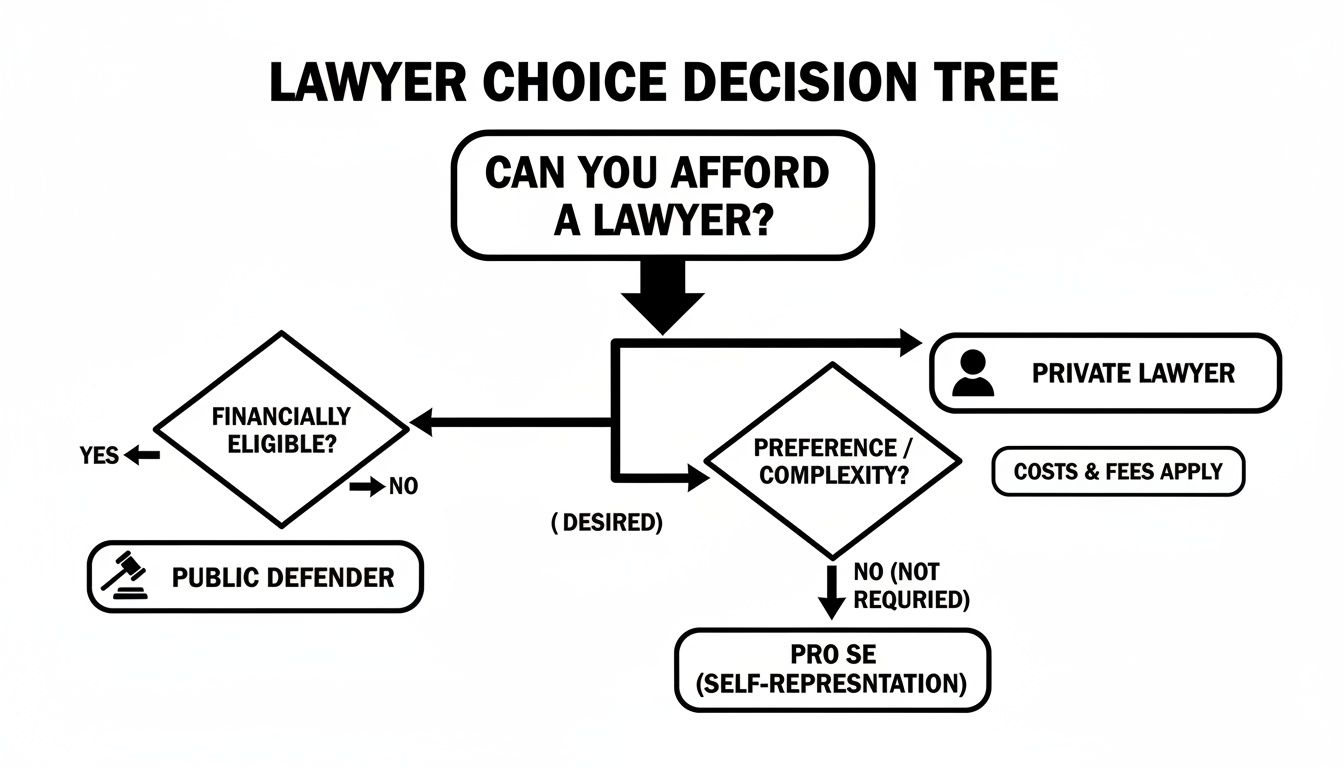
As you can see, the flowchart simplifies the first big decision points, showing how things like financial eligibility and your desire for personal choice steer you toward either a court-appointed or private attorney.
Plea Deals and Sentencing Disparities
The vast majority of criminal cases—well over 90%—never go to trial. They end in a plea bargain. This is where the differences in representation can become crystal clear.
The quality of a plea deal depends entirely on an attorney's ability to negotiate from a position of strength. That strength comes from having the time to do the work: investigating, reviewing evidence, and planning a strategy.
A private attorney’s smaller caseload gives them the time to build leverage for these critical negotiations. They can:
- Launch Independent Investigations: Uncover new evidence or find witnesses that poke holes in the prosecution’s case.
- File Pre-Trial Motions: Challenge the legality of a search or the admissibility of key evidence, putting real pressure on the prosecutor.
- Build a Trial-Ready Defense: Show the prosecutor they are 100% prepared to fight it out in court, which is often the best way to get a better plea offer.
The ultimate goal isn't just to avoid a conviction; it's to secure the best possible outcome. That could mean negotiating for reduced charges, getting alternative sentencing like probation, or even a complete dismissal of the case.
For a parent in Texas, a good plea deal can be the difference between a misdemeanor that can be sealed and a felony conviction that costs you your job and threatens your child custody rights. The ability to get that kind of result is often tied to the time and resources your lawyer can pour into your case.
Having a skilled negotiator who knows how to get criminal charges dropped can fundamentally change the course of your life. While many public defenders are fantastic negotiators, their crushing caseloads can make it impossible to prepare for every single negotiation with the same depth as a private lawyer.
When a Private Lawyer Is a Critical Investment
Public defenders are absolute pillars of our justice system, and they provide essential legal help to countless Texans every single day. But let's be realistic—some situations are just too high-stakes. They demand the kind of focused, dedicated resources that, frankly, only a private attorney can bring to the table. Knowing when your case has crossed that line is one of the most important decisions you'll make for your future.
When a conviction could completely upend your life, hiring a private lawyer stops being a luxury and becomes a necessity. This is especially true when your freedom, your professional license, or even your relationship with your children is hanging in the balance.

High-Stakes and Complex Cases
Some charges just carry more weight and demand a much more intensive, specialized defense strategy right from the jump. If you find yourself facing any of these situations, making a private lawyer your first call should be a priority:
- Serious Felony Charges: We're talking about offenses like aggravated assault, robbery, or anything else that could land you in prison for years. These cases require a powerful defense from day one.
- Complex Evidence: Is your case built on digital forensics, tangled financial records, or dueling expert witnesses? You need a lawyer with the resources to hire their own investigators and specialists to pick apart the prosecution's story.
- Cases with Devastating Collateral Consequences: For professionals—nurses, teachers, commercial drivers—even a seemingly minor misdemeanor can be a career-ender. A private attorney can zero in on protecting you from these specific professional fallout scenarios.
When Criminal Charges Overlap with Family Law
I can't think of a more terrifying situation for a Texas parent than when a criminal charge puts them on CPS's radar. A simple assault accusation from a heated argument, a DWI with your child in the car, or a drug possession charge can instantly spiral into a full-blown family law nightmare.
This is where the difference between a public defender and a private lawyer becomes painfully obvious. A public defender's job is to handle the criminal charge, and they do it well. But they simply don't have the training or the bandwidth to also fight the parallel CPS proceedings that could lead to your parental rights being terminated under Texas Family Code Chapter 161.
A private attorney who knows both criminal defense and family law can create a unified strategy. They work to resolve the criminal matter in a way that actively protects you in family court—an advantage that can be the difference between keeping your family together and having it torn apart.
The research is clear on how much dedicated representation matters. A landmark study of Philadelphia murder trials showed that public defenders cut the odds of a life sentence by 62% and reduced expected prison time by an average of 24 months compared to court-appointed private lawyers. This proves that well-resourced defense directly impacts sentencing. Interestingly, that same study found that when appointed counsels' pay went up, their performance improved, showing that adequately funded legal work—public or private—is what gets results. Learn more about how legal representation impacts case outcomes.
When you're up against complex charges with life-altering consequences, a private lawyer offers a level of strategic depth and specialized knowledge that isn't just a service—it's a critical investment in your future.
If your freedom and your family are on the line, you can't afford to leave your defense to chance. The compassionate, experienced attorneys at The Law Office of Bryan Fagan are here to build the dedicated defense your case deserves. Contact us today for a free, confidential consultation to discuss your options.
What to Do Next to Protect Your Rights in Texas
Knowing the difference between a public defender and a private lawyer is a great first step. But what comes next—the actions you take right now—is what truly matters. If you've been arrested or are under investigation by law enforcement or CPS in Texas, the choices you make in these first few hours can define the rest of your life. Your future, your job, and your family's stability all hang in the balance, and a calm, strategic response is non-negotiable.
The most powerful tool you have is your constitutional right to remain silent. You must state clearly and calmly, "I am exercising my right to remain silent, and I want a lawyer." That's it. Do not try to explain your side of the story or answer questions from law enforcement or a CPS investigator. Your silence is a shield; use it.
Your First Call: A Free Consultation
As soon as you've invoked your rights, your very next move should be to get legal advice. This is no time to wait and see what happens. A free, confidential consultation with a private family and criminal defense firm gives you a chance to understand your situation and your options without any pressure or commitment.
Here at The Law Office of Bryan Fagan, we've designed this first meeting to be a safe space. It's your opportunity to tell us what's going on, and we will listen with compassion and give you an honest, straightforward assessment of what you're up against.
You can expect us to:
- Go Over the Facts: We’ll ask you to walk us through what happened, listening carefully to the details to start identifying the core legal issues at play.
- Explain the Potential Charges and CPS Process: We'll cut through the complex legal jargon and explain in plain English the criminal charges you could be facing and what to expect from the CPS investigation.
- Outline a Path Forward: We will start talking about potential defense strategies and lay out the immediate steps we would take to begin protecting you and your family.
Questions to Ask Any Potential Attorney
Choosing the right lawyer is a deeply personal decision. As you weigh your options, you need to be prepared. When you sit down with any attorney, you should feel empowered to ask tough questions to make sure they're the right fit for you and your family. Learning how to choose a criminal defense attorney really just starts with asking the right questions.
You are not just hiring a lawyer; you are entrusting someone with your freedom and your family's future. The connection and confidence you feel in that person are just as important as their legal credentials.
When a criminal charge turns your world upside down, you don't have to face the fear and uncertainty on your own. The compassionate and experienced attorneys at The Law Office of Bryan Fagan are here to provide the unwavering support and aggressive defense you deserve.
We understand exactly what's at stake. Call us now for a free, confidential consultation to discuss your case. Let us show you how our team can fight to protect everything you hold dear.
Common Questions About Legal Representation
When you're trying to make sense of the legal system, it's easy to feel overwhelmed. For parents, that feeling is magnified because your family's entire future hangs in the balance. Here are some quick answers to the questions we hear most often from Texas parents trying to decide on legal representation.
Can I Switch From a Public Defender to a Private Lawyer?
Yes, absolutely. You have the right to hire a private attorney at any point in your criminal case, whether it just started or is already moving forward. Once you bring a private lawyer on board, they will file a "Notice of Appearance" with the court, officially taking over your defense and making the transition smooth.
It’s actually a pretty common move. Many people start with a public defender and later realize they need more dedicated attention or specific expertise, especially when a criminal charge could spill over into a child custody battle or a CPS investigation.
Is a Private Lawyer Guaranteed to Win My Case?
No ethical lawyer—public or private—can ever promise you a win. Be very cautious of any attorney who makes that kind of guarantee. The true advantage of a private attorney is in their focused resources, personalized defense strategy, and complete dedication to getting you the best possible result.
The real goal is to protect your future. That might mean fighting for a complete dismissal, negotiating a plea deal that minimizes the damage to your life, or taking your case to trial and winning an acquittal. A private lawyer’s smaller caseload gives them the time to build the strongest defense to make that happen.
Should I Get a Consultation Even If I Qualify for a Public Defender?
Without a doubt. A free, confidential consultation with a private firm comes with zero obligation. It is one of the smartest, most proactive steps you can take to protect yourself and your family.
Think of it as gathering intelligence. You're arming yourself with the information needed to make a clear-headed decision about your future. During a consultation, you can get invaluable insight into your specific charges, explore potential defense strategies, and understand how a private attorney would approach a case that could trigger family law issues, like a CPS investigation under Texas Family Code Chapters 262 or 263. It gives you the power to truly compare your options and choose the path that offers your family the most security.
When criminal charges threaten to turn your world upside down, the fear can be paralyzing. But you don't have to face it alone. The dedicated attorneys at The Law Office of Bryan Fagan are here to listen, offer clarity, and build the aggressive defense your family deserves. We know what’s at stake for Texas families.
Contact us today for a free, confidential consultation to learn how we can fight to protect your freedom and your future. Visit us at https://texascpslawyer.net to get started.