Skip to content
When Child Protective Services (CPS) becomes involved in your life, the fear and confusion can be overwhelming. The first question that floods your mind is almost always the same: How do I get my kids back? That journey is what we call the reunification process in Texas. It's the legal and practical road map for parents to regain custody after their children have been removed by the state. This path involves working a court-ordered plan designed to resolve the very issues that brought CPS to your door, with the ultimate goal of safely and permanently putting your family back together.
The Moment Your World Turns Upside Down
That unexpected knock on the door from a CPS caseworker is a moment no parent is ever prepared for. Your world can feel like it's tilting on its axis as a stranger with a clipboard starts asking questions that feel like accusations. In that instant, fear and confusion can take over, but it's critical to know you are not alone, and you are not the first parent to go through this.

What Happens When Your Child Is Removed
Let's walk through a common scenario. Imagine a single mother, "Sarah," is overwhelmed trying to manage her job and her two young children. A neighbor, concerned after hearing Sarah yelling in frustration one evening, decides to call the CPS hotline. What started as a moment of parental stress can quickly spiral. A caseworker visits, and due to a misunderstanding or a misinterpretation of the home environment, decides there's an "immediate danger" and removes Sarah's children.
Under the authority of Texas Family Code Chapter 262, this removal triggers a rigid and fast-moving legal timeline. This isn't a final judgment on your love for your child; it's a legal action that demands an immediate and strategic response. The first critical deadline is the Adversary Hearing, which must happen within 14 days. This is where a judge decides if CPS had enough evidence to remove your child and whether they should remain in state custody. It’s your first chance to present your side of the story, which is why having an experienced attorney's guidance from day one is absolutely crucial.
Hope on the Horizon
It’s completely natural to feel defeated in a moment like this. But it’s vital to understand that the primary goal of the Texas Department of Family and Protective Services (DFPS) is not to permanently break up families. The entire system is built around the principle of family preservation.
The primary goal of the Texas child welfare system is, and always has been, family reunification. While the path can be challenging, the entire process is designed to give you the opportunity to resolve the issues and bring your children home safely.
In fact, bringing families back together is the most common permanency goal for children in the Texas system. Recent data from the Texas Children's Commission shows that reunification is the top goal for 44% of children in DFPS conservatorship, which shows a strong systemic focus on keeping families intact. This isn't the end of your story. It's the beginning of a fight for your family, and the first steps you take are the most important. By understanding the reunification process in Texas CPS cases, you can start to replace that initial panic with a clear, actionable plan.
Understanding Your Family Plan of Service
When your child has been removed, one of the first and most critical documents you'll encounter is the Family Plan of Service. It’s easy to view this plan as a list of punishments, but it’s more empowering to see it as your personalized roadmap back to your child. It's a formal agreement between you and DFPS that lays out exactly what you need to do to resolve the concerns that led to CPS involvement.
The plan can feel overwhelming—a state agency handing you a checklist of tasks just to prove you're a good parent. But learning to navigate this plan is your first real step toward taking back control. It transforms a feeling of helplessness into a series of clear, achievable goals.
What Goes into a Family Service Plan
The requirements in your Family Plan of Service aren’t random. According to the Texas Family Code, they must directly address the specific reasons the court is concerned about your child’s safety. This isn't a one-size-fits-all document; it's tailored to your family's unique situation.
Common services you might see on a plan include:
- Parenting Classes: To provide new tools for positive discipline and healthy communication.
- Individual or Family Counseling: To work through underlying emotional struggles or difficult family dynamics.
- Anger Management Courses: To help you manage frustration and resolve conflict constructively.
- Substance Abuse Assessment and Treatment: A standard requirement if drugs or alcohol were even mentioned in the initial report.
- Maintaining Stable Housing and Employment: To demonstrate to the court that you can provide a safe and secure home.
Each of these services is meant to give you skills and resources—not just to check a box for the court, but to make your family stronger for the future.
Your Family Plan of Service is your chance to demonstrate to the court, to CPS, and most importantly, to yourself, that you are committed to building a safe and loving home. It's an opportunity to actively prove your dedication and growth.
You Have a Voice in Your Plan
Here’s a critical piece of information that many parents miss: you have a right to participate in creating your service plan. You don't have to passively accept a list of services that seem unfair, irrelevant, or simply impossible for you to complete. The law is clear that the plan must be reasonable and achievable.
This is precisely where having an experienced attorney becomes a game-changer. An attorney can review the proposed plan with you and advocate on your behalf. They can argue against services that don't match the allegations or negotiate for alternatives that better suit your family's needs. For instance, if your child has special needs, your attorney can push to include specialized resources like effective autism parent training to demonstrate your proactive commitment. The goal is a plan that sets you up for success, not failure. To learn more, read our comprehensive guide to the CPS family service plan in Texas. The reunification process in a Texas CPS case is a marathon, not a sprint, but with the right strategy, you can navigate your service plan and put your family back together.
Navigating the Strict Court Timeline
When your family gets involved with CPS, the legal process doesn't wait for you to catch up. It runs on a strict calendar set by the Texas Family Code, often called a "rocket docket." It can feel like you’ve been thrown onto a fast-moving train with court dates rushing toward you.
But here’s the thing: understanding this timeline isn’t just about knowing dates. It’s about seeing each court hearing as a critical opportunity—a chance to show your commitment and get one step closer to bringing your child home. Under Texas Family Code Chapter 263, the law sets a firm deadline for the case to be resolved, usually within 12 to 18 months from the day your child was removed. This timeline puts immense pressure on parents to show real, significant progress, and to do it quickly.
The 14-Day Adversary Hearing: Your First Major Checkpoint
The very first court date you'll face is the Adversary Hearing, which must occur within 14 days of CPS taking your child into custody. This hearing is not a trial to determine guilt or innocence. Its sole purpose is for a judge to decide two things: Was there enough evidence for CPS to remove your child, and would it be dangerous for your child to go home right now?
During this hearing, both CPS and your attorney will present evidence. This is your first official opportunity to tell your side of the story in a courtroom. While rare, a positive outcome could mean your child comes home immediately. More often, this hearing sets the stage for the rest of the case.
Key Hearings Along the Path to Reunification
After that initial hearing, your case moves through a series of review and permanency hearings. Think of each one as a vital checkpoint where the judge will look closely at your progress on your Family Plan of Service.
To give you a clearer picture, the court process has several mandatory deadlines designed to keep cases moving.
Key Timelines in a Texas CPS Case
| Event | Deadline (from date of removal) | Purpose |
|---|---|---|
| Adversary Hearing | Within 14 days | To determine if the removal was justified and if the child can safely return home. |
| Status Hearing | Within 60 days | To review the child’s status and the parents' initial progress on the service plan. |
| Initial Permanency Hearing | Within 180 days | To set a long-term "permanency goal" for the child, which is almost always reunification. |
| Subsequent Permanency Hearings | Every 120 days | Regular check-ins to monitor parental compliance and the child’s well-being. |
| Final Trial | Within 12 to 18 months | The final deadline for the judge to make a permanent decision about the child's future. |
These deadlines are not suggestions; they are hard-and-fast rules that the court must follow, designed to prevent children from getting stuck in foster care. This requires parents to be proactive from day one.
This timeline shows how your service plan fits into these court-mandated reviews.
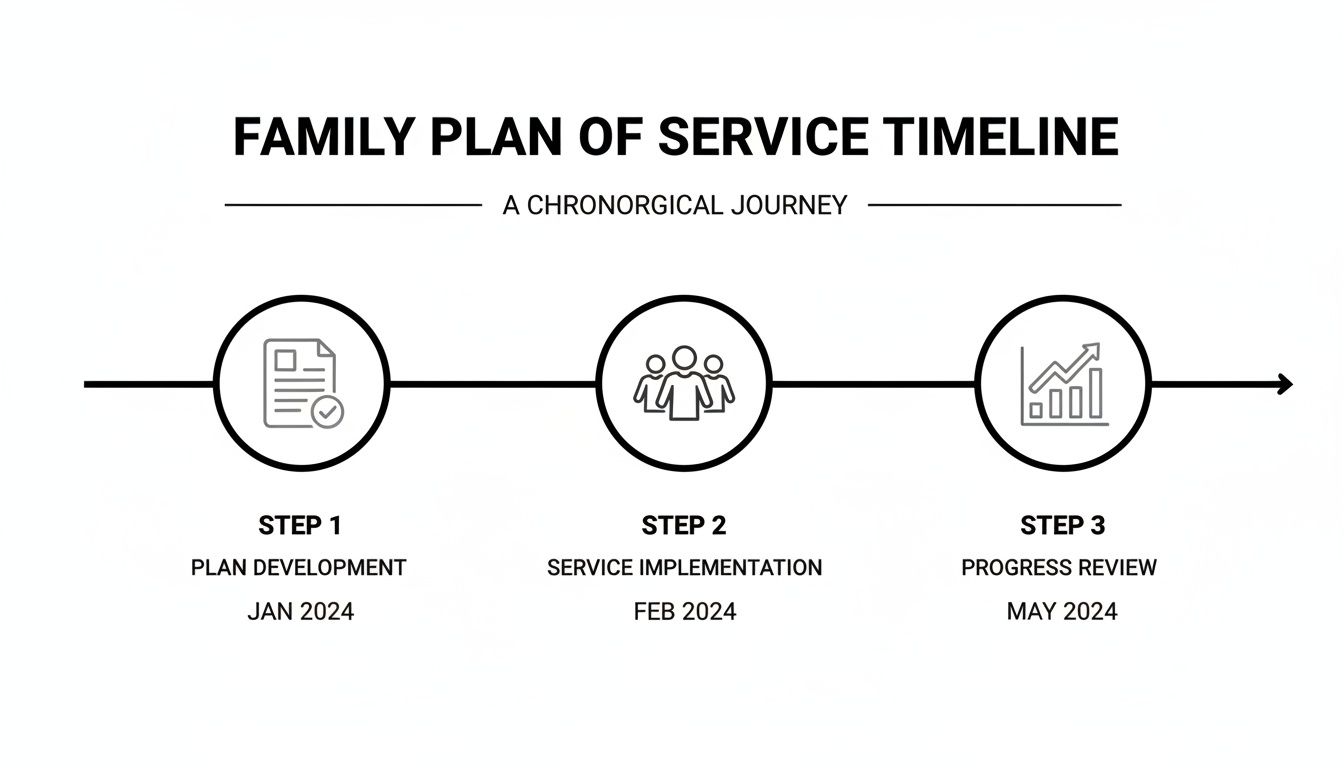
It's a constant cycle of doing the work, documenting it, and presenting your progress to the judge. As you prepare for these court dates, remember that your communications can become evidence. It's smart to understand the admissibility of text messages in court, as relevant conversations with caseworkers or co-parents could be shown to the judge.
Every court date is an audition. It’s a chance to show the judge, with actions and documentation, that you are the parent your child deserves and that you are working tirelessly to provide a safe, stable, and loving home.
This strict timeline adds pressure, but it also gives you a clear finish line to work toward. For a more detailed look at these dates, read our guide on the CPS reunification timeline in Texas.
Proving Your Progress: Documentation is Everything
When you're fighting to get your child back from CPS, simply checking the boxes on your service plan isn't enough. A judge and your caseworker need to see real, undeniable proof that you have made meaningful changes. This is your opportunity to show them you’re not just compliant—you’re committed to building a safe, stable home for good.

Think of it this way: you are building a legal case for your family. Every positive action you take, every class you complete, every clean test you pass—it's all evidence. Your job is to collect that evidence and organize it into a powerful story of your commitment and progress. Taking this proactive stance can make all the difference in the reunification process for Texas CPS cases.
The Power of Documentation
Words can be twisted or forgotten, but a stack of documents is hard to argue with. From the very first day, you need to become the lead record-keeper for your own case. Get a binder or start a digital folder and save everything. This isn't just for you; it's a treasure trove of evidence that your attorney can use to fight for you in court.
Actionable Advice: Start a "Reunification Binder" and collect the following:
- Certificates of Completion: Every certificate from parenting classes, anger management courses, or other required programs.
- Attendance Logs: Keep a detailed record of your attendance for all services, including therapy appointments and support group meetings.
- Positive Reports: Proactively ask your counselor, therapist, or program facilitator to write a letter or email highlighting your progress and active participation.
- Clean Drug Test Results: Get a copy of every clean drug test result. This builds a clear, consistent pattern of sobriety that speaks volumes.
When you present this organized evidence, you paint a picture of dedication that a judge simply cannot ignore.
A Scenario of Proving Progress
Let's imagine a father we'll call "David." His son was removed because of concerns over substance abuse and an unstable home environment. His service plan required counseling, random drug tests, and maintaining stable employment.
At first, David had a few stumbles. He missed a counseling session and was late for a drug test, which CPS immediately flagged as negative. But after a serious talk with his attorney, he changed his strategy. He started emailing his counselor to confirm every appointment. He kept a log of his job search. After every clean drug test, he asked for a printed copy for his binder.
Months later, at the next court hearing, his attorney didn't just say David was doing better. She presented a folder full of proof: six months of perfect attendance records, a glowing progress letter from his counselor, and a thick stack of clean drug test results. That tangible evidence proved to the judge that David's early mistakes were part of a journey toward real, lasting change.
Handling Setbacks and Supervised Visits
Setbacks happen. A failed drug test or a tense supervised visit can feel like the end of the world, but it’s how you react that truly matters. Instead of getting defensive, the first thing you should do is call your attorney. A proactive response—like immediately asking for more frequent testing or scheduling a session with your therapist to discuss what happened—shows the court you're taking the issue seriously.
A setback is not a failure. It's a chance to prove your resilience and your commitment to getting back on track. The court values consistent effort far more than it expects perfection.
Supervised visits are another place where you can shine. These aren't just opportunities to see your child; they are auditions for your role as a parent. Show up on time. Bring a snack or an age-appropriate game. Most importantly, give your child your undivided, loving attention. A positive, patient, and warm interaction is some of the most powerful evidence you can offer. If you're wondering what comes next, you can learn more about what to expect when reuniting with a child after a CPS case.
Thankfully, more families are successfully navigating this path. Recent data shows a 1.1% statewide increase in children in Texas exiting foster care to reunification within one year in FY23 compared to the prior year. You can read more about these reunification trends on the DFPS website. With focused effort and the right strategy, bringing your children home is an absolutely achievable goal.
When Criminal Charges and CPS Cases Overlap
For many Texas families, the nightmare of a CPS case doesn’t start with a knock from a caseworker. It begins with the jarring flash of red and blue lights. An arrest for DWI or a domestic argument that escalates into a family violence charge can trigger a call to CPS, pulling you into two legal battles at once.
Suddenly, you’re not just fighting one legal case; you're fighting two on separate, but deeply connected, fronts.
It can feel like you're caught in a storm, with a criminal prosecutor seeking a conviction and a CPS caseworker focused on your child's welfare. It’s confusing, terrifying, and the stakes in both courtrooms are unimaginably high. Understanding how these two parallel tracks work is essential for anyone trying to navigate the reunification process in Texas CPS cases while also defending their freedom.
Two Courts, Two Sets of Rules
The criminal court and the family court are different worlds. The criminal court asks: did you break a law? The family court, which handles all CPS matters, operates under one guiding principle: the best interest of your child.
This can create incredibly frustrating situations. A judge in your criminal case might issue a "no-contact order," forbidding you from going near your spouse or even returning home. At the same time, your CPS caseworker is telling you that to get your kids back, you need to attend family counseling and have supervised visits. How can you comply with both? This is where a unified legal strategy is a necessity.
When you face both a criminal charge and a CPS case, you're not just fighting to clear your name. You're fighting to hold your family together. The actions you take in one courtroom will have a direct and powerful impact on the other.
A Scenario of Overlapping Cases
Let's walk through a common scenario. A parent we'll call "Mark" is arrested for DWI with his child in the car. This single event triggers two immediate legal crises:
- The Criminal Case: Mark is charged with Driving While Intoxicated with a Child Passenger, a state jail felony. He now faces potential jail time, fines, and a criminal record.
- The CPS Case: Citing the danger posed by his actions, CPS removes his child and requires him to complete alcohol treatment and testing.
Mark feels completely overwhelmed. But with his attorney's guidance, he begins a path forward. He proactively enrolls himself in an intensive outpatient alcohol treatment program. This decisive action serves double duty.
His criminal defense attorney uses the progress reports from his treatment program to negotiate a much better outcome in the felony case. At the same time, those same reports are submitted as evidence in his CPS case. Mark isn't just checking a box; he's actively demonstrating to both judges that he understands the gravity of his mistake and is taking concrete steps to ensure it never happens again. By coordinating his legal strategy, Mark uses his progress in one case to build momentum in the other, a crucial step in the reunification process for Texas CPS cases.
When Reunification Is No Longer the Goal
Every Texas CPS case begins with one primary goal: bringing your family back together safely. But what happens when, after months of court dates and services, a judge decides that reunification is no longer a viable option? Hearing those words is devastating, and it’s essential to understand what this shift means for you and your child.
This is when a CPS case enters its most critical phase. The state's focus may pivot from helping you reunite with your child to permanently ending your legal rights as a parent. This isn't a step the state takes lightly—it's a drastic measure that requires them to meet an incredibly high legal standard under Texas Family Code Chapter 161.
The Grounds for Termination of Parental Rights
For a judge to terminate your parental rights, CPS must prove two things by “clear and convincing evidence,” a much tougher standard of proof than in the rest of the case.
First, CPS must prove you committed at least one of the specific acts listed in the law, known as statutory grounds. These include acts like:
- Knowingly placing or allowing your child to remain in conditions that endangered their physical or emotional well-being.
- Failing to comply with the court-ordered service plan designed to facilitate reunification.
- Using a controlled substance in a way that endangered the health or safety of your child.
Second, CPS must also prove that terminating your rights is in the “best interest of the child.” This is a separate and equally vital finding. The judge will weigh numerous factors, from your child's emotional and physical needs to the stability of the proposed new home and your own actions throughout the case.
Alternatives to Termination
When reunification is off the table, it doesn't automatically mean your rights will be terminated. A proactive legal strategy can often open the door to other options that keep family connections alive. One of the most common alternatives is a Permanent Managing Conservatorship (PMC) granted to a relative, often called kinship care.
In this situation, a grandparent, aunt, uncle, or another trusted family member steps in to become the child’s legal guardian. You would no longer have legal custody, but this arrangement can preserve your ability to have contact, visits, and a relationship with your child—something termination would permanently destroy.
This path depends on having a relative who is willing and able to take on this huge responsibility and can pass all required background checks. It is a critical alternative to discuss with your attorney. The court's ultimate goal is lasting stability, especially since recidivism is a concern. Data shows a small number of children who are reunified end up back in the system, which is why finding a truly permanent, safe home is the priority. You can see more about post-reunification data on the DFPS website.
If the state is seeking to terminate your parental rights, you need an experienced attorney more than ever. The stakes couldn't be higher, and mounting a powerful defense at trial is your last, best chance to protect your family.
Common Questions About the Reunification Process
When you're in the middle of a CPS case, the uncertainty can be just as draining as the process itself. The questions can keep you up at night. We want to give you clear, straightforward answers to the most common questions we get from parents, hopefully bringing a little clarity and control back into your life.
Can I Refuse to Talk to CPS?
This is often the first question a parent asks. While you absolutely have the right to remain silent, refusing to speak with a caseworker can be flagged as uncooperative, which can work against you.
Actionable Advice: Be polite but firm. Simply state, "I want to cooperate fully, but I cannot answer any questions until I have spoken with my attorney." This protects your rights without creating unnecessary conflict.
How Long Does the Texas CPS Reunification Process Take?
There's no single answer, but Texas law doesn't leave things open-ended. The system is built on a strict timeline, or "rocket docket," designed to resolve most CPS cases within 12 to 18 months. The goal is to give children a permanent, stable home as quickly as possible. The single biggest factor that dictates how long your specific reunification process in a Texas CPS case will take is you. Your consistent progress on your service plan is what moves the needle and gets you closer to bringing your child home.
What Is a Monitored Return?
Think of a monitored return as the final, hopeful step before your case closes. It means your child is back in your home, but CPS continues to monitor the situation for a set period, usually a few months. A caseworker will make scheduled and sometimes unannounced visits to ensure the transition is going smoothly and the home remains safe. A successful monitored return is the last box to check before the case can be officially closed.
Can a Difficult Co-Parent Stop Me from Getting My Child Back?
This is a deep and understandable fear for many parents. The short answer is no—another person’s actions, or lack thereof, don't have to torpedo your chances at reunification. The court evaluates your individual progress.
Your journey is your own. Focus on completing your services and demonstrating your commitment. The court is focused on what you do to create a safe home, not on a co-parent's lack of compliance.
Your hard work and commitment can and will stand on their own merits.
Navigating the legal maze of a CPS case is one of the most stressful experiences a parent can face, but you don’t have to do it alone. The compassionate attorneys at the Law Office of Bryan Fagan have the experience and dedication to guide you through every hearing, every requirement, and every step of the reunification process. If you are a Texas parent fighting for your family, your future, and your children, we are here to help. Contact us today for a free consultation and let us help you build your path back to your family.