Skip to content
A status hearing in a Texas CPS case is the first major court date set to review your family’s progress after your child has been removed. It must happen within 60 days of the court placing your child in the temporary custody of the state. While this isn't the final trial, it's an absolutely critical progress report for the judge to see how things are going for everyone involved—you, your child, and Child Protective Services (CPS).
Your First Texas CPS Status Hearing Explained
Those first 60 days of a CPS case can feel like an eternity. If you're a parent facing your initial status hearing, it’s completely normal to feel overwhelmed, confused, and frankly, terrified for your family’s future. The fear of the unknown is often the hardest part, leaving you to wonder what will happen next and if you'll ever get your children back home where they belong.
But you must see this hearing for what it is: your first formal opportunity to stand before the judge and show you are committed to doing whatever it takes to heal your family.
Think of the status hearing less like a trial where someone is found guilty or innocent, and more like a crucial check-in. The judge's primary goal is to get straight answers to a few key questions:
- Is your child safe and well-cared for in their current placement?
- Are you, the parent, making progress on the tasks outlined in your Family Service Plan, as required by the Texas Family Code?
- Is everyone—including the CPS caseworker—actively working toward the goal of getting your family back together?
The Legal Timeline and Its Purpose
When it comes to Texas CPS cases, the timeline is everything. A status hearing is a major milestone that Texas Family Code Chapter 263 mandates must happen within 60 days after the Department of Family and Protective Services (DFPS) is named the temporary managing conservator of a child. What you do in this hearing can dramatically shift the direction of your case.
After this initial hearing, the court will schedule permanency hearings, which happen every 120 days. These regular check-ins keep the pressure on for everyone to work toward a long-term, stable solution—whether that’s reuniting the family, placing the child with relatives, or, as a last resort, moving toward the termination of parental rights under Chapter 161.
To help you visualize where this first hearing fits into the bigger picture, we've put together a summary of the key court dates you can expect in a typical CPS case.
Texas CPS Case Key Hearing Timeline
Understanding the rhythm of a CPS case can help you feel more prepared and in control. This table breaks down the most important hearings, when they happen, and what they're for, all based on the Texas Family Code.
| Hearing Type | When It Occurs (Texas Family Code) | Primary Purpose |
|---|---|---|
| Adversary Hearing | Within 14 days of child's removal (Chapter 262) | To determine if CPS had legal grounds to remove the child and if continued removal is necessary. |
| Status Hearing | Within 60 days of child's removal (Chapter 263) | The first major review of the case, checking progress on the family service plan. |
| Initial Permanency Hearing | Within 180 days of child's removal (Chapter 263) | To establish a permanent plan for the child (e.g., reunification, adoption, relative placement). |
| Subsequent Permanency Hearing | Every 120 days after the initial permanency hearing | To review progress toward the permanent plan and make any necessary adjustments. |
| Final Hearing/Trial | Within 12 months of child's removal (can be extended to 18 months) | To make a final, legally binding decision on the child's future. |
Each of these hearings is a chance to show the judge you're serious about getting your child back. They are all stepping stones on the path to resolving your case.
The timeline below also shows where the initial 60-day status hearing fits into the broader CPS case schedule.
As you can see, that 60-day mark is the first significant judicial review, making it an incredibly important moment in your case.
Moving from Powerless to Proactive
Just understanding the purpose of this hearing is the first step toward taking back some control. It lets you shift your mindset from feeling like a victim of the system to being an active, engaged participant in your family's future.
For instance, I once worked with a mother from Houston whose service plan required her to attend parenting classes and find stable housing. Overwhelmed by the demands, she initially felt paralyzed. However, instead of just waiting for the hearing, we helped her immediately enroll in a class and start documenting her apartment search.
At her status hearing, we were able to present her enrollment certificate and a detailed log of the apartments she had applied to. This proactive approach showed the judge her dedication right from the start and set a positive, reassuring tone for the rest of her case. While this hearing is just one step, its function is very similar to what you'll encounter in later stages, which you can learn more about by reading our guide on what a review hearing is.
What Happens Inside the Courtroom
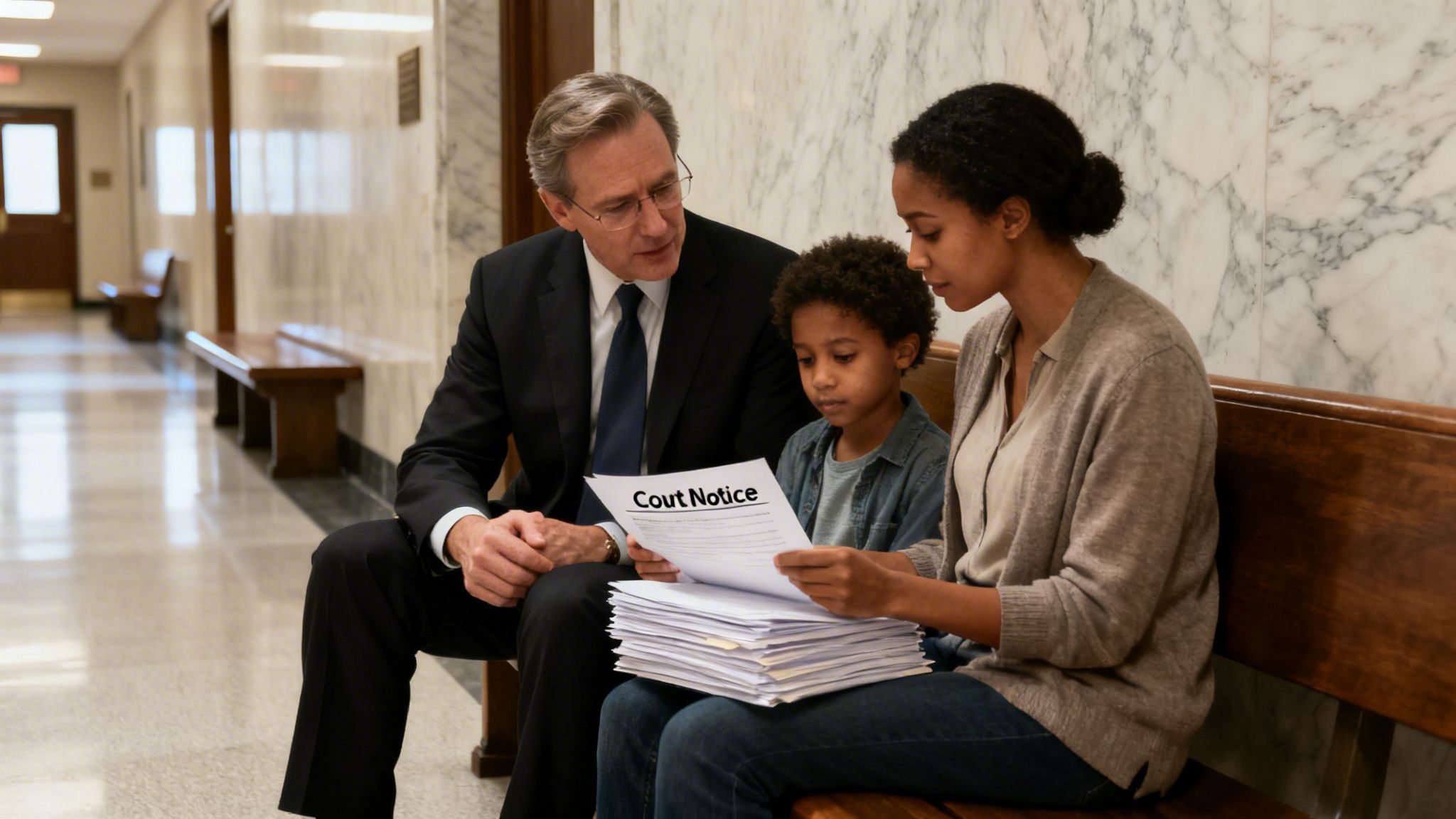
Walking into a courtroom for any reason can be unsettling. When your family’s future is at stake, that feeling is magnified tenfold. The heavy wooden doors, the rows of benches, and the elevated judge's bench can make anyone feel small and anxious. Our goal here is to pull back the curtain, removing the fear of the unknown so you can walk in with a clear head.
A status hearing in a Texas CPS case isn't meant to be a surprise attack. It follows a structured process where everyone involved has a specific role. Understanding who is in the room and what they do is the very first step toward feeling more in control of your situation.
The Key People in the Room
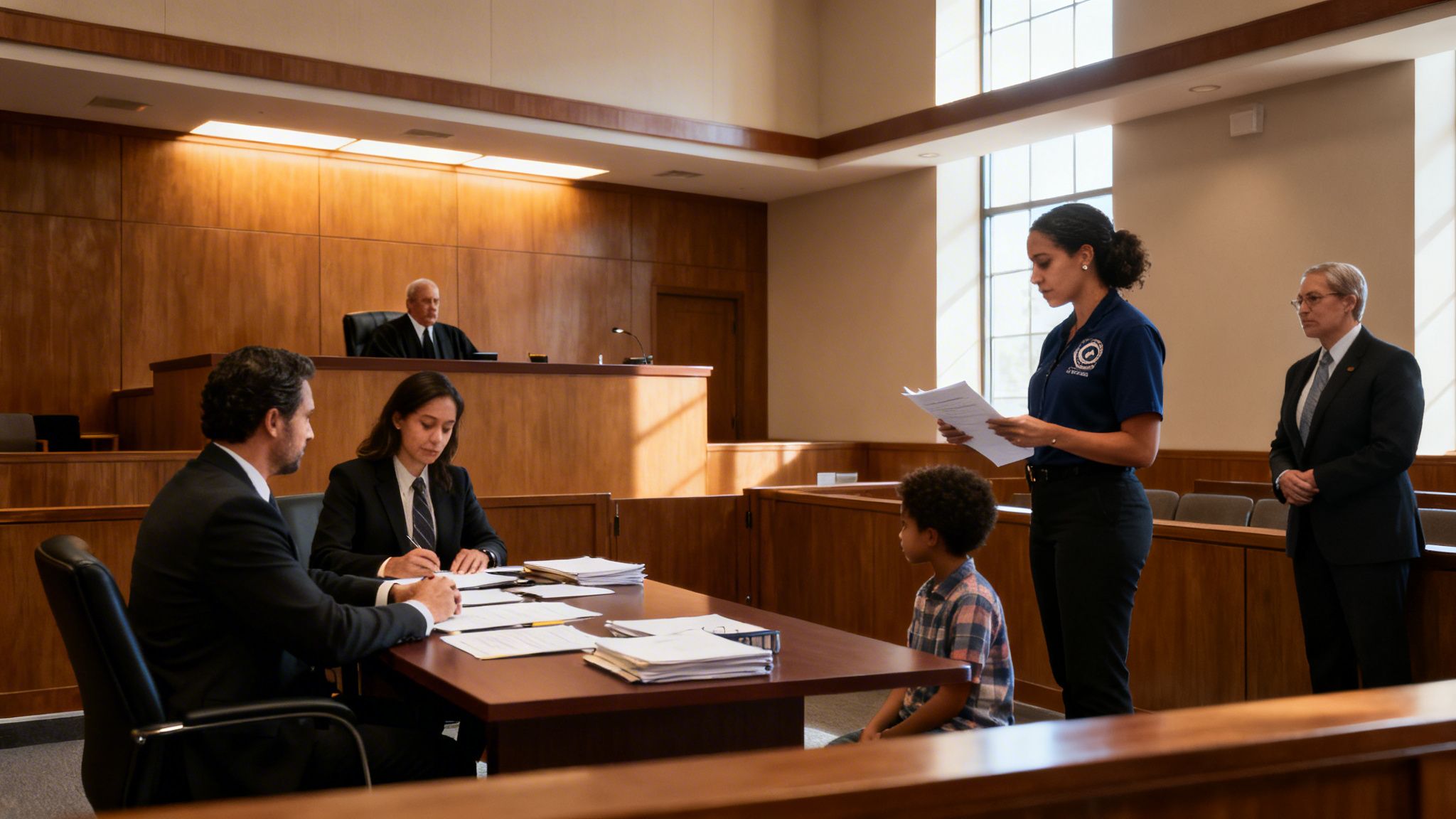
When your case is called, you’ll see several people at the front of the courtroom, each with a distinct job. Knowing who they are and what they’re responsible for will help you make sense of the proceedings as they unfold.
- The Judge: The judge is the ultimate decision-maker. They listen to all sides, review the evidence, and issue orders based on the Texas Family Code and what is in the child's best interest. Their primary focus is always on your child's safety and your family's progress.
- The CPS Caseworker: Your caseworker will be there to give the court an update on your case. They’ll talk about where your child is living and how you're progressing (or not) on your Family Service Plan.
- The CPS Attorney: This lawyer represents the Department of Family and Protective Services (DFPS). Their job is to present the caseworker's report and the Department's recommendations to the judge.
- The Attorney Ad Litem: This is an attorney the court appoints specifically to represent your child’s best interests. They will have likely met with your child and will tell the judge what they believe is best for them.
- Your Attorney: Your lawyer is your voice and your advocate in the courtroom. Their job is to present your progress, challenge any inaccuracies in the CPS report, and argue for what is best for you and your family.
This group will discuss your family’s situation, but remember, the hearing is designed to be about progress, not punishment.
The Flow of the Hearing
While every case has its own unique details, most status hearings follow a predictable rhythm. Think of it as a formal, guided conversation with the judge, led by the attorneys. The hearing typically unfolds in these steps:
- The Case is Called: The judge or bailiff will call your case number and name. You and your attorney will then approach the counsel tables at the front of the courtroom.
- CPS Presents Its Update: The attorney for CPS will usually start. They will have the caseworker testify about your child’s status, their current placement, and how you are doing with your required services.
- Your Attorney Responds: This is your turn to shine. Your lawyer will get the chance to cross-examine the caseworker and present your side of the story. This is where they submit evidence of your progress and highlight your commitment.
- The Ad Litem's Report: The child's attorney will then give their own recommendations to the judge based on their independent investigation.
- The Judge Makes Rulings: After hearing from all parties, the judge will make their decisions. These are temporary orders—not the final outcome—that will guide the case over the next few months. This could involve ordering new services, changing visitation, or setting the date for the next hearing.
Your status hearing is your opportunity to show the judge who you are beyond the paperwork. It’s a chance to transform a simple update into a powerful statement about your commitment to your family.
Imagine a mother, Maria, who was required to attend parenting classes and submit to drug tests. Instead of just doing the bare minimum, she gets a certificate of completion and a positive letter from her class instructor. Her attorney presents these documents in court, along with a consistent record of clean drug tests. This isn't just checking a box; it's building a story of a parent who is actively working to create a safe and healthy home for her child. That proactive effort speaks volumes to a judge and can change the entire tone of the hearing.
Know Your Rights and Responsibilities
When Child Protective Services enters your life, it's easy to feel like you’ve lost all control. The ground shifts beneath your feet, and it can seem like every choice has been stripped away. But here’s the truth: the law, specifically the Texas Family Code, grants you a very specific set of rights and a clear path to follow.
Knowing your rights is the first step toward reclaiming your role in your family's future. It's how you move from being a bystander to an active participant. These rights aren't just legal jargon; they are the tools you have to demand fairness and transparency throughout the status hearing CPS case Texas process.
At the same time, you have responsibilities. But don't look at them as burdens. Instead, see them as opportunities—actionable advice and proactive steps you can take to prove to the court that you are committed to bringing your children home.
Your Fundamental Rights in a CPS Case
The Texas Family Code is your shield. It's there to protect you during one of the most difficult times a parent can face. Understanding these protections empowers you to stand on solid ground.
Here are the most critical rights you hold as a parent:
- The Right to Be Notified: You must receive an official notice telling you the date, time, and location of your status hearing. This isn't a simple courtesy; it's a legal requirement designed to guarantee you have a chance to be there and have your voice heard.
- The Right to an Attorney: You absolutely have the right to a lawyer. If you cannot afford to hire one, the court is legally required to appoint an attorney for you. This is non-negotiable, as an experienced lawyer is your best advocate in a system they know inside and out.
- The Right to Review Evidence: CPS cannot hide the ball. You have the right to see and review every report, document, and piece of evidence they file with the court. This includes the caseworker's report, which often carries significant weight with the judge.
- The Right to Present Your Own Evidence: You are not just a defendant in this process. You have the right to bring your own evidence and witnesses to challenge CPS's allegations and, just as importantly, to show the court the progress you've made.
Understanding these rights is just the starting point. The real power comes from actively using them to your advantage. For a deeper dive, we've put together a detailed guide on your rights during a CPS investigation.
Turning Your Responsibilities into Strengths
Along with your rights, the court and CPS will assign you a set of responsibilities, which are typically laid out in your Family Service Plan. It's easy to see this plan as just another checklist of demands, but we urge you to reframe it. See it as your roadmap back to your kids. Every task you complete is another piece of positive evidence you can present in court.
A common misconception is that just checking the boxes is enough. In my experience, the parents who get their kids back the fastest are the ones who go above and beyond, using their service plan to actively prove their commitment.
Think of it this way: A father I once worked with was required to submit to a drug test. He didn't just take the test and call it a day. He also proactively enrolled in a local support group and got a letter from his sponsor vouching for his dedication. This simple, proactive step transformed a mandatory requirement into a compelling story of positive change, which is exactly what a judge wants to see.
Your key responsibilities—and our actionable advice—will almost always include:
- Work Your Service Plan: This is your absolute top priority. Go to every class, counseling session, and appointment. No excuses. And document everything.
- Stay in Contact: Keep the lines of communication with your CPS caseworker and your attorney open and professional. When they call or email, respond promptly.
- Attend All Court Hearings: Your presence in the courtroom matters more than you might think. Showing up for every single hearing, especially the status hearing in your CPS case in Texas, tells the judge you are engaged and taking this process seriously.
- Maximize Visitation: Never miss a scheduled visit with your children unless it's a true, unavoidable emergency. These visits are not just for your benefit; they are also a chance for CPS to observe your parenting skills and your bond with your child.
How to Build a Strong Case for Reunification
Your first status hearing in a CPS case in Texas is a pivotal moment. This is your first real opportunity to stand before the judge and demonstrate your commitment to getting your child back. It’s natural to think that just following your service plan is enough, but building a powerful case means going beyond simply checking off boxes.
You have to show the judge, not just tell them, that you’ve changed. In a courtroom, words are fleeting, but documentation is concrete. Think of it as creating a portfolio of your progress. Every certificate, letter, and photograph you gather becomes undeniable proof of your hard work and your dedication to bringing your child home.
More Than Words: Proving Your Progress
Walking into that courtroom with a well-organized file of positive evidence sends a clear message. It tells the judge you're not just a passive participant in this process; you're actively working to create the safe, stable home your child deserves. It shows you respect the court and understand exactly what's at stake.
Here are the kinds of tangible evidence that can truly make a difference in your case:
- Certificates of Completion: Don't just mention you finished a class—bring the certificate. Whether it's for parenting, anger management, or a substance abuse program, this is non-negotiable proof of your effort.
- Clean Drug Test Results: Keep a detailed log of every drug test you take, noting the date, the location, and the result. A consistent, documented history of clean tests is one of the most compelling pieces of evidence you can present.
- Proof of Stability: You need to show you’re building a stable life. This can include a letter from your boss confirming your employment, recent pay stubs, or a signed lease agreement for a suitable home.
- A Safe Home Environment: A picture is worth a thousand words. Take clear, well-lit photos of your home, especially your child's clean and furnished bedroom, a kitchen with a stocked pantry, and general living areas that are free from any hazards.
- Statements from Credible Witnesses: Letters from people who can vouch for your progress—like a therapist, sponsor, pastor, or counselor—add incredible weight. These are objective, third-party endorsements of your character and commitment.
This collection of evidence doesn't just list your accomplishments. It weaves together a powerful story of a parent who is actively and intentionally rebuilding their life for their child.
A Real-Life Example: David’s Path to Proving Stability
Let's imagine a father, we'll call him David, whose service plan required him to find stable housing. He could go to his status hearing and simply tell the judge, "I'm looking for a place." Or, he could do what our most successful clients do and show the court he means business.
Instead, David and his attorney arrive at court fully prepared. They hand the judge a file that contains:
- A copy of his newly signed, one-year lease agreement.
- Clear photographs of his two-bedroom apartment, including a clean, furnished room waiting for his child.
- Copies of recent utility bills in his name, proving he's established services.
- His most recent pay stub, showing he can comfortably afford the rent.
This stack of documents accomplishes so much more than just proving he has an apartment. It showcases his foresight, his sense of responsibility, and his genuine dedication to providing a secure home. It completely shifts the narrative from what he intends to do to what he has already done.
This proactive, evidence-based approach is infinitely more persuasive than a verbal promise. It gives the judge the confidence they need to see that your progress isn't just a hope, but a reality.
The checklist below can help you start organizing your own evidence so you're ready for your day in court.
Evidence Checklist for Your CPS Status Hearing
Think of this table as your guide for gathering the crucial documents you'll need. Keeping everything neatly organized in a binder will allow your attorney to present your progress to the judge clearly and effectively.
| Category of Progress | Examples of Documentation |
|---|---|
| Service Plan Compliance | Certificates from parenting classes, anger management, or counseling. Attendance records from support groups (e.g., AA/NA). |
| Sobriety and Health | A log of all drug test results. Letters from your substance abuse counselor or sponsor. Records of therapy attendance. |
| Financial and Housing Stability | A signed lease or mortgage statement. Recent pay stubs or a letter from your employer. Photos of your safe, clean home. |
| Parent-Child Bond | A log of every visit you've attended. Notes on what you did during visits. Letters or drawings from your child. |
| Personal Growth | Statements from credible witnesses (therapist, sponsor, pastor) vouching for your character and progress. |
By methodically collecting these items, you and your attorney can build a powerful, persuasive case for reunification at every status hearing in your CPS case in Texas.
Potential Outcomes of Your Status Hearing

After everyone has had their say and all the evidence is on the table, the judge makes a decision. The weight of this moment is immense. The judge’s ruling at your status hearing in a CPS case in Texas charts the course for the next several months of your life and your child's. Knowing the possibilities can help you brace for what’s coming, no matter which way the gavel falls.
It's important to remember that these decisions, called court orders, aren't the final chapter. They are temporary guardrails meant to keep everyone moving toward one single goal: finding a safe, permanent home for your child.
Positive Steps Forward
A positive outcome at your status hearing is the direct fruit of your labor. If you’ve been putting in the work and following your service plan, the judge has a few ways to acknowledge your progress and inch your family closer to being whole again.
These favorable rulings might look like this:
- Increased Visitation: The judge could expand your time with your child. This might mean moving from supervised visits to unsupervised ones, or simply getting to see them more often and for longer periods.
- A Monitored Return: This is a huge win. A monitored return means the judge orders your child to come back home, though CPS will continue to keep an eye on things. This sends a strong message that the court is regaining confidence in you.
- Reduced Services: If you’ve successfully checked off certain requirements on your service plan, the judge might decide you don’t need to do them anymore. This frees you up to concentrate on the remaining goals.
Any of these is a victory. It’s the court’s way of saying, “We see you. We see your effort.”
The Most Common Outcome
Honestly, in many cases, the most frequent result of that first 60-day status hearing is that nothing changes. The current service plan stays in place, and your child stays where they are. This is not a loss. It just means the judge needs more time to see a consistent pattern of progress.
Think of your CPS case as a marathon, not a sprint. The 60-day status hearing is just the first checkpoint. A ruling to continue the status quo is the judge’s way of saying, “You’re on the right track, but you need to keep going.”
This outcome gives you a clear roadmap. It tells you precisely what to focus on between now and your next court date.
When Progress Is Not Enough
Sometimes, even when you feel like you’ve been trying your hardest, the judge might decide it’s not enough to guarantee your child’s safety. This is a tough pill to swallow, but it’s not the end of the road.
If the judge still has significant worries, they could order:
- Additional Services: The court might add new tasks to your service plan, like more intensive therapy or a different kind of psychological evaluation.
- Limited Contact: In more serious cases, the judge could scale back your visitation if they believe contact with you isn't in your child’s best interest right now.
- A Change in Placement: If the child’s current foster home or relative placement isn't a good fit, the court could order them moved to a new home.
This first status hearing is one of several checkpoints designed to find a safe, permanent home for your child. After this, permanency hearings happen every 120 days, as mandated by the Texas Family Code, acting as recurring reviews of the long-term plan. For a deeper dive into this legal structure, you can learn about Texas CPS reviews and permanency hearings.
No matter what the judge decides, the ruling gives you a clear set of tasks for the next phase. Even a difficult outcome provides a path forward.
Why an Experienced Attorney Is Your Strongest Ally
Walking into a CPS hearing by yourself is a risk no parent should ever have to take. With your family's future hanging in the balance, it's natural to feel lost, intimidated, and completely overwhelmed by a system that feels stacked against you. This is one journey you should never have to make alone.
An experienced CPS attorney does far more than just stand beside you in court. They are your personal strategist, your staunchest advocate, and your guide through a process that can be terrifying. They are the one person in the room whose only job is to protect you and your parental rights.
More Than Just a Lawyer
A skilled CPS defense lawyer becomes your most powerful asset in a few critical ways. They know how to dive deep into complex CPS reports, which are sometimes filled with errors, subjective opinions, or secondhand information presented as hard fact. They know the right way to object to improper evidence and how to challenge a caseworker's inaccurate statements on the witness stand.
Most importantly, they know how to tell your story in a way that truly connects with the judge.
Your attorney is the one who translates all your hard work—every parenting class you've finished, every clean drug test, and every stable paycheck—into a powerful legal argument for getting your kids back home. They make sure your progress isn't just seen, but fully understood by the court.
I once represented a father who was having a tough time proving he had secured a stable home. Following our advice, he brought his signed lease, photos of the new bedroom he'd set up for his child, and copies of his utility bills to the status hearing in his CPS case in Texas. This proactive preparation, guided by legal experience, completely changed the narrative of his case from one of uncertainty to one of clear, undeniable progress.
Your Advocate in a Complex System
An attorney's value goes far beyond the courtroom walls. They are the ones negotiating directly with the CPS attorney, working behind the scenes to find common ground and push for more reasonable terms in your service plan. They understand the local court procedures in Houston, Dallas, and across Texas, and they know the judges, caseworkers, and other key players involved.
This deep knowledge of the Texas Family Code and local court customs is your shield. For parents who find themselves navigating both a CPS case and a related criminal matter, having a knowledgeable legal team becomes even more critical. Learning how to choose a criminal defense attorney can bring some much-needed clarity during such a stressful time.
Don't leave the future of your family to chance. You and your children deserve dedicated legal support fighting for you every step of the way.
Frequently Asked Questions About CPS Status Hearings
When you're facing a status hearing in a CPS case in Texas, it's completely normal for a flood of questions and worries to keep you up at night. With so much on the line, feeling lost is understandable. To help cut through the confusion and give you some solid ground to stand on, we’ve answered some of the most pressing questions we hear from parents just like you every single day.
Can My CPS Case Be Closed at the Status Hearing?
While it is rare for a case to be completely dismissed at the very first 60-day status hearing, it's not impossible, and you can still make huge strides forward. Think of this hearing as your first major opportunity to show the court you're serious.
If you’ve completed every task on your service plan and CPS agrees your children are safe, the judge might order a "monitored return." This is a massive step in the right direction. It means your kids come home, but with CPS still keeping an eye on things. A full dismissal is more common at a later permanency hearing, but a stellar performance at this first status hearing paves the way for a much quicker family reunification.
What if I Disagree with the CPS Caseworker's Report?
This is exactly where having a skilled attorney becomes non-negotiable. You and your lawyer have every right under the Texas Family Code to challenge any information in the caseworker’s court report that is false, misleading, or inaccurate.
Your attorney has a couple of powerful ways to do this:
- They can present your own evidence—things like text messages, emails, photos, or even witness testimony that tells the true story.
- They can put the caseworker on the witness stand and cross-examine them, asking sharp, targeted questions to expose inaccuracies and biases in their report.
Never let false allegations go unchallenged. The status hearing in your CPS case in Texas is your formal chance to set the record straight and make sure the judge hears the whole truth, not just the CPS version of it.
Will I Get to Speak to the Judge Directly?
For the most part, you'll communicate with the court through your attorney. This is by design. Your lawyer is a professional advocate, trained to frame arguments and present facts in a way that is persuasive and follows court rules. It keeps the hearing orderly and focused.
However, there's always a chance you could be called to the stand to testify. If that happens, your attorney will walk you through extensive preparation beforehand. They’ll make sure you know what to expect, how to answer questions calmly and truthfully, and how to share your side with confidence and compassion.
What Happens if I Miss My Status Hearing?
Missing a court date is one of the worst mistakes you can make in a CPS case. It can trigger immediate and severe consequences. A judge is likely to see your absence as a sign of non-compliance, a lack of concern, or disrespect for the court's authority—all of which can destroy your credibility.
The court can, and often will, proceed with the hearing without you. This means the judge will make crucial decisions about your children and your rights based solely on the information provided by CPS.
If a legitimate, unavoidable emergency keeps you from attending, your very first call must be to your attorney. They can notify the court, explain the situation, and take immediate action to protect your rights while you're absent.
The Texas legal system is a maze, and your family's future is far too important to navigate alone. The Law Office of Bryan Fagan is here to offer the authoritative, compassionate, and aggressive legal representation you need. If you're a parent facing a CPS investigation or heading to court in Texas, your family's future is on the line. Contact us today for a free, confidential consultation to learn how we can fight for you and your children.