Skip to content
The phrase "termination of parental rights" is a cold, legal term for what is arguably the most devastating outcome in any family law case. It's often called the "civil death penalty" for a reason. When a judge terminates your rights, the legal bond between you and your child is severed completely and permanently. All your rights, duties, and responsibilities as a parent are gone forever.
The Knock on the Door: When a CPS Investigation Begins
It’s a moment that stops your world cold: the unexpected knock on the door or a phone call from an unknown number, with a Child Protective Services (CPS) caseworker on the other end. In that instant, a storm of fear, anger, and confusion can overwhelm you as you face the terrifying possibility of losing your child.
This is where the journey begins—a path no parent ever wants to walk, one that could lead to the permanent termination of your parental rights. This isn't just about a temporary custody dispute; it's about the potential for an irreversible break in your family. Understanding what’s at stake from the very first minute is the first step in defending your family.
What an Investigation Really Means for Your Family
Imagine getting a call from your child's school. The principal informs you a CPS caseworker is on-site, waiting to interview your daughter. Your heart pounds as you race to the school, only to discover an anonymous caller alleged neglect because your child mentioned being home alone for a short while after school. You feel judged, blindsided, and utterly terrified.
This scenario is an all-too-common entry point into the sprawling CPS system. An investigation isn't a guilty verdict, but it does mean your family is now under a microscope. From this point forward, every word you say, every decision you make, will be scrutinized.
The stated goal of a CPS investigation is to assess a child's safety, often with the aim of preserving the family. However, the process itself can feel incredibly adversarial and threatening. Your most powerful defense, right from that first interaction, is knowing your rights.
The Ultimate Stakes: Termination of Parental Rights
That first phone call kicks off a long, winding road filled with legal hurdles and critical deadlines. Knowing what’s happening—and what could happen—is the key to facing it head-on. The initial stages are absolutely crucial. You can get a more detailed look at what to expect by reading about the Texas CPS investigation process.
Ultimately, a CPS investigation can conclude in a few different ways:
- Case Closed: The investigator finds no credible evidence of abuse or neglect and closes the case. This is the best-case scenario.
- Services Offered: Without opening a formal court case, CPS might require or recommend your family participate in services like parenting classes, counseling, or substance abuse assessments.
- Court Intervention: If CPS believes your child is in immediate danger, they will file a lawsuit. This can lead to court-ordered supervision or, in the most serious cases, the removal of your child and the start of a lawsuit to terminate your parental rights.
The fear is very real, but so is the possibility of reunification and putting this crisis behind you. The key is to take immediate, informed action to protect your rights and fight for your family’s future.
Navigating the Texas CPS Court Process
The moment CPS decides to file a lawsuit against you is a moment you'll never forget. The ground shifts beneath your feet. This is no longer just an investigation; it's the start of a formal court case where a judge will make life-altering decisions about your family. The legal clock starts ticking immediately, and it’s governed by incredibly strict timelines laid out in the Texas Family Code.
Trying to understand this process can feel like trying to navigate a maze in the dark. But knowing the steps—the hearings, the deadlines, the key players—is the first step toward regaining a sense of control. It transforms you from a passenger to a participant in your own case.
This isn't just a single event. It’s a series of critical milestones that will lead either toward reuniting your family or toward the permanent loss of your parental rights.
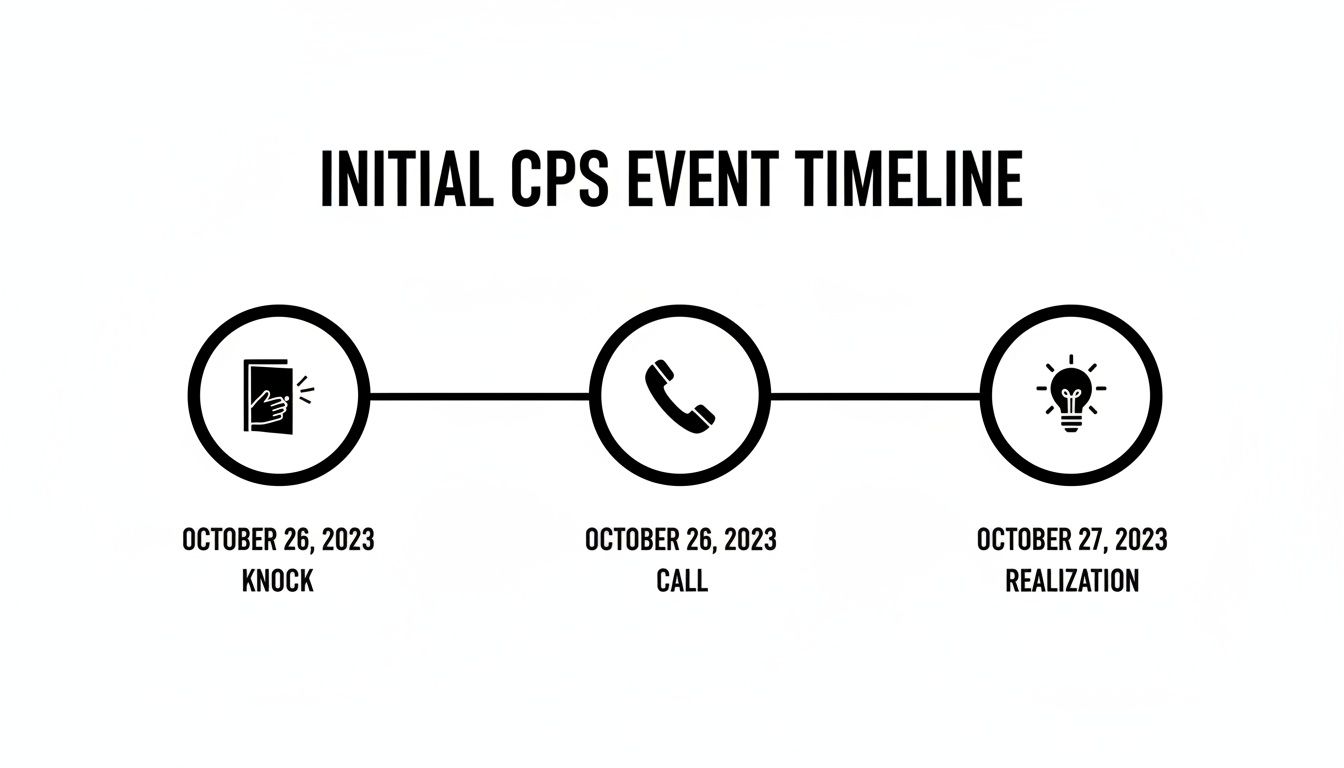
The timeline above shows just how fast things can escalate. A knock on the door can turn into a full-blown legal crisis in a matter of hours.
The court process is a structured, time-sensitive journey. To help you visualize the path ahead, here are the key stages and what to expect at each one.
Key Stages in a Texas CPS Case Timeline
| Stage | What Happens | Typical Timeframe |
|---|---|---|
| Emergency Hearing | If your child has been removed, this is the first court date. CPS must prove the child is in immediate danger. | Within 14 days of removal |
| Status Hearing | The court reviews your progress on the service plan and the child's well-being. | Within 60 days of removal |
| Initial Permanency Hearing | A major hearing to review the permanent plan for the child (reunification, adoption, etc.). | Within 180 days of removal |
| Subsequent Permanency Hearings | Follow-up hearings to monitor progress toward the permanent plan. | Every 120 days after the initial hearing |
| Final Trial | The case must go to a final trial to determine the outcome. | Within 12 months of removal (can be extended to 18 months) |
Understanding these deadlines is non-negotiable. Missing one can have devastating consequences for your case and your ability to bring your child home.
The First Court Dates and Your Service Plan
If CPS has taken your child, Texas law is clear: an emergency hearing, often called an Adversary Hearing, must happen within 14 days of the removal. This is mandated by Texas Family Code Chapter 262. It's your first real chance to stand before the judge, present your side of the story, and fight for your child's immediate return.
At this early stage, the judge will also appoint an attorney ad litem. This is a lawyer whose only client is your child. Their job is to investigate the situation independently and recommend what they believe is in the child's best interest.
Soon after, you'll be handed a Family Service Plan (FSP). Think of this as the official roadmap CPS creates for you. It’s a list of tasks and services you must complete to prove to the court that you can provide a safe home. This often includes things like:
- Parenting classes or individual therapy
- Drug and alcohol testing
- Psychological evaluations
- Maintaining stable housing and a job
A Critical Shift in Texas Law
For years, the FSP has been a double-edged sword. While its stated goal is to help families reunite, failing to check off every box has been a primary weapon used by CPS to terminate parental rights. But a huge change is on the horizon.
On September 1, 2025, a game-changing update to Texas law takes effect. The legislature has completely repealed the legal ground for terminating parental rights based only on a parent's failure to complete a CPS service plan, a provision formerly in Texas Family Code Section 161.001(O).
This is a massive reform that addresses a long-standing injustice. It means that, starting in 2025, a court can no longer take your child away forever just because you missed a counseling session or struggled to complete a confusing, and sometimes impossible, service plan. Even better, this law is retroactive, which could impact ongoing cases. You can read more about how this 2025 law protects parents from unfair FSP-based terminations.
Even with this new protection, your best strategy is to tackle that service plan head-on. Document everything. Keep a file with every certificate from every class, every clean drug test, and every email with your caseworker. Proving your commitment is one of the most powerful ways to show a judge that you are a safe, capable parent who is ready for your child to come home.
Understanding the Grounds for Termination in Texas
In Texas, the bond you have with your child isn't just an emotional tie; it's a fundamental right protected by the constitution. A judge can't just wake up one day and decide to sever that relationship. Before the state can take a step as final and life-altering as terminating your parental rights, Child Protective Services (CPS) has to clear an incredibly high legal hurdle.
They don't just have to make a general case that you're a bad parent. They have to prove two very specific things. First, that you've committed at least one of the specific acts listed in the Texas Family Code Section 161.001. Second, they must prove that termination is in the “best interest of the child.” Proving one without the other isn't enough.
Think of this two-part test as a critical firewall. It prevents the state from ending your rights based on vague feelings or accusations and forces them to build a case on specific, provable facts. The first step to defending yourself is understanding exactly what those facts, or "grounds," are.
Translating the Legal Code into Plain English
The Texas Family Code lists over 20 different grounds for termination, but when CPS is involved, you tend to see the same few allegations pop up over and over. It's crucial to understand what these legal terms actually mean in the real world, not just in a law book.
Here are some of the most common grounds CPS will argue:
- Endangerment: This is the big one and probably the most common. It means you knowingly put your child in situations or environments that endangered their physical or emotional health. This isn't just about direct harm. It can mean exposing a child to domestic violence in the home, having illegal drug activity around them, or even leaving a child with someone you know is dangerous.
- Abandonment: This ground applies if you've left your child with someone else without providing for their support and have shown you don't intend to return. It can also be used if you leave a child somewhere without any way to identify them or ensure they get back to a safe place.
- Failure to Support: This isn't about missing a few child support payments. This ground can be used if you've had the ability to support your child financially but have failed to do so for a full year, with that year ending within six months of when CPS files the lawsuit. It’s about a consistent pattern of non-support when you were capable of providing it.
- Criminal Conduct: If your criminal history, current criminal behavior, or a prison sentence means you'll be unable to care for your child for an extended time (usually two years or more), CPS can use this as a reason to terminate your rights.
The High Bar for CPS: Clear and Convincing Evidence
For any of these grounds to stick, CPS has to prove them with “clear and convincing evidence.” This is a much, much higher standard than the "preponderance of the evidence" used in most civil cases, like a personal injury lawsuit.
To meet the "clear and convincing" standard, the evidence has to be strong enough to create a firm belief or conviction in the judge's mind that the allegation is true. This isn't about what's probably true; it's about what is highly probable. This high burden of proof exists for one reason: to protect the sacred parent-child relationship from being destroyed without overwhelming cause.
The reality, however, is that the state pursues these cases aggressively. The numbers are sobering. Since 2006, Texas courts have terminated parental rights for a staggering 91,589 children—a figure higher than any other state in the country. This just goes to show how seriously you must take a CPS case from the moment it begins.
A Real-Life Scenario: Endangerment Through Exposure
Let's imagine a mother, "Maria." Maria doesn't use drugs, but her boyfriend does. One day, he gets arrested for drug possession while driving, and Maria's child is in the back seat.
CPS could file for termination against Maria, arguing endangerment. Their case would be that even though Maria wasn't using drugs herself, she knowingly allowed her child to be in a dangerous environment by staying with her partner and letting him be around the child. To fight this, Maria would have to prove she took immediate, decisive action to protect her child, like ending the relationship and cutting off all contact. This is a perfect example of how your specific actions—or inactions—become the entire focus of the case. For more key facts and defenses, you may be interested in our guide to understanding CPS termination of parental rights.
It's easy to feel defeated when facing these kinds of accusations. But you have to remember, the burden of proof is entirely on CPS. Your job, with the help of an experienced attorney, is to poke holes in their case and show the judge their evidence simply doesn't meet that high "clear and convincing" standard.
Building Your Defense and Protecting Your Rights
It’s completely natural to feel overwhelmed and powerless when an agency as large as CPS targets your family. The pressure can feel immense, but you have to remember one crucial thing: you are not without power in this fight. The Texas Family Code and the U.S. Constitution grant you fundamental rights, and the very first step in building your defense is to know exactly what they are.
Once CPS files a lawsuit to terminate your parental rights, the dynamic shifts. You’re no longer just part of an investigation; you are now a respondent in a legal battle, and that comes with a specific set of rights. It's time to move from a defensive position to a proactive one, armed with a clear strategy and the knowledge to protect your family.

Know Your Fundamental Rights in a CPS Case
The court system can be intimidating, but it also provides you with the tools to fight for your family. These aren't favors the court is doing for you; they are your absolute legal rights. While your attorney will work to protect them, you need to know what they are.
Your most important rights include:
- The Right to an Attorney: You have the right to hire your own lawyer. If the court determines you cannot afford one, it is required to appoint an attorney for you. You should never, ever face CPS in court by yourself.
- The Right to Discovery: This is the legal process that gives you the right to see all the evidence CPS has collected against you. This isn’t just some of it; it includes every caseworker note, report, photo, and witness statement they intend to use in their case.
- The Right to Present Your Case: You are entitled to present your own side of the story. This means you can show your own evidence, bring in your own witnesses to testify for you, and question the witnesses that CPS calls to testify against you.
These rights are the very foundation of your defense. They exist to make sure the process isn't a one-sided affair where a judge only hears the state's version of events.
Turning Compliance into Your Strongest Weapon
While you have rights, you also have responsibilities as soon as a case is filed. The court will issue a Family Service Plan (FSP), which is essentially the roadmap the judge will use to see if you’re making progress. Your single best defense is to attack that plan with everything you have, completing every task methodically and documenting every single step.
Think about a parent, let's call him "David," who was accused of neglect related to a past substance abuse problem. Instead of fighting every requirement, he treated the service plan like a checklist for getting his child back. He diligently collected certificates from every class, kept a perfect folder with months of clean drug test results, and got letters of support from his sponsor, boss, and therapist.
When it was time for the final trial, his lawyer didn't just tell the judge David had turned his life around; he showed the judge with a mountain of undeniable proof.
This isn't just wishful thinking; it is a proven legal strategy. By out-complying CPS, you turn their own requirements into your strongest weapon. You create a powerful narrative of a parent who is safe, committed, and ready to be reunified with their child.
This proactive approach to documentation becomes your shield. It serves as powerful, tangible evidence that refutes any claims of non-compliance and shows a judge, in black and white, that you are a fit parent.
Building Your Evidence Locker
From the very first day, you need to become the head record-keeper for your own case. Every single interaction, document, and completed task is a potential piece of evidence that can help you win. Start a physical binder or a digital folder right away and keep everything organized.
Your evidence locker should include items like:
- Completion Certificates: For parenting classes, anger management, drug education, or any other required course.
- Clean Drug Test Results: Keep a copy of every single report, filed in order by date.
- Attendance Records: Proof you went to every therapy session, support group meeting, or scheduled visitation.
- Letters of Support: Positive character references from credible people like therapists, employers, landlords, teachers, or community leaders who can speak to your stability.
- Communication Logs: A simple journal where you note the date, time, and topic of every phone call, text, and email with your caseworker.
It's also crucial to be aware of what you post online. CPS investigators often look through social media profiles for anything they can use against you. It's smart to understand how that information is gathered, and this comprehensive guide to social media investigation and digital identity protection offers good insight into what they look for.
While the goal is to win and get your child back, you should also be prepared for every possibility. If the court's decision doesn't go your way, it’s vital to know your next steps. You can learn more about how to navigate and succeed in appealing Texas CPS decisions in our detailed guide.
The Shifting Tides: Reforms and Hope for Families
When you're caught in a Child Protective Services (CPS) case, it can feel like you're fighting an enormous, rigid machine. But here's some good news: that system isn't set in stone. The Texas child welfare system is always changing, influenced by major court cases and new laws that have a real impact on parents just like you.
Knowing about these changes isn't just for lawyers; it's a real source of hope. Recent reforms are pushing the system away from a culture of "remove first, ask questions later" and toward a stronger focus on keeping families together. This means that judges and caseworkers are now more often required to prioritize services that help families stay safely intact.
A Systemic Shift Toward Family Preservation
For a long time, Texas had a reputation for its aggressive approach to child removals, which led to countless heartbreaking family separations. But a dramatic overhaul has been happening behind the scenes, fundamentally changing how CPS gets involved with families. The numbers themselves paint a vivid picture of this reform.
The data reveals a clear and promising trend. Back in 2018, CPS removed an almost unbelievable 20,685 children from their homes. Jump to 2024, and that number has fallen to just 9,220—a massive 55% drop in only six years. These aren't just figures on a page; they represent thousands of families who were able to stay together while they worked through their problems. You can see more data on this child welfare revolution in Texas to grasp the full scale of this transformation.
What This Means for Your Case
This statewide shift directly affects what happens in the courtroom. There's a growing legal and cultural mandate for CPS to make every reasonable effort to help parents, not just jump to removing their children.
This shift gives you and your attorney a stronger platform to argue for reunification. When you show you're committed to making your home a safe place, your actions line up perfectly with the system's new goals.
While the system can still feel incredibly intimidating, it has checks and balances in place to support parents who are genuinely trying. Knowing that the tide is turning in favor of family preservation can give you the strength to fight harder and with more confidence.
How Reforms Empower You to Fight for Reunification
These reforms put you on much firmer ground when arguing that terminating your parental rights is not what’s best for your child. You can demonstrate to the court that you are actively participating in services and that keeping your family together, with the right support, is the best path for everyone.
Think about it this way: a parent might be having trouble with a part of their service plan because they don't have a car. In the past, that might have been used as simple proof of non-compliance. Now, your attorney can argue that CPS has a duty to help you solve that problem—by providing bus passes or connecting you with local resources—before they can argue that you've "failed."
This evolving landscape highlights just how critical it is to have an advocate who is up-to-date on these reforms. A seasoned attorney can leverage these trends to build a powerful case that your family deserves the chance to heal and stay together, holding CPS accountable to its stated mission of preserving the family unit.
Take Action Now to Protect Your Family
Facing a CPS case that threatens your parental rights is one of the most isolating and terrifying experiences a person can endure. The weight of the legal jargon, the looming court deadlines, and the constant, gnawing fear for your child's future can feel completely overwhelming. But you don't have to face this storm alone.

We've walked through the harsh realities and the potential paths forward in this guide. Now, let’s boil it all down to the most important truths you need to grab hold of right now.
Your Path Forward from This Moment
The legal process can feel like it's stacked against you from the start. The state wields enormous resources, and its caseworkers and attorneys are trained to build a case that fits their narrative. This does not mean the fight is over before it begins.
Termination of parental rights in Texas is the legal equivalent of the death penalty for a family. However, you have fundamental rights, there are powerful legal defenses, and there is always a reason to hope—especially when you take immediate, decisive action.
The single most important move you can make to shield your family is to hire an experienced attorney immediately. Going up against CPS alone is a gamble no parent should ever have to take. A lawyer who knows the ins and outs of Texas family law, specifically Chapters 161, 262, and 263 of the Texas Family Code, is more than just a legal representative; they become your guide, your defender, and your advocate.
Why You Need an Advocate on Your Side
A seasoned CPS defense lawyer does far more than just show up for court dates. They become an active partner in your fight. A good attorney will:
- Protect Your Rights: They ensure CPS follows every letter of the law and doesn't overstep its authority, holding them accountable at every turn.
- Build Your Defense: They help you gather the evidence, witness testimony, and documentation needed to dismantle the state’s allegations.
- Guide You Through the Process: Your lawyer will explain every confusing step, from the first hearing to the final trial, so you are never left guessing what comes next.
- Fight for Reunification: They will argue passionately and strategically that keeping your family intact is in your child's best interest.
The next step is both simple and urgent. You do not have to try and navigate this overwhelming system by yourself. Here at The Law Office of Bryan Fagan, we have dedicated our practice to defending Texas families and the sacred parent-child bond that is the bedrock of our communities.
Your future with your child is far too precious to leave to chance. Contact our office today for a free, confidential consultation. Let us help you understand your options and start building the strongest possible defense for your family.
Frequently Asked Questions About Parental Rights Termination
When you're caught in the crosshairs of a CPS case, a million questions can race through your mind, keeping you up at night. The legal system feels like an impossible maze, and the fear of what could happen is overwhelming. Let's tackle some of the most urgent questions parents have when they're facing the terrifying possibility of losing their children for good.
Can I Get My Rights Back After Termination?
This is the question that weighs heaviest on every parent's heart, and the answer is incredibly stark. In Texas, when a judge terminates your parental rights, that decision is permanent and final.
There is no "do-over" or second chance. Aside from a successful and immediate appeal right after the trial, or proving the order was obtained through fraud—both of which are exceedingly rare—the court's decree cannot be reversed. This is why you must treat a CPS case with the absolute seriousness it deserves from the moment it begins. The fight for your family happens before a final order is signed, not after.
Can I Voluntarily Give Up My Rights?
Yes, a parent can choose to voluntarily relinquish their parental rights. This is done by signing a formal legal document, an affidavit of relinquishment. But make no mistake, this isn't like signing a simple permission slip.
A judge must still review and approve the relinquishment, and they will only do so if they believe it is genuinely in the child’s best interest. This usually happens in specific scenarios, like a stepparent adoption where a biological parent agrees to step aside so the new parent can legally adopt the child. It is not a shortcut to escape a CPS investigation or get out of paying child support.
Voluntarily signing away your rights is a permanent, life-altering decision. It carries the exact same finality as an involuntary termination by a court. You should never, ever take this step without first consulting with a seasoned family law attorney who can ensure you grasp the lifelong consequences of your signature.
What If I Am an Out-of-State Parent?
If you live in another state but your child has been taken into CPS custody in Texas, you are still a critical party in the case and you still have rights. The court and CPS are required to make reasonable efforts to work with you, but the practical reality is that the distance creates immense challenges.
Trying to complete court-ordered services from hundreds of miles away can be a logistical nightmare, and the cost of traveling back and forth for court dates can be crippling. It is absolutely vital that you hire a Texas-based attorney immediately. They can appear in court on your behalf when possible and help you find and coordinate services in your home state that will satisfy the Texas court. Ignoring a Texas CPS case because you live elsewhere is one of the surest and fastest ways to lose your parental rights by default.
This is a daunting journey, but you do not have to walk it alone. The most critical step you can take right now is to secure experienced legal representation. The team at The Law Office of Bryan Fagan, PLLC is dedicated to protecting Texas families and the sacred parent-child bond. Contact our office today for a free, confidential consultation.