Skip to content
The moment a Texas Department of Family and Protective Services (DFPS) investigator knocks on your door, your world can feel like it's shattering. A wave of fear, confusion, and defensiveness crashes over you. You know you're a loving parent, but suddenly, you are at the center of an investigation that threatens the very thing you cherish most: your family. This terrifying moment is the start of a complex legal journey, one where having a dedicated Texas DFPS attorney is not a luxury—it's a necessity for protecting your rights and your children.
This guide is for you, the Texas parent staring into the intimidating face of a CPS investigation. We will walk you through the process, explain your rights under Texas law, and show you how the right legal partner can be your shield, your advocate, and your best hope for keeping your family together.

Understanding the DFPS Investigation Process
When that first phone call or knock on the door from DFPS comes, it's easy to panic. But knowledge is power. Understanding the stages of a DFPS investigation is your first step toward regaining control and navigating this challenge with a clear head. This isn't just a friendly chat; it's a formal inquiry governed by specific rules and timelines under the Texas Family Code.
How a Simple Misunderstanding Can Spiral
Imagine this all-too-common scenario: Maria and David get a visit from a DFPS investigator. A disgruntled neighbor, angry over a simple property line dispute, made a false report of neglect, claiming the children were frequently left unsupervised. The reality? Maria and David both work from home, and their kids were just playing in their own fenced-in backyard.
Wanting to be seen as cooperative, the couple invites the investigator in, answers every question, and even lets the investigator interview their young children alone. In the stress of the moment, David makes an offhand comment about being overwhelmed with work, which is taken completely out of context. Suddenly, a baseless accusation snowballs into a formal case file, all because they didn't know they had the absolute right to say, "I am happy to cooperate, but I would like to speak with my attorney first." This is exactly where a Texas DFPS attorney becomes your most critical ally.
The Key Stages of a DFPS Investigation
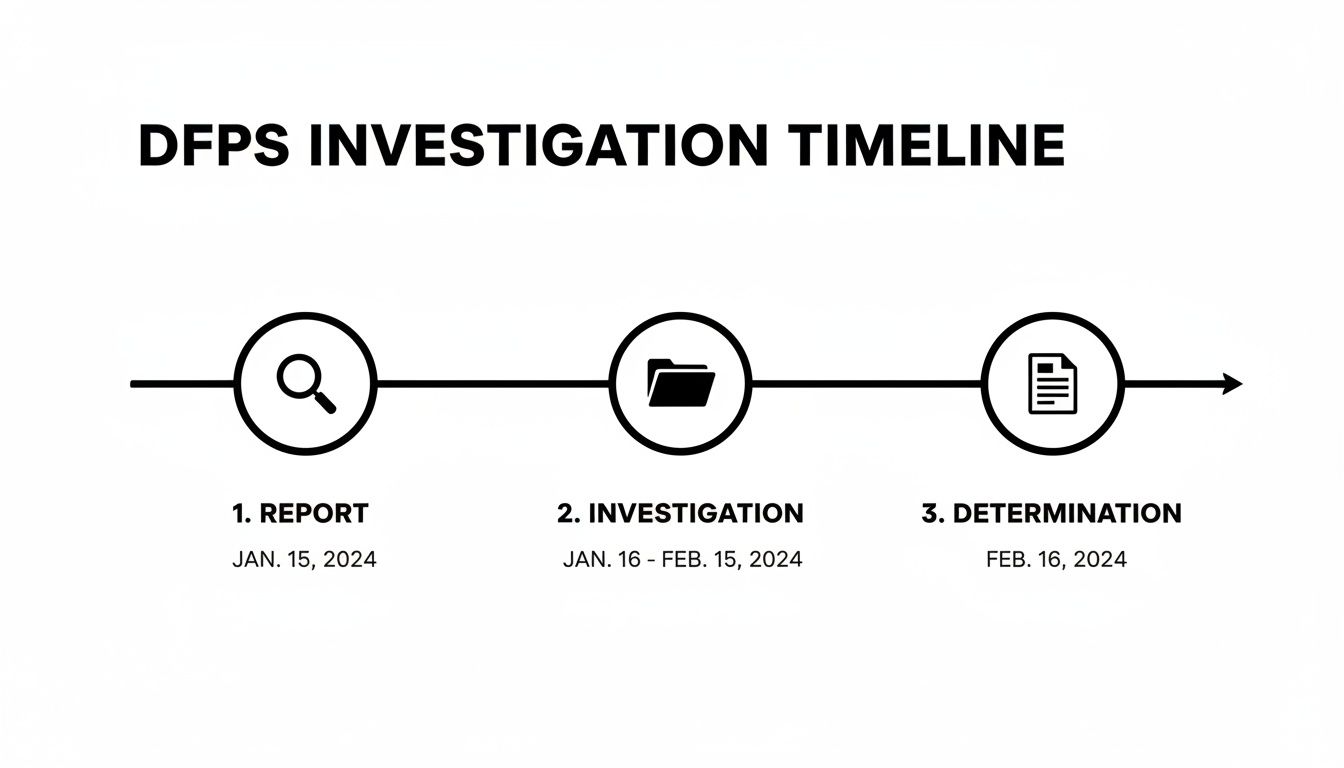
An investigation officially kicks off when DFPS decides a report of abuse or neglect needs a closer look. A caseworker is assigned and, depending on the severity of the allegations, must make contact within 24 to 72 hours. Their job is to assess the child's immediate safety and gather evidence to determine if the report is valid. This process is invasive by design and full of legal pitfalls.
- Initial Contact and Safety Assessment: The caseworker's first priority is to see the child named in the report to check for immediate signs of harm. This often happens at your home but could also occur at your child's school without you even knowing.
- Interviews: The investigator will want to interview you, any other adults in the home, and all children—often alone. They will also contact "collateral sources" like teachers, doctors, and relatives.
- Home Visit: The caseworker will ask to inspect your home, looking for cleanliness, adequate food, and any safety hazards. It's crucial to remember you are not required to let them in without a court order, a right an attorney can help you exercise without appearing obstructive.
- Information Gathering: You will be asked to sign releases for medical records, school files, and psychological evaluations. You should never sign any DFPS document without your lawyer reviewing it first.
DFPS Investigation Stages and Your Parental Rights
| Investigation Stage | What DFPS Does | Your Rights and Actionable Advice |
|---|---|---|
| Initial Contact | Caseworker makes contact (24-72 hours) to see the child and assess immediate safety. | Right to Remain Silent: You don't have to answer questions on the spot. Action: Politely state, "I will cooperate, but I need to speak with my attorney first." |
| Interviews | Interviews parents, children (often alone), and collateral sources (teachers, doctors). | Right to Counsel: You have the right to an attorney during your interview. Action: Never attend an interview alone. Have your attorney schedule and attend with you. |
| Home Visit | Requests to enter and inspect your home for safety, cleanliness, and food. | Right to Privacy: You are not legally required to grant entry without a court order. Action: Consult your attorney. They can arrange a controlled inspection if it's strategically wise. |
| Information Gathering | Asks you to sign releases for sensitive medical, school, and therapy records. | Right to Refuse: You do not have to sign any releases. Action: Let your lawyer review every document. They will protect you from overly broad requests. |
The Final Determination
Typically within 45 to 60 days, the investigator makes a formal finding that will shape everything that happens next.
The DFPS system is enormous. In a recent year, the agency handled over 300,000 child protective investigations. You can review the scale of the agency in the official DFPS Data Book.
The possible outcomes are:
- Ruled Out: DFPS found no credible evidence of abuse or neglect. The case is closed.
- Unable to Determine: Not enough evidence was found to confirm or deny the allegations. The case is usually closed but remains on record.
- Reason to Believe (RTB): DFPS concluded abuse or neglect likely occurred. This is the finding you must avoid, as it can lead to court-ordered services or even the removal of your child.
Trying to navigate these stages alone is a recipe for disaster. An experienced Texas DFPS attorney is your guide, ensuring you understand your rights under the Texas Family Code and make informed decisions to protect your family. If DFPS has contacted you, the time for action is now.
Navigating the Courtroom When DFPS Takes Action
If an investigation ends with a "Reason to Believe" finding, the battle to keep your family together can escalate dramatically, shifting from your home to the courthouse. This is the moment things get terrifyingly real, often beginning with the traumatic removal of your child. This is not a procedural step; it is the start of a formal lawsuit where DFPS is actively trying to gain legal control over your children.
Once your child is removed, a strict legal clock starts ticking under the Texas Family Code. You are now in a full-blown legal fight where the state, with its vast resources, will argue that you are an unfit parent. Having a skilled Texas DFPS attorney at this stage is absolutely critical for your family's survival.
The Critical First Hearing: The 14-Day Adversary Hearing
When DFPS removes your children, they must file a lawsuit and get you before a judge for an Adversary Hearing within 14 days. This hearing, governed by Chapter 262 of the Texas Family Code, is one of the most important moments in your entire case. It is your first and best opportunity to get your children back home quickly.
At this hearing, the judge must decide two things: was there an "immediate danger" that made removing the child necessary, and is it in the child’s "best interest" to remain in state custody? Your attorney’s job is to aggressively challenge the state's case. A sharp Texas DFPS attorney will:
- File motions attacking the legal basis for the removal.
- Cross-examine the CPS caseworker, exposing weaknesses and holes in their investigation.
- Present your own evidence—witnesses, photos, documents—proving your home is safe.
- Argue forcefully that the state has failed to meet its high legal burden.
Without an experienced lawyer, you are left to face the state’s attorney alone while emotionally devastated—an impossible situation for any parent.
A Real-Life Example: The Power of a Prepared Defense
We once represented a father whose infant was taken after an accidental fall led to a broken arm. The hospital and DFPS immediately jumped to the conclusion of abuse. At the 14-Day Adversary Hearing, our firm came prepared. We brought in the child’s pediatrician to testify that the baby had a vitamin D deficiency that made their bones more fragile. We presented photos of the safe, child-proofed home and had family members testify about the father's loving and gentle nature. Seeing the full picture, not just the state's one-sided story, the judge ordered the baby returned home to his dad. This was only possible because we acted fast to build a compelling defense.
Beyond the First Hearing: The Marathon to Reunification
If the judge keeps your children in state custody after the first hearing, the case moves into a much longer phase of status and permanency hearings. During this time, the court will monitor your compliance with a court-ordered service plan. Your attorney’s role shifts to holding DFPS accountable, ensuring your plan is fair, and constantly pushing for more visitation—all with the ultimate goal of bringing your family back together. This is a marathon, and your legal team is there to defend you every step of the way.
The DFPS legal machine is vast. The agency's attorneys handle cases involving over 150,000 children in state conservatorship annually, per the interactive DFPS Data Book. You cannot afford to face this system alone.
Your DFPS Attorney: Your Shield, Strategist, and Voice
When you're up against the full power of the state, it's easy to feel like you're drowning. A Texas DFPS attorney does more than just file papers; they become your shield, your strategist, and your voice. Their job is to level a playing field that is heavily tilted against you.
One of the first things a good lawyer does is get between you and the caseworker. All communication now must go through your attorney. This single move immediately stops the unscheduled visits, harassing phone calls, and pressure to sign documents you don't understand. This isn't about being uncooperative; it's about control. It ensures your words aren't twisted and you don't accidentally sign away your parental rights.
Building Your Defense and Challenging the State's Narrative
While DFPS is building a case against you, your attorney is building one for you. A proactive defense is key. This means launching an independent investigation to find the truth DFPS may have missed or ignored. An experienced lawyer will:
- Interview key witnesses who can speak to your character and parenting, like teachers, family members, or therapists.
- Collect documentation that paints a true picture of your family life.
- Consult with experts, such as medical professionals to dispute a misdiagnosed injury or a psychologist to provide a favorable evaluation.
- Fight for kinship placement. If removal is unavoidable, your attorney will aggressively push for your children to be placed with a grandparent, aunt, or trusted family friend, drastically reducing trauma and maintaining vital family bonds.
Negotiating Your Service Plan: Your Roadmap Home
One of the most dangerous parts of a DFPS case is the "Family Plan of Service." This is the list of tasks the court orders you to complete to get your children back. Without a lawyer, this plan can be loaded with irrelevant, impossible, or punitive requirements designed to make you fail.
A sharp Texas DFPS attorney scrutinizes every item. They negotiate to remove unreasonable demands and ensure the services you're ordered to complete are actually aimed at solving the specific issue that brought DFPS to your door. For example, if the allegation was a messy house, your lawyer fights a plan that orders six months of intensive therapy, arguing instead for a simple home study to prove the issue is resolved.
Your lawyer is your navigator through this legal minefield. They prepare you for court, protect you from missteps, and fight tirelessly for your family's reunification.
The Path to Bringing Your Family Back Together
When DFPS separates your family, the road back can feel impossibly steep. But this is where the fight to reunite truly begins. The entire legal journey hinges on one critical document: the Family Plan of Service. With the right legal strategy, this plan becomes your roadmap to a joyful family reunion.

A Story of Hope: From a Service Plan to Reunification
Consider a client of ours, a single mother whose two young children were removed due to allegations of neglect rooted in her untreated depression and a chaotic home. The first service plan DFPS handed her was overwhelming: intensive group therapy, multiple psychological evaluations, and supervised visits just once a month. She felt defeated.
Once we got involved, the strategy changed. We successfully argued that group therapy was wrong for her diagnosis and negotiated for individual counseling with a therapist she helped choose. We showed the judge how damaging monthly visits were and secured weekly, unsupervised visits as she made progress.
This mother dedicated herself to her new, personalized plan. She never missed a therapy session, meticulously organized her home, and documented everything. At each court hearing, we presented this mountain of evidence, showing undeniable change. After nine months of hard work and strategic advocacy, the judge ordered her children returned home. Her story is a powerful reminder that with the right support, reunification is an achievable goal.
Proving Your Progress Is Key
It's not enough to do the work; you must prove you did it. Meticulous documentation is your best friend. Keep a file with every certificate, attendance record, letter from counselors, and photos of your clean, safe home. Your Texas DFPS attorney will use this portfolio to build an undeniable case for bringing your children home.
This process is a marathon that will test your strength. But you don't have to run it alone. A compassionate, experienced lawyer is your partner on the path to bringing your children home for good. You can even find encouragement in learning how others reconnect with friends and family once you're in recovery to build a strong support network.
How to Find the Right Texas DFPS Attorney for Your Family
When your family’s future is on the line, choosing the right lawyer is the single most important decision you will make. You don't just need a family lawyer; you need a Texas DFPS attorney who has been in these specific trenches and knows the way out. They must have a rock-solid command of the Texas Family Code—especially Chapters 262 (Procedures in Suit by Governmental Entity), 263 (Review of Placement of Children), and 161 (Termination of the Parent-Child Relationship).
Critical Questions to Ask a Potential Attorney
When you consult with a lawyer, you are interviewing them for the most important job in your life. Ask tough questions to ensure they are up for the fight.
- How many DFPS cases have you personally handled in this county?
- What percentage of your practice is dedicated to defending parents against DFPS?
- How many parental rights termination trials have you taken to a jury?
- What is your strategy for dealing with caseworkers and negotiating service plans?
Their answers will reveal their experience and whether their approach aligns with your family’s needs. For more guidance, learn about finding the right CPS lawyer in Texas. While circumstances differ, the goal of family unity is universal, a theme also seen in legal processes for bringing your family home in Texas after separation.
The Law Office of Bryan Fagan: Your Ally in the Fight
Choosing a law firm like The Law Office of Bryan Fagan means you’re not just getting a lawyer; you're gaining a team dedicated to protecting Texas families. We understand the fear and desperation you're feeling because we have stood with countless parents in your shoes. We meet that fear with compassionate, strategic, and unwavering representation. You are a parent fighting for your child, and we are ready to stand with you.
Common Questions Parents Ask When DFPS Knocks
When you're thrown into a DFPS investigation, your mind races with urgent questions. Getting clear, straight answers is the first step toward taking back control.
Can I Refuse to Let a Caseworker into My Home?
Yes. You have a constitutional right to privacy. A caseworker cannot enter your home without your clear permission or a court order signed by a judge. However, how you refuse matters. Calmly and politely state, "I want to cooperate, but I need to speak with my lawyer before I can let you in." This asserts your rights without appearing uncooperative. Your attorney can then manage any necessary inspection on your terms.
What Happens if They Try to Terminate My Parental Rights?
This is the fight of your life. Under Chapter 161 of the Texas Family Code, the state can file to permanently sever the legal bond between you and your child. To win, the state must prove two things with "clear and convincing evidence": that you committed a specific act listed in the code (like endangerment or neglect) AND that termination is in the child’s "best interest." Facing a termination suit without a seasoned trial lawyer is an unthinkable risk to your family's future.
How Much Does a DFPS Attorney in Texas Cost?
Costs vary, but most experienced DFPS attorneys work on a retainer basis. It's easy to focus on the cost, but it's critical to reframe this as an investment in keeping your family together. Your parental rights are priceless. The real cost isn't the lawyer's fee—it's the permanent loss of your children if you don't have expert representation.
You should never have to face the power of DFPS alone. At The Law Office of Bryan Fagan, we are passionate about defending Texas families and fighting for your rights. If CPS has contacted you, your family's future is at stake. Call us today for a free, confidential consultation to learn how we can start protecting you immediately.