Skip to content
When the flashing lights appear in your rearview mirror, it feels like your world stops. The fear and confusion of a DWI arrest in Texas can be overwhelming, especially when you're a parent with a family depending on you. The first questions that race through your mind aren't about yourself, but about them: "Will I lose my job?" "How will this affect my kids?" "How can we possibly afford this?" A single mistake can feel like it's threatening the stable, secure life you've worked so hard to build for your family.
This guide is here to cut through the legal jargon and overwhelming anxiety. We understand that a DWI charge is more than just a legal problem; it's a family crisis. We've helped countless Texas families navigate this exact situation, and our goal is to replace your uncertainty with clear, actionable knowledge. You are not alone in this fight, and building a strong defense starts with understanding exactly what you're up against.
The Shock of a DWI Arrest and Its Impact on Your Family
The moment you are placed under arrest for a DWI, you're thrown into a confusing legal maze. The immediate challenge is often just getting out of jail, which means trying to make sense of understanding DUI bail costs. This is the first hurdle in a long, exhausting race that can leave you feeling lost and alone. The weight of a potential DWI penalty can feel crushing, but it's the ripple effect on your family that truly hurts.
A Real-Life Scenario: The Ripple Effect
Imagine a single dad, Mark, driving home after a celebratory dinner with friends. He feels fine, but a minor traffic violation leads to a DWI arrest. His first panicked thought is for his daughter, who is waiting at home with a babysitter. Suddenly, his world is turned upside down. He faces losing his license, which he needs for his delivery job. Without his job, he can't pay the rent or provide for his child. This single arrest has triggered a chain reaction that threatens his family's entire foundation.
Mark's story is a common one. A DWI charge doesn't just impact the driver; it sends shockwaves through the entire family:
- Financial Strain: The combination of fines, court costs, lawyer fees, and skyrocketing insurance premiums can put an immense strain on your family's budget.
- Employment Risks: Many employers have strict policies regarding criminal charges. A DWI conviction could jeopardize your career and your ability to provide for your family.
- Emotional Toll: The stress and uncertainty of a pending DWI case can create a heavy emotional burden, straining relationships with your partner and children.
- Risk of CPS Involvement: In certain situations, especially if a child was in the vehicle, a DWI arrest can trigger an investigation by Child Protective Services (CPS), adding a terrifying new dimension to your legal troubles. Understanding your rights during a CPS investigation under the Texas Family Code is critical.
The toughest part of a DWI arrest is often the feeling of helplessness. You're not just fighting a legal charge; you're fighting to protect your family's future.
Breaking Down DWI Offenses and Penalties in Texas
Understanding the Texas DWI penalty starts with knowing how the state classifies these offenses. It's not a one-size-fits-all punishment. Texas law uses a tiered system where the consequences become dramatically more severe with each subsequent charge. Let's break down what that means for you and your family.
The Escalating Scale of DWI Charges
Think of Texas DWI law as a ladder. Each conviction moves you up a rung, and the potential fall becomes steeper. The penalties don't just increase; they expand in ways that can permanently alter your life.
- First DWI Offense: This is typically a Class B Misdemeanor. While it's the lowest level, the penalties are designed to be a serious wake-up call.
- Second DWI Offense: The charge escalates to a Class A Misdemeanor, carrying the potential for much longer jail time and significantly higher fines.
- Third (or Subsequent) DWI Offense: This is a game-changer. A third DWI is automatically a Third-Degree Felony. This means you could face state prison time and consequences that will follow you for the rest of your life.
This rapid escalation shows how quickly a DWI arrest can threaten your freedom, your job, and your family's stability.
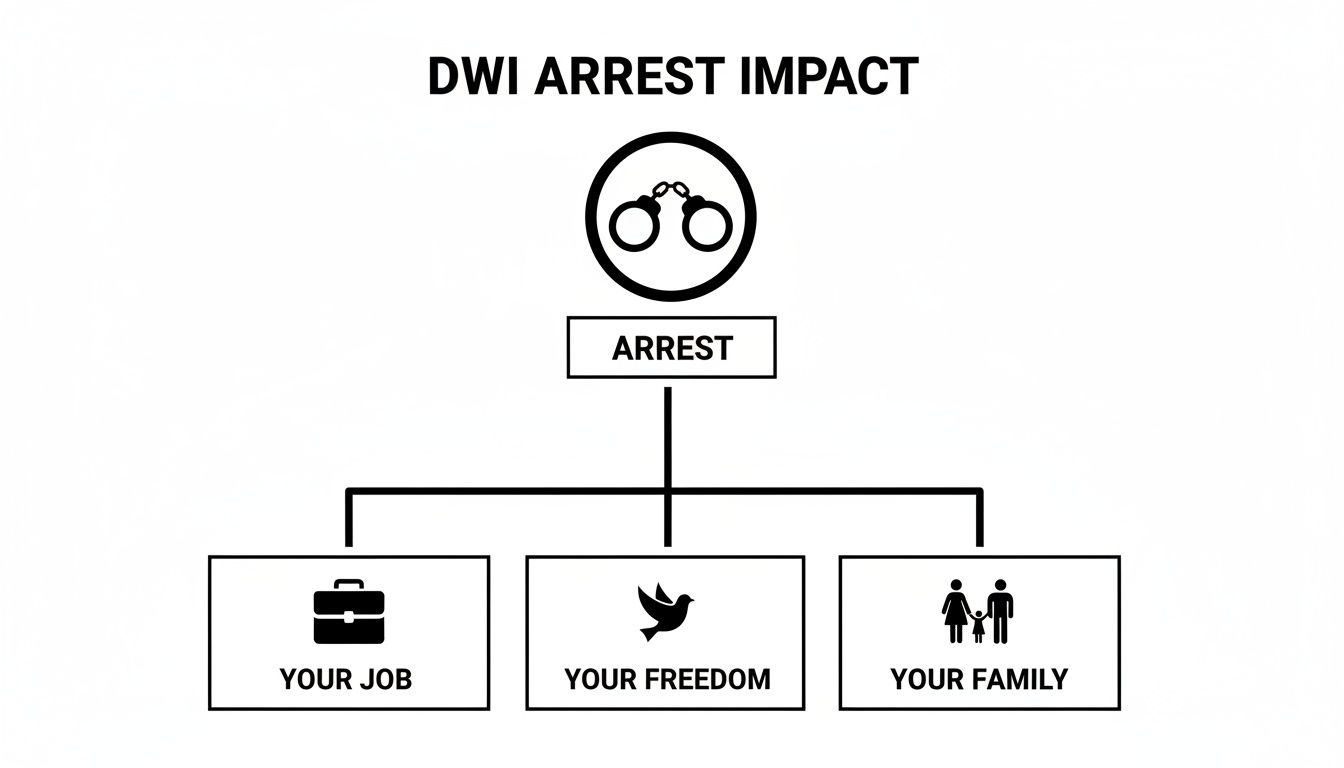
As you can see, the arrest is just the beginning. It immediately triggers a cascade of risks that threaten the most important parts of your life.
Understanding the Specific Penalties
Knowing the "class" of the offense is one thing, but what does that actually mean for you? Here are the real-world punishments you could be facing.
For a first-time DWI, you could face a minimum of 72 hours in jail (up to 180 days), fines up to $2,000, and a driver's license suspension for up to a year. A second offense increases the stakes to 30 days to a full year in jail, fines up to $4,000, and a license suspension of up to two years.
By the third offense, you are in felony territory. This means 2 to 10 years in a state prison and fines up to $10,000. These are life-altering numbers, a fact underscored by the strictness of Texas DWI laws.
Texas DWI Penalties at a Glance
This table provides a clear summary of the standard penalties.
| Offense | Classification | Jail Time | Maximum Fine | License Suspension |
|---|---|---|---|---|
| First DWI | Class B Misdemeanor | 72 hours to 180 days | Up to $2,000 | 90 days to 1 year |
| Second DWI | Class A Misdemeanor | 30 days to 1 year | Up to $4,000 | 180 days to 2 years |
| Third DWI | 3rd Degree Felony | 2 to 10 years in prison | Up to $10,000 | 180 days to 2 years |
It's crucial to remember that this table represents the standard ranges. Your actual sentence can be influenced by many factors, including the specific details of your arrest and the strength of your legal defense.
The Critical Role of Enhancements
On top of these standard charges, certain factors—known as "enhancements"—can dramatically increase the severity of a DWI penalty. An enhancement is any fact related to your arrest that allows the prosecutor to file a more serious charge. For example, if your Blood Alcohol Concentration (BAC) was 0.15% or higher, a first-time DWI is "enhanced" from a Class B to a Class A Misdemeanor. We'll explore these critical factors next.
What Circumstances Can Make DWI Penalties Even Worse?
While the standard DWI penalties are severe, certain aggravating factors can instantly elevate a charge, turning a bad situation into a catastrophic one. These are called "enhancements," and they can turn a misdemeanor into a life-altering felony. If any of these apply to your case, seeking experienced legal counsel is not just a good idea—it is absolutely essential to protect your family's future.
High Blood Alcohol Concentration (BAC)
One of the most common enhancements is a high Blood Alcohol Concentration (BAC). While the legal limit in Texas is 0.08%, the law gets much tougher if your BAC is significantly higher.
If a breath or blood test shows your BAC was 0.15% or higher, a first-time DWI is automatically enhanced from a Class B Misdemeanor to a Class A Misdemeanor. This means the potential penalties are the same as for a standard second DWI, with up to a year in jail and a $4,000 fine.
Driving with a Child Passenger
For any parent, this is the most terrifying scenario. If you are arrested for DWI with a child under the age of 15 in your vehicle, the charge is automatically a State Jail Felony. This is true even if it's your first offense.
A conviction for DWI with a Child Passenger can result in up to two years in a state jail facility, a fine of up to $10,000, and a permanent felony on your record. Crucially, this offense will almost certainly trigger a CPS investigation under Chapter 262 of the Texas Family Code, which governs the procedures in a suit affecting the parent-child relationship. This puts your parental rights and the stability of your family at immediate risk. You could face court-ordered services, or in the worst-case scenario, the termination of your parental rights under Chapter 161.
DWI Resulting in Injury or Death
When an impaired driving incident leads to an accident, the charges become much more severe. These are not just DWIs with enhancements; they are distinct felony offenses with devastating consequences.
- Intoxication Assault: If an accident you cause while intoxicated results in serious bodily injury to another person, you will be charged with Intoxication Assault, a third-degree felony punishable by 2 to 10 years in state prison.
- Intoxication Manslaughter: If an accident caused by your intoxication leads to the death of another person, the charge becomes Intoxication Manslaughter, a second-degree felony carrying a prison sentence of 2 to 20 years.
These charges raise the stakes immensely. A strong legal defense becomes about more than just reducing fines; it becomes a fight for your freedom and for your family's future.
Navigating License Suspension and Ignition Interlock Devices
When you're arrested for DWI in Texas, you are fighting a war on two fronts. The first is the criminal case dealing with fines and jail time. The second is a civil process with the Texas Department of Public Safety (DPS) concerning your driver's license. This is the Administrative License Revocation (ALR) process, and it moves much faster than the criminal case.
You have only 15 days from the date of your arrest to request an ALR hearing. If you miss this deadline, your license will be automatically suspended.
Actionable Advice: Don't Miss the 15-Day Deadline
Imagine a mother of two is arrested for her first DWI. Overwhelmed and embarrassed, she decides to wait for her court date, unaware of the ticking clock on her license. On day 16, she misses the deadline. A month later, she receives a letter from the DPS informing her that her license is suspended. She can no longer drive to work, take her children to school, or run essential errands. Her ability to care for her family is crippled by a deadline she didn't know existed.
Your first action step after a DWI arrest should be to contact an attorney to request an ALR hearing. This is your only chance to challenge the automatic suspension and protect your ability to drive while your criminal case is pending. For many families, keeping that license is just as critical as fighting the criminal charge.
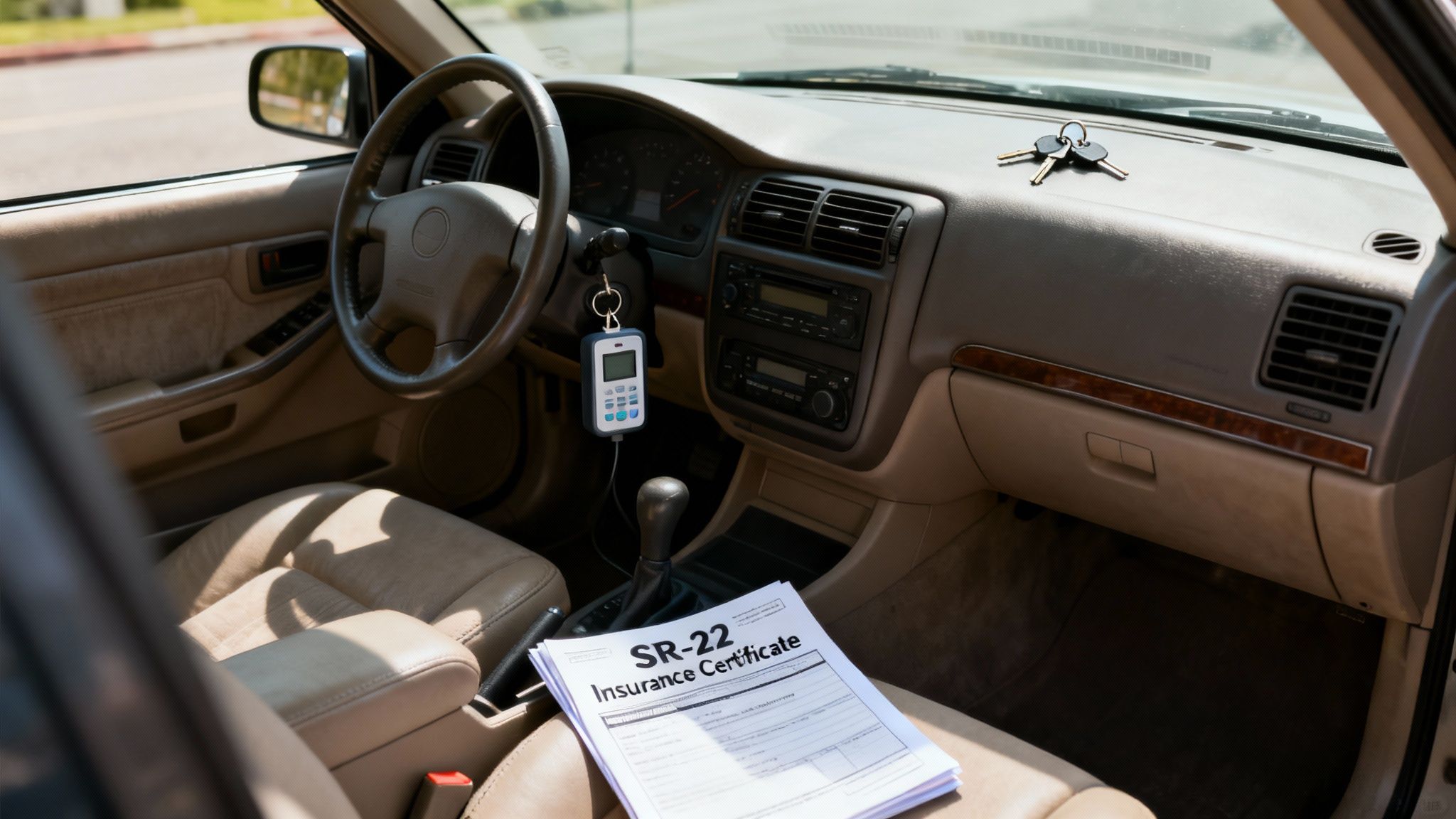
Understanding SR-22 and Ignition Interlock Devices
Even if you successfully challenge the suspension, there are often strings attached. The state requires proof of responsibility, which usually comes in two forms:
- SR-22 Insurance: This is a certificate filed by your insurance company to prove you have minimum liability coverage. An SR-22 requirement will cause your insurance premiums to skyrocket.
- Ignition Interlock Device (IID): This is a small breathalyzer wired into your car's ignition. You must provide a clean breath sample to start the car and perform random "rolling retests" while driving. The installation and monthly monitoring fees are your responsibility.
These administrative penalties add another layer of financial and logistical stress. For those trying to get back on the road, our guide on how to reinstate a suspended license offers practical steps.
The Hidden Costs of a DWI Conviction on Your Life

The official Texas DWI penalty is only the beginning. The hidden, long-term consequences are what often cause the most damage to a family's well-being. These collateral damages can derail the professional and personal life you've spent years building.
Professional and Employment Consequences
For most Texans, a driver's license is essential for making a living. A license suspension can mean immediate job loss, especially for commercial drivers (CDL holders) or anyone who drives for work.
Furthermore, many professions require state-issued licenses, and their governing boards have strict rules about criminal convictions.
- Nurses and Healthcare Professionals: A DWI can trigger a review by the Texas Board of Nursing, risking suspension or revocation of your license.
- Teachers: School districts and the Texas Education Agency have character standards that can be threatened by a DWI on your record.
- Pilots, Realtors, and Other Licensed Professionals: Nearly every licensed profession has a governing body that can take disciplinary action, putting your entire career in jeopardy.
Imagine a registered nurse who, after one mistake, faces a board inquiry that could strip her of the ability to practice. In that moment, the DWI penalty pales in comparison to losing the career she loves and needs to support her family.
Financial and Personal Fallout
The financial strain extends far beyond court fines. The secondary costs pile up quickly, creating a massive burden on your family’s budget. Your auto insurance premiums will increase dramatically, a lasting financial impact we explore in our guide on how a DWI can affect your insurance.
For non-citizens, a DWI can have devastating immigration consequences, potentially leading to deportation or hindering the path to citizenship. Finally, the social stigma can strain relationships with friends and family, leaving you feeling isolated. This combination of financial pressure, career uncertainty, and personal shame puts an enormous weight on the entire family.
How an Experienced DWI Lawyer Can Defend Your Future
When facing a DWI charge, it's easy to feel hopeless, but an arrest is not a conviction. The prosecution's case is rarely as solid as it seems. An experienced Texas DWI lawyer can change the entire course of your case by holding the police and prosecution to their high burden of proof. A skilled attorney knows where to find the cracks in the state's evidence and how to use them to protect your freedom and your family.
Challenging Every Aspect of the Case
A strong defense is built by systematically examining every detail of the case, from the initial traffic stop to the chemical tests.
- The Legality of the Traffic Stop: Did the officer have a valid legal reason to pull you over? If not, all evidence gathered after the illegal stop can often be thrown out.
- The Field Sobriety Tests: These tests are notoriously subjective. Your attorney can challenge their administration, arguing that factors like medical conditions, fatigue, or even the road conditions skewed the results.
- The Breath and Blood Tests: Chemical tests are not infallible. We can challenge the calibration of the breathalyzer or scrutinize the chain of custody for blood samples. Any error can render the results inadmissible.
Navigating the Two-Front Battle
Your attorney fights for you on both fronts: in the criminal court and at the critical Administrative License Revocation (ALR) hearing to save your license. Managing both legal battles simultaneously is essential for a complete defense strategy. The goal is always the best possible outcome, whether that's a reduction of charges, a favorable plea, or a complete dismissal.
A skilled defense is critical. Hiring an experienced DWI lawyer is an investment in your family's future. It provides the best chance to avoid the devastating consequences of a Texas DWI conviction. For a deeper look at defense strategies, read our guide on how to beat a DWI charge in Texas.
Answering Your Questions About Texas DWI Penalties
Facing a DWI charge brings a wave of questions and anxiety. Here are clear answers to some of the most common concerns we hear from families in your situation.
Can They Really Give Me a DWI on Private Property?
Yes, absolutely. Texas law allows for a DWI arrest if you are operating a motor vehicle in a "public place." The courts define "public place" very broadly—it's not about ownership, but about public access. This includes apartment complex parking lots, bar parking lots, and even streets within a gated community. If the public has access, you can be charged with a DWI there.
What if I Was Just Taking My Prescription Medication?
This is a shocking reality for many. A DWI charge in Texas is not limited to alcohol. "Intoxication" is legally defined as not having the normal use of your faculties due to alcohol, a drug, a controlled substance, or any other substance. This means you can be charged with DWI even if you were only taking medication legally prescribed by your doctor. If your prescription medication impaired your ability to drive safely, you could be arrested.
Shouldn't I Just Take a Plea Deal to Get It Over With?
It's tempting to accept a plea deal to end the stress, but pleading guilty has permanent consequences. A DWI conviction never leaves your criminal record and can affect your job, insurance rates, and professional licenses for years. Before you consider any plea, an experienced attorney must thoroughly review the state’s case against you. Were there errors in the stop, the field sobriety tests, or the chemical testing? Never accept a plea without a skilled lawyer examining every piece of evidence. An arrest is not a conviction, and you may have a much stronger defense than you realize.
A DWI charge in Texas threatens your freedom, your family, and your future. You do not have to face this overwhelming challenge alone. At the Law Office of Bryan Fagan, we understand what is at stake for you and your loved ones. Our compassionate and experienced attorneys know how to build a powerful defense to protect what matters most. Contact us today for a free, confidential consultation to discuss your case and learn how we can fight for you.