Skip to content
When you’re staring down a theft charge, the legal jargon can feel like a foreign language, adding a thick layer of confusion to an already stressful time. For Texas families, this isn't just a legal problem; it's a personal crisis that threatens your stability, your job, and your ability to care for your children. In Texas, the one thing that separates a minor charge from a life-altering felony is the value of the property involved. This is often called the texas felony theft amount.
The magic number? $2,500. Anything valued at or above this amount instantly kicks the offense up from a misdemeanor to a felony, with consequences that can ripple through every aspect of your family's life.
The Financial Line That Changes Everything in Texas Theft Cases
Facing a theft allegation can make your world spin. The fear of what comes next—for your job, your reputation, and most importantly, your family—is overwhelming. In these moments, you need clarity, not confusion. Understanding the specific dollar amounts that define theft offenses is the first step toward getting your feet back on the ground and building a solid defense to protect the ones you love.
Think of Texas theft law as a ladder. Each rung you climb represents a higher property value and, as a result, much harsher penalties. A misdemeanor might be a stumble, but a felony is a serious fall with consequences that can follow you for the rest of your life. It’s not just about the immediate fines or potential jail time; it’s about protecting your entire future and ensuring you can continue to provide for your family.
How Property Value Defines the Charge
The Texas Penal Code is crystal clear about how it categorizes theft based on the item's price tag. A simple mistake or a moment of bad judgment can escalate quickly depending on the value of the property in question. The jump from a Class A Misdemeanor to a State Jail Felony happens at one specific point.
Here’s the simple breakdown of that dividing line:
- Misdemeanor Theft: Applies when the value of the stolen property is less than $2,500.
- Felony Theft: Begins when the value is $2,500 or more.
This is why the valuation of the property is so often a major point of conflict in a theft case. The prosecution has to prove, beyond a reasonable doubt, that the value meets the threshold for the charge they’re pursuing.
"A theft charge is more than just a legal problem; it's a personal crisis that threatens your stability and your family's well-being. Knowing exactly where you stand legally is the first, most powerful step you can take."
In Texas, felony theft charges kick in when stolen property is valued at $2,500 or more—a threshold that's actually one of the highest in the country. Crossing that $2,500 line immediately elevates the offense to a state jail felony, which carries a sentence of 180 days to two years in a state jail facility and fines up to $10,000.
The penalties only get steeper from there. To give you a clearer picture, we've organized the different levels of theft charges in Texas into a simple table.
Texas Theft Charges by Property Value
This table breaks down the different levels of theft charges in Texas based on the value of the stolen property. As you can see, the potential consequences escalate dramatically as the value increases, moving from minor misdemeanors all the way up to first-degree felonies.
| Value of Stolen Property | Offense Level | Potential Jail/Prison Time | Maximum Fine |
|---|---|---|---|
| Less than $100 | Class C Misdemeanor | None | Up to $500 |
| $100 to $750 | Class B Misdemeanor | Up to 180 days in jail | Up to $2,000 |
| $750 to $2,500 | Class A Misdemeanor | Up to 1 year in jail | Up to $4,000 |
| $2,500 to $30,000 | State Jail Felony | 180 days to 2 years in state jail | Up to $10,000 |
| $30,000 to $150,000 | Third-Degree Felony | 2 to 10 years in prison | Up to $10,000 |
| $150,000 to $300,000 | Second-Degree Felony | 2 to 20 years in prison | Up to $10,000 |
| $300,000 or more | First-Degree Felony | 5 years to life in prison | Up to $10,000 |
As the table shows, values from $30,000 to $150,000 constitute a third-degree felony, and anything over $300,000 becomes a first-degree felony that could land someone in prison for life. This structure highlights just how critical it is to understand the specific value attached to your case. You can discover more insights about these theft thresholds on TLGTexasLaw.com.
A Guide to Felony Theft Levels and Their Penalties
When a theft charge crosses the $2,500 threshold, it enters new and much more dangerous territory. In Texas, "felony theft" isn't just a single charge; it's a ladder of escalating offenses, and each step up carries drastically different consequences for your freedom, your finances, and your family.
Grasping what these levels mean is the first step in understanding the gravity of the situation you or a loved one might be facing. An allegation can feel like a nightmare, especially when you see how quickly the potential penalties stack up. Let’s break down each felony tier so you have a clear picture of what the law says.
State Jail Felony Theft
This is the first rung on the felony ladder. A theft gets classified as a State Jail Felony when the value of the stolen property is between $2,500 and $30,000. While it’s the lowest-level felony, the consequences are still life-altering.
- Potential Sentence:180 days to 2 years in a state jail facility.
- Maximum Fine: Up to $10,000.
A conviction here can slam the door on job opportunities, make it nearly impossible to secure housing, and strain family relationships to the breaking point. This is a serious charge that demands an immediate, strategic defense.
The infographic below shows just how quickly a theft charge can escalate from a misdemeanor to a serious felony based on nothing more than the alleged value of the property.
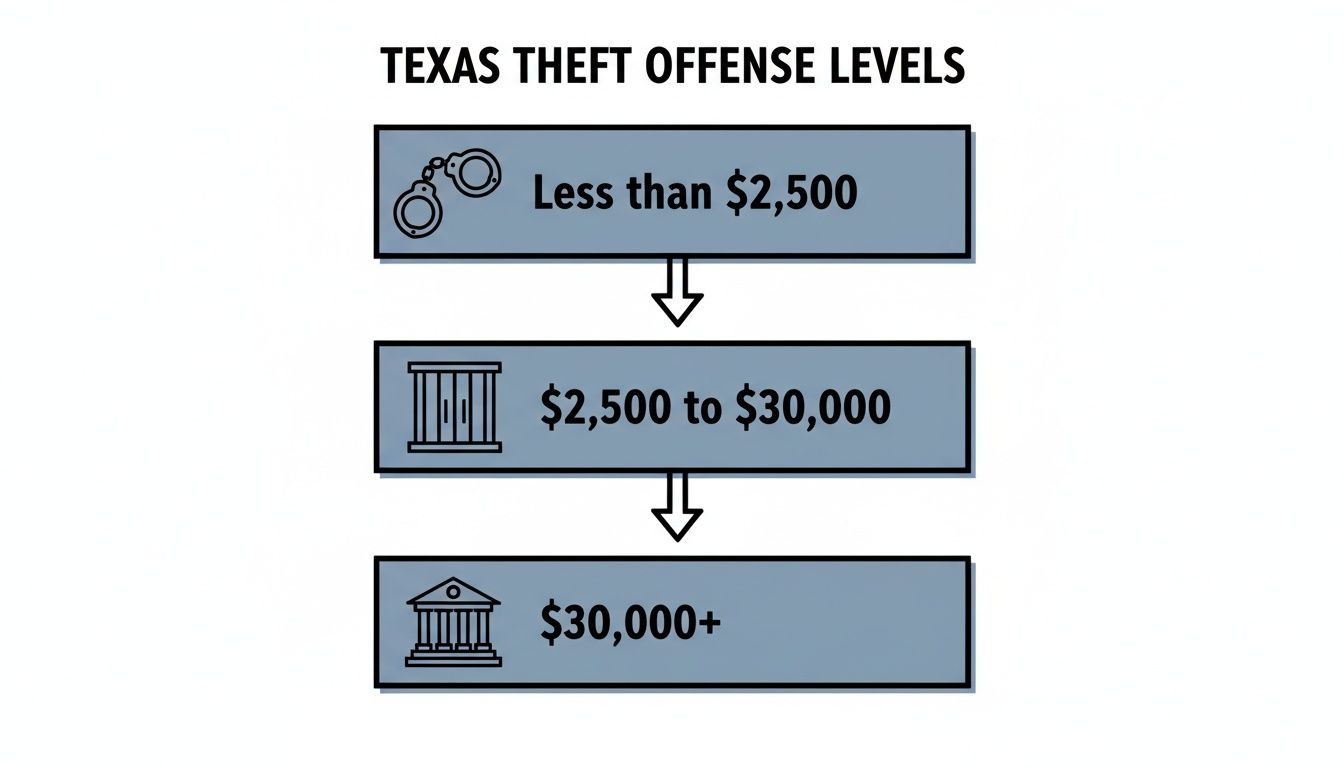
As you can see, crossing that $2,500 line is the critical point where the justice system's response becomes incredibly severe.
Third-Degree Felony Theft
The penalties ramp up significantly once the alleged value climbs higher. You're looking at a Third-Degree Felony charge when the property is valued at $30,000 to $150,000.
- Potential Sentence:2 to 10 years in a state prison.
- Maximum Fine: Up to $10,000.
At this level, we are no longer talking about state jail—we're talking about the Texas Department of Criminal Justice prison system. A conviction means potentially losing a decade of your life, missing priceless moments with your family, and carrying the weight of a serious felony record forever. It’s also critical to know that past convictions can make these penalties even worse, a concept we explain in our guide on the Three Strike Law in Texas.
Second-Degree and First-Degree Felonies
The highest tiers of theft charges are reserved for cases involving enormous sums of money, and the penalties reflect that severity.
- Second-Degree Felony: This applies to values between $150,000 and $300,000. The prison sentence ranges from 2 to 20 years, plus a potential $10,000 fine.
- First-Degree Felony: For thefts of $300,000 or more, this is the most severe charge. It carries a sentence of 5 years to life in prison and a fine up to $10,000.
These numbers can feel abstract, but they represent real lives and real situations. Think about a parent accused of shoplifting items over several months to provide for their family. Each incident might seem small, but prosecutors can add the value of every item together. What started as a few desperate acts can suddenly become a felony charge, threatening to separate a parent from their children for years.
How Prosecutors Use Aggregation to Increase Theft Charges

It’s a common—and dangerous—misunderstanding to think that several small thefts will always stay small, separate offenses. A prosecutor in Texas has a powerful tool called aggregation that can completely change the landscape of a case, turning what seems manageable into a fight for your freedom. This legal doctrine lets them bundle the value of multiple alleged thefts into a single, much more serious charge.
This is a tactic that often catches families completely off guard. It can escalate what they believed were minor misdemeanors into a felony with life-altering penalties. Understanding how aggregation works is absolutely critical to grasping the true legal jeopardy you might be facing.
What Is a Continuing Course of Conduct?
The legal authority for this comes straight from the Texas Penal Code, specifically Section 31.09. This law states that when someone commits two or more thefts as part of one "scheme or continuing course of conduct," the amounts can be added together.
What does that mean in plain English? If the prosecution can make a convincing argument that multiple thefts were all part of the same ongoing plan, they can combine their values. The law doesn't require some complex, pre-planned conspiracy; it can be as simple as a pattern of behavior over time.
Let's look at a relatable scenario: a single mother struggling financially is accused of using a company credit card for small personal purchases—gas, groceries, school supplies—over several months.
- Each individual transaction might be just $75, a Class B misdemeanor.
- But if this happens 35 times over a year, the total value adds up to $2,625.
- Suddenly, those individual acts are rolled together to form a State Jail Felony charge.
This is exactly how dozens of small, seemingly insignificant acts can be legally bundled together to meet the Texas felony theft amount threshold, launching the case into a completely different league of severity and threatening to tear a family apart.
How Prosecutors Build an Aggregation Case
To use aggregation, a prosecutor has to convince a judge or jury that the separate acts were connected. They don't have to prove every single theft; instead, their goal is to establish a clear pattern.
An allegation of theft can feel like a tidal wave, and the principle of aggregation is often what gives that wave its devastating power. One moment you're dealing with a small issue, and the next you're facing a felony charge that threatens your entire future.
They might use evidence like:
- Video Surveillance: Footage showing the same person committing similar acts repeatedly.
- Financial Records: Reports uncovering a pattern of missing inventory or cash that lines up with an employee’s work schedule.
- Witness Testimony: Statements from coworkers or managers who observed suspicious behavior over a period of time.
This legal strategy completely transforms the narrative of the case. The defense is no longer about a single, isolated incident but about refuting an entire pattern of alleged conduct. It dramatically raises the stakes and makes having an experienced legal advocate on your side absolutely essential to challenge the prosecutor's claims and protect your rights.
Other Ways a Theft Charge Becomes a Felony
When a theft charge crosses the $2,500 threshold, it typically jumps from a misdemeanor to a felony. That's the line in the sand most people know about. But what many families are shocked to learn is that this dollar amount is far from the only trigger.
Certain circumstances can automatically launch a seemingly minor theft charge into felony territory, no matter how little the property was worth. In the legal world, these are often called "enhancements." They reflect the state's decision to treat specific kinds of theft with a much heavier hand.
This is a critical detail to grasp. A charge you might have thought was manageable can suddenly mushroom into a life-altering legal battle, complete with the threat of prison and a permanent felony record. Understanding these rules is the only way to know the full scope of what you're up against.
When the Nature of the Property Matters Most
Sometimes, what is stolen carries more weight than how much it costs. Texas law singles out certain items for special protection, meaning that taking them is an automatic felony.
Here are a few of the big ones:
- Firearms: Stealing a firearm is always a State Jail Felony. It doesn’t matter if it’s a beat-up pistol worth less than $100. The law is focused on the inherent danger of a stolen gun, not its sticker price.
- Livestock: Theft of cattle, horses, or other specified livestock gets elevated quickly. For instance, stealing fewer than 10 head of cattle is a Third-Degree Felony, which can land someone in prison for up to 10 years.
- Certain Metals: Swiping materials like aluminum, bronze, or copper valued at less than $20,000 can be charged as a State Jail Felony if the theft creates a public safety hazard—think of someone ripping out copper wiring from a power grid and causing an outage.
It’s clear from these examples that the context and the specific item can completely change the game, pushing the consequences far beyond a simple calculation of monetary value.
Prior Convictions and the Victim’s Status
Your own history and the identity of the person you allegedly stole from can also trigger a felony upgrade. The law is written to offer more protection to vulnerable people and to come down harder on repeat offenders.
A misdemeanor theft charge can be bumped up to a State Jail Felony if you have two or more previous theft convictions. It’s a kind of "three strikes" approach where the court isn't just looking at this one incident; it's looking at your entire history.
A theft charge isn't just about one moment in time; the law often looks at the bigger picture. Who was involved and what has happened in the past can dramatically raise the stakes, highlighting the need for a defense that considers every single detail.
The status of the victim is another massive factor. Stealing from certain people or organizations can increase the offense by one full degree. These include:
- The Elderly: If the alleged victim is 65 years of age or older, the charges are automatically more serious.
- Nonprofit Organizations: Theft from a registered nonprofit or a charitable group is treated more severely.
- Government Agencies: Taking public funds or property from any government entity will also trigger these enhancements.
So, a Class A Misdemeanor theft—something valued between $750 and $2,500—could instantly become a State Jail Felony if the victim was an elderly person. It's these kinds of nuances that make it absolutely vital to have an experienced attorney dig into every detail of your case. They know how to spot the specific factors that are driving up the risk and can build a defense to counter them.
The Lifelong Consequences of a Felony Theft Conviction
When you’re facing a felony theft charge, it’s easy to get tunnel vision. Your mind naturally races to the most immediate threats—the possibility of jail time and the crippling weight of heavy fines. But the hard truth is, a conviction casts a long shadow that follows you and your family for years, long after any sentence is served.
Think of it as a permanent barrier, a wall that suddenly appears between you and the life you always planned to build. It can quietly dismantle your career, lock you out of housing opportunities, and even strip away some of your most basic rights as a citizen.
This isn't just a legal problem; it's a personal crisis that can unravel the stability you've worked so hard to achieve. For your family, this can mean a devastating loss of income, relentless emotional strain, and a future clouded with uncertainty. Our goal isn't just to fight the charge in court—it’s to protect the future you have ahead of you.
How a Felony Conviction Impacts Your Daily Life
Imagine being the perfect candidate for a job, only to be denied because of a background check. Picture the frustration of trying to find a safe apartment for your family, only to be turned away by one landlord after another. This isn't a hypothetical scenario; it's the daily reality for countless people with a felony on their record.
A felony theft conviction can lock you out of opportunities you once took for granted:
- Employment: Many employers have strict policies against hiring individuals with felony convictions, especially for any role involving trust, finances, or handling money.
- Housing: Landlords routinely run background checks and can legally deny rental applications based on a felony record, making it incredibly difficult to find a place to live.
- Professional Licenses: A conviction can stop you from getting or renewing professional licenses in fields like nursing, real estate, teaching, or even cosmetology.
- Fundamental Rights: You can lose your right to vote (while on parole or probation), and you will permanently lose your right to own a firearm under both federal and state law.
Your Record and Your Future
A felony theft conviction leaves a permanent mark on your public record. It's crucial to understand just how accessible these records are. A person's entire history is often open for public viewing, a reality explored in guides on navigating the world of public records. This digital footprint can follow you for years, impacting everything from personal relationships to financial opportunities.
The most painful consequence of a conviction is often the feeling of being permanently defined by a single mistake. Our firm believes that everyone deserves a chance to move forward, which is why we fight not only the charge but also the long-term shadow it can cast over your life.
Fortunately, a conviction isn't always the end of the story. Depending on how your case is resolved, there may be legal paths to clear your name and reclaim your future. Options like an expunction (which destroys the record) or a nondisclosure (which seals it from public view) could be on the table.
Successfully getting your record cleared feels like a fresh start. It allows you to legally and honestly say you haven't been convicted on job applications and pass those critical background checks.
From day one, our primary goal is to achieve an outcome that preserves your eligibility for these remedies. To learn more about this crucial process, you can find detailed information in our guide on expunging a criminal record in Texas. It is a vital step toward rebuilding your life and protecting your family’s future.
Building Your Defense Against Felony Theft Allegations

Hearing the words "felony theft" can feel like the ground has crumbled beneath your feet. But it's critical to remember this one truth: an accusation is not a conviction. The prosecution bears the heavy burden of proving every element of their case beyond a reasonable doubt, and a skilled criminal defense attorney can build a powerful strategy to challenge their claims at every turn.
Your future is worth fighting for. Understanding the potential defense strategies is the first step toward reclaiming your peace of mind. Every case is unique, but many successful defenses are built on a foundation of proven legal principles that question the evidence, the procedures, and the prosecution's entire narrative.
Contesting the Value of the Property
Since the Texas felony theft amount of $2,500 is the magic number that separates a misdemeanor from a felony, one of the most effective defenses is to challenge the prosecution’s valuation of the property. The state must prove the property's fair market value at the very moment of the alleged offense. A sharp attorney can attack an inflated value, potentially pushing the amount below that felony line and getting the charge significantly reduced.
This strategy is especially powerful in cases involving used goods, antiques, or other items where the value is highly subjective. By presenting our own evidence—like expert appraisals or proof of depreciation—we can create the reasonable doubt needed to dismantle the prosecution's central claim.
Challenging the Element of Intent
Theft requires intent. It's not enough for the state to show you took something; they have to prove you intentionally and unlawfully took property belonging to someone else, all with the purpose of permanently depriving them of it. A strong defense can be built by showing a simple lack of criminal intent.
Common arguments include:
- Mistake of Fact: You genuinely believed the property was yours or that you had a right to take it.
- Consent: You had the owner’s permission, and the allegation is just the result of a misunderstanding or a later dispute.
- Lack of Knowledge: You were completely unaware that the property was even in your possession.
"A theft charge often hinges on what was going through a person’s mind at a specific moment. Proving a lack of criminal intent can dismantle the prosecution's entire case, transforming the narrative from one of guilt to one of misunderstanding."
Interestingly, Texas actually has one of the highest felony theft thresholds in the country at $2,500. When the state raised this threshold, it didn't lead to an increase in crime. In fact, between 2005 and 2015, Texas saw a 31.5% drop in its larceny-theft rate. An experienced defender can use this context to argue for lesser charges, reinforcing that a high dollar amount doesn't automatically equal a high-level crime. You can read the full research about these findings here.
Protecting Your Constitutional Rights
Beyond the specific facts of the case, procedural errors can become a powerful defense. If law enforcement violated your constitutional rights at any point, any evidence they collected might get thrown right out of court. This is a critical step for any parent, as a strong defense can prevent a conviction that could be used against you in family court or a CPS investigation.
This could involve an illegal search of your home or vehicle, a confession obtained without reading you your Miranda rights, or improper handling of evidence. Our firm meticulously reviews every single step of the investigation to identify any such violations. To learn more, check out our guide on how to get criminal charges dropped.
Your future, your family, and your freedom are on the line. Facing these allegations alone is an overwhelming burden you shouldn't have to carry.
Common Questions About Texas Theft Charges
When you're facing a theft charge in Texas, the questions can feel endless. The uncertainty is overwhelming, and it's easy to get lost in worst-case scenarios about your future and your family. Let's clear up some of the most common concerns we hear from clients, cutting through the legal jargon to give you straight answers.
I’ve Never Been in Trouble Before. Can I Really Go to Jail for a First-Time Felony Theft Charge?
Yes, it's absolutely possible. This is a tough reality for many people to face. Even for a first-time offender, the lowest level of felony theft—a State Jail Felony—carries a potential punishment of 180 days to 2 years in a state jail facility.
Now, that doesn't mean jail time is a certainty. A skilled defense attorney can often negotiate alternatives like probation, community supervision, or even a reduction in the charge itself. For parents, avoiding incarceration is paramount to keeping your family together and avoiding potential CPS involvement. The threat of incarceration is very real, which is why you must treat any felony charge with the seriousness it deserves from day one.
What if I Paid the Store Back? Can They Still Press Charges?
Yes, they can, and they usually do. This is a huge misconception. Paying the store back for the items after you've been caught doesn't erase the criminal offense. From a legal standpoint, this is called "civil recovery," and it's completely separate from the criminal case the State of Texas can bring against you.
The crime isn't just against the store; it's considered an offense against the State. While paying restitution can be a good-faith gesture that helps your attorney during negotiations with the prosecutor, it will not make the criminal case just disappear. Never try to handle this on your own without talking to a lawyer first.
One of the biggest mistakes we see is people thinking that returning the property or paying for it later fixes everything. The law just doesn't work that way. Once the act of theft has allegedly occurred, the state has every right to prosecute, no matter what you do to make amends afterward.
How Do They Figure Out the Value of the Stolen Property?
This is a critical question because value is what separates a misdemeanor from a life-altering felony. In Texas, the value is typically the "fair market value" at the time and place the theft occurred. It's not as straightforward as it sounds and can be determined in a few ways:
- Retail Price: For new items taken from a store, the value is almost always the price on the tag.
- Replacement Cost: For used, unique, or hard-to-price items, the prosecution might argue for the cost to replace the item with a similar one.
- Expert Testimony: In cases involving valuable or rare items like art or jewelry, an expert might be brought in to provide a professional appraisal.
Challenging the prosecution's valuation is a cornerstone of a solid defense. If your lawyer can successfully argue that the value is lower than what the state claims, it can mean the difference between a felony and a misdemeanor. That's a game-changer.
Can I Get a Felony Theft Charge Off My Record?
It all comes down to the final outcome of your case. A final conviction for felony theft is generally a permanent mark on your record in Texas. It's not something you can easily clear later, which is why fighting the charge from the outset is so incredibly important.
However, if your case resolves in a more favorable way, you might have options for clearing your name:
- Dismissal or Acquittal: If the charges are dismissed or you're found not guilty at trial, you are likely eligible for an expunction. This is the best-case scenario, as it completely destroys all records of the arrest and charge.
- Deferred Adjudication: If you successfully complete a term of deferred adjudication probation, you can often petition the court for an order of nondisclosure. This seals the record from the public, so it won't show up on most background checks.
Securing an outcome that allows your record to be cleared is one of the most important goals in any criminal defense strategy. It's about protecting your future opportunities and ensuring a past mistake doesn't impact your ability to provide for your children.
The weight of a felony theft charge is immense, but you do not have to carry it alone. When your family's future is on the line, you need a legal team that understands what's at stake. The dedicated attorneys at The Law Office of Bryan Fagan, PLLC have the experience and compassion to guide you through this difficult time. We will fight to protect your rights, your family, and your future. For a free, confidential consultation to discuss your case, please contact us today at https://texascpslawyer.net.