Skip to content
Being pulled over with the flashing lights in your rearview mirror is a moment of pure panic. But when you’re a parent, that fear is instantly magnified. It’s not just about you anymore. The first thoughts that race through your mind are about your children: Who will take care of them if I’m arrested? How will this affect our family? Could Child Protective Services (CPS) get involved? A DUI charge in Texas isn’t just a legal problem; it’s a family crisis that can feel like your entire world is about to unravel.
The penalties can be severe—jail time, thousands in fines, and the loss of your driver’s license. But for a parent, the stakes are even higher. A conviction creates a permanent criminal record that can impact your job, your finances, and even your relationship with your children long after the legal battle is over. Understanding exactly what you’re facing is the first step toward protecting your family and your future.
The Reality of a DWI Arrest in Texas
The moment those red and blue lights flash in your rearview mirror, it can feel like your entire world is spinning out of control. A DWI arrest in Texas is so much more than a simple traffic ticket. It’s a sudden, jarring event that unleashes a tidal wave of fear, confusion, and profound uncertainty about what comes next—for your future, your family, and your freedom. For most parents, the first thought that rushes in is how this will impact their children and their ability to provide for them.

This guide is designed to bring some clarity to what is undoubtedly a chaotic time. We're going to walk through the Texas penalties for DUI, step-by-step, starting from the traffic stop all the way through the long-term consequences. Think of this as your roadmap for the legal journey you're now facing, with a focus on what matters most: protecting your family.
What Happens Immediately After an Arrest
After you've been pulled over, the officer will likely ask you to perform a series of field sobriety tests and may request that you provide a breath or blood sample. It's an incredibly high-pressure situation, and the choices you make right then can have massive consequences. For example, you may be wondering, "Can you refuse a breathalyzer test?" While you absolutely have the right to refuse, doing so triggers an automatic license suspension—an administrative penalty that's completely separate from the criminal charge you're facing.
The hours that follow an arrest are just as critical. You'll be taken to jail, booked, and then have to figure out how to arrange for bail. From the very second of a DWI arrest, every single action you take matters. This includes avoiding common social media mistakes that could seriously jeopardize your defense. A simple post or photo could easily be twisted and used against you by the prosecution.
Our goal here is to empower you with knowledge. The first step toward regaining a sense of control is knowing exactly what you're up against and understanding how an experienced legal advocate can help you navigate this difficult process and protect your family’s future.
Navigating Your First DWI Offense
Getting charged with a DWI for the first time is a gut-wrenching experience. One minute, you could be heading home after a rare dinner out with friends, and the next, you're thrown into a legal nightmare that feels like it could unravel everything you've worked for. A single mistake can spiral fast, leaving you overwhelmed and terrified of what’s coming, especially for your children.

Here in Texas, a first-time DWI is usually classified as a Class B Misdemeanor. While "misdemeanor" might sound less severe than a felony, don't let the term fool you. The consequences are serious and can throw your entire life off track. The state of Texas does not take these charges lightly, and the penalties are designed to reflect that.
The Criminal Penalties: More Than Just a Fine
The criminal penalties for a first DWI in Texas are some of the toughest in the country. We’re talking about mandatory jail time—a minimum of 72 hours and up to 180 days, even for a first offense. On top of that, you could be looking at fines up to $2,000, which is a huge financial hit for most families.
And the stakes get even higher if your blood alcohol concentration (BAC) was 0.15 or higher. That’s nearly double the legal limit, and it bumps the charge up to a Class A Misdemeanor. The potential jail time increases, and the maximum fine doubles to a staggering $4,000. If you want to dig deeper into the numbers, you can find more Texas DWI statistics on ZealousAdvocate.com.
These aren't just abstract numbers. They represent real days away from your job, your family, and your life—not to mention a financial burden that can take years to recover from.
The Administrative Battle for Your Driver's License
Here’s something most people don’t realize: the moment you’re arrested for a DWI, a second clock starts ticking on a completely separate civil case involving your driver's license. This is the Administrative License Revocation (ALR) program, and it runs parallel to your criminal case.
This means you can lose your license before you ever step foot in a criminal courtroom—even if the DWI charge is eventually dropped.
You have only 15 days from the date of your arrest to request an ALR hearing. If you miss this deadline, your license will be automatically suspended. For a first offense, that suspension typically lasts between 90 and 180 days.
This administrative fight is incredibly time-sensitive. The ALR hearing is your first—and often best—chance to challenge the suspension. It's also a critical opportunity for your lawyer to question the arresting officer under oath, locking in their testimony and gathering evidence that can be a game-changer for your criminal defense.
First-Time Texas DWI Penalties at a Glance
To make this crystal clear, I've put together a table that breaks down what a first-time DWI offender is up against. This outlines both the criminal and administrative penalties you face right out of the gate for a standard Class B Misdemeanor DWI.
| Penalty Category | Potential Consequence | Important Details |
|---|---|---|
| Jail Time | 72 hours to 180 days | A mandatory minimum jail sentence is often part of the deal, even for first-timers. |
| Fines | Up to $2,000 | This figure doesn't include court costs, probation fees, or other hidden expenses. |
| License Suspension | 90 days to 1 year | This is handled through two separate channels: the criminal court and the ALR process. |
| Community Service | 24 to 100 hours | Judges almost always require community service as a condition of probation. |
| Annual Surcharges | $1,000 to $2,000 per year for 3 years | These are fees you pay directly to the state just to keep your license valid after a conviction. |
For many parents, the combination of potential jail time, lost income, and the inability to drive can create a full-blown crisis. Understanding both sides of this fight—the criminal case and the administrative one—is the absolute first step toward building a defense that protects your family's stability.
When a DWI Charge Becomes a Felony
Most people think of a DWI as a misdemeanor. It's a serious mistake, but not something that could trigger an investigation from Child Protective Services. This is a dangerous misconception. In Texas, specific circumstances can instantly elevate a DWI into a life-shattering felony, putting your career, your finances, and even your future with your children in grave jeopardy.
Understanding these triggers is critical. The most frightening scenario for any parent is a DWI arrest turning into a CPS case, which can happen under Chapter 262 of the Texas Family Code if a child is deemed to be in immediate danger.
What Triggers a Felony DWI Charge
Texas law is not forgiving when certain "aggravating factors" are involved. These aren't just minor technicalities. They're situations the state considers so reckless that they demand a much heavier punishment, often intersecting with family law and parental rights.
The most common ways a DWI becomes a felony are:
- DWI with a Child Passenger: If you are arrested for DWI and have a child under the age of 15 in your vehicle, the charge is automatically a state jail felony. This is a direct trigger for CPS involvement, as it is considered child endangerment. The agency may open an investigation to assess your child's safety and your fitness as a parent.
- Intoxication Assault: If you're intoxicated and cause an accident that results in serious bodily injury to someone else, you'll be charged with Intoxication Assault. This is a third-degree felony.
- Intoxication Manslaughter: The most tragic and severe scenario is causing a fatal accident while intoxicated. This is Intoxication Manslaughter, a second-degree felony.
And make no mistake, these felony charges aren't just for repeat offenders. A first-time DWI can turn into a felony in an instant if one of these situations occurs.
A Real-World Scenario: A Parent's Worst Nightmare
Imagine Maria, a single mother, picks up her 10-year-old daughter from a friend's house after having two glasses of wine at a work dinner. She feels fine to drive. On the way home, she is pulled over for a minor traffic violation. The officer smells alcohol, conducts an investigation, and arrests her for DWI.
Because her daughter was in the car, Maria isn't facing a misdemeanor. She is charged with a state jail felony for DWI with a Child Passenger. Within 24 hours, she gets a call from a CPS investigator. The agency has been notified of the arrest and is now opening a case to determine if her daughter is safe in her care.
Suddenly, Maria isn't just fighting to stay out of jail; she's fighting to keep her child. The DWI charge has spiraled into a CPS investigation that could, under Chapter 161 of the Texas Family Code, lead to the termination of her parental rights if the court finds a pattern of endangerment. This is how quickly a single mistake can threaten the very foundation of your family.
This story shows just how fast things can escalate. Maria didn't intend to harm her child, but under Texas law, the act itself is enough to trigger devastating legal consequences in both criminal and family court.
Enhanced Penalties Even Without an Accident
Even if you don't get into an accident, other factors can dramatically ramp up the severity of a DWI charge. While they might not make a first offense a felony, these enhancements push you closer to that line and guarantee harsher penalties.
A prime example is driving with a high Blood Alcohol Concentration (BAC). A standard first-offense DWI is a Class B Misdemeanor. But if your BAC is 0.15 or higher—nearly double the legal limit—the charge gets bumped up to a Class A Misdemeanor. That means the potential jail time doubles from 180 days to a full year, and the maximum fine jumps from $2,000 to $4,000.
When you're facing a felony DWI allegation, the stakes are as high as they get. It's a fight for your freedom, your future, and your family. Understanding how quickly these situations can escalate highlights why having a skilled legal defense team in your corner from day one is not just a good idea—it's an absolute necessity.
The Escalating Penalties for Repeat DWI Offenses
Getting arrested for DWI is a terrifying experience. But if you have a prior conviction, the legal landscape gets a whole lot rougher. The Texas justice system has very little patience for repeat offenses, and the penalties climb dramatically with each new charge.
This isn’t just about bigger fines or a few more days in jail. It’s a fundamental shift in how the state sees you—moving from someone who made a serious mistake to someone who shows a pattern of dangerous behavior. For parents, this can be used by CPS or in a custody case as evidence of instability, posing a direct threat to your parental rights.
If you’re facing a second or third DWI, the stakes couldn't be higher. The possibility of spending serious time in jail—or even a state prison—becomes a stark reality. The impact on your family, your job, and your freedom can be permanent.
The Jump to a Class A Misdemeanor for a Second DWI
A second DWI charge in Texas isn't just a slap on the wrist; it's an upgrade to a Class A Misdemeanor. That's a huge leap from the Class B Misdemeanor you face for a first offense, and the penalties are designed to reflect that. The court's focus shifts from rehabilitation to punishment, sending a clear message that this kind of behavior won't be tolerated again.
For a second offense, you're looking at some serious consequences. You could spend anywhere from 30 days to a full year in jail, and the fines can reach as high as $4,000. On top of that, your driver's license can be suspended for a period of 180 days to two full years.
And if your last DWI was within five years of this one, Texas law makes it mandatory to have an ignition interlock device installed on your vehicle for at least a year.
When a Third DWI Becomes a Felony
The third strike is where the ground completely falls out from under you. A third DWI in Texas is automatically charged as a third-degree felony. It doesn't matter how much time has passed since your last two convictions. This is a life-altering event that moves your case out of the county courthouse and into a district court, putting you at risk of becoming a convicted felon for the rest of your life.
A felony conviction brings with it devastating collateral consequences that last long after any prison sentence is served. It means:
- Losing your right to vote while incarcerated and on parole.
- Being permanently stripped of your right to own or possess a firearm.
- Facing extreme, often insurmountable, difficulty finding a job or getting a professional license.
- Potential challenges in securing housing and educational opportunities.
This flowchart shows just how quickly a DWI can escalate into a felony, whether it's due to repeat offenses, having a child in the car, or causing an accident with injuries.
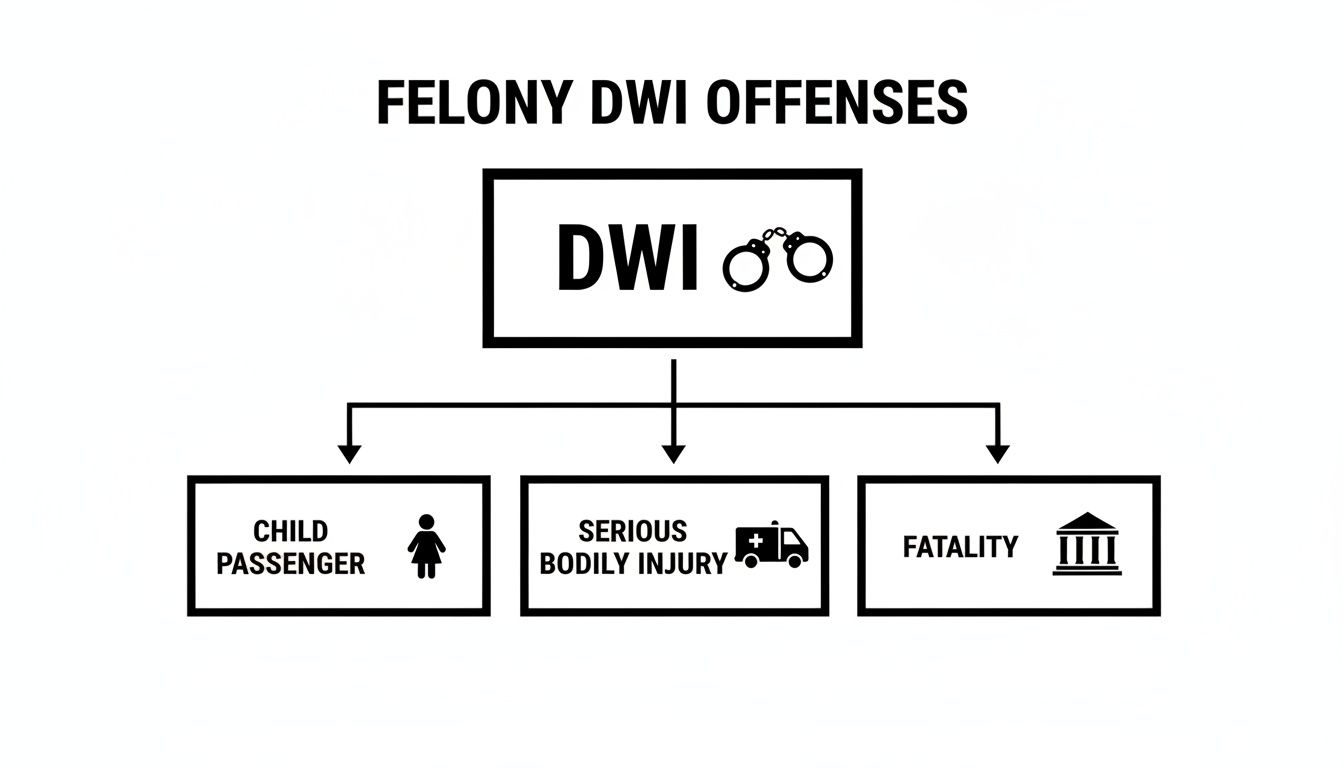
As you can see, certain situations can immediately turn a DWI into a felony, just as a third offense automatically triggers this severe classification.
The penalties for a third-degree felony DWI are as harsh as they sound: a potential prison sentence of two to 10 years in a Texas state prison and a fine that can go up to $10,000. The state will also impose a lengthy driver's license suspension—often up to two years—that doesn't even start until after you get out of prison. If you're trying to wrap your head around the financial hit, you can check out our guide on DWI fines in Texas to see how quickly all these costs can add up.
When you're staring down a felony charge, the fight is no longer just about avoiding jail. It’s about saving your future and protecting your family from the devastating fallout.
The Hidden Consequences: How a DWI Impacts Your Family and Future
When the judge’s gavel falls and the courtroom part of a DWI is over, most people think the worst is behind them. They’ve dealt with the fines, the potential jail time, and the license suspension. But that’s just the opening act.
A DWI conviction unleashes a wave of hidden consequences—what we in the legal world call “collateral consequences”—that can follow you for years, impacting your wallet, your career, and especially your family in ways you never saw coming. These are the penalties that don't show up on a sentencing sheet but can be just as devastating.
For most, the first gut punch comes from their auto insurance company. A single DWI conviction can make your premiums explode, sometimes doubling or even tripling almost overnight. To get a real sense of the numbers, you can learn more about how long a DWI affects your insurance rates in our detailed guide.
Your Career and Livelihood on the Line
Beyond the shock to your insurance, a DWI conviction can put your entire career on shaky ground. If you’re a professional who needs a license to work—think nurses, pilots, or real estate agents—a conviction can trigger a review by your licensing board. That could lead to a suspension or, in some cases, the revocation of the license you worked so hard to earn. And if you drive for a living with a Commercial Driver’s License (CDL)? A DWI is often a career-ending event.
Even for jobs without special licensing, the stigma is real. Many employers run background checks, and a conviction can easily get you passed over for a promotion or even fired, especially if your role involves driving a company car or handling sensitive responsibilities.
The Impact on Your Family and Personal Life
The fallout from a DWI charge often hits closest to home, creating a mountain of stress for your family. The financial pressure from fines, legal fees, and those skyrocketing insurance rates can put an incredible strain on your household budget. But nowhere is the impact more personal and frightening than in matters involving CPS and child custody.
If you're going through a divorce or a custody battle, a DWI conviction is a powerful piece of evidence for the other parent to use against you. They can argue you're an unsafe or irresponsible caregiver, and a judge might agree, imposing restrictions like supervised visitation to ensure the child’s safety. If CPS is involved, a conviction can be a major obstacle to reunification, as outlined in Chapter 263 of the Texas Family Code, which governs the timelines and requirements for parents to regain custody. That conviction becomes a permanent part of your story, a black mark on your character that can be used to question your judgment as a parent for years.
Actionable Advice for Parents Facing a DWI
If you are a parent arrested for a DWI, you must act strategically to protect your parental rights.
- Be Proactive: Do not wait for CPS to call you. Engage with a family law attorney immediately to understand your rights and prepare for a potential investigation.
- Document Everything: Keep detailed records of your arrest, your interactions with law enforcement, and any steps you take toward rehabilitation, such as attending AA meetings or counseling.
- Comply and Cooperate (Strategically): If CPS opens a case, cooperate with your investigator under the guidance of your attorney. Following their "service plan" is often crucial for keeping your family together or achieving reunification.
These hidden costs are precisely why fighting a DWI charge is so critical. It’s not just about staying out of jail; it’s about protecting your financial future, your career, and the well-being of your family from the long-term damage a conviction can cause.
Building a Strong Defense to Protect Your Future
When you're staring down the barrel of a Texas DWI charge, it's easy to feel like the fight is already over. The flashing lights, the handcuffs, the breathalyzer… it can all make a conviction seem inevitable.
But that is not how our justice system works. An arrest is not a conviction. The time between your arrest and your day in court is a critical window where a powerful defense can be built, piece by piece, to protect everything that matters to you.

A seasoned DWI defense lawyer does much more than just show up and plead your case. Our job is to scrutinize the prosecution's story, looking for every error, every constitutional violation, and every procedural misstep. And they are often there if you know where to look. This is how we begin to level the playing field and fight for your family.
Challenging Every Piece of the Puzzle
Think of the prosecutor's case as a chain. A good attorney knows how to spot the weakest links and apply pressure. We start right at the beginning—the traffic stop—and question every single action law enforcement took.
Here are the key areas we dig into:
- The Traffic Stop Itself: Did the officer even have a legal reason to pull you over? We’re talking about "reasonable suspicion," a legal standard they must meet. An illegal stop can get every piece of evidence that came after it thrown right out of court.
- Field Sobriety Tests: These roadside tests are notoriously shaky and subjective. We want to know everything. Was the ground perfectly flat? Were the instructions given correctly? Did the officer even consider things like medical conditions, footwear, or just plain exhaustion that can make anyone look impaired?
- Breath and Blood Test Results: These chemical tests seem scientific and unbeatable, but they're far from it. We demand the maintenance logs for the breathalyzer, the machine's calibration records, and proof that the officer was certified to operate it. Any mistake in that chain of custody can make the results completely inadmissible.
This isn't about finding a cheap "loophole." It's about holding the state to its burden of proof and ensuring your constitutional rights were protected every step of the way.
A Real-World Example: Why Procedure is Everything
Let's imagine a guy we'll call "Mark." He gets pulled over late one night for swerving, though he never left his lane. The officer immediately puts him through field sobriety tests on the sloped, gravelly shoulder of the highway. Back at the station, the breathalyzer machine he blows into hasn't been calibrated in over a month, which is a clear violation of protocol.
A defense attorney would see this and immediately file motions. First, to challenge the sobriety tests because they were conducted under unfair and unsafe conditions. Second, to challenge the breath test result because the machine's reliability is completely in doubt.
These aren't minor technicalities. They are fundamental errors that can dismantle the entire case, often leading to a reduction or even a full dismissal of the charges.
A strong defense is built on details. From the officer's initial report to the lab's testing procedures, every document is an opportunity to uncover inconsistencies that can strengthen your case and weaken the prosecution's argument.
Fighting for the Best Outcome, Whatever It Takes
Our goal is always to protect your future. Sometimes, that means negotiating with the prosecutor to get the charge reduced to something less severe, like obstruction of a highway, which doesn't carry the same life-altering stigma as a DWI. Other times, it means fighting to get a key piece of evidence suppressed, leaving the state with a case that's too weak to move forward.
And if a fair deal can't be reached? We are always prepared to take your case to trial and make our argument to a jury.
The objective never changes: minimize the impact of this charge on your job, your family, and your life. You don't have to walk this path alone. Having an experienced legal advocate in your corner means having someone to stand between you and the state, fighting for the best possible result at every single turn.
Answering Your Urgent Questions About Texas DWI Penalties
When you're facing a DWI charge, the sheer number of questions swirling in your mind can feel overwhelming. That uncertainty is often just as stressful as the charge itself. Let's cut through the noise and give you direct, clear answers to some of the most common concerns we hear from families in your exact situation.
Can I Refuse a Breathalyzer Test in Texas?
Yes, you absolutely have the right to refuse a breath or blood test. But you need to know what happens next. Texas operates under an "implied consent" law, which means that simply by having a driver's license, you've already agreed to submit to a test if lawfully asked.
Refusing comes with immediate and automatic consequences. The biggest one is an automatic driver's license suspension—typically for 180 days if it's your first refusal. While prosecutors won't have a BAC number to use against you, they can and absolutely will use the fact that you refused as evidence of guilt in court. This is a critical battleground where an experienced attorney is essential, both for fighting the license suspension and building a strong defense around your refusal.
Will I Need an Ignition Interlock Device on My Car?
It's highly likely. Texas law has gotten much stricter, and judges now frequently require an ignition interlock device (IID) as a condition of just getting out of jail on bond, even for a first offense.
An IID is almost always mandatory for any repeat offenses, cases involving a high BAC of 0.15 or more, or if you need to get an occupational driver's license to keep your job. This device forces you to provide a clean breath sample to start your car and then again at random times while you're driving, creating a significant daily expense and a major inconvenience.
A DWI conviction in Texas stays on your permanent criminal record forever. This is why it is absolutely critical to fight the charge from the very beginning to protect your future.
Can a DWI Conviction Be Removed From My Record?
This is a tough one, and the answer hinges entirely on the final outcome of your case. A final DWI conviction cannot be removed or sealed. It's permanent.
However, if your DWI charge is ultimately dismissed or you are found not guilty at trial, you may be eligible for an expunction. This is the best-case scenario, as it completely erases the arrest from your record as if it never happened. In some very specific and rare situations involving deferred adjudication probation, you might qualify for an order of nondisclosure, which seals the record from public view but doesn't erase it.
The answers to these questions highlight just how much is on the line from the moment of your arrest. You do not have to face this complex legal battle alone, especially when your family is at risk. At the Law Office of Bryan Fagan, our compassionate and experienced attorneys understand the fear and uncertainty you are facing. We are here to defend your rights, protect your family, and fight for your future.
We invite you to contact us for a free, confidential consultation to discuss your case. Let us provide the clear guidance and strong advocacy you need during this difficult time.