Skip to content
When you or a loved one is facing a third felony charge in Texas, the fear and confusion can be overwhelming. The state's "three strikes" law, officially known as the Habitual Felony Offender statute, is an unforgiving piece of legislation. It's designed to dramatically increase the penalties for people with prior felony convictions, potentially turning what might have been a standard sentence into 25 years to life in prison. The moment that notice lands, it feels like the weight of the past is about to crush your family's future.
For parents, this fear is magnified a thousand times. A serious criminal charge often triggers an immediate investigation by Child Protective Services (CPS), and the threat of a life-altering sentence raises the terrifying possibility of losing your children permanently. The legal system can feel cold and impersonal, and the thought of navigating both a criminal case and a CPS case at the same time is enough to paralyze anyone.

Here at The Law Office of Bryan Fagan, we understand that you are more than a case number. You are a parent, a spouse, a member of a family whose world has been turned upside down. This guide is meant to provide clear, compassionate explanations about how this law works and, more importantly, what you can do to protect yourself and your family. We want to empower you with knowledge, so you can move from a place of fear to a position of strength.
Understanding the Emotional and Legal Weight
A habitual offender enhancement isn't just a legal fight; it's an emotional battle for your family's survival. The stakes couldn't be higher, and the very idea of a life-altering sentence brings a storm of anxieties to the surface:
- Fear for your children's future: The primary concern for most parents is what will happen to their kids. A long prison sentence can lead to the termination of parental rights under Texas Family Code Chapter 161.
- Worry for your family: Who will take care of the kids? Who will support your spouse? How will the bills get paid? These questions become urgent and overwhelming.
- Confusion about the law: The legal jargon and complex procedures can make you feel completely powerless and alone, especially when dealing with both criminal court and family court.
- Regret over past actions: Old convictions you've worked so hard to move past suddenly have the power to define your entire future and threaten to tear your family apart.
It is critical to remember this: an enhancement notice from the prosecutor is not a final sentence. It's the start of a fight, and there are absolutely ways to challenge it. A skilled attorney doesn't just look at the new charge; they dig into every single detail of your prior convictions and understand how it connects to your family's CPS case. We are here to offer the clear, expert guidance you need to face this challenge head-on.
Understanding the Habitual Felony Offender Statute
When you're facing a serious charge, the legal jargon can feel overwhelming. But getting a grip on the key terms is your first step toward taking back control. What many people call the "three strikes law in Texas" isn't its official name. In the Texas Penal Code, it's known as the Habitual Felony Offender statute.
Its purpose is crystal clear: to hit individuals with prior felony convictions with much, much harsher penalties.
Forget the simple "three strikes and you're out" baseball analogy. It’s far more accurate to think of this law as a sentence multiplier. The statute doesn't invent a new crime. Instead, it takes the felony charge you're currently facing and dramatically "enhances" the potential punishment based on your criminal history.
This means a third-degree felony, which might normally land someone in prison for 2 to 10 years, could suddenly be treated like a second-degree felony, carrying a punishment range of 2 to 20 years. For more serious charges, the jump is even steeper, potentially leading to a sentence of 25 years to life.
Texas Law Sets a Tough Standard
Every state has its own way of dealing with repeat offenders, and Texas has a reputation for being particularly strict. In fact, Texas was a trailblazer in this area, putting its Habitual Offender Statute on the books way back in 1974. This made it the first state to roll out this type of law aimed at getting tough on repeat felony offenses.
Unlike California's more famous 1994 law, which often required a third serious or violent felony to trigger a life sentence, the Texas law can kick in with severe enhancements after just two prior felony convictions of almost any kind. That distinction is critical—it means the bar for facing a life-altering sentence is much lower here than most people assume.
To understand how prior cases, even ones that didn't result in a final conviction, can affect you, check out our guide on what deferred adjudication is in Texas. The state essentially views a third felony not as a one-off mistake but as a dangerous pattern. The law is designed to take people it considers a continuing threat off the streets for a very long time.
How Sentence Enhancement Works in Practice
Let’s walk through a relatable scenario. Imagine Maria, a mother of two, who had two felony shoplifting convictions from her early twenties. She served her time, got her life on track, and has been a devoted parent for over a decade. One day, she's arrested for possession of a controlled substance after a friend left something in her car. It's a third-degree felony, which typically carries a sentence of 2 to 10 years.
Because of this new charge, CPS opens an investigation under Texas Family Code Chapter 262, placing her children with a relative while the case proceeds. During the criminal proceedings, the prosecutor discovers her old convictions and files a notice to enhance her punishment under the habitual offender statute. Suddenly, her current third-degree felony is punished as a second-degree felony. The potential prison time instantly jumps from 2-10 years to 2-20 years. A mistake from her distant past now not only doubles her potential sentence but also jeopardizes her ability to ever reunify with her children.
This is a powerful tool for prosecutors, and they use it to gain leverage and secure lengthy prison terms.
The table below breaks down how these enhancements typically play out.
Table: How a Third Felony Enhances Sentences in Texas
This table illustrates how a third felony charge can be enhanced based on prior convictions, showing the potential increase in prison time.
| Current Felony Charge Level | Required Prior Convictions | Enhanced Punishment Range |
|---|---|---|
| Third-Degree Felony | Two prior felony convictions | Punished as a Second-Degree Felony (2-20 years) |
| Second-Degree Felony | Two prior felony convictions | Punished as a First-Degree Felony (5-99 years or life) |
| First-Degree Felony | Two prior felony convictions | Punished by 25-99 years or life in prison |
As you can see, the consequences stack up incredibly fast. While the law is designed to be severe, it’s not airtight. A skilled defense involves meticulously reviewing the prior convictions to find grounds to challenge the enhancement—a critical step in fighting for your freedom and your family.
Which Convictions Count as a Strike?
One of the biggest—and most dangerous—misconceptions about Texas's three-strikes law is that it only kicks in for violent crimes. Most people hear "three strikes" and immediately think of a long history of violent offenses like robbery or assault.
The reality is that Texas law casts a much, much wider net. This common misunderstanding can leave people completely blindsided by the staggering penalties they suddenly face. A wide range of prior felony convictions can be used to label you a habitual offender, meaning past mistakes you thought were behind you can stack up in the most devastating ways.
Not Just Violent Felonies
It's absolutely critical to understand that the prosecution can pull from a long list of prior convictions to build their case for habitual offender status. There is no requirement that the prior offenses be violent.
In fact, a history of purely non-violent felonies can absolutely trigger these life-altering sentence enhancements. Common non-violent felonies that can count as strikes include:
- Drug Possession: A conviction for possessing a controlled substance that qualifies as a felony.
- Third DWI: In Texas, a third Driving While Intoxicated offense is automatically charged as a third-degree felony.
- Theft Crimes: Felony-level theft, burglary of a building, or even credit card abuse can all count as prior strikes.
- White-Collar Crimes: Offenses like embezzlement or fraud also qualify if they were charged as felonies.
Some states limit their three-strikes laws to serious or violent felonies, but Texas is far more inclusive. The focus here is on deterring any repeat felony behavior. For Texans with a criminal history, this means even a lower-level felony charge can quickly spiral into decades, or even life, behind bars.
This flowchart gives you a simplified look at how a third felony charge can lead down the path to an enhanced sentence.
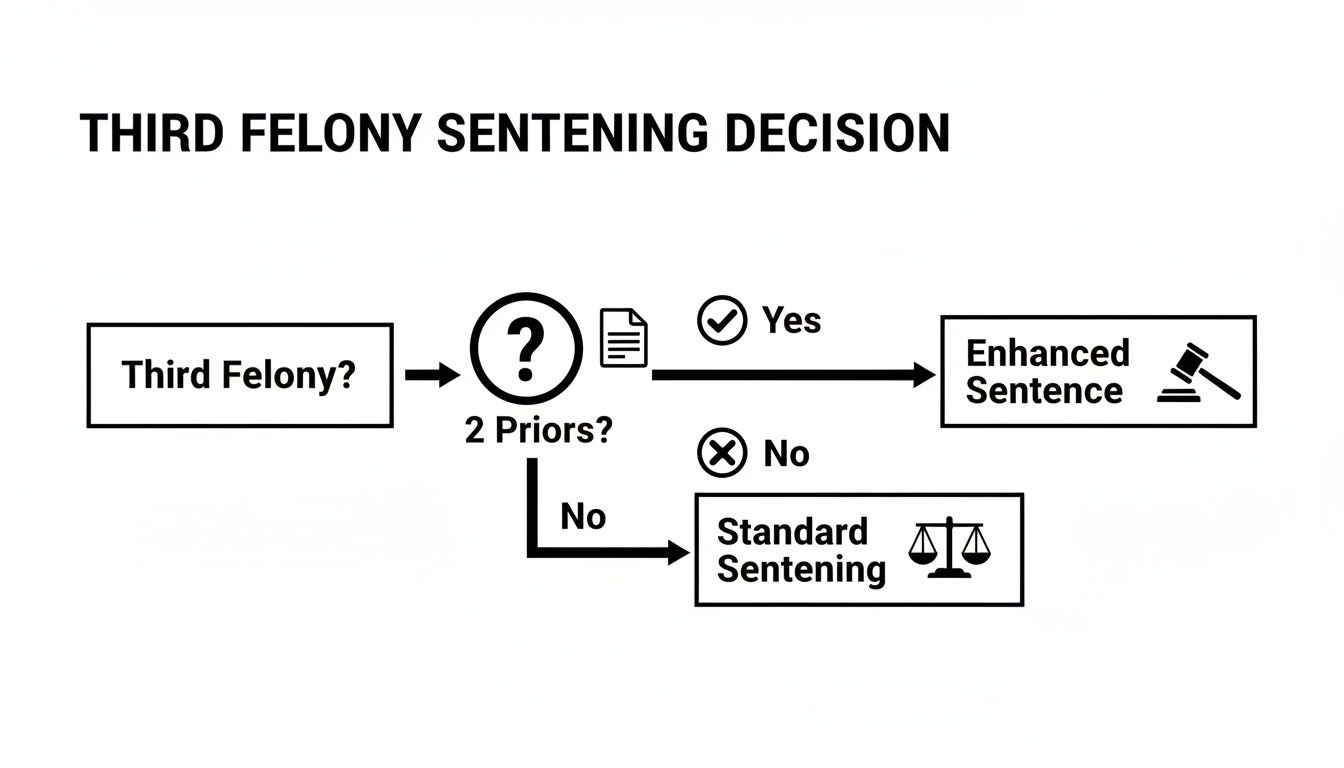
As you can see, the trigger is straightforward: the existence of two prior felony convictions opens the door for the state to seek a dramatically harsher sentence.
The Critical "Pen Trip" Rule
Now, it's not just about having two prior convictions. The timing and sequence of those convictions matter immensely. This is where a vital legal concept called the "pen trip" rule comes into play. It's a rule that can make or break the prosecution's case and often becomes the cornerstone of a powerful defense.
The "pen trip" rule, found in Texas Penal Code § 12.42(d), demands that the second prior felony conviction must have happened after the first prior felony conviction became final.
Let me break that down. The sequence has to look exactly like this:
- Commit and be convicted of the first felony.
- Then, commit and be convicted of the second felony.
- Then, commit the current (third) felony.
Let's say someone was on probation for a first felony offense when they committed a second one. If the conviction for that second offense occurs before their probation for the first one is revoked and finalized, the "pen trip" sequence might be broken. You can learn more about the specifics of community supervision in our guide on how probation works in Texas.
This isn't some minor technicality; it's a strict legal requirement. A sharp defense attorney will meticulously comb through the dates of offenses, convictions, and sentencing for every single prior felony. If the state can't prove this exact sequence, the habitual offender enhancement has to be thrown out. This is precisely why a detailed, deep-dive review of your entire criminal history is the first and most essential step in fighting these charges.
Building Your Strategic Defense
Receiving an enhancement notice under the three strike law in Texas can feel like a final judgment, especially when your children's futures are on the line. It's designed to feel that way. But this notice isn't the end of the road—it’s the start of a serious legal fight. This is where you shift from despair to action by building a strategic defense designed to protect your freedom and your family.

The state carries the entire burden of proof. They have to show that every single prior conviction is valid and that the timeline of those offenses meets the law’s rigid requirements. An experienced attorney will dig into every document, every plea, and every date to find the cracks in their argument. More often than not, the key to protecting your future is buried in the details of your past.
Actionable Advice for Parents: Challenging Prior Convictions
A prosecutor can't just point to a line on your record and call it a day. Each prior conviction they want to use as a "strike" has to be legally airtight. Your first action step is to work with your attorney to launch a full-scale investigation into those old cases, no matter how long ago they happened.
Let's consider Michael, a father facing his third felony. The state digs up a conviction from 20 years ago to use as his first "strike." But after a thorough review, his lawyer finds the court records from that old case are incomplete. There's no clear proof Michael was properly represented by a lawyer or that he truly understood his rights when he took that plea deal all those years ago.
That kind of discovery is a game-changer. If a prior conviction was obtained in violation of your constitutional rights—like the right to an attorney—it simply cannot be used to enhance a new charge. Your attorney can file a motion to have that conviction tossed out for enhancement purposes, which could completely invalidate the "three strikes" allegation against him.
We meticulously comb through prior cases looking for flaws, including:
- Lack of Legal Counsel: Is there concrete proof you had a lawyer or formally waived your right to one?
- Invalid Plea Agreements: Did the judge properly admonish you about the consequences of your plea? Was it truly voluntary?
- Clerical Errors: Are the dates, charges, or sentencing documents accurate and filed correctly? A simple mistake can have huge implications.
Even a seemingly minor documentation error from decades ago can be the crucial detail that gets an enhancement notice thrown out. This is a vital step toward a better outcome in both your criminal case and your CPS case.
Dismantling the "Pen Trip" Sequence
As we've covered, the state has to prove a very specific sequence of events known as the "pen trip" rule. They must show that you were convicted of the first felony, then committed and were convicted of the second, and only then committed the current offense.
This isn't just a suggestion; it's a strict legal requirement. If the prosecution's timeline is off by even a single day—if the second offense was committed before the first conviction became final—the habitual offender enhancement fails. Period.
Your legal team should build a detailed timeline of your entire case history, cross-referencing every offense date, arrest date, conviction date, and sentencing date. Proving the state's timeline is flawed is one of the single most effective ways to defeat a habitual offender charge and show the family court that you are fighting proactively for your future.
Negotiating with the Prosecution
Not every battle needs to be fought in a full-blown trial. In many cases, the smartest strategy involves skillful, tough negotiation. Once potential weaknesses in the state’s case are uncovered—whether it’s a shaky prior conviction or a busted "pen trip" timeline—you gain leverage.
Your attorney can present these findings directly to the prosecutor and argue for them to withdraw the habitual offender notice. This is a critical goal, as a successful negotiation protects you from a life-altering sentence and demonstrates to CPS and the family court that the situation is less severe than initially alleged. It opens the door to a much more reasonable outcome for the current charge, which in turn can positively impact your CPS service plan and reunification goals.
When a habitual offender enhancement lands on the table, it feels like your entire world is about to shatter. It’s not just a legal fight; it’s a battle for your family, your freedom, and your future. In a moment this critical, you need more than just a lawyer. You need a fierce ally who sees the human being behind the charges.
At The Law Office of Bryan Fagan, we start with a simple understanding: behind every case file is a person, often a parent, whose life has been completely turned upside down. Our defense is built on that foundation. We don't just glance at the current charge; we dive deep into your history, hunting for every single weakness in the state's case against you.
A Defense as Comprehensive as Your Life
A "three strikes" charge never happens in a bubble. We know these cases often collide with sensitive family issues, from protective orders to fragile child custody agreements. Our attorneys are skilled at handling these tangled situations with the care and comprehensive knowledge they require, making sure your defense strategy considers every part of your life.
Our promise is to guard your constitutional rights at every single turn. We'll meticulously review every prior conviction, searching for procedural mistakes or rights violations that could make them invalid for an enhancement. We firmly believe a mistake from your past shouldn't be used to unfairly erase your future, and we will fight relentlessly to make sure that doesn't happen.
For law firms committed to providing top-tier legal help, using effective marketing tactics for criminal defense lawyers is crucial. It ensures that families in crisis can find the experienced representation they so desperately need when facing serious charges like these.
Our Strategy in Action
Our firm’s philosophy is all about action. We’re not just defending you against a charge; we're fighting for your chance to rebuild your life.
This fight can look different depending on the specific facts of your case:
- Getting the Enhancement Dismissed: Our primary objective is often to find grounds to have the habitual offender notice thrown out completely. This could be based on flawed prior convictions or a broken "pen trip" sequence.
- Negotiating a Fair Plea: When the evidence seems overwhelming, we use any cracks in the state’s case to negotiate a fair plea deal, one that helps you avoid the devastating sentences that come with a habitual offender conviction.
- Winning at Trial: We are seasoned trial attorneys, always ready to take your case to a judge and jury and fight for an acquittal.
Firms like the Law Office of Bryan Fagan PLLC, with over 100 years of combined experience across Houston, Dallas, Austin, and San Antonio, know how to build strategic defenses to challenge priors, negotiate pleas, or seek reduced charges. We help our clients steer clear of life-altering sentences and explore options like expunctions or record sealing after a case is resolved.
You are not alone in this. If you’re feeling overwhelmed and don’t know where to turn, our team is ready to stand with you. We invite you to contact The Law Office of Bryan Fagan today for a free, confidential consultation to talk about your case and learn how we can help protect your family’s future.
Common Questions About the Texas Three Strikes Law
Facing a habitual offender charge unleashes a tidal wave of urgent, stressful questions. The legal process can feel like a maze, and every answer seems buried in confusing legal jargon. I want to cut through that noise and give you straightforward, empowering answers to the questions my clients ask most often about the three strikes law in Texas.
Knowledge is the first step toward building a strong defense. My goal is to help you understand the challenge you're up against so you can face it head-on, with confidence.
Can an Out-of-State Felony Count as a Strike?
Yes, it absolutely can, but it’s not automatic. This is a common point of confusion and a critical area where a skilled defense can make a huge difference. A prosecutor can't just wave around a felony conviction from another state; they have to prove that the crime you were convicted of there has nearly identical legal elements to a felony here in Texas.
Let’s say you have a prior drug possession conviction from another state, where the amount you had was a felony. If that same amount is only a misdemeanor under Texas law, then that conviction cannot be used as a "strike" to enhance your current charge.
A sharp defense attorney will dig into the criminal statutes of both states, hunting for any little difference in the legal definitions. Finding those discrepancies is a powerful way to get an out-of-state prior thrown out and defeat the enhancement allegation.
Is There a Time Limit on Old Convictions?
This is one of the harshest realities of the Texas habitual offender statute, and it catches a lot of people by surprise. Generally speaking, there is no "lookback" period for prior felony convictions. That means a felony from 10, 20, or even 30 years ago can still be legally weaponized against you today as a "strike."
A mistake you made when you were young—one you've worked hard to leave in the past—can suddenly roar back to life with devastating consequences. While this lack of a time limit gives prosecutors immense power, it also opens up an angle for your defense.
The older a conviction is, the more likely the records are incomplete, lost, or full of errors. We often discover that in these decades-old cases, there’s no clear proof that the person was properly represented by a lawyer or that their constitutional rights were fully protected. If we can prove a constitutional violation happened back then, that old case becomes inadmissible for enhancement purposes today.
What if My Prior Conviction Was a State Jail Felony?
The specific classification of your prior felonies is incredibly important. This is one of those details that can mean the difference between facing a potential life sentence and a much less severe punishment. In Texas, state jail felonies are the lowest level of felony, and they're treated differently for habitual offender purposes.
To trigger the most severe enhancement—the one that carries a punishment of 25 years to life—the law demands that both of the prior felony convictions be for offenses higher than a state jail felony. This usually means third, second, or first-degree felonies.
But don't get me wrong, state jail felonies aren't irrelevant. They can still be used for other types of sentence enhancements. For example, a prior state jail felony can be used to bump a new third-degree felony charge up to a second-degree felony, which dramatically increases the potential prison time.
A meticulous analysis of your complete criminal record is the essential first step. Correctly identifying the classification of every prior offense is fundamental to understanding the exact legal threat you face and building the right defense strategy.
Can I Expunge My Record if I Am Convicted?
This question really gets to the heart of the permanent, life-altering consequences of a habitual offender conviction. Unfortunately, if you are convicted as a habitual offender, that conviction makes you permanently ineligible to have that offense sealed or expunged from your record. Ever.
That conviction will follow you for the rest of your life. It creates massive barriers to finding a job, securing a place to live, and even getting certain professional licenses. This is exactly why fighting the enhancement allegation from the very beginning is so critical. Your entire future is on the line.
Defeating the habitual offender notice is the only way to preserve your future eligibility for record-clearing options. To get a better handle on that process and its strict requirements, you can learn more about how to get a record expunged in Texas in our detailed guide. Successfully challenging the enhancement doesn’t just save you from a draconian prison sentence; it protects your ability to one day clear your name and truly move on with your life.
When your future and your family's well-being are at stake, you cannot afford to face this alone. The fear and uncertainty can be isolating, but you have the power to take the first step toward reclaiming your life. The attorneys at The Law Office of Bryan Fagan understand the profound connection between a criminal charge and your rights as a parent. We are dedicated to providing compassionate, knowledgeable, and aggressive representation to protect what matters most.
You are not just another case to us; you are a parent fighting for your family. If you or a loved one is facing a habitual offender charge and a CPS investigation, we are here to stand with you. Contact us today for a free, confidential consultation to discuss your case and learn how we can help you build the strongest possible defense for your freedom and your family.