Skip to content
When you’re a parent facing a serious accusation, the fear can be overwhelming. The thought of being separated from your children, of a legal system that seems complex and unforgiving, is a nightmare. This fear intensifies dramatically if you have a past criminal record, and you hear phrases like the "three-strikes law" being mentioned. It’s a terrifying thought, suggesting that past mistakes could erase your family’s future.
While Texas doesn't have a law officially called the Three-Strikes Law, it has a much older and more severe statute that works similarly: the Habitual Felony Offender statute. The consequences can be devastating for Texas families. This guide is here to provide clear, compassionate answers and reassuring guidance during a time filled with confusion and fear.
Understanding The Texas Habitual Offender Law
Hearing a prosecutor or even your own attorney mention that you could be labeled a "habitual offender" is a punch to the gut. It’s a moment filled with dread—fear of a massive prison sentence, of being permanently torn away from your family, and of a system that feels designed to keep you down.
It can make you feel like your past mistakes are about to erase your entire future. But you are not just a case file. You are a person whose life is on the line, and understanding the law that threatens to change it forever is the first, most critical step in fighting back. This guide is designed to replace that fear with knowledge and a clear path forward. We'll break down this complex part of Texas law into simple, understandable terms.
The Origin Of The Law
Most people connect "three-strikes" laws with the tough-on-crime policies that swept the nation in the 1990s. But Texas was way ahead of the curve. In fact, Texas basically pioneered the concept with its Habitual Offender Statute, which has been on the books since 1952.
This law was created for one specific reason: to target repeat felony offenders by hitting them with incredibly harsh sentences, including life in prison, after a third felony conviction. So, while other states were just starting to pass their famous three-strikes laws, the Texas version has been quietly and consistently putting people away for a very, very long time. You can read more about the history of the Texas habitual offender statute and its impact.
The most important thing to grasp is that this statute doesn't create a new crime. It's a sentencing enhancement. This means if you're charged with a new felony and have the right number of prior felony convictions, the prosecutor can use this law to ask for a punishment far beyond what the new charge would normally carry.
The key takeaway is this: The Habitual Felony Offender law is a tool prosecutors use to dramatically increase your potential prison sentence based on your criminal history. It elevates the stakes of your current case exponentially.
Grasping this distinction is vital. You are not being charged with "being a habitual offender." Instead, the state is using your past to argue that you deserve to spend decades, or even the rest of your life, behind bars. Knowing this is where the fight begins. It allows us to build a defense that not only challenges your current charge but also scrutinizes every detail of the past convictions the state wants to use against you.
How The Habitual Felony Offender Law Works
It’s easy to get confused about this, but understanding how the habitual offender law works is critical. It’s not a separate charge that gets tacked onto your case; think of it more like a powerful sentencing multiplier that prosecutors can pull out of their toolbox.
Imagine your criminal record as a ladder. Every prior felony conviction bumps you up another rung. With each step up, the potential consequences for a new charge get exponentially more severe. This system is designed for escalating punishments, and we need to break down exactly how that ladder works, from a single prior conviction all the way to the life-altering "three strikes" enhancement.
The First Step Up The Ladder
The climb begins with just one prior felony conviction. If you have a felony on your record and find yourself facing a new felony charge, prosecutors can use that prior conviction to "enhance" the punishment range for the new offense.
For example, a third-degree felony normally carries a sentence of 2 to 10 years. But with one prior felony, it can be enhanced to the punishment range of a second-degree felony—that’s 2 to 20 years. Just like that, a single prior conviction has the power to double your maximum potential prison time.
The Second Strike Enhancement
The next rung up is what many people would call the "two strikes" rule. This part of the law applies if you're facing a new felony charge and have one prior sequential felony conviction that you actually served prison time for.
This is where the enhancements get really serious:
- A Third-Degree Felony is punished as a second-degree felony (2-20 years).
- A Second-Degree Felony gets bumped up to a first-degree felony (5-99 years or life).
- A First-Degree Felony sees its punishment range jump to a minimum of 15 years, all the way up to 99 years or life.
This is a massive leap in potential prison time. It shows just how quickly a criminal history can stack up against you and why understanding these rules is a vital part of evaluating your case, especially when you're weighing options like how probation works in Texas against the risk of a massively enhanced sentence.
The Top Rung: Three Strikes
Finally, we’ve reached the top of the ladder—the provision most people think of as the Texas "three-strikes" law. This is the habitual felony offender enhancement, and it carries the heaviest consequences of all.
To trigger this, the prosecution has to prove two very specific things:
- You have been previously convicted of two felony offenses.
- Those two prior convictions were sequential. This is the key detail. It means the second felony conviction had to happen after the conviction for the first felony became final.
This "sequential" requirement is everything. The timeline of your past convictions matters immensely. The State has the burden to prove that you were convicted of Felony A, got out, and then committed and were convicted of Felony B before ever committing the current offense, Felony C.
What Does "Sequential" Mean in Practice?
Let's say someone was convicted of Felony A back in 2010. They did their time and were released. Then, in 2015, they committed and were convicted of Felony B. Now, fast forward to today, they're charged with Felony C. Because the convictions for A and B happened in the correct sequence, prosecutors can use both of them to trigger the habitual offender law for Felony C.
This flowchart helps break down the difference between what people often think these laws mean and what they actually say.
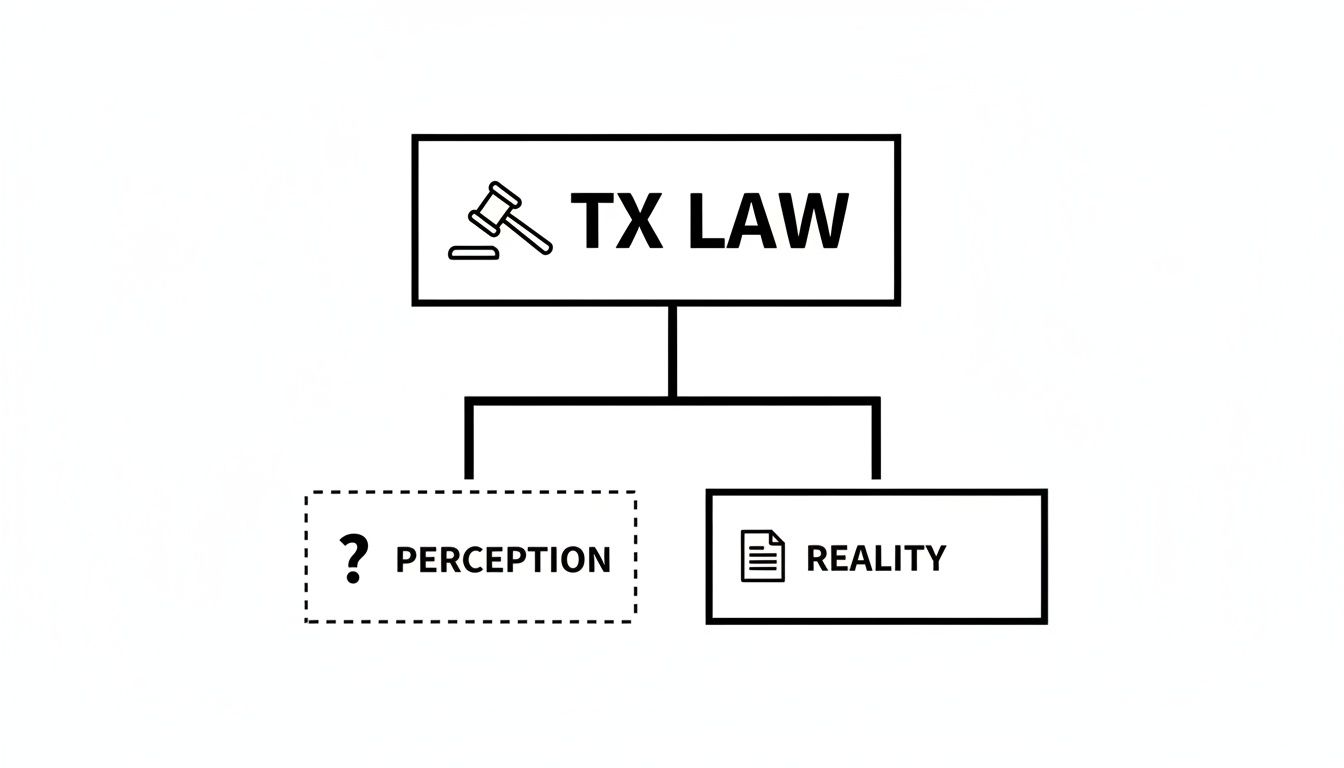
As you can see, it's not the simple "three strikes and you're out" rule that's common in pop culture. The Texas statute is a much more complex legal machine with very specific requirements that have to be met.
If the prosecution successfully proves those two sequential prior felony convictions, the punishment for the new felony charge automatically becomes 25 years to life in prison. This is a mandatory minimum, which takes a huge amount of discretion away from the judge and jury. The stakes simply could not be higher, which is why challenging every single element of the state's enhancement notice is absolutely essential to a strong defense.
What Offenses Count As Strikes In Texas?
If you’re staring down the barrel of an enhanced sentence, one of the first questions you’re probably asking is, “What kind of crime even counts as a strike?” In a lot of other states with similar laws, the answer is usually limited to violent or especially serious felonies. That’s not how it works in Texas. The reality here is much broader and, frankly, a lot more frightening.
The Texas habitual offender statute is incredibly expansive. It doesn’t bother with creating a special list of qualifying "strike" offenses. Instead, almost any felony conviction can potentially be weaponized by the prosecution to enhance your current charge. This includes a huge range of crimes, from non-violent property offenses to much more serious acts.

A Wide Net for Felony Offenses
The law hands prosecutors tremendous leverage by letting them dig through a person’s entire felony history. This means old convictions for completely unrelated crimes can suddenly be stacked against you. The qualifying offenses can include:
- State Jail Felonies, particularly when they are enhanced to a higher degree under certain circumstances.
- Third-Degree Felonies, like a third DWI or certain types of theft.
- Second-Degree Felonies, such as aggravated assault or burglary of a habitation.
- First-Degree Felonies, which are the most serious crimes on the books.
This incredibly broad application is what makes the Texas law so dangerous. A mistake you made twenty years ago can suddenly roar back to life with devastating consequences, even if the charge you’re facing today is for something entirely different.
A Relatable Scenario
To really see how this plays out, picture a father we’ll call David. Twenty years ago, as a young man, he was convicted of felony drug possession. He did his time, got out, and turned his life around. Ten years later, he made another mistake and was convicted of burglary of a building—another felony. He paid his debt to society, met his wife, started a family, and has been holding down a steady job ever since, focused on being a good dad.
Now, David gets arrested for a third DWI, which is a felony in Texas. On its own, a felony DWI is a serious charge. But because David has two prior, sequential felony convictions on his record, the prosecutor can file a notice of enhancement. Suddenly, his DWI case isn't about a potential 2-to-10-year sentence anymore. It's about a mandatory minimum of 25 years to life in prison—and the potential of being permanently separated from his children.
This example shows just how easily a family can get caught in the shadow of the habitual offender law. The offenses don't have to be violent. They don't even have to be related. Each felony conviction, no matter how old or different, can become another "strike" used to justify a life sentence.
Out-of-State and Federal Convictions
The reach of the Texas habitual offender law doesn't stop at the state line, either. Prosecutors can and will use prior felony convictions from other states or the federal system to enhance a sentence right here in a Texas courtroom.
For an out-of-state conviction to count, the prosecution has to prove that the crime would also be considered a felony under Texas law. This can turn into a complex legal battle, and it's where an experienced defense attorney will meticulously scrutinize the laws of both states to challenge the validity of the enhancement. Fighting back against these kinds of charges is tough, which is why it's so critical to understand the nuances of related offenses, like the specifics of assault charges in Texas.
The Reality Of Habitual Offender Sentencing
When a prosecutor files a notice to seek a habitual offender enhancement, the entire ground shifts beneath your feet. It's a game-changer. Suddenly, the case isn't just about the current charge anymore; it's about a future that could be measured in decades, not months or years. Understanding what that truly means is terrifying, but it's the first critical step in building a defense.
This isn't just about a number on a piece of paper. Under what many call the three strikes law in Texas, a conviction as a habitual offender triggers a mandatory minimum sentence: 25 years to life in prison. That’s not a guideline or a suggestion for the judge or jury—it's the mandatory floor.
Understanding Flat Time and Parole Eligibility
The true harshness of this sentence comes into focus when you understand the concept of "flat time." In Texas, anyone sentenced as a habitual offender must serve a minimum of 25 calendar years before they even get a chance at parole. This is a detail that trips up many people, and it's absolutely crucial.
Any "good conduct time" an inmate might earn to shorten other sentences simply does not apply to this initial 25-year period. It cannot be reduced. You serve every single day of those 25 years before the parole board will even look at your file. It’s what makes the habitual sentence one of the most unforgiving in the entire Texas justice system.
Facing this reality is overwhelming. The fear and anxiety are completely understandable. But being brutally honest about the stakes is the first step toward building the strongest possible defense. It’s this knowledge that empowers you to see why fighting the enhancement isn't just an option—it's a necessity.
How Enhancements Drastically Change Sentencing
To really grasp the power of the habitual offender law, it helps to see the numbers side-by-side. The threat of a 25-to-life sentence gives prosecutors enormous leverage, often pressuring people into taking plea deals they would never otherwise consider.
This table shows just how dramatically prior convictions ratchet up the potential prison time, culminating in that severe habitual sentence.
Texas Felony Sentencing Ranges With and Without Enhancements
The table below starkly illustrates how prior convictions drastically increase potential prison time under Texas law. Notice how quickly the penalties escalate.
| Original Felony Level | Standard Penalty Range | Penalty with One Prior Felony | Penalty with Two Prior Felonies (Habitu |
|---|---|---|---|
| Third-Degree Felony | 2-10 years | 2-20 years | 25 years to life |
| Second-Degree Felony | 2-20 years | 5-99 years or life | 25 years to life |
| First-Degree Felony | 5-99 years or life | 15-99 years or life | 25 years to life |
As you can see, it doesn’t matter if the new charge is a first, second, or third-degree felony. Once you’re found to be a habitual offender, the end result is the same: a minimum of 25 years behind bars before parole is even a possibility. This reality underscores just how vital it is to have an experienced attorney who knows how to challenge the state’s evidence and protect your future from the system's harshest consequences.
How To Fight A Habitual Offender Enhancement
Getting that notice—the one where the state says they're seeking a habitual offender enhancement—feels like a door slamming shut on your future. It's a terrifying moment. The prospect of a life sentence suddenly becomes very, very real, and it’s easy to feel like all hope is lost.
But that notice isn't the end of the road. It's the start of a critical fight, and there are powerful ways to defend your freedom.
A strong defense doesn't just focus on the charge you're facing today. It starts with a deep, methodical dive into the past. We have to meticulously dissect every single detail of the prior convictions the prosecution wants to use to lock you away for life.

Actionable Advice: How to Protect Your Family's Future
When facing a habitual offender charge, your first priority is to build a strong defense. Here are practical steps to take:
- Do Not Speak to Law Enforcement Without an Attorney: Anything you say can be used against you. Politely decline to answer questions until you have legal representation.
- Gather All Documents: Collect every piece of paper you have related to your past convictions and the current charge. This includes plea paperwork, court orders, and correspondence.
- Hire an Experienced Attorney Immediately: Time is critical. An attorney can file motions to challenge the prior convictions and begin negotiating with the prosecutor from a position of strength.
Challenging The Validity Of Prior Convictions
Every single conviction on your record has to stand up to constitutional scrutiny. We investigate the circumstances of your previous cases, hunting for critical errors that could make a prior conviction totally inadmissible for an enhancement. This isn't about re-litigating old cases; it's about making sure your rights were protected every step of the way.
Potential grounds for a challenge are often found in the fine print:
- Ineffective Assistance of Counsel: Was the lawyer in your previous case so deficient that you were effectively denied a fair trial? If so, that conviction could be invalidated for enhancement purposes.
- Improper Plea Proceedings: Were you properly and fully advised of your rights before you took that plea deal years ago? A plea that wasn't made knowingly and voluntarily might not be valid.
- Errors in the Judgment: You'd be surprised how often simple clerical errors or fundamental mistakes in official court documents can be used to challenge a prior conviction's use.
Finding these flaws requires a skilled legal eye and an exhaustive review of old court records, transcripts, and dusty case files. It's painstaking work, but it can make all the difference.
Verifying The Sequential Requirement
The State of Texas has the complete burden of proving that your prior convictions meet the strict "sequential" requirement. As we've covered, this means the second felony conviction had to be final before you ever committed the third felony. That timeline is everything.
We force the prosecution to prove this sequence beyond a reasonable doubt. We scrutinize the dates of the offense, the conviction, and the sentencing to find any break in that chain—any gap that would disqualify the enhancement. A single mistake in the state's timeline can be the key to defeating a 25-to-life sentence.
This isn't just a technicality; it's a crucial safeguard. It's also an area where prosecutors often make assumptions that can be successfully challenged. The state has to follow the letter of the three strike law Texas statute, and we hold them to it.
The Power Of Negotiation
Beyond pure legal challenges, a huge part of the defense comes down to strategic negotiation. A seasoned attorney can often get the prosecutor to withdraw the enhancement notice in exchange for a plea agreement on the main charge.
Why would a prosecutor do this? Because fighting over old convictions is complex, expensive, and risky for them. If the defense has raised valid challenges to the priors, a prosecutor might prefer to secure a definite conviction on the current case rather than roll the dice at trial.
Texas's Habitual Offender Statute has deep roots, predating the more famous laws from Washington and California that emerged in the 1990s. The 1980 Supreme Court case Rummel v. Estelle cemented its power, upholding life sentences for even non-violent felonies and rejecting Eighth Amendment challenges. While some states have reformed their laws, Texas has largely stuck to its original, harsh script, making a skilled defense even more critical. Read more insights about the history and application of these laws.
Ultimately, fighting an enhancement requires a multi-faceted approach combining aggressive legal challenges, meticulous investigation, and savvy negotiation. Knowing these avenues exist can provide a ray of hope in what feels like the darkest of times. And if a conviction is unavoidable, it’s just as important to understand all your post-conviction options, including how to appeal a criminal conviction in Texas.
Take Action To Protect Your Freedom
The stakes couldn't be higher. We've walked through how severe the Texas habitual offender law is, and the penalties are genuinely life-altering. If you're feeling a mix of fear and uncertainty right now, that's completely understandable—especially when staring down the barrel of a potential 25-year-to-life sentence.
But this isn't the time for despair. It's the time for clear-headed, strategic action. You don't have to navigate this overwhelming situation by yourself. Reaching out to an experienced criminal defense attorney is the single most critical step you can take to start regaining some control over your life and your future.
Your First Step Is Your Most Important One
Making that first call is often the hardest part, but it's absolutely essential. A consultation gives you a safe, confidential space to tell your side of the story and get honest, straightforward answers about the road ahead. It's your chance to replace that fear with facts and a concrete plan of action.
The right legal team does more than just represent you in a courtroom. They provide guidance, support, and a much-needed shield against the immense pressure of the criminal justice system. They'll dig into the prosecution's case, challenge the validity of prior convictions, and fight to protect your rights at every single turn.
The most powerful tool you have right now is the ability to choose an advocate who will stand beside you. A skilled attorney can mean the difference between a life sentence and a second chance.
When you're up against habitual offender enhancements, getting experienced legal counsel is non-negotiable. You can learn more about the broader scope of services offered by Law Firms and Attorneys to see how specialized knowledge can be applied to your defense. This is all about finding the right expertise to handle the complexities of what many people call the three strike law in Texas.
We Are Here to Fight for You and Your Family
The Law Office of Bryan Fagan is committed to providing a compassionate ear and an aggressive defense for Texas parents and families. We understand that more than just your freedom is at stake—your family’s future is on the line. With decades of combined experience across Texas, we have the knowledge and unwavering determination to challenge the prosecution’s case from every possible angle. We know what you're up against, and we are ready to fight for you.
We invite you to call us for a free, confidential consultation. Let's talk about the specifics of your case, answer your questions, and start building the powerful, strategic defense you and your family deserve. Your future is too important to leave to chance—let's protect it together.
Common Questions About Texas's Habitual Offender Law
When you’re facing a habitual offender enhancement, it’s natural for a wave of confusion and urgent questions to hit you. The legal language is dense, and let's be honest, the stakes are as high as they get. Let’s break down some of the most common questions we hear from people trying to navigate this terrifying situation.
Can A State Jail Felony Count As A Strike?
Yes, a state jail felony can absolutely be counted as one of the prior convictions, or "strikes," used against you, but there's a catch. For it to qualify, a state jail felony usually has to be bumped up to a third-degree felony first.
How does that happen? It typically involves specific circumstances around the original crime, like the use of a deadly weapon. A sharp defense attorney will always put the state's prior convictions under a microscope to make sure they aren't improperly using a state jail felony to stack the deck.
What If My Prior Felonies Are Over Ten Years Old?
This is a critical point that trips a lot of people up. In Texas, there is generally no "washout" period or expiration date for old felony convictions when it comes to the habitual offender law. It doesn't matter if a conviction happened 15, 20, or even 30 years ago—the prosecution can still dig it up and use it to push for a life sentence today.
The age of the conviction simply doesn't make it go away. This is exactly why it's so important to have a legal team that knows how to investigate the details of those old cases. The only real way to fight them is to find potential constitutional errors from back then.
The tough reality is that a mistake you made decades ago can still have life-altering consequences under Texas law. The system isn't built on forgiveness over time, which makes having a smart, strategic defense absolutely essential.
Can I Avoid A Life Sentence If I Have Two Prior Felonies?
Absolutely. Getting a notice that the state plans to seek a habitual offender sentence isn’t the end of the road—it’s the start of the fight. You have options, and there is always hope.
An experienced criminal defense attorney can attack this from several angles to protect your future:
- Challenge the Priors: We can dig into those old convictions, looking for any legal flaws that would get them thrown out and deemed inadmissible for enhancement.
- Negotiate with the Prosecutor: A strong, well-prepared defense often gives us the leverage needed to convince the prosecutor to drop the enhancement in exchange for a plea on the new charge.
- Fight the New Charge at Trial: We can go to trial and fight for a "not guilty" verdict on the current charge. If we win, the entire enhancement issue vanishes.
An enhancement notice definitely raises the stakes, but it doesn't take away your right to a powerful defense. With the right strategy, it is entirely possible to beat a life sentence and get your future back.
Facing a habitual offender enhancement is one of the most serious legal battles anyone can go through, especially when your family's future hangs in the balance. You shouldn't have to face it alone. The dedicated attorneys at The Law Office of Bryan Fagan, PLLC are here to offer the compassionate support and aggressive defense you deserve. Call us today for a free, confidential consultation to talk about your case and find out how we can protect your freedom and your family. Contact us at https://texascpslawyer.net.