Skip to content
When you're facing a new criminal charge, the fear and uncertainty can be overwhelming. But when a prosecutor mentions that past mistakes could turn this charge into a life sentence, that fear turns into pure terror. This is the harsh reality of what many call the "three strikes law in Texas." While Texas doesn't have a statute with that exact name, its Habitual Felony Offender statute is very real, and for many families, it feels like a nightmare coming true.
The purpose of this guide is to cut through the confusing legal jargon and offer clear, compassionate answers. If you or a loved one are facing the devastating possibility of a sentence enhancement, you are likely filled with questions and anxiety about what this means for your family's future. We understand the weight of this situation and are here to provide the practical guidance you need to navigate this incredibly challenging time.
The Harsh Reality of Repeat Offender Laws in Texas
Hearing that a mistake from your past could suddenly result in a life sentence is a terrifying thought. It’s the kind of news that hits you like a ton of bricks, bringing a crushing wave of fear, confusion, and anxiety for you and everyone you love. The term "three strikes law" gets thrown around a lot, but what it actually means here in Texas is incredibly specific and severe.
This isn’t about committing three identical crimes. It's about how prior felony convictions on your record can act as a powerful multiplier, drastically enhancing the punishment for a brand-new felony charge.
Our goal is to cut through the dense legal jargon and explain exactly what's happening in plain, simple terms. Facing the criminal justice system is stressful enough without trying to decipher confusing statutes. This law creates immense pressure, making it absolutely critical that you have a clear grasp of how it could derail your future.
How the "Enhancement" Really Works
At its core, the Texas habitual offender law is designed to impose much heavier penalties on individuals the state considers "career criminals." It’s not a separate crime but a sentencing enhancement. The law works on a tiered system where your past convictions stack up, pushing you into far more serious sentencing ranges for the current offense.
Here’s what that actually means for you:
- It’s All About Enhancement: The law doesn’t create a new charge. Instead, it "enhances" the punishment for the current felony you're facing, solely based on your criminal history.
- Felonies are the Trigger: This statute is only activated by prior felony convictions, not misdemeanors. Crucially, even old, non-violent felonies can count as "strikes."
- The Stakes Couldn't Be Higher: A third felony conviction can automatically lock you into a mandatory minimum sentence of 25 years to life in prison—regardless of what the new offense is.
This is a tough reality to process. A mistake you made years, or even decades, ago can suddenly reappear with life-altering consequences. For example, a person with two old, non-violent theft convictions on their record could find themselves facing a potential life sentence for a completely new and unrelated felony. It’s a situation that can feel deeply unfair and overwhelming, and it highlights just how vital a strong legal defense is right from the start. We understand the emotional toll this takes, and we're here to provide the clear guidance and aggressive defense you and your family deserve.
How The Habitual Offender Law Actually Works
When people talk about a "three strikes" law in Texas, they're usually referring to the Habitual Felony Offender statute. Found in Texas Penal Code § 12.42, this law isn't quite as simple as its nickname suggests. It’s a powerful, tiered system that drastically increases punishments based on your criminal history.
Think of it less like a baseball game and more like a ladder. Each prior felony conviction can push you up another rung, launching you into a much more severe sentencing category for whatever new charge you’re facing. This escalation can happen automatically, turning what might seem like a manageable felony into a life-changing prison sentence.
The Two-Strike Enhancement
The law’s impact is felt long before a third strike ever comes into play. In what is essentially a "two-strike" scenario, just a single prior felony conviction can dramatically increase the penalty for a new one.
For instance, let’s say you’re charged with a state jail felony (the lowest level felony in Texas). If you have a previous conviction for a third-degree felony or higher, that new charge gets an automatic upgrade.
Suddenly, that state jail felony—which normally carries a sentence of 180 days to two years—is bumped up to a third-degree felony. The potential prison time skyrockets to a range of two to ten years. A single past mistake can quintuple the maximum punishment on the table.
This chart shows how a new felony charge gets elevated based on a defendant’s prior convictions.
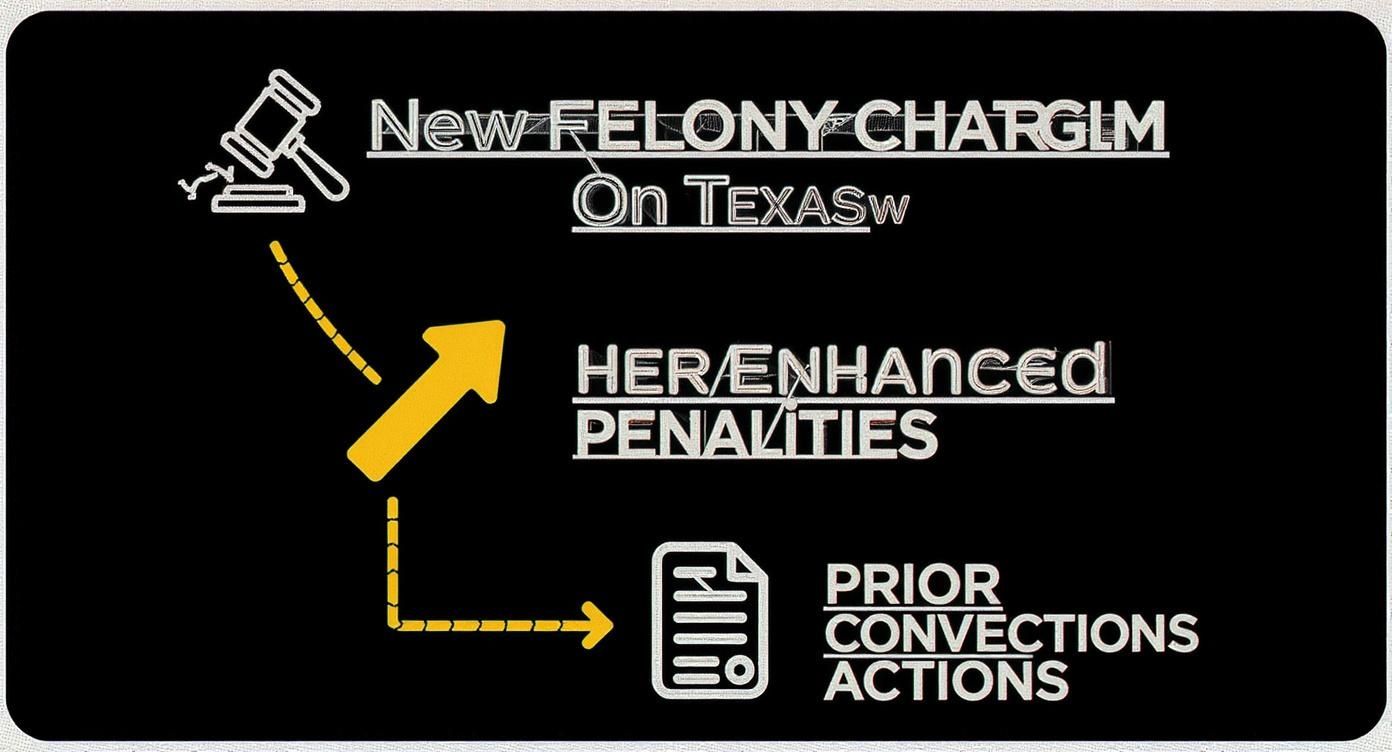
As you can see, the statute has a powerful multiplier effect, where past offenses make the current legal battle exponentially more serious.
The Three-Strike Trigger: A Life Sentence
The most severe application of the law—the true "three strikes" scenario—is triggered when someone with two prior felony convictions gets charged with a new one. When this happens, the consequences are staggering.
Upon conviction for that third felony, the defendant faces a mandatory minimum sentence of 25 years to life in prison. This is the heart of the three strikes law in Texas, and it's what makes our state's version one of the toughest in the nation. The judge has no discretion to go below that 25-year minimum, no matter what the third offense is.
Let’s look at a real-world example. Imagine a man who was convicted of felony theft in his early twenties and then drug possession five years later. He served his time for both, got his life together, and has been clean for over a decade. He's a father, a husband, and a valued member of his community. Now, he's arrested for another non-violent felony, like credit card fraud, after making a poor decision during a time of financial stress for his family.
Because he has two prior felony convictions on his record, prosecutors can use the habitual offender statute. If he is convicted of the new fraud charge, he won’t be sentenced based on that crime’s typical punishment range. Instead, he will automatically face a sentence of 25 years to life. A single new charge, combined with mistakes from his distant past, puts him at risk of spending the rest of his life behind bars, devastating his family.
This unforgiving approach highlights just how rigid the Texas law is. Unlike some states that limit these enhancements to serious or violent felonies, Texas law makes no such distinction. Any third felony, including non-violent drug offenses, can trigger these mandatory sentences.
While the law was designed to take career criminals off the streets, it often ensnares people who made mistakes long ago and are now trying to build a better life. When a family gets caught in this situation, understanding all the options is critical, which is why we've put together a guide on how probation works in Texas.
What Legally Counts As A Prior Conviction
When prosecutors decide to use the habitual offender law, they can’t just point to any past mistake on your record. Each prior conviction, or "strike," has to pass a strict set of legal tests. Honestly, figuring out whether the state’s case holds up here is one of the very first things a defense attorney will do. It's often where we find the first crack in the prosecution's argument.
You see, not every brush with the justice system leaves a permanent mark that can be used for this kind of sentencing enhancement. The state carries the full burden of proving that your past offenses meet some very specific standards before they can even think about seeking a life sentence.
The Conviction Must Be Final
One of the most important rules is that a prior conviction must be final. That’s a specific legal term with a very clear meaning. Generally speaking, a conviction isn’t considered "final" until the entire sentence has been served—including any probation or parole—and the window for filing an appeal has officially closed.
This single requirement provides a huge layer of protection. For instance, if you successfully completed a deferred adjudication program for an old offense, it typically does not result in a final conviction. Because you were never technically "convicted," that case usually can't be used as a strike against you. Getting into the weeds of these legal outcomes is critical, and you can learn more about what deferred adjudication is in Texas in our detailed guide.
The Sequential Rule: A Critical Timing Requirement
Beyond finality, the timing of the convictions is everything. The law has a non-negotiable "sequential" rule that prosecutors are required to follow. This rule is specifically designed to target individuals who commit new crimes after already being held accountable for previous ones.
Here’s how it works: for the habitual offender statute to apply, the second prior offense must have been committed after the conviction for the first prior offense became final. The timeline has to be perfect.
Let’s walk through a scenario to see why this is so important.
Imagine someone is arrested for two separate felonies in the same week. They go through the court process and are eventually convicted of both. Even though this person now has two felony convictions on their record, they do not qualify as a habitual offender. Why? Because the second crime was committed before the conviction for the first crime was final.
This timing requirement is an incredibly powerful tool for the defense. A detailed review of your criminal history can often show that the state’s timeline simply doesn't meet this strict sequential test, which can completely invalidate their attempt to enhance your sentence.
The table below breaks down the key requirements a prior conviction must meet to be used as a "strike" under Texas law.
Criteria For A Prior Conviction To Count As A Strike
| Requirement | What It Means In Plain English | Practical Example |
|---|---|---|
| Finality | The sentence, including any probation or parole, must be fully completed, and the time for appeal must have expired. | A conviction from five years ago where you finished your 3-year probation sentence two years ago would be considered final. |
| Sequential Order | The second felony must have been committed after the first felony conviction became final. | If you were convicted of Felony #1 in 2015 and then committed Felony #2 in 2018, the sequence is correct. |
| Offense Level | The prior convictions must be felonies. | Misdemeanor convictions, no matter how many, do not count as strikes for the habitual offender law. |
| Jurisdiction | The conviction can be from Texas or another state, as long as the offense would also be a felony in Texas. | A felony burglary conviction from Oklahoma would likely count as a strike in Texas. |
Each of these rules provides a clear opportunity to challenge the state's case.
Other Factors That Determine A Strike
A few other key questions come up all the time when we're determining what counts as a prior conviction. Knowing the answers will help you understand exactly where you stand.
- What level of offense counts? The prior convictions must be felonies. However, state jail felonies, which are the lowest level, generally cannot be used for the three-strikes provision, though they can be used for other types of sentence enhancements.
- Do out-of-state convictions count? Yes, most of the time. If you have a felony conviction from another state for something that would also be a felony here in Texas, prosecutors can often use it as a prior strike.
- What about juvenile offenses? Typically, juvenile adjudications do not count as final felony convictions for the purpose of the habitual offender law. The adult criminal justice system operates under a completely different set of rules and consequences.
An experienced attorney will meticulously pick apart every detail of your prior record, hunting for procedural errors, timing issues, or misclassifications that could get a prior conviction thrown out. This careful investigation is your first and best line of defense against the devastating penalties of the three strikes law in Texas.
Of course. Here is the rewritten section, crafted to sound completely human-written and natural, following all your specified requirements and examples.
The History Behind This Strict Texas Law
To really get why Texas’s habitual offender law is so unforgiving, you have to look back at where it came from. The tough-on-crime identity that defines our state’s justice system isn't some recent trend. Truth be told, Texas was a pioneer, writing laws to lock up repeat offenders and throw away the key long before "three strikes" became a national catchphrase in the 1990s.
This whole approach was born from a social and political era that labeled certain people as "career criminals"—individuals seen as beyond saving. The goal of the lawmakers was brutally simple: get these people off the streets for as long as humanly possible. This backstory is absolutely critical because it doesn't just explain what the law does, but why it was designed with such overwhelming and rigid power.
A Pioneer in Tough Sentencing
Most people hear "three strikes" and immediately think of California's famous law from the 90s. But Texas was decades ahead of the game. This proactive, aggressive mindset toward repeat felons has been shaping our legal world for generations.
Texas was the very first state to enact a habitual offender law back in 1974, beating California's well-known three-strikes law to the punch by two full decades. Dubbed the Texas Habitual Offender Statute, this groundbreaking law really set the stage for what would become a nationwide movement. It wasn't until Washington in 1993 and California in 1994 that other states started jumping on the bandwagon. As you can discover more insights about the history of the 3 strikes law on laws.com, the Texas statute was a major forerunner, shaping how the rest of the country thought about punishing repeat offenders.
What does that long history mean for you? It means Texas courts have had nearly 50 years to interpret, apply, and build upon this law. The result is a massive, tangled web of case law that's next to impossible to navigate without someone who’s been through it countless times before.
The Social and Political Climate
The Texas habitual offender law was created and kept alive by a powerful tough-on-crime feeling that’s been part of our state’s DNA for a long time. As crime rates climbed across the country in the second half of the 20th century, the public clamored for harsher punishments and wanted judges to have less say in sentencing. Texas lawmakers delivered.
They responded with policies designed to simply warehouse repeat offenders, pushing any idea of rehabilitation to the side.
This thinking led directly to a law that was built to be inflexible. The statute was intentionally written to give prosecutors all the leverage and leave judges with almost no wiggle room to consider personal circumstances once the prior convictions were proven. The core belief was simple: if you commit two felonies and get convicted, you don't get a third chance. You've lost your right to any leniency.
Over the years, that philosophy has become part of the very bedrock of the Texas criminal justice system. And while the national conversation on justice reform has evolved, the legacy of these hardline policies is still alive and well right here. Understanding this history is the first step toward building a defense that truly grasps the massive challenge you're facing and prepares a smart strategy to fight back.
Common Defenses Against Habitual Offender Charges
Hearing that old mistakes could land you in prison for life is a moment that can stop your heart. But an allegation isn't a conviction, and the prosecutor's notice to seek an enhancement isn't the final word. This is where hope meets strategy. There are powerful, proven ways to fight back against a habitual offender enhancement, and it all begins with a deep dive into the prosecution's case.
An experienced defense attorney knows the state’s evidence is rarely as airtight as it looks on paper. Our first job is to scrutinize every single detail of your past, hunting for the procedural errors and legal technicalities that can dismantle the state’s case, piece by piece. The stakes are sky-high, but there are clear legal paths to protecting your future.
Challenging The Validity Of Prior Convictions
One of the most powerful strategies is to attack the prior convictions themselves. The state carries the full burden of proving that each "strike" they want to use against you meets strict legal standards. If we can knock out even one of them, the entire habitual offender enhancement can crumble.
We meticulously investigate every angle:
- Were your constitutional rights violated? We pull the records from your past cases to see if you were denied the right to a lawyer or if there was a problem with your plea agreement.
- Is the conviction truly final? As we've covered, a conviction isn't "final" until the sentence is fully served and all appeals are done. We verify every date and document to make sure the state isn't using a conviction that doesn't legally qualify.
- Was the prior plea made knowingly and voluntarily? If you were pressured into a plea in the past without fully understanding the consequences, we may be able to invalidate that conviction for enhancement purposes.
Think of it like building a house. The state needs a solid foundation of two valid, final, and sequential prior convictions. If we can prove that just one of those foundational bricks is cracked, their entire structure collapses.
Disproving The Sequential Requirement
Timing is everything under the Texas three-strikes law. The statute is crystal clear: the second prior felony must have been committed after the conviction for the first felony became final. This isn't just a suggestion; it's a hard and fast rule.
A common scenario involves someone who was arrested for multiple offenses around the same time and resolved them all in court on the same day.
Relatable Scenario: Imagine a young man gets arrested for felony drug possession. While he's out on bail, he's arrested again for a totally unrelated felony theft. He ends up pleading guilty to both charges on the same date. Even though he now has two felony convictions on his record, the state cannot use them for a habitual offender enhancement later. Why? The second offense (the theft) was committed before the conviction for the first offense (drug possession) was final.
By carefully reconstructing the timeline of your past, we can often show that the state’s case fails this critical sequential test. This is a purely legal argument that can get an enhancement thrown out before a trial on the new charge even begins.
Questioning Out-Of-State Convictions
Prosecutors can absolutely use felony convictions from other states as strikes, but there's a catch. The crime you were convicted of in that state must also be considered a felony here in Texas. This isn't always a simple, one-to-one comparison, because criminal codes vary wildly from state to state.
For instance, what qualifies as a felony theft in another state might only be a misdemeanor in Texas, depending on the value of the property stolen. We can argue that an out-of-state conviction doesn't have a direct Texas equivalent, making it legally ineligible to be used as a prior strike. This defense demands a deep knowledge of both Texas law and the laws of other states.
Fighting a habitual offender charge is a complex, technical battle. It demands an aggressive, detail-obsessed defense from an attorney who knows exactly where to look for the weak spots in the prosecution's case. It’s not just an option—it’s a necessity.
How A Defense Attorney Protects Your Future

When you're staring down the barrel of a potential life sentence under the three strikes law in Texas, the role of a defense attorney isn't just about showing up in court. It’s about building a formidable shield to protect everything you have left. An allegation is just that—an allegation. It’s not a conviction, and our job is to stand firmly between you and the harshest penalties the law allows.
Our work starts the moment you hire us. We move fast to get ahead of the state's momentum. This is a proactive, aggressive defense strategy designed to pick apart the prosecution's case long before it ever sees the inside of a courtroom.
A Deep Dive Into Your Past
The first—and most critical—step is a painstaking investigation into your entire criminal history. The prosecutor will paint a picture based on their records, but we never, ever take their version of the story at face value. We pull every single document, from the initial police reports to the final sentencing orders for each prior conviction.
We’re hunting for the details the state either missed or intentionally glossed over:
- Procedural Errors: Was there a constitutional rights violation in a past case that could make the conviction invalid for enhancement purposes?
- Incorrect Timelines: Does the state's sequence of prior convictions actually meet the strict legal requirements? A simple mistake here can unravel their whole case.
- Misclassified Offenses: Is an old conviction from another state being improperly counted as a Texas felony?
This deep dive is where we often find the hairline cracks that can shatter the prosecution's foundation. It gives us the leverage we need to fight for your freedom. In some situations, a successful defense can even create opportunities down the road, and our guide on how to seal criminal records offers more insight on that front.
Strategic Legal Challenges and Negotiation
Armed with the facts from our investigation, we go on the offensive. This means filing strategic pre-trial motions aimed at getting those prior convictions thrown out as evidence. If we can successfully argue that even one of the "strikes" is legally inadmissible, the entire habitual offender enhancement crumbles.
It's a common misconception that the real fight only happens in front of a jury. The truth is, some of the most critical victories are won through tenacious negotiation with the prosecutors behind the scenes. We use every weakness we uncover in their case to argue for a plea agreement that avoids the habitual offender enhancement completely, potentially turning a life sentence into a much more manageable outcome.
While we're fighting for you, our firm also relies on tools like legal workflow automation software to handle the administrative load. This frees up our time to focus on what really matters: crafting the strongest possible defense for your case.
If negotiation doesn’t get us where we need to be, we are always ready for trial. We will build a powerful, comprehensive defense to present to a jury, making sure your story is heard and your rights are aggressively defended. That’s our promise: to fight for you, your family, and your future with everything we’ve got.
Common Questions About Texas's Habitual Offender Law
When you’re staring down the barrel of a felony charge in Texas, the last thing you want to hear is that your past could make a bad situation infinitely worse. The fear and confusion around the state’s “three strikes” or habitual offender law are completely understandable. Getting straight answers is the first step to taking back some control.
Let's clear up some of the most common questions we hear from families caught in this tough spot.
Do Misdemeanors Count As Strikes?
No, absolutely not. This is a point that causes a lot of unnecessary panic. The Texas habitual offender law is triggered only by prior felony convictions. You could have a long list of misdemeanors on your record, but they will not be used to invoke the 25-years-to-life sentence.
What About a Prior State Jail Felony?
This is where things get a bit more technical, and it’s a critical detail. While a state jail felony is, of course, a felony, it generally can’t be used as one of the two priors needed to trigger the harshest "three-strikes" penalty.
However, a state jail felony can still come back to haunt you in other ways. For instance, it could be used to enhance a new state jail felony charge, bumping it up to a third-degree felony with much more serious consequences.
Can a Really Old Conviction Be Used Against Me?
Yes, and this is a harsh reality of Texas law. The age of a prior felony conviction simply doesn't matter. A prosecutor can absolutely use a final felony conviction from 10, 20, or even 30 years ago as a "strike" to enhance the sentence for a new offense. As long as it was a final conviction, it’s fair game.
Does Deferred Adjudication Count as a Prior Strike?
Typically, no. This is another crucial point of defense. When you successfully complete a deferred adjudication probation, the case is dismissed without a final finding of guilt. Since the habitual offender statute requires a final conviction, a completed deferred adjudication generally can't be used as a strike. An experienced attorney will dig into your record to confirm this immediately.
The details in Texas sentencing law are everything. The timing of offenses, the specific classification of a prior conviction—any one of these nuances could be the key to defending your freedom. A sharp lawyer analyzes every piece of your history to build the arguments needed to fight back.
The legal path ahead is intimidating, but you and your family do not have to walk it alone. At the Law Office of Bryan Fagan, we understand the profound fear you are experiencing, and we are here to provide the compassionate, knowledgeable, and aggressive defense you deserve. If you or a loved one is facing a charge that could be enhanced under Texas's habitual offender laws, the time to act is now. Contact us immediately for a free, confidential consultation to discuss your case. Let us help you protect your family and your future. Visit us at https://texascpslawyer.net to get started.