Skip to content
Facing a legal charge is a terrifying experience for any parent. The moment you learn about a misdemeanor, your world can feel like it's spinning out of control. Suddenly, you're not just worried about fines or court dates; you're consumed by fear for your family's future. What does this mean for your kids? Could this affect your custody? If you're overwhelmed by these questions, please know you are not alone. This guide is here to provide clear, reassuring answers and help you understand the path forward.
Making Sense of a Misdemeanor Charge in Texas
A phone call from Child Protective Services (CPS) or the sight of a legal notice can turn a family’s world upside down. One minute, everything is normal. The next, you're facing a legal system that feels confusing and hostile. The fear of the unknown is often the most difficult part—worrying about your reputation, your job, and most importantly, your children. This guide is designed to bring clarity and reassurance during an incredibly stressful time.

Why This Matters for Your Family and a CPS Case
For Texas parents, a misdemeanor charge is never just a legal issue; it's a family crisis. A conviction, even for a minor offense, can have devastating consequences, especially if CPS is involved. It can be used as evidence against you, making it harder to fight for your parental rights during a CPS investigation or prevent a removal under Texas Family Code Chapter 262. The stress alone can strain your entire household, creating tension and anxiety that affects everyone.
Consider this real-life scenario: A mother gets into a loud argument with her ex-partner during a child exchange. A neighbor calls the police, and she's charged with assault by contact, a Class C misdemeanor. A week later, CPS opens an investigation, citing the charge as a reason to question her fitness as a parent. She is a loving mother, but the fear that this one mistake could lead to her children being taken away is paralyzing. She needs to understand what she’s facing in plain, simple terms to protect her family.
Finding a Clear Path Forward
The first step in taking back control is to get informed. By understanding the classes of misdemeanors in Texas, you can begin to demystify the legal process and see a clear path forward. This knowledge is your power—it empowers you to ask the right questions, make informed decisions, and actively participate in your defense.
It's easy to feel isolated when facing a criminal charge, but remember: an accusation is not a conviction. The Texas justice system has specific rules and protections, and understanding them is your first line of defense.
Our goal is to walk you through each misdemeanor class, explain the potential penalties, and provide actionable advice to safeguard your family’s future. The road ahead may seem intimidating, but with the right information and compassionate legal guidance, you can navigate it with confidence.
The Three Tiers of Texas Misdemeanors
When you hear the word “misdemeanor,” it’s easy to just lump everything that isn’t a felony into one big, messy category. But the Texas legal system is a lot more specific than that. It breaks misdemeanors down into three distinct tiers, making sure the punishment fits the crime.
Think of it like a ladder—the higher you climb, the more serious the charge and the bigger the potential impact on your family and your future. This structure is meant to create a predictable system, but when you’re the one facing a charge, it can feel like trying to read a foreign language. The first step to making sense of it all is understanding exactly what the classes of misdemeanors in Texas are.
At the top, you’ll find Class A misdemeanors, which sit just one rung below a state jail felony. In the middle is Class B, which covers a lot of common offenses but still packs a serious punch. And at the bottom, there’s Class C, the least severe type, usually handled with a simple fine.
Texas Misdemeanor Classes At a Glance
To give you a clearer picture, let's lay out the basic penalties tied to each level. This quick-reference table gives you an immediate snapshot of what each class involves, from potential jail time to the maximum fines allowed under the law.
| Misdemeanor Class | Maximum Jail Time | Maximum Fine | Common Examples |
|---|---|---|---|
| Class A | Up to 1 Year | Up to $4,000 | Second DWI, Assault with Bodily Injury, Burglary of a Vehicle |
| Class B | Up to 180 Days | Up to $2,000 | First DWI, Criminal Trespass, Possession of a Small Amount of Marijuana |
| Class C | No Jail Time | Up to $500 | Traffic Tickets, Public Intoxication, Disorderly Conduct |
This table is just a starting point. It’s important to remember that every case is different, and factors like prior convictions or other unique circumstances can absolutely change these potential outcomes.
Why This Classification Matters to Your Family
Knowing the class of a misdemeanor is about so much more than just the possible fines or jail time. It shapes every single part of your case, from the legal strategy we build to the long-term effects on your life. For instance, a Class C ticket is handled very differently from a Class A assault charge that could put your parental rights at risk in a CPS investigation.
The classification of a misdemeanor sets the stage for everything that follows. It determines the court you'll be in, the prosecutor's approach, and the legal options available to you, such as deferred adjudication or plea bargains.
Picture a mother of two facing a Class B misdemeanor for criminal trespassing. She was just taking a shortcut through a commercial property after hours to get home to her kids. While it might seem minor, a conviction saddles her with a permanent criminal record. This could suddenly stop her from chaperoning a school field trip or passing a background check for a new job—consequences that ripple out and harm her entire family. Her attorney would approach this case with a completely different level of urgency than if she’d only gotten a Class C citation.
The level of the charge dictates the stakes. An experienced attorney can look at the specific class of the offense and explain what it actually means for you in real-world terms. They help you see past the legal jargon to the personal consequences and build a defense aimed squarely at protecting your family’s well-being. Knowing exactly where you stand is the first step toward fighting back and navigating the road ahead with confidence.
Class A Misdemeanors: The Most Serious Offenses
When you hear that a family member is facing a Class A misdemeanor charge, you know the situation is serious. This is the highest and most severe tier of misdemeanor offenses in Texas, sitting just one step below the felony level. A conviction isn't just a slap on the wrist; it carries penalties that can completely upend your life and family stability.
The stakes are high because the consequences are severe. Anyone convicted of a Class A misdemeanor is looking at up to one year in county jail and a fine as high as $4,000. These aren't minor mistakes—they're charges that often involve physical harm or a significant threat to public safety.
This visual shows exactly where Class A misdemeanors fall in the hierarchy.
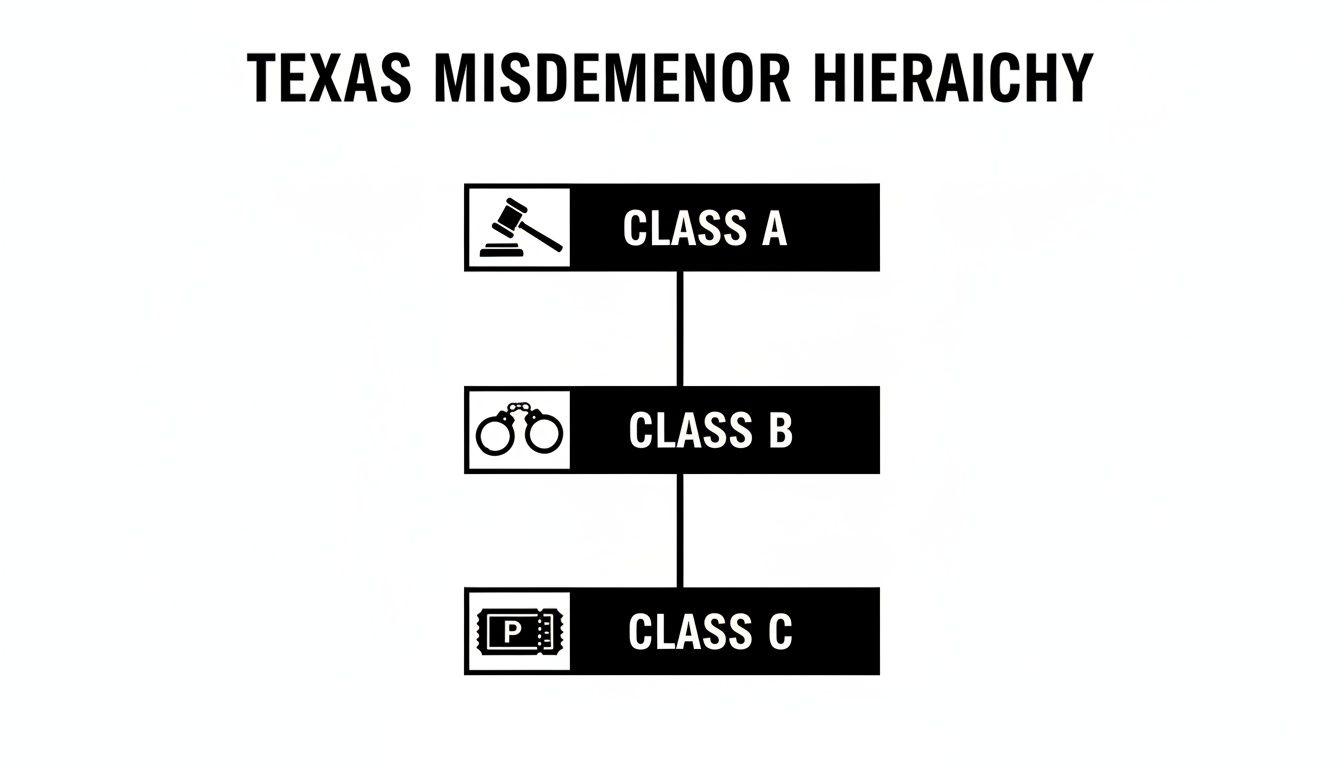
As you can see, Class A offenses are at the top, carrying the heaviest possible penalties you can face without entering the felony system.
Common Examples of Class A Charges
To get a real sense of what this means, it helps to look at some concrete examples. Many parents are shocked to find out what kind of charges fall into this category.
Common Class A misdemeanors include:
- A second DWI offense: While a first-time DWI is usually a Class B, a second charge gets bumped up to a Class A.
- Assault Causing Bodily Injury: This is what happens when someone intentionally or recklessly causes physical pain to another person.
- Burglary of a Vehicle: This isn't just theft; it's breaking into someone's car with the intent to steal or commit another crime.
- Theft of Property: Stealing items with a value between $750 and $2,500.
- Cruelty to Non-Livestock Animals: Certain acts of animal abuse are classified at this serious level.
These are not simple mistakes. Prosecutors and judges take them very seriously, especially when they overlap with family law matters. For example, an assault charge can become a massive problem in a CPS investigation or a custody dispute.
The Real-World Impact on a Family
Let's put this into perspective. Imagine a father going through a messy divorce. An argument over child drop-off gets heated, there's a shoving match, and his ex-spouse calls the police. He's suddenly charged with assault causing bodily injury—a Class A misdemeanor.
His entire world is now at risk. He isn't just worried about jail time or a fine that could drain his savings. He's terrified this charge will be used against him in family court, potentially leading to him losing access to his children. The accusation alone casts a dark cloud over his reputation as a father, long before a verdict is ever reached. This is a common and heartbreaking scenario where one bad moment threatens the most important relationships in a person's life.
Why You Need a Proactive Defense
When you’re facing a charge this serious, you have to be proactive. Waiting around is not an option. Certain circumstances can even "enhance" a Class A charge and elevate it to a felony. For instance, if that assault involved a family member and included impeding breathing (choking), it could quickly become a third-degree felony with the potential for state prison time.
This is why having an experienced attorney in your corner is absolutely essential. Their job is to protect your rights, challenge the prosecution's case, and work to mitigate these life-altering consequences.
For a deeper dive into this topic, you can learn more about Class A misdemeanors in our detailed guide. Protecting your family's future starts with understanding exactly what you're up against and building the strongest possible defense right from the start.
Navigating a Class B Misdemeanor Charge
A Class B misdemeanor sits in the middle of the Texas criminal justice system. While it's a step down from a serious Class A charge, it's far more significant than a simple Class C ticket. A Class B carries penalties that can genuinely disrupt your life and throw your family into chaos, making it a charge you have to take seriously from day one.
Under the Texas Penal Code, a conviction for a Class B misdemeanor can result in up to 180 days in county jail and a fine of up to $2,000. These aren't just numbers on a page; they represent a real threat to your freedom, your job, and your future. For any parent, the thought of being separated from their children for up to six months is a nightmare.
Common Examples of Class B Offenses
Many of the most frequent misdemeanor charges land in this category. You might be surprised at how quickly an ordinary situation can escalate into a Class B offense.
Here are a few common examples:
- First-Time Driving While Intoxicated (DWI): If it's your first DWI arrest and there are no aggravating factors like a car accident or an especially high BAC, it's usually filed as a Class B.
- Criminal Trespass: This is when someone enters or stays on another person's property without their permission.
- Possession of a Small Amount of Marijuana: In Texas, possessing two ounces or less of marijuana is a Class B misdemeanor.
- Harassment: This can cover things like repeated anonymous phone calls or other communications meant to annoy or alarm someone.
- Theft of Property: Stealing items valued between $100 and $750.
These charges often stem from a single bad decision, but the consequences can follow you for years, which is why it’s so important to understand what’s at stake.
The Lasting Impact of a Class B Conviction
Let’s walk through a real-world scenario that plays out all too often. Imagine your college-aged son gets arrested for possessing a small amount of marijuana at an off-campus party. He’s a good kid with a bright future ahead of him, but he made a mistake. If he's convicted, that Class B misdemeanor becomes a permanent part of his criminal record.
Suddenly, his future looks a lot different. That conviction will pop up on background checks for years. It could cost him job opportunities, prevent him from renting an apartment, or even make him ineligible for certain student loans and professional licenses. What felt like a minor mistake at the time has now created major, long-term roadblocks to his success.
The most damaging aspect of a Class B misdemeanor is often not the jail time or the fine, but the permanent criminal record that follows you. It acts as a barrier to opportunity long after the sentence is served.
This is exactly why fighting the charge is so critical. A skilled attorney can explore every option to get the charge dismissed or reduced. They can also work toward a resolution like deferred adjudication, which could prevent a final conviction and open the door to sealing the record down the line. For more details on this specific charge, you can find a comprehensive breakdown by exploring our guide on what a Class B Misdemeanor in Texas entails.
Facing a Class B charge can feel like you’re caught in a current, being pulled toward a bad outcome. But it’s crucial to remember you have rights and options. A strategic legal defense isn't just about staying out of jail; it’s about protecting your—or your child’s—entire future from the lasting shadow of a criminal conviction.
What to Expect from a Class C Misdemeanor
When you see a charge labeled a Class C misdemeanor, it’s easy to breathe a sigh of relief. On paper, they’re the least severe offenses in the Texas legal system. Most people know them as “fine-only” violations because they don’t carry the threat of jail time.
But treating them like a simple traffic ticket can be a serious mistake for your future.
While you won’t face jail, a conviction for a Class C offense can still lead to a fine of up to $500. More importantly, it creates a permanent criminal record that will haunt you on background checks for years, potentially torpedoing everything from job applications to your ability to volunteer at your kid's school.
Common Class C Misdemeanors
These offenses are the most common in the state, and many people will face one at some point in their lives. Class C misdemeanors are the lowest tier of Texas's criminal charges, hit with fines up to $500 and zero jail time. Yet, they still stain your record and pop up in background checks. Over 200,000 are issued annually across the state, dominating 55% of all misdemeanor filings, according to Texas court stats.
These are your everyday slip-ups, often handled with a citation instead of an arrest. But ignoring that piece of paper will lead straight to a warrant. Common examples include:
- Public intoxication
- Disorderly conduct
- Theft under $100
- Minor in Possession of Alcohol: When someone under 21 is found with alcohol.
- Assault by Contact: This involves physical contact that is offensive or provocative but doesn't cause actual bodily injury.
- Possession of Drug Paraphernalia: Having items used for consuming or concealing illegal substances.
You can find more insights about Texas misdemeanor statistics at bartonlawoffice.com.
The Hidden Consequences of "Just Paying the Fine"
Here’s a scenario we see all the time. A college student gets ticketed for public intoxication after a night out with friends. It’s a Class C misdemeanor, and the ticket says he can just pay the $500 fine online and be done with it. It feels like the path of least resistance—the easiest way to make the problem go away.
So, he pays it, figuring the issue is behind him. What he doesn't realize is that by paying that fine, he has legally pleaded "guilty." A few years later, he’s applying for his first professional job after graduation. The company runs a background check, and the public intoxication conviction pops right up. The employer, seeing a criminal record, decides to hire another candidate. That simple ticket just cost him a career.
Paying the fine for a Class C misdemeanor is an admission of guilt. While it may seem like the simplest solution, it results in a final conviction on your permanent record, which can have unexpected and long-lasting negative consequences.
Why Legal Guidance Is Crucial, Even for Minor Charges
This is why having a skilled attorney is vital, even for a "fine-only" offense. The main goal is to prevent a conviction from ever hitting your record in the first place. An experienced lawyer can often negotiate with the prosecutor for outcomes that keep your record clean, such as:
- Deferred Adjudication: Think of this as a form of probation. If you successfully complete all the terms set by the court, the case is dismissed, and you avoid a final conviction.
- Case Dismissal: A sharp attorney will scrutinize the evidence. If there are holes in the state's case or procedural errors, they can argue to have the charge dismissed entirely.
Successfully completing a deferred adjudication program or getting a dismissal is the key that unlocks the best possible outcome: an expunction. This is the legal process of completely erasing the arrest and charge from your record, as if it never even happened. It allows you to legally deny the incident ever occurred. Protecting your future starts with taking every charge seriously, no matter how small it seems.
What Happens After a Misdemeanor Charge? Your Path Forward
Let's be honest: facing a misdemeanor charge is terrifying. It’s overwhelming, confusing, and it feels like your whole world has been turned upside down. But it's critical to remember one thing: an arrest is not a conviction. It's simply the start of a legal journey, and you have more power than you think to shape what comes next.
The single most important first step? Getting an experienced lawyer in your corner to break down your case and start building a strong, strategic defense.

This process is about protecting your future, your family, and your reputation. With the right guidance, you can face this challenge head-on, armed with the knowledge you need to move forward.
Your Immediate Action Plan
Once you are facing a charge—especially if CPS is involved—your actions matter. Here is some practical advice for navigating this difficult time:
- Document Everything: Write down every detail you remember about the incident leading to the charge and any interactions with law enforcement or CPS. No detail is too small.
- Stay Calm with CPS: If a CPS investigator contacts you, remain calm and polite, but do not agree to an interview or allow them into your home without speaking to an attorney first. You have the right to legal counsel.
- Follow Your Attorney’s Advice: Your conversations with your lawyer are confidential. Do not discuss your case on social media or with anyone other than your legal team. This protects your rights and strengthens your defense.
- Understand Your Service Plan: If CPS creates a service plan, review it carefully with your attorney. Completing these services is critical for reunification and showing the court you are a dedicated parent.
Taking these initial steps gives your legal team the foundation they need to build the strongest possible defense for you and your family. As you manage your legal affairs, you might also need to handle sensitive documents, making it important to learn about proper secure document redaction.
Clearing Your Name for Good
One of the most damaging long-term consequences of any criminal charge is the public record it creates. Even if your case gets dismissed, the arrest itself can pop up on background checks for years, causing problems with jobs, housing, and more.
Fortunately, Texas law provides powerful tools to help you move forward with a truly clean slate.
An arrest record can create obstacles long after a case is closed. Securing an expunction or nondisclosure is not just about clearing your name—it's about reclaiming your future opportunities without the shadow of a past mistake.
The two main legal tools for this are:
- Expunction: This is the gold standard. An expunction legally destroys the records of your arrest, essentially erasing it as if it never happened. You're typically eligible for an expunction if your case was dismissed, you were found not guilty at trial, or you successfully finished a deferred disposition program for a Class C offense.
- Order of Nondisclosure: If an expunction isn't an option but you successfully completed deferred adjudication for a Class A or B misdemeanor, you might qualify for an order of nondisclosure. This legal order seals your record from the public, which means it won't show up on most background checks.
Navigating this process can be complicated, but the result is nothing short of life-changing. You can learn more about how to expunge a misdemeanor in Texas in our detailed guide.
Don't let a misdemeanor charge define your family's future. The Law Office of Bryan Fagan is here to provide the compassionate and authoritative legal guidance you need. Contact us today for a free consultation to discuss your case and learn how we can help you fight for the best possible outcome.
Frequently Asked Questions About Texas Misdemeanors
When you or someone you love is staring down a misdemeanor charge, the questions can feel like a flood, and the uncertainty is often the hardest part. Let’s cut through the noise and get you some clear, straightforward answers to the questions we hear most often from families in your exact situation.
Can a Misdemeanor Charge Be Dropped in Texas?
Absolutely. Getting a charge dropped is often the best-case scenario, and it happens more than you might think. A prosecutor might dismiss a case if they realize the evidence against you is weak, if your constitutional rights were violated during the arrest, or if a key witness suddenly becomes unavailable.
This isn't something that just happens on its own, though. An experienced defense attorney is crucial here. They will dig into every detail of the police report, witness statements, and procedures to find the cracks in the prosecution's case and negotiate directly for a dismissal.
How Long Does a Misdemeanor Stay on Your Record?
This is a big one, and the answer often surprises people: a misdemeanor conviction stays on your criminal record permanently unless you take legal action to remove it. There’s a common myth that charges just "fall off" after a certain number of years, but in Texas, that’s simply not true.
That conviction will pop up on background checks for jobs, housing applications, and professional licenses for the rest of your life. The good news is that Texas law provides tools like expunctions and orders of nondisclosure, which can either completely erase or seal the record from public view, giving you a clean slate.
Do I Need a Lawyer for a Class C Misdemeanor?
While you're not legally required to hire an attorney for a Class C charge, it is almost always a smart move. Too many people make the mistake of just paying the fine to make it go away, not realizing that doing so is the same as pleading guilty. It results in a permanent conviction on their record.
An attorney can often work with the prosecutor to get the charge dismissed entirely or arrange for something called deferred disposition. If you successfully complete the terms of deferred disposition (usually staying out of trouble for a set period), the case is dismissed, it never becomes a conviction, and you can later have the record expunged.
Think of it this way: treating a Class C misdemeanor like a simple parking ticket is a huge mistake. A conviction, even one that comes with no jail time, can throw up roadblocks to your future. Getting legal guidance is a small investment to protect your entire record.
Can I Go to Jail for a First-Time Misdemeanor Offense?
Yes, it's possible to face jail time even if it's your first offense, depending on the severity of the charge.
- Class C Misdemeanor: No jail time is possible.
- Class B Misdemeanor: You could face up to 180 days in the county jail.
- Class A Misdemeanor: The maximum sentence is up to one year in the county jail.
While first-time offenders are often good candidates for alternatives like probation or deferred adjudication, the threat of jail is very real, particularly for Class A and B charges. This is exactly why having a powerful legal defense from the get-go is so critical.
Facing a misdemeanor charge is a serious matter, with consequences that can ripple through every aspect of your family’s life, especially when CPS is involved. You do not have to navigate this challenging time alone. At The Law Office of Bryan Fagan, PLLC, we understand the fear and uncertainty you are feeling. Our commitment is to provide warm, authoritative guidance, defend your rights, and fight to protect your family.
We are here to listen to your story and help you find the best path forward. Contact The Law Office of Bryan Fagan, PLLC for a Free Consultation today to discuss your case in confidence and learn how we can help you and your children.