Skip to content
When the blue and red lights flash in your rearview mirror and a routine drive home ends in handcuffs, your world can feel like it's been turned upside down. The initial moments after a DUI arrest are a chaotic mix of confusion, fear, and flashing lights. You're taken into custody, your car gets towed, and a legal clock starts ticking that could impact not just your driver's license, but your family's future. The dread can be paralyzing, especially for a parent whose first thoughts are about their children and what this means for them.
But here’s the most important thing to remember: An arrest is not a conviction. Figuring out what comes next is the first step you can take to regain control and protect what matters most.
The Shock of an Arrest: What Happens Right Away

The second those handcuffs click, it feels like the floor has dropped out from under you. One minute you're a parent on your way home from a dinner with friends; the next, you're sitting in the back of a squad car, your mind racing with worries about your job, your kids, and what this means for your future. That feeling of powerlessness is completely normal, and the fear is real.
At The Law Office of Bryan Fagan, we’ve walked countless Texas families through this exact situation. We understand that the questions flooding your mind aren't just legal—they're deeply personal. What's going to happen to my car? When can I call my spouse? Could this impact my custody agreement? The uncertainty is suffocating, but you don't have to face it alone.
Your First Concerns and Critical First Moves
The initial shock can leave you frozen, but the choices you make in the first few hours and days are absolutely critical. The Texas legal system doesn't wait. There are deadlines that start immediately, especially the one that could save your driver's license.
Here's a quick rundown of what you need to focus on right now:
- Your Right to Remain Silent: This is non-negotiable. You have the right to remain silent, and you should use it. Politely refuse to answer questions about where you were, what you had to drink, or any other details until you've spoken to an attorney.
- The Two-Front Battle: A DWI arrest in Texas means you're fighting two separate cases at the same time. The first is the criminal case, which will decide things like guilt, fines, or jail time. The second is an administrative case with the Department of Public Safety (DPS), which will determine whether or not you get to keep your license.
- The 15-Day Deadline: That clock I mentioned? It starts the second you're arrested. You have only 15 days to request a special hearing (called an ALR hearing) to challenge the automatic suspension of your license. If you miss that window, your license will be suspended. No exceptions.
An arrest is just the start of a legal journey, not the end of your story. The choices you make from this point forward, guided by calm and experienced counsel, will shape everything that comes next.
Think about Sarah, a single mom pulled over after having two glasses of wine at a work dinner. Scared and confused, she answered every question the officer asked, thinking her cooperation would get her out of trouble. Instead, everything she said was used against her in court. It’s a common mistake, but it proves that knowing your rights from the very beginning is your best defense.
This guide will break down exactly what happens after a DUI arrest into clear, manageable steps. From the booking process to the courtroom, you’ll learn what to expect, what your rights are, and the crucial first steps you must take to protect your family and your future.
From Roadside to Jail Cell: The Booking and Arraignment Process
After the flashing lights fade and the roadside stop ends, the next part of your DWI arrest unfolds at the police station. This is the booking process, a cold, formal procedure that can make anyone feel intimidated and alone. It’s a jarring experience, but knowing what’s happening can help dial down the anxiety and fear.
During booking, officers will take down your personal information, run your fingerprints, and snap that infamous photograph—the mugshot. They'll also inventory your personal belongings and store them until you're released. This is not the time to tell your side of the story or try to explain what happened. Remember, your right to remain silent is still your best defense.
The whole point of booking is to officially log your arrest into the legal system. Think of it as the administrative starting line for everything that comes next. Once it's done, you'll likely be held in a local jail cell until it's your turn to see a judge for the first time.
The First Court Appearance: Your Arraignment
Your first time standing in front of a judge after an arrest is called the arraignment. It's a quick but incredibly important hearing where a few key things happen. The judge will formally read the DWI charge against you, making sure you understand exactly what the state is accusing you of doing. Then, you'll be asked to enter a plea.
This is a critical moment. You have three options:
- Guilty: An admission to the crime as charged.
- No Contest (Nolo Contendere): You aren't admitting guilt, but you're accepting the punishment as if you were.
- Not Guilty: A denial of the charges, which forces the prosecutor to prove their case against you.
It is almost always in your best interest to plead 'not guilty' at the arraignment. Pleading guilty or no contest this early on slams the door on your case. You give up your right to challenge the evidence, negotiate a better outcome, or fight the charges in court.
Pleading not guilty keeps every single one of your legal options on the table. It gives your attorney the breathing room they need to dig into the police reports, review any video footage, and scrutinize the results of chemical tests. A 'not guilty' plea isn't a lie; it's a procedural move essential to building your defense. If you want to dive deeper into the complexities of chemical tests, you can read our guide on refusing a breathalyzer test.
Understanding Bail and Getting Released
At the arraignment, the judge will also decide on the terms of your release from jail, which usually involves setting bail. Bail isn't a punishment or a fine. It's simply a financial guarantee to the court that you'll show up for all your future court dates. To set the amount, the judge looks at things like your ties to the community, your criminal history, and the specific details of the DWI charge.
There are a few different ways to post bail and get out of jail:
- Cash Bond: This means you pay the full bail amount directly to the court. As long as you make all your court appearances, you get this money back at the end of the case, minus some small administrative fees.
- Surety Bond: This is the go-to method for most people. You hire a bail bondsman and pay them a non-refundable fee, which is typically 10-15% of the total bail. The bondsman then puts up the full amount for you, guaranteeing you'll be in court.
- Personal Recognizance (PR) Bond: In some situations, especially for first-time misdemeanors where the person isn't seen as a flight risk, a judge might grant a "PR bond." This means you're released on your written promise to appear in court—no money is needed upfront.
Getting through the arraignment and bail process is your first real chance to start regaining some control. It marks the shift from the shock of being arrested to the beginning of your formal legal fight.
The 15-Day Countdown to Save Your Driver's License
While the criminal charge of a DWI is a massive concern, a second, more urgent battle begins the moment you're arrested—and it has nothing to do with a courtroom. This is the fight for your driver's license, and it moves at lightning speed. The clock is ticking, and you have only 15 days to act.
This immediate threat to your driving privileges comes from a Texas law called "Implied Consent." By simply getting behind the wheel on a Texas road, you have legally agreed to give a breath or blood sample if an officer has probable cause to suspect you of driving while intoxicated. If you refuse that test or fail it (by having a Blood Alcohol Concentration of 0.08% or higher), it triggers an automatic process to suspend your license.
The Two-Front War of a DWI Case
You have to understand that a DWI arrest immediately splits your legal troubles into two completely separate cases that run on parallel tracks.
- The Criminal Case: This is the one everyone thinks of, handled in criminal court. It’s where guilt or innocence is decided and involves prosecutors, potential fines, and even jail time. This process can drag on for months or sometimes more than a year.
- The Administrative Case: This is a civil case handled by the Texas Department of Public Safety (DPS). Its only purpose is to decide whether your driver's license should be suspended. This process is incredibly fast and operates completely independently of your criminal charge.
You can win your criminal DWI case and still lose your license in the administrative case. On the flip side, you can be found guilty in your criminal case but successfully save your license. They are entirely separate proceedings with different rules, different goals, and different standards of proof.
Understanding the ALR Hearing
The only way to stop the automatic suspension of your license is to formally request an Administrative License Revocation (ALR) hearing. You absolutely must submit this request within 15 calendar days of your arrest. If you miss this deadline, your license will be suspended automatically on the 40th day after your arrest, and there is no way to appeal it.
The ALR hearing isn't a criminal trial. It’s a small, administrative proceeding where a lawyer from the DPS tries to prove that the arresting officer had a valid reason to pull you over and arrest you, and that you either refused the chemical test or failed it.
But this hearing offers a massive strategic advantage. It's the first—and often the only—chance your attorney gets to question the arresting officer under oath before your criminal trial. It’s a golden opportunity to lock them into their story, poke holes in the prosecution's case, and gather critical evidence that can be used to build a powerful defense against the criminal charges. Winning the ALR hearing doesn't just save your license; it can seriously weaken the prosecutor's criminal case against you.
To help you visualize this, we've created a table comparing the timelines for both the administrative and criminal sides of a DWI case.
Texas DWI Administrative vs. Criminal Case Timeline
This table highlights the parallel timelines and critical deadlines for both the Administrative License Revocation (ALR) hearing and the criminal court proceedings after a DWI arrest. Notice how quickly the administrative side moves compared to the criminal case.
| Milestone | Administrative Case (DPS) | Criminal Case (Court) |
|---|---|---|
| Arrest | Day 0: The clock starts. | Day 0: The criminal process begins. |
| Crucial Deadline | Within 15 days: Must request an ALR hearing. | Weeks to months: First court appearance (arraignment). |
| First Hearing | Within 40 days (approx.): ALR hearing occurs (if requested). | Weeks to months after arrest. |
| Potential Outcome | License suspended or saved. | Plea bargain offered or trial date set. |
| Resolution Time | Typically resolved within a few months. | Can take months to over a year to resolve. |
As you can see, the fight for your license is an immediate crisis that can't wait. The criminal proceedings will unfold over a much longer period, but the 15-day ALR deadline is non-negotiable.
This timeline chart further illustrates the immediate legal steps you'll face, showing how the booking process runs alongside the urgent need to address your license.
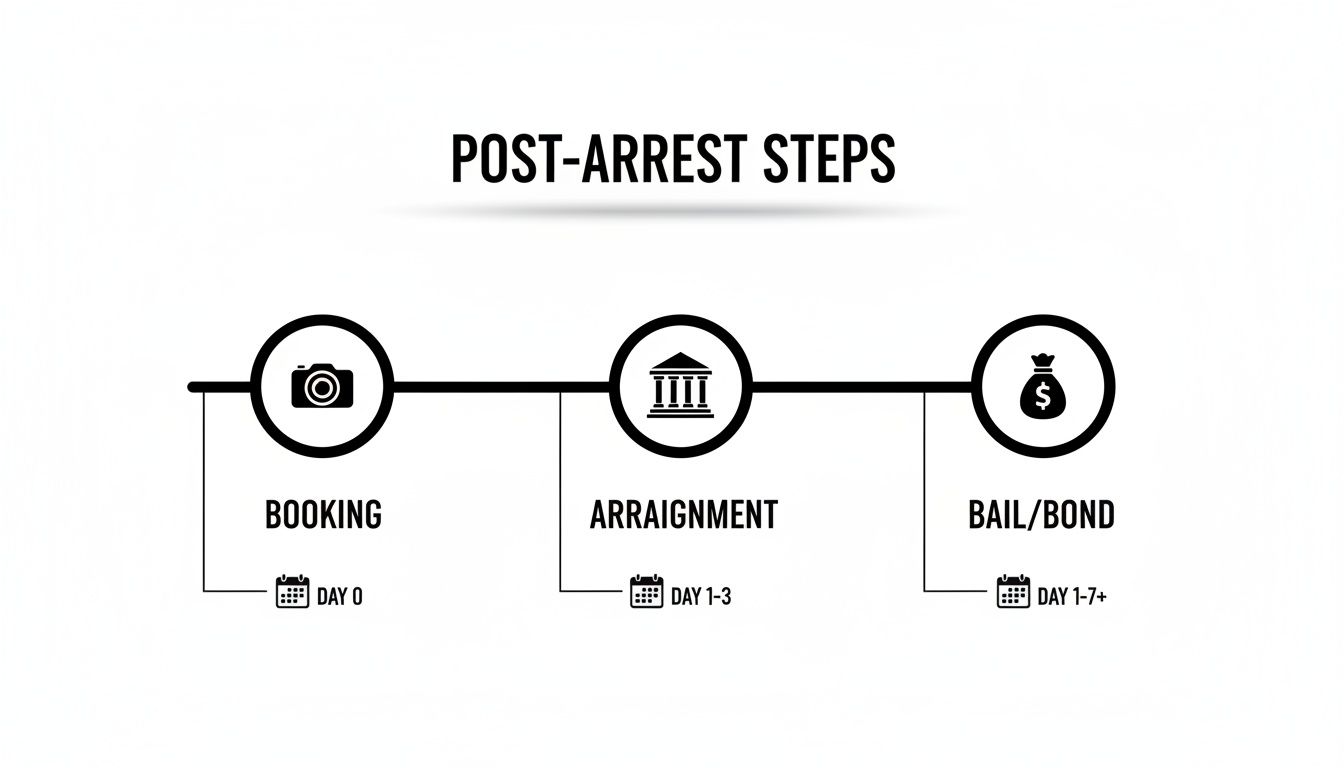
The visualization drives home the point: while the criminal justice system slowly moves through booking and arraignment, the administrative clock on your license suspension starts ticking the second you're arrested.
Imagine a father, Mark, who was arrested for DWI after a company party. He was so focused on the criminal charge and getting out on bail that he didn't realize the 15-day ALR deadline was bearing down on him. By the time he hired an attorney on day 16, it was too late. His license was suspended, making it incredibly difficult to get his kids to school and himself to work.
If your license is suspended, you may still have options. You can learn more about how to get an occupational license in Texas in our detailed guide, which explains how to legally drive for essential needs. Taking swift action is the absolute key to protecting your ability to drive and mounting the strongest possible defense.
Navigating the Criminal Court Process
Once the dust settles from the booking and arraignment, and you’ve dealt with the urgent 15-day deadline to save your license, the main event begins: the criminal court case. This is where the State of Texas, represented by a prosecutor, will try to prove beyond a reasonable doubt that you were driving while intoxicated.
Think of it like this: the prosecutor’s entire case is a structure they have to build. The bricks and mortar are the pieces of evidence they gather—things like the arresting officer’s sworn report, the results of any breath or blood tests, and any dashcam or bodycam footage. The strength, or weakness, of that structure will determine which path your case takes next.
Two Roads Forward: Plea Bargain or Trial
At this point, your case is essentially at a fork in the road. It can go down one of two paths.
The first, and by far the most common, is a plea bargain. This is a negotiated deal between your defense attorney and the prosecutor. In exchange for you pleading guilty or "no contest," the prosecutor agrees to recommend a specific, often reduced, punishment.
The second path is a trial. This is the classic courtroom showdown you see on TV, where your case is put before a judge or a jury who will decide your guilt or innocence. Here, your attorney gets to go on the offensive—directly challenging the state’s evidence, cross-examining their witnesses (especially the arresting officer), and laying out your side of the story.
Choosing between a plea deal and a trial is one of the biggest decisions you’ll make. It’s a choice that should only be made after a deep, strategic analysis of your case with an experienced attorney.
Weighing the Pros and Cons of a Plea Deal
For a lot of folks, the phrase "plea bargain" sounds a lot like giving up. But in the right hands, it can be a savvy strategic move that leads to a much more predictable and manageable outcome. A good lawyer doesn’t just take the first offer thrown on the table; they negotiate from a position of strength, methodically pointing out every crack and flaw in the prosecutor's evidence to get you the best deal possible.
What can a well-negotiated plea deal actually get you?
- Reduced Charges: In some cases, a skilled attorney can get a DWI charge knocked down to a lesser offense, like Obstruction of a Highway. This often carries lighter penalties and doesn't have the same stigma attached.
- Lighter Sentences: A good plea agreement might mean avoiding jail time altogether in favor of probation, community service, or required educational classes.
- Certainty: A trial is always a gamble. You never know what a jury will decide. A plea deal locks in a definite outcome, which can bring a huge amount of relief to you and your family during a stressful time.
Of course, there's a trade-off. Accepting a plea means you’re giving up your right to a trial and will have a conviction on your record (unless the deal is for something like deferred adjudication). It's a serious decision that needs careful thought.
The consequences of a DUI arrest extend far beyond the immediate legal proceedings. Statistics show that approximately one million individuals are arrested annually in the United States on drunk driving charges. Individuals typically face criminal charges, license suspension, mandatory court appearances, and potential jail time. In Texas specifically, driver's license suspension periods can range from 90 days to two years for first-time offenders alone. Discover more insights about these drunk driving statistics on BetterLifeRecovery.com.
What Happens When You Go to Trial
If a fair plea agreement just isn't on the table, or if the evidence against you is full of holes, then heading to trial might be your strongest move. A DWI trial is a formal, structured process with several distinct phases: jury selection, opening statements, the presentation of evidence, closing arguments, and finally, the jury's verdict.
This is where your attorney’s skill really gets put to the test. They will scrutinize every single detail. Did the officer have a legal reason to pull you over in the first place? Was the breathalyzer machine calibrated correctly? Was the blood sample handled properly?
An experienced DWI lawyer knows that the state's case often isn't as airtight as it first appears. Every piece of evidence is a chance to create that crucial "reasonable doubt." A trial is the ultimate way to force the state to meet its high burden of proof, and your future could depend on that meticulous, determined approach.
Understanding the Penalties and Long-Term Consequences
When a DWI case in Texas ends in a conviction, the sentence handed down by the judge is really just the opening chapter. A conviction isn’t a single event you put behind you; it’s the start of a ripple effect that can touch every corner of your life for years. It's so important to look past the courtroom drama and grasp the full scope of what this means for you and your family.
Most people fixate on the immediate legal penalties, and for good reason. These are the direct punishments from the court, and they get harsher depending on whether this is your first, second, or third offense. The consequences escalate quickly, turning what might feel like a single mistake into a cascade of life-altering challenges.
For so many Texas families, the fear of these penalties is completely overwhelming. The possibility of jail time means being separated from your kids. Heavy fines can shatter an already tight family budget. These aren't just abstract legal terms; they are real-world problems that demand a powerful, strategic defense.
The Direct Penalties of a DWI Conviction
The Texas Penal Code provides a clear framework for DWI punishments. While a judge does have some leeway, the law sets firm minimums and maximums you can expect to face. Knowing these potential outcomes is the first step in preparing for the road ahead.
- First DWI Offense: This is a Class B Misdemeanor. You're looking at fines up to $2,000, jail time anywhere from 72 hours to 180 days, and a driver's license suspension for up to a full year.
- Second DWI Offense: The charge gets bumped up to a Class A Misdemeanor. The potential fine doubles to $4,000, and the jail sentence can range from 30 days to one year.
- Third (or More) DWI Offense: A third DWI is a third-degree felony in Texas. This is a huge jump, carrying a potential prison sentence of two to 10 years and a fine that can reach $10,000.
On top of these core penalties, the court will almost certainly order you to complete probation, attend mandatory DWI education classes, and perform community service. Each of these adds another layer of complication to your life, demanding your time, money, and focus.
The fallout from a DWI arrest often spreads far beyond the courthouse steps, impacting your personal and professional life in ways you might not expect. The court will likely mandate DWI education programs, substance abuse counseling, and the installation of an Ignition Interlock Device (IID) on your car—a device that can run you $1,000 to $2,000 a year. The financial pain doesn't stop there; your car insurance premiums will likely shoot up by 50-100%, if your provider doesn't just cancel your policy outright. Without legal action to seal or expunge the record, that conviction remains public indefinitely.
The Hidden "Collateral" Consequences
The penalties ordered by the court are just one piece of the puzzle. The so-called "collateral consequences" are the unofficial, often shocking, ways a DWI conviction bleeds into your everyday life. These are the penalties that aren't spelled out in the law books but can be just as devastating.
Think about someone like Maria, a registered nurse and mother of two who got a first-time DWI. She managed to avoid jail, but the State Board of Nursing opened its own investigation. Suddenly, she was on a probationary license and forced to undergo random drug and alcohol testing, putting her entire career—and her family's financial stability—on thin ice.
Maria's story is a perfect example of common collateral consequences:
- Employment Issues: Many jobs, especially those that require driving or a professional license (like nursing, teaching, or commercial driving), are suddenly at risk.
- Professional Licenses: State licensing boards have the power to suspend or even revoke your professional license after a criminal conviction.
- Child Custody Disputes: In a custody battle, a DWI can be used as leverage to argue that you're an unsafe parent, potentially changing your custody or visitation rights for the worse.
- Educational Opportunities: Some universities and scholarship programs may deny admission or funding to applicants with a criminal record.
Taking proactive steps to address the root causes of a DWI, such as seeking professional substance abuse treatment, can be a crucial step. It not only helps you manage long-term consequences but also shows the court and your family that you're committed to making a positive change. You can also dive deeper into what you might be up against by exploring our detailed guide to the Texas penalties for DWI.
A DWI conviction is a serious matter, and its consequences can follow you for a lifetime. But it doesn't have to be a life sentence. Understanding the full picture of what lies ahead is the first step toward making informed decisions and fighting for the best possible future.
How a Dedicated DWI Attorney Can Protect Your Future

Trying to face the Texas justice system alone after a DWI arrest is like trying to navigate a storm without a compass. The legal system is a maze, the stakes couldn't be higher, and make no mistake—the prosecutor is not on your side. Hiring a dedicated DWI defense attorney is the single most important decision you can make to protect your family, your freedom, and your future.
A good attorney doesn't just passively show up to court; they immediately go on the offensive to defend your rights. Their work starts the second you call, beginning with the most urgent deadline of all: filing the ALR hearing request within 15 days to save your driver’s license. This move alone can stop an automatic suspension and give us a critical first look at the state's evidence.
Building a Powerful and Strategic Defense
Your attorney’s main job is to take the prosecutor's case apart, piece by piece. They are your shield and your advocate, meticulously digging into every detail for procedural mistakes, shaky evidence, or violations of your constitutional rights. This isn't about searching for some obscure loophole; it’s about holding the police and the prosecution to the high standard of proof the law demands.
An experienced lawyer gets to work immediately. They will:
- Analyze Police Reports: They’ll scrutinize the officer's report for any weaknesses, like an illegal traffic stop made without reasonable suspicion or field sobriety tests that weren't administered correctly.
- Challenge Chemical Tests: Breath and blood tests are far from perfect. A skilled attorney knows exactly how to challenge their validity, questioning everything from the machine's calibration records to the chain of custody for a blood sample.
- Negotiate from a Position of Strength: Armed with a thorough analysis of the evidence, your lawyer can negotiate with the prosecutor from a place of power. The goal? To get the charges reduced—maybe to something other than a DWI—or thrown out completely.
- Prepare a Compelling Trial Defense: If a fair plea agreement isn't on the table, they will build a powerful defense for trial, ready to cross-examine the arresting officer and tell your side of the story to a judge or jury.
A DWI arrest can make you feel like your story has already been written. An attorney’s job is to remind the court that you are a person, not a police report, and that an arrest is not the same as a conviction.
We get it. Good people, loving parents, find themselves in tough situations. The fear of what a DWI charge could do to your job, your reputation, and your kids is immense. But an arrest is just the beginning of the legal process, not the end of your story. Having the right advocate in your corner makes all the difference in the world.
Frequently Asked Questions About the Texas DWI Process
Getting arrested for a DWI in Texas kicks up a whirlwind of questions and anxiety. It’s completely normal to feel overwhelmed. Here are some straightforward answers to the questions we hear most often from good people caught in a tough spot.
Should I Refuse the Breathalyzer Test in Texas?
This is the million-dollar question, and there's no easy answer. On one hand, if you refuse the breath or blood test, Texas's "implied consent" law kicks in, and the Texas Department of Public Safety will automatically suspend your driver's license. The prosecutor can also tell the jury that your refusal shows you knew you were guilty.
On the other hand, giving a sample hands the prosecutor the exact evidence they need to build their case against you. It's a classic catch-22. The right move depends entirely on the unique details of your situation, which is why it's critical to talk this over with an experienced DWI attorney right away.
Will I Definitely Go to Jail for a First-Time DWI?
Not necessarily. While a first-time DWI is a Class B misdemeanor that carries the potential for jail time, it’s far from a guarantee. An experienced lawyer can often negotiate for alternatives, especially if there weren't any aggravating factors like a car accident or an extremely high BAC.
Often, we can work towards outcomes like probation, mandatory DWI education classes, and community service instead of jail. The goal is to show the court this was a one-time mistake, not a pattern of behavior.
Can a DWI Charge Be Removed from My Record?
Yes, in some cases, it's possible to clear a DWI from your record, which is a huge relief for your future. If your case gets dismissed or you're found not guilty at trial, you may be eligible for an expunction. This process essentially destroys the public records of the arrest, as if it never happened.
Another path is an order of nondisclosure, which seals the record from the public if you successfully complete a deferred adjudication probation. On a related note, people often have questions about what's allowed behind the wheel, like: Can You Drink Non-Alcoholic Beer While Driving? Navigating the nuances of the law is key. An attorney can review your case and tell you exactly what options you have for clearing your name.
The legal maze after a DWI arrest is complicated and stressful, especially when your family's well-being is on the line. But you don't have to walk it by yourself. The dedicated attorneys at the Law Office of Bryan Fagan, PLLC are here to protect your rights, your license, and your future. We understand what you are going through, and we are ready to fight for you. Contact us today for a free, confidential consultation to go over the details of your case and create a plan to move forward.