Skip to content
When you get that dreaded call from Child Protective Services (CPS) or law enforcement, your world can feel like it's spinning out of control. Suddenly, you're thrown into a confusing legal system filled with unfamiliar terms and terrifying accusations. A Class B misdemeanor might sound minor, but in Texas, it's a serious charge that can have devastating consequences for your family, especially if it's connected to a CPS investigation.
Understanding what you're up against is the first step toward taking back control and protecting your family's future.
What a Class B Misdemeanor Means for Your Family
In the Texas justice system, crimes are organized by severity. At the bottom are Class C misdemeanors—mostly fine-only offenses. At the top are serious felonies. A Class B misdemeanor sits on a crucial middle rung. It's a significant charge, but it's not the end of the road.

This isn't just about a simple fine. For a parent facing CPS scrutiny, a criminal charge can become a powerful weapon used against you. A conviction can send ripples through every part of your family's life, from your finances to your parental rights. The stakes are real, and they deserve to be taken seriously from day one.
Understanding the Penalties and Stakes
The Texas Penal Code is crystal clear about the potential consequences of a Class B misdemeanor. The law sets the maximum punishment at up to 180 days in county jail and a fine of up to $2,000. You can discover more insights about Texas criminal charge classifications and what they mean for defendants.
These aren't just abstract numbers; they represent real-world impacts on your family:
- Time Away From Loved Ones: Six months in jail means missing birthdays, school events, and the everyday moments that you can't get back. It almost certainly means losing a job and the income your family relies on. In a CPS case, it can be used as evidence that you cannot provide a stable home for your children.
- Serious Financial Strain: That $2,000 fine is just the beginning. Court costs, probation fees, and legal expenses can quickly add up, putting immense pressure on your household budget.
- A Lasting Criminal Record: A conviction doesn't just disappear. It becomes a public record that can haunt you for years, making it harder to find a good job, rent an apartment, or even volunteer at your child's school. It can also be a major obstacle in a child custody case.
The most frightening part of a criminal charge is often the unknown, especially when your children's future is on the line. By understanding the potential outcomes, you empower yourself to make informed decisions and build the strongest possible defense for your family's future.
To get a clearer picture, it helps to see how a Class B charge stacks up against other misdemeanor offenses in Texas.
Texas Misdemeanor Classes at a Glance
The legal system sets clear boundaries for punishment based on the classification of the crime. This table breaks down the maximum penalties for each level.
| Misdemeanor Class | Maximum Jail Time | Maximum Fine |
|---|---|---|
| Class A | Up to 1 year | Up to $4,000 |
| Class B | Up to 180 days | Up to $2,000 |
| Class C | None (fine-only) | Up to $500 |
As you can see, a Class B offense is a serious matter with penalties that can absolutely disrupt your life. For a parent, this distinction is critical because it often opens the door for negotiations and alternative sentencing aimed at minimizing the impact on your life, livelihood, and your relationship with your children.
Where Class B Charges Come From in the Real World
It's a huge myth that criminal charges are only for "criminals." The reality is, most Class B misdemeanors arise from ordinary life situations. A single bad judgment call, a misunderstanding, or a moment of carelessness can suddenly become a legal nightmare, especially when it catches the attention of CPS.
When you see how these charges happen, the law stops being an abstract concept and becomes a real-world problem that good, hardworking parents can face. Let’s look at some common ways families find themselves facing a Class B misdemeanor charge in Texas.
A Night Out Ends With a DWI Arrest
Imagine this: you and your spouse finally get a night out. You go to dinner, have a couple of glasses of wine over a few hours, and feel perfectly fine to drive. But on the way home, you see flashing lights for a minor traffic violation. The officer smells the wine and starts a DWI investigation. Your rare night out has turned into an arrest for a first-time DWI—a classic Class B misdemeanor.
Now, picture CPS getting an anonymous report about that arrest. Suddenly, they are at your door asking questions about "endangering a child," even if the kids weren't in the car. They might claim your arrest shows a substance abuse problem that makes you an unfit parent. One incident can put your driver's license, your job, and your very family structure on the line. Under the Texas Family Code, a finding of endangerment can be grounds for removal, turning a simple mistake into a fight for your children.
Finding a Small Amount of Marijuana
Another common scenario involves possessing a small amount of marijuana. In Texas, having less than two ounces is a Class B Misdemeanor that can land you in jail.
Consider a parent who uses marijuana for medical reasons, even if it's not legally prescribed in Texas. A messy breakup leads to a spiteful ex calling CPS and reporting drug use in the home. The caseworker arrives, and a search reveals a small amount of marijuana. Now, you’re not just facing a criminal charge; you're also facing allegations of neglect under Texas Family Code Chapter 262, which could lead to your children being removed from your care. A conviction can haunt you for years, creating roadblocks for everything from student loans to job opportunities, and it can be used against you in family court indefinitely.
A single mistake shouldn't define the rest of your life or your ability to be a parent. The first step toward defending yourself is understanding the specific facts of your case and building a strategy to protect your family and your reputation.
Other Common Class B Offenses
Beyond DWI and marijuana possession, several other situations can lead to a Class B misdemeanor, often intertwining with family law and CPS cases.
- Criminal Trespass: This could be as simple as refusing to leave a former partner's home after an argument. If the police are called, what was a family dispute can become a criminal charge.
- Theft (Shoplifting): Taking property valued between $100 and $750. For a family struggling financially, a desperate choice can lead to a charge that CPS might use to argue you cannot provide a stable environment for your children.
- Harassment: This charge often stems from ugly breakups or custody battles. Repeated, unwanted texts or phone calls, even those sent in anger or frustration, can cross a legal boundary and be used to seek a protective order against you.
These examples make it clear how easily a regular person can get caught up in the system. Being charged doesn't say anything about your character or your love for your children. With the right legal guidance, you can face this situation head-on.
Navigating the Court System Step by Step
Getting that call—the one saying CPS is investigating or a loved one is in jail—is a terrifying, heart-stopping moment. The path forward feels like an impossible maze. But knowing the map is the first step toward finding your way out.
The legal journey, from arrest to a final outcome, follows a specific path. Understanding each stage can help cut through the anxiety and empower you to make the right decisions for your family.
The Initial Steps: Arrest and Booking
It all starts with the arrest. The person is taken to a local jail for the booking process, where an officer records personal info, takes fingerprints and a mugshot. While procedural, it's a jarring and dehumanizing experience.
Soon after, a magistrate judge reviews the case to ensure there was probable cause for the arrest. This is also when bail is set. Bail is a financial promise to appear for future court dates. For many families, posting bond is the first major hurdle to getting their loved one back home, allowing them to participate in their defense and deal with any pending CPS matters.
The First Court Appearance: Arraignment
Once released on bond, the next critical stop is the arraignment. This is the first formal court appearance. The judge reads the official charges, and the accused person enters a plea—usually "guilty," "not guilty," or "no contest."
Pleading "not guilty" is almost always the right move at this stage. It protects all your legal rights and gives your attorney the time needed to investigate the evidence and prepare a defense. This is especially vital in a CPS case, as a guilty plea can be used against you immediately in family court. You can learn more about what happens at an arraignment hearing in our guide.
This visual breaks down a few of the most common situations that can escalate into a Class B misdemeanor charge.
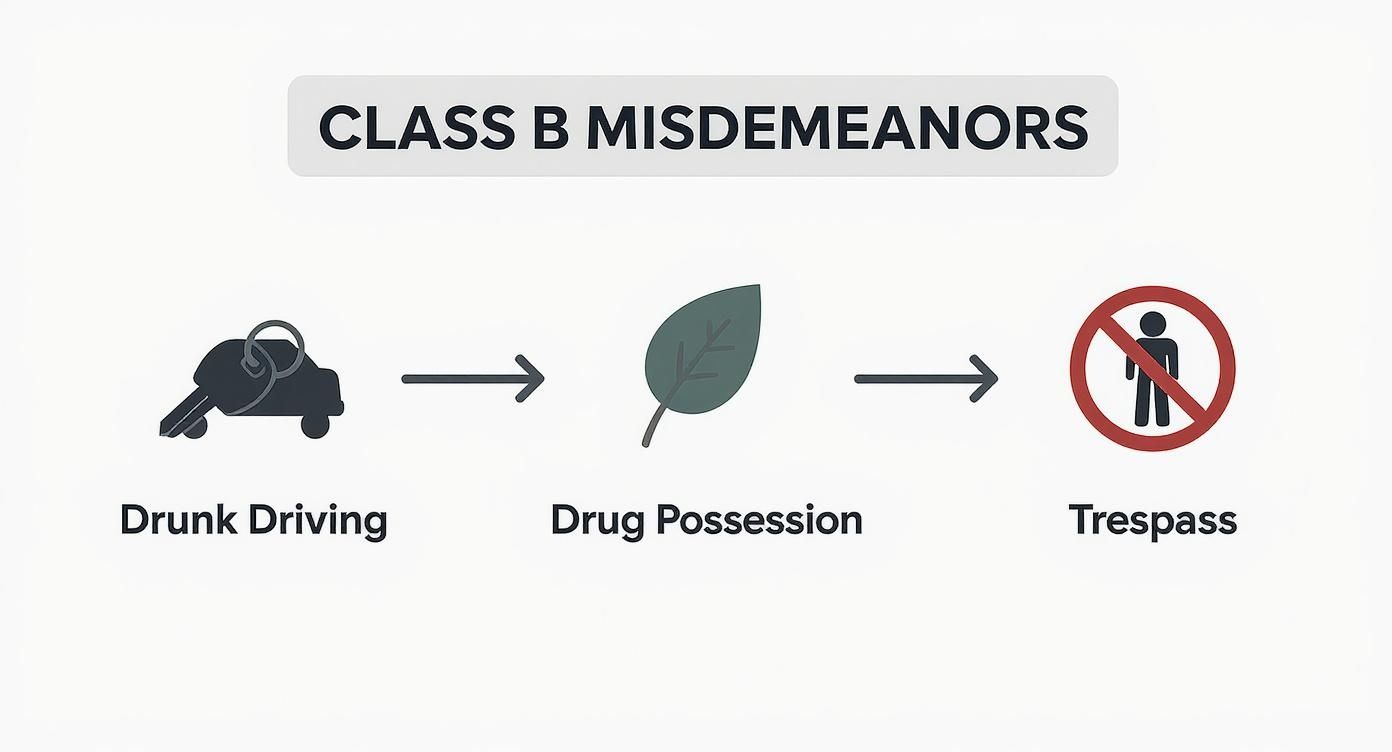
It’s surprisingly easy for an everyday scenario—like having a drink with dinner or being in the wrong place at the wrong time—to turn into a serious criminal charge with family law implications.
Pre-Trial and Resolution
After the arraignment, the case moves into the pre-trial phase. Your attorney will demand and review every piece of evidence the prosecutor has, a process known as discovery. This includes police reports, witness statements, and body cam footage.
This is also when negotiations happen. Some of the possibilities include:
- Case Dismissal: If the evidence is weak or was obtained illegally, your lawyer can push to have the charges thrown out.
- Plea Bargaining: The prosecutor might offer a deal to a lesser charge or recommend a lighter sentence, like probation instead of jail.
- Pre-Trial Diversion: A great option for some first-time offenders. You complete certain tasks (like classes or community service), and afterward, the charges get dismissed. This is often a key goal when a CPS case is also active.
If no agreement can be reached, the case is set for trial. A conviction can lead to sentencing, where the judge hands down the punishment. Having an open line of communication with your legal team is everything. Knowing you can reach your lawyer for updates provides immense peace of mind. Many people research how firms manage client contact, with some even looking into things like a Law Firm Phone Answering Service to understand professional communication standards.
Understanding the Full Range of Penalties
When a judge decides on a sentence for a Class B misdemeanor, they aren't just picking numbers off a chart. The law sets the ceiling—up to 180 days in county jail and a $2,000 fine—but those are the maximums. In the real world, a judge has many other options.
The goal is to give you a clear, honest picture of what's on the line. Once you understand the full range of possibilities, you can see how a strong defense can aim for outcomes that keep you with your family and minimize the disruption to your life. We always fight for the best possible result, and that starts with knowing all the options on the table.
Beyond Jail Time: Community Supervision
For many people, especially first-time offenders, judges often lean toward community supervision, commonly known as probation. It's an alternative to jail that lets you serve your sentence in the community under strict supervision.
Think of probation as a second chance with a short leash. You get to sleep in your own bed, go to work, and be with your children, but you must follow a long list of rules. For any family, this is almost always a better outcome than jail. For parents in a CPS case, successfully completing probation can be a critical part of your service plan and a step toward reunification, as outlined in Texas Family Code Chapter 263.
The Demands of Probation in Texas
Probation isn't a free pass—it's a highly structured program. The conditions can feel overwhelming, but they're the trade-off for staying out of jail. Common requirements include:
- Regular Check-ins: Reporting to a probation officer, usually once a month.
- Mandatory Classes: Depending on the offense, you could be ordered to complete programs like DWI education, anger management, or parenting classes.
- Community Service: Completing a set number of hours of unpaid work.
- Drug and Alcohol Testing: Random testing is standard.
- Fines and Fees: You'll still be responsible for court costs and monthly probation fees.
Here's a closer look at the types of conditions a judge might impose.
| Probation Condition | Brief Explanation |
|---|---|
| Reporting to a Probation Officer | Regular meetings to monitor compliance. |
| Maintaining Employment | You must actively seek and hold a job. |
| Abstaining from Drugs/Alcohol | You cannot consume alcohol or illegal substances. |
| Completing Educational Programs | Such as DWI classes, drug awareness, or parenting courses. |
| Paying Restitution | If your offense caused financial harm, you may have to pay it back. |
| Avoiding Criminal Activity | You cannot be arrested for any new offenses. |
| Travel Restrictions | You may need permission to leave the county or state. |
Staying on top of these requirements is tough, but successfully completing your term is key to putting this behind you. You can get a more detailed breakdown in our guide about how probation works in Texas.
When Penalties Can Increase
While probation is a common path, certain factors can push a judge toward tougher penalties. Things that can ratchet up the punishment include:
Prior Offenses: A criminal record is one of the biggest red flags for a judge. If you have prior convictions, the court is far less likely to show leniency.
- Weapon Involvement: If a weapon was used, penalties will get worse.
- Vulnerable Victims: Crimes committed against children, the elderly, or individuals with disabilities are treated much more seriously.
These "enhancing" factors can sometimes bump a Class B misdemeanor up to a more serious charge, like a Class A misdemeanor. This is another reason why having a skilled attorney to frame your case in the most positive light is so critical for protecting your family's future.
The Lingering Shadow: A Conviction's Impact on Your Parental Rights
When you walk out of that courtroom, the judge’s decision isn’t the end of the story. A criminal conviction, even for a misdemeanor, casts a long shadow that can follow your family for years, creating quiet roadblocks that are as frustrating as they are painful.
These are what lawyers call “collateral consequences”—the hidden penalties that stick around long after the fines are paid. Knowing what’s really on the line is the first step in defending the life you’ve worked so hard to build for your children.
The Challenge of Providing for Your Family
One of the most stressful ways a criminal record hits home is your ability to make a living. Background checks are standard for most jobs, and a conviction can slam the door shut.
This is a huge problem in careers built on trust:
- Professional Licenses: If you're a nurse, a teacher, or a real estate agent, a Class B misdemeanor can make getting or renewing that license a nightmare, putting your livelihood at risk.
- Jobs Requiring Background Checks: Think about jobs in finance, security, or anything involving kids or the elderly. Many employers have zero-tolerance policies.
- Driving-Related Jobs: If your conviction is a DWI, forget about any job that involves driving.
The stress of trying to find stable work with a record can strain your family’s finances. For CPS, this can be used as proof that you cannot provide a stable home, complicating your efforts to comply with your service plan.
A conviction isn’t just a mark against your name; it can become a barrier to providing for the people who depend on you most. This is why fighting the charge is not just about the present—it’s about protecting your family’s future.
Finding a Place to Call Home
Your ability to find a safe place to live can also take a serious hit. Landlords almost always run background checks. A misdemeanor conviction can be grounds for an automatic denial, making it difficult to find suitable housing for your family.
This can become a major issue in a CPS case. If your service plan requires you to secure stable housing and a criminal record prevents you from doing so, you can fall out of compliance through no fault of your own, jeopardizing reunification. For families with a member who isn't a U.S. citizen, some misdemeanors can also trigger devastating immigration consequences, from deportation to being barred from re-entering the country, potentially tearing a family apart.
Giving Your Family a Fresh Start by Clearing Your Record
A criminal charge can feel like a permanent stain, a constant worry that follows your family long after the court case is over. But it doesn't have to be a life sentence. In Texas, the law provides powerful tools that offer a fresh start, allowing you to move forward without the weight of a past mistake holding you back.
Understanding your options for clearing your record is the first step toward reclaiming your family’s future. Two main paths exist in Texas, and knowing the difference is key.
Expunction: The Power to Erase Your Record
The most complete way to clear your name is through an expunction. Think of it like hitting a "delete" button on your criminal record. An expunction legally destroys all records of the arrest and the case.
Once an expunction is granted, you can legally deny that the arrest ever happened. It truly is a clean slate.
This powerful remedy is typically available only in very specific situations:
- Your case was dismissed by the prosecutor.
- You were found not guilty at trial.
- You successfully completed a pre-trial diversion program.
- You were arrested, but no charges were ever filed.
Nondisclosure: Sealing Your Record from Public View
If your case doesn't qualify for an expunction, you may still have another strong option: an order of nondisclosure. Instead of destroying the record, this process seals it from public view. This means that private employers, landlords, and the general public will not see it on a typical background check.
While law enforcement and certain state agencies can still access a sealed record, a nondisclosure effectively removes the barrier for most job and housing opportunities. It provides immense relief and opens doors that were previously closed.
Nondisclosure is often an option for individuals who successfully completed a type of probation called deferred adjudication for a Class B misdemeanor. There are waiting periods and other rules, but it’s an invaluable tool for people who have earned a second chance. The process of clearing a record can seem complex, but our guide on the expungement process in Texas provides a clear overview of the steps involved.
Facing a Class B Misdemeanor? We Have Answers.
When you're hit with a criminal charge, especially with CPS involved, your mind starts racing. The questions and "what-ifs" can feel overwhelming. We get it. Below, we've answered some of the most pressing questions we hear from families in your exact situation.
Is It Possible to Get My Class B Misdemeanor Dismissed?
Yes, absolutely. Getting a Class B misdemeanor charge dismissed is often the primary goal of a strong legal defense. A dismissal isn't about luck—it's usually the result of a skilled attorney finding a critical weakness in the prosecutor's case.
For instance, maybe the police conducted an illegal search of your car or home. If so, your lawyer can file a "motion to suppress." If the judge agrees the search was illegal, that evidence gets thrown out. Without their key evidence, the prosecutor might have no choice but to drop the charges. This is a crucial victory, especially when CPS is trying to use that same evidence against you in family court.
Do I Really Need to Hire a Lawyer for This?
Legally, you can represent yourself, but it's an incredibly risky gamble, particularly when your parental rights are at stake. The criminal justice system is a confusing maze, and the prosecutor's only job is to secure a conviction. Going in alone is like stepping into the ring without a coach.
An experienced attorney is your shield and your advocate. They understand how a criminal case can impact a CPS investigation under the Texas Family Code. They know how to negotiate with prosecutors, challenge flimsy evidence, and build a defense strategy aimed at protecting not just your freedom, but your family.
How Long Is This Going to Stay on My Record?
This is the question that keeps parents up at night. A conviction for a Class B misdemeanor will remain on your public record forever unless you take legal action to clear it. That's why fighting the charge from day one is so important.
A criminal record can haunt you for years, creating roadblocks when you apply for a new job, try to rent an apartment, or seek a professional license. The decisions you make right now will echo far into your family's future.
But there is hope. If your case gets dismissed, you're typically eligible for an expunction, which completely destroys all records of the arrest. If you complete deferred adjudication probation, you can often petition for an order of nondisclosure, which seals the record from public view. Clearing your record is the final, crucial step to moving on with your life and protecting your family.
Navigating the legal system when your family's future is at stake is daunting, but you don't have to do it alone. The experienced attorneys at the Law Office of Bryan Fagan understand the intersection of criminal defense and CPS family law. We are here to protect your rights, answer your questions, and fight for the future you and your children deserve. For a free and completely confidential consultation to talk about your case, please contact us today.