Skip to content
When you're facing an investigation from Child Protective Services (CPS), the fear and confusion can be overwhelming. Then, a sheriff's deputy hands you a stack of legal papers, and your world tilts on its axis. It’s a protective order. Suddenly, you're not just worried about CPS; you're legally barred from your own home, unable to contact your partner, and terrified about what this means for your children. This moment, filled with dread and uncertainty, is where many Texas parents find themselves.
At its core, a protective order in Texas is a civil court order meant to stop future family violence, stalking, or harassment. A judge issues it after finding that family violence has occurred and is likely to occur again. It creates a set of legally binding rules that a person must obey. While it isn't a criminal conviction on its own, breaking the rules of the order can lead to an immediate arrest and serious criminal charges, creating a devastating setback in your CPS case.
What a Texas Protective Order Really Means for Your Family

Being served with a protective order can feel like the ground has just dropped out from under you. It's completely normal to feel a flood of emotions—fear, anger, and sheer confusion—especially when your relationship with your children is suddenly on the line. The formal legal language and the immediate, harsh restrictions are overwhelming, often leaving you paralyzed and unsure of what to do next.
Moving Beyond the Initial Shock
The very first thing to do is take a deep breath. You need to understand what this order actually is and, just as importantly, what it isn't. Think of a protective order as a legal tool the court uses when it has reason to believe family violence has already happened and is likely to happen again. Its main purpose is preventative; it’s designed to create a safe distance and stop harmful behavior before it can escalate.
It's critical to grasp that this is a civil matter, not a criminal one. You have not been found guilty of a crime simply by being served. However, the consequences are incredibly real and will directly impact your CPS case and your parental rights.
To give you a clearer picture, this table breaks down the core elements of a protective order, giving you a quick reference for its purpose, who is involved, and the legal basis.
Quick Guide to Texas Protective Orders
| Key Aspect | What It Means |
|---|---|
| Purpose | To prevent future acts of family violence, stalking, or harassment. It's about safety and prevention, not punishment. |
| Who's Involved | The Petitioner is the person asking for protection. The Respondent is the person the order is against. |
| Issuing Authority | A civil court judge issues the order after hearing evidence. |
| Legal Basis | Based on the Texas Family Code, specifically when a judge finds that family violence has occurred. |
| Consequences of Violation | Violating the order can lead to immediate arrest and new criminal charges, even if the original matter was civil. |
This table shows how a civil document can carry the weight of criminal law if its terms are ignored. The rules aren't suggestions—they are mandates.
A protective order places strict, legally binding restrictions on your behavior. Understanding these rules is not just a suggestion; it's a requirement to protect your freedom and your future role in your family's life.
A Relatable Scenario for Parents
Let's walk through a common situation. Imagine you and your partner have a heated argument over finances—a major stressor for many families. Voices get raised, maybe a door is slammed in frustration. Your child, hearing the commotion from their room, gets scared. The next day, after a CPS caseworker visits, you are served with papers. Your partner, fearing the CPS investigation, felt pressured to file for a protective order, claiming they felt threatened.
Suddenly, you are legally barred from going back to your own home. You can't contact your partner to talk things through. Most terrifyingly, you can't see your kids without a separate court order allowing it, which CPS will now be involved in arranging. This is a classic example of how a single, intense moment can quickly escalate into a significant legal problem, one that demands a calm, strategic response instead of an emotional one. For any parent navigating this, the number one worry is always the children. A protective order can have a direct and immediate impact on your parental rights and often triggers a more aggressive investigation from Child Protective Services (CPS). Understanding the order is the first, most critical step toward protecting your family bonds and preparing for the legal road ahead. If this is where you find yourself, looking into resources on emergency protective orders in Texas can give you some immediate clarity.
Who Can Get a Protective Order in Texas?
To protect your rights, you must understand the rules of the game. The Texas Family Code is very specific about who can ask for a protective order and why. A judge doesn’t grant these lightly; they are looking for two key elements required by law: a specific type of relationship between the parties and evidence of family violence. This isn't about a simple disagreement; it’s a legal standard that must be met before your life is turned upside down.
The Relationships Covered by Law
You can’t just get a protective order against anyone. A legally recognized relationship has to exist first. Under the Texas Family Code, this includes:
- Family Members: Spouses, parents, children, and other relatives connected by blood or marriage.
- Household Members: This is a broad category that covers anyone living under the same roof, whether they are romantically involved or not.
- Dating Relationships: People who are in or were in a "dating relationship." The law defines this as a continuing relationship of a romantic or intimate nature.
This broad reach means a dispute with an ex-partner you never married, a roommate, or even a relative staying with you could land you in court facing a protective order that complicates your CPS case.
A protective order isn't about a single bad argument. A judge has to be convinced that family violence has already happened and is likely to happen again. That’s the threshold they have to cross.
What the Law Considers "Family Violence"
The term "family violence" probably brings images of physical abuse to mind, but the legal definition in Texas is much wider. According to the Texas Family Code, it includes any act against a family member intended to cause physical harm, injury, assault, or sexual assault. But it also includes a threat that places that person in fear of those things.
This is where many parents get into trouble. A heated argument where harsh words are exchanged, a moment where you lose your temper, or a series of angry text messages can be presented to a judge as a "threat" that justifies an order. Actions like stalking or repeated harassment can also be used as the foundation for a protective order.
How a Misunderstanding Can Spiral
Picture this: You and your ex are in a nasty text battle over co-parenting. You're frustrated, and you fire off a message like, "You'll be sorry if you keep me from my kids." In your mind, you’re talking about taking them back to court. But your ex sees it as a physical threat.
They can walk into a courthouse with that text message, tell the judge about past arguments, and claim they are terrified for their safety. A judge, acting out of an abundance of caution, might grant a temporary order on the spot. Suddenly, you're locked out of your home and legally barred from seeing your children, all before you’ve had a chance to explain yourself.
This is how quickly a simple misunderstanding can escalate into a legal nightmare. Unfortunately, with domestic violence being such a serious problem—statistics show 1 in 3 Texans will experience it—courts are trained to act fast to prevent harm. You can read more about the state's ongoing challenges with domestic violence and the critical role protective orders play.
Facing these kinds of allegations is terrifying, but understanding the law is your first line of defense.
How the Protective Order Process Unfolds in Court
Getting served with legal papers can make the world feel like it’s spinning out of control. The court process for a protective order is intentionally fast, which can be a terrifying experience for a parent just trying to understand their rights and do what’s best for their family. The best way to regain your footing is to arm yourself with a clear roadmap of what lies ahead.
This visual guide breaks down the basic steps that kick off a protective order filing in court.
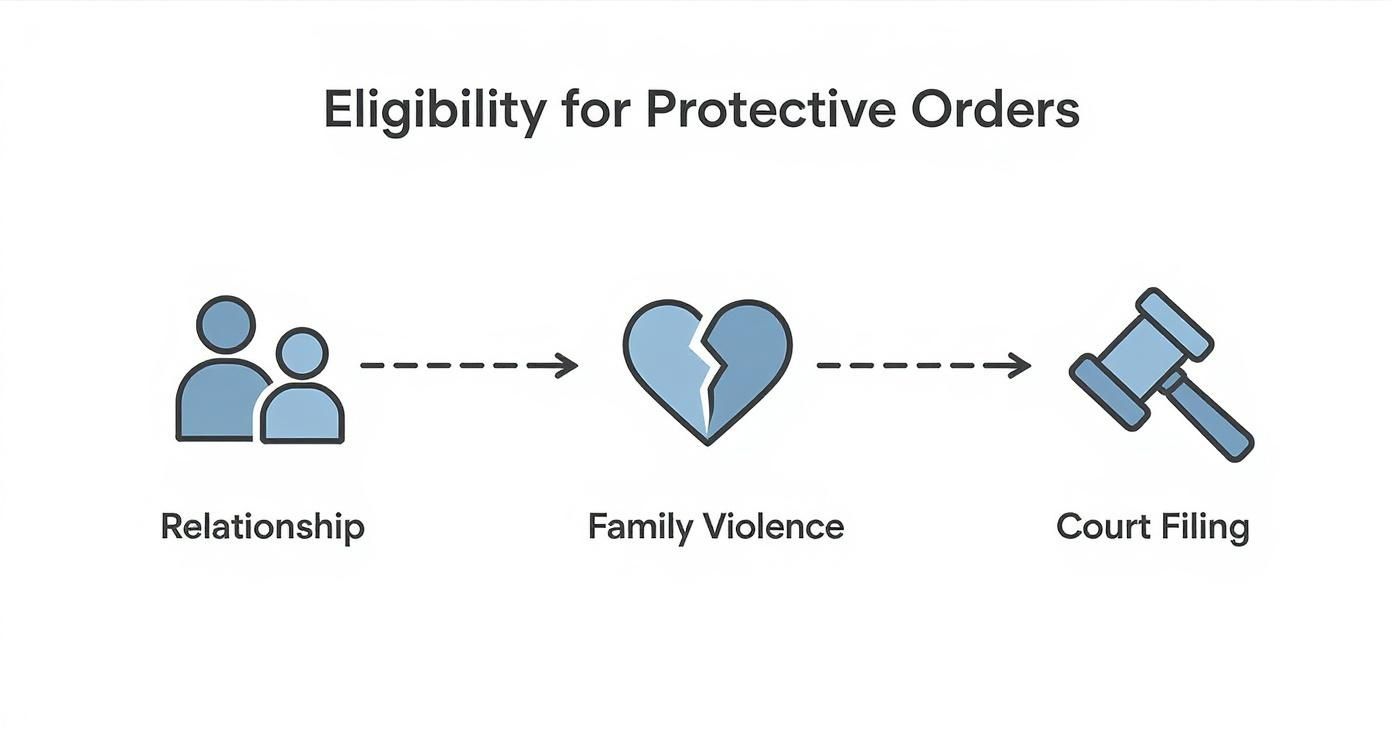
As you can see, it all starts with an allegation of family violence between people in a specific type of relationship. This prompts one person—the petitioner—to ask the court for legal protection.
The First Step: The Temporary Ex Parte Order
The process usually kicks off before you even know it’s happening. The person who filed the petition, known as the Petitioner, can appear before a judge for what’s called a temporary ex parte hearing. Don’t let the legal jargon intimidate you; "ex parte" simply means only one party is present for the hearing.
Based entirely on the petitioner’s side of the story and whatever evidence they bring, a judge can issue a Temporary Ex Parte Protective Order. This happens if the judge believes there's a clear and present danger of family violence. This initial order is a short-term fix, typically lasting up to 20 days. Think of it as an emergency brake, designed to create immediate safety until a full hearing can be scheduled where both sides get to speak. For a deeper dive into this first stage, check out our detailed guide on the emergency protective order in Texas.
Being Served and Preparing for Your Day in Court
Once the temporary order is signed by the judge, a sheriff's deputy or a private process server will hand-deliver the legal documents to you. This is what it means to be "served." Inside that packet, you’ll find a copy of the petition spelling out the allegations against you. Most importantly, you'll see the date, time, and location of the final hearing.
This is the moment the clock starts ticking, and it moves fast. You have a very small window to build your defense. Whatever you do, don't ignore the hearing date. That's the single worst mistake you can make. If you’re a no-show, the judge will only hear the petitioner's narrative and will almost certainly grant a final protective order that could impact your life for two years or even longer.
Attending the hearing isn’t just a suggestion—it's your one and only chance to protect your rights. This is where you get to present your side of the story, challenge the accusations, and introduce evidence that paints the complete picture.
Gathering Your Evidence for the Final Hearing
Your word in court matters, but solid, tangible evidence is what truly sways a judge. It's time to put on your detective hat and start collecting anything and everything that supports your version of events or casts doubt on the petitioner's claims. Your objective is clear: show the court that family violence has not happened and is not likely to happen.
Here’s what you should be looking for:
- Written Communications: Dig up text messages, emails, or social media exchanges that provide crucial context or directly contradict the accusations. For instance, a text thread showing a perfectly normal, friendly conversation right before an alleged incident can be incredibly persuasive.
- Witnesses: Think about who can vouch for you. It could be a friend who witnessed an argument and can testify that it never became violent, or a relative who can speak to your character as a peaceful and responsible parent.
- Photos and Videos: If you have any legally obtained photos or video clips that are relevant to the case, they can offer compelling, objective proof.
- Documentation: Gather other documents that can help your case. Receipts, GPS data from your phone, or call logs can establish a timeline or prove you were somewhere else when an event allegedly occurred.
Getting ready for a protective order hearing is a legally complicated and emotionally exhausting fight. But you don't have to go through it by yourself. Having a skilled attorney in your corner to help organize evidence, prepare your testimony, and argue your case in the courtroom can be the deciding factor in the outcome.
Understanding the Rules of a Protective Order

Being handed a protective order can feel like trying to read a complicated rulebook in a language you don't understand. But it's absolutely critical to get this right. This document isn't a guideline or a friendly suggestion—it's a direct command from a judge, backed by the full weight of the law.
Every single rule, or "prohibition," listed in that order must be followed to the letter. A minor slip-up can trigger severe and immediate consequences. The very first thing you need to do is read the order word for word. It will spell out exactly what you are legally forbidden from doing.
While the details can be tailored to your specific case, most orders include a standard set of restrictions. These are designed to create a clear, non-negotiable boundary between you and the petitioner. Your freedom, your rights as a parent, and your entire future hinge on your strict compliance from the moment you're served.
Common Restrictions You Must Obey
Think of these rules as invisible, legally-enforced fences. Crossing them, even if you don't mean to, is a serious violation. The court's number one goal is to stop any form of contact that could be seen as threatening, harassing, or violent.
To help you understand exactly what the court expects, we've outlined the most common restrictions you'll find in a Texas protective order.
Common Restrictions in a Texas Protective Order
This table outlines the typical prohibitions included in a protective order so you can understand exactly what is legally required of you.
| Restriction Category | Common Examples of Prohibited Actions |
|---|---|
| No Contact (Direct & Indirect) | Calling, texting, emailing, or messaging on social media. Using a friend or family member to pass along a message. |
| Physical Distance ("Stay-Away") | Coming within a specified distance (often 200-500 feet) of the person's home, work, or their child's school/daycare. |
| Harassment & Threats | Any action intended to harass, annoy, alarm, abuse, torment, or embarrass the person. This can be very broad. |
| Firearms & Ammunition | Possessing, buying, or having access to any firearm or ammunition. This is a separate federal crime. |
These rules aren't flexible. They are black and white, and any violation, regardless of your intent, can land you in serious trouble.
A Real-World Example of an "Innocent" Mistake
Let's walk through a common scenario. Imagine you've just left a tense court hearing, and a two-year protective order is now active. You're feeling terrible about the conflict and how it's impacting your kids. Believing you're doing the right thing, you send a single text: "I'm so sorry for everything. Can we please talk for the sake of the children?"
In your mind, it's an olive branch. In the eyes of the law, you just broke the "no contact" rule.
Your ex can immediately show that text message and the protective order to the police. That's all they need for probable cause to arrest you on the spot. You'll be facing a brand-new criminal charge—Violation of a Protective Order—which is typically a Class A Misdemeanor in Texas.
That one well-intentioned text could lead to a year in jail and a $4,000 fine. It will also destroy your credibility in any other family law or CPS case you might be involved in.
The law makes no distinction between a hostile threat and a heartfelt apology sent via text. Any prohibited contact is a violation, period. Your intent does not matter; only the action does.
This example shows just how unforgiving these orders are. Strict, absolute compliance isn't just the best approach—it's the only one that will keep you out of jail and preserve your chances for a better future for your family. Understanding these rules is the first, most important step in getting through this.
How a Protective Order Can Impact Your Parental Rights and CPS Cases
When a parent is hit with a protective order, the legal restrictions are daunting enough. But one question usually drowns out all the others: "What does this mean for my kids?" It's an instant, gut-punch of a fear. The hard truth is that a protective order can drastically alter your relationship with your children and, more often than not, pull Child Protective Services (CPS) directly into your life.
The second a judge signs a protective order based on a finding of family violence, your parental rights are on shaky ground. In Texas, courts are legally bound to prioritize the "best interest of the child." A formal finding of family violence flips a switch, creating a legal presumption that letting the offending parent have unsupervised time with their child is not in their best interest.
This immediately throws up a huge roadblock. A protective order can directly limit your conservatorship (the power to make key decisions for your child) and your possession and access (your physical time with them). You could suddenly find your time with your children restricted to supervised visits, or in the most serious situations, have it suspended completely until the court is confident the kids are safe.
The Unavoidable Link to CPS
Allegations of family violence, especially when kids are in the home, are a massive red flag for CPS. The person filing for the protective order is often legally required to report the alleged abuse to the CPS hotline. Sometimes, the court itself will make the report. This means you could be fighting a war on two fronts: the protective order in civil court and a completely separate CPS investigation.
That protective order becomes a key piece of evidence in the CPS case. Caseworkers see a judge's official finding of family violence as a serious indicator of risk. It can put an investigation on the fast track and heavily influence the agency’s decisions, including those made under Texas Family Code Chapter 262 (procedures in a suit by a governmental entity) and potentially leading toward termination under Chapter 161.
Here’s how these two legal worlds smash into each other:
- Evidence Crossover: Anything said or presented in your protective order hearing can—and likely will—be used against you in the CPS investigation.
- Safety Plan Overlap: CPS will almost certainly put a safety plan in place that mirrors the protective order’s rules, meaning you'll likely be required to stay away from the family home and have no contact with your kids outside of approved, supervised settings.
- Legal Leverage: The other parent can use the protective order as a powerful tool in both the CPS case and any custody battle that's happening at the same time.
Actionable Advice for Parents
Protecting your relationship with your children through this process demands a calm, strategic game plan. You have to follow the protective order's terms to the letter while also proactively engaging with the CPS investigation to show you are a safe, capable parent.
- Comply Completely: Follow every rule in the protective order without exception. This is the fastest way to demonstrate stability to both the court and CPS.
- Engage with CPS Proactively: Don’t wait for CPS to dictate terms. Ask what services you can start immediately. Enrolling in anger management, parenting classes, or counseling before being ordered shows a judge and a caseworker that you are taking this seriously and are committed to your children’s well-being.
- Document Everything: Keep a detailed log of your communications with CPS, your attendance at services, and any efforts you make to comply with your case plan. This documentation is vital for hearings and reviews under Texas Family Code Chapter 263.
A protective order isn't the end of your relationship with your children, but it's a serious detour. How you react in the first few days and weeks can determine the entire direction of your case.
It's vital to know your fundamental rights during this time; you can get a deeper understanding by exploring our guide on Texas parental rights and how to defend them. The path forward is tough, but with the right guidance, it is absolutely possible to protect and maintain your bond with your children.
The Consequences of Violating a Protective Order
Understanding the rules of a protective order is one thing, but fully grasping the severe consequences of breaking them is another entirely. A violation isn't just a misstep—it's a criminal offense that can completely unravel any progress you’ve made in your family law or CPS case and put your freedom on the line.
Let’s be crystal clear: the state of Texas takes these orders incredibly seriously. There is absolutely zero tolerance for non-compliance.
A single violation, even one you might think is harmless, can trigger an immediate and unforgiving legal process. The moment the protected person reports a breach, law enforcement has the authority to arrest you on the spot, often without needing a warrant. That’s because violating a protective order is a crime in itself.
From Civil Order to Criminal Charge
The second you breach that order, you’ve crossed a critical line from a civil court matter straight into the criminal justice system. A first-time violation is typically charged as a Class A Misdemeanor. This is a serious offense that comes with penalties of up to one year in jail and a fine of up to $4,000. We’re not talking about a simple slap on the wrist; this is a criminal charge that creates a permanent record.
And the penalties escalate quickly. If you have a prior conviction for violating a protective order, any new violation can be charged as a third-degree felony. This move dramatically raises the stakes, with potential prison time of two to ten years. The charge can also jump to a felony if the violation involved an act of assault or stalking.
To make sure these orders are enforced without fail, Texas maintains a statewide database called the Protective Order Registry of Texas (PROTECT). This system gives law enforcement officers immediate access to the details of your order, making it simple for them to verify a violation and make an arrest. You can see how this registry works to support officer and victim safety at the official PROTECT website.
The Ripple Effect on Your Family Case
A criminal charge for violating a protective order is devastating enough on its own, but the impact it has on your family law and CPS cases can be catastrophic. It sends a clear signal to a judge that you are incapable of following court orders, which instantly destroys your credibility and paints you as a risk to your family.
Any hope you had of modifying custody, expanding your visitation time, or successfully completing a CPS service plan is immediately put in jeopardy. Even a seemingly minor offense like a Class B Misdemeanor in Texas can have lasting effects on your case. Your only defense against these life-altering outcomes is strict, perfect adherence to every single term of the protective order. No exceptions.
When you get hit with a protective order, it's natural for your mind to start racing. The legal system can feel like a maze, and suddenly you're full of questions. Getting clear, straightforward answers is the very first step toward getting your feet back under you. We've put together some of the most common questions we hear from families to give you the practical information you need right now.
What Is the Difference Between a Protective Order and a Restraining Order?
This is easily the most frequent point of confusion, and the difference is absolutely critical.
Think of a Protective Order as a very specific tool designed to stop family violence. Because it's all about preventing physical harm, violating one is a criminal offense. That means a violation can lead to an immediate arrest.
A Temporary Restraining Order (TRO), on the other hand, is a much broader civil court order. You see these all the time in divorce cases to stop a spouse from selling off marital property, draining joint bank accounts, or harassing the other party. While breaking a TRO has consequences, they're civil—things like fines or being held in contempt of court—not criminal.
The key takeaway: Violating a protective order can land you in jail. Violating a TRO usually leads to civil penalties. You have to know which one you're dealing with.
How Long Does a Protective Order Last in Texas?
The duration can really vary. An initial Temporary Ex Parte Protective Order is a short-term fix, usually lasting just 20 days. It’s put in place to provide immediate safety until a full court hearing can happen where both sides can be heard.
If the judge grants a final protective order after that hearing, it typically lasts for two years. But, in really serious cases involving severe violence or certain felony offenses, a judge has the power to make it last much longer—sometimes even for life.
Can a Protective Order Be Changed or Removed Early?
Yes, it’s possible, but it isn't easy. You can ask the court to modify or even get rid of a protective order before it expires. This involves filing a formal legal motion and convincing a judge that there's been a "material and substantial change in circumstances" since the order was first issued.
For instance, you might need to show you’ve successfully completed a batterer's intervention program, consistently attended counseling, and stayed sober for a long time. The person protected by the order has every right to fight this motion, and the judge's top priority will always be their safety. It's a tough legal battle, and one you shouldn't try to handle without professional help.
Will a Protective Order Show Up on a Background Check?
Absolutely. A final protective order is a public court record, and it will almost certainly pop up on any comprehensive background check. This can throw up some serious roadblocks in your life, potentially affecting:
- Job opportunities, especially if you work in fields like education, healthcare, or for the government.
- Housing applications, since most landlords run background checks.
- Professional licenses for careers in nursing, law, real estate, and more.
- Owning a gun, as a protective order triggers a federal ban on possessing firearms.
Understanding these long-term consequences is why it's so important to mount a serious, strategic defense from the moment you're served.
Facing a protective order alongside a CPS investigation can make you feel completely isolated and powerless. You do not have to walk this path alone. The experienced attorneys at The Law Office of Bryan Fagan understand the fear and confusion you are feeling, and we are here to restore your hope. We will stand up for your rights, explain your options in clear language, and fight for the best possible outcome for you and your children. Contact us today for a free, confidential consultation to talk about your case. Let us help you protect your family and your future. You can reach us at https://texascpslawyer.net.