Skip to content
That knock on the door from a Child Protective Services caseworker is a moment no parent is ever ready for. The fear, the confusion, and the sheer helplessness that crash down when your child is taken from your home are overwhelming. We have stood beside countless Texas parents who have been in your exact shoes, feeling like their world has shattered in a single, terrifying instant.
This guide is meant to help you find your footing and move from that initial state of panic to a place of empowerment. The first step is understanding the “affidavit of removal”—the critical legal document that initiates the formal court process when CPS takes your child in an emergency.
It’s the document CPS files to justify their drastic action, and it represents your first real opportunity to start fighting back to bring your child home.
This flowchart shows the emotional journey so many parents go through, shifting from the initial shock to empowered, focused action.
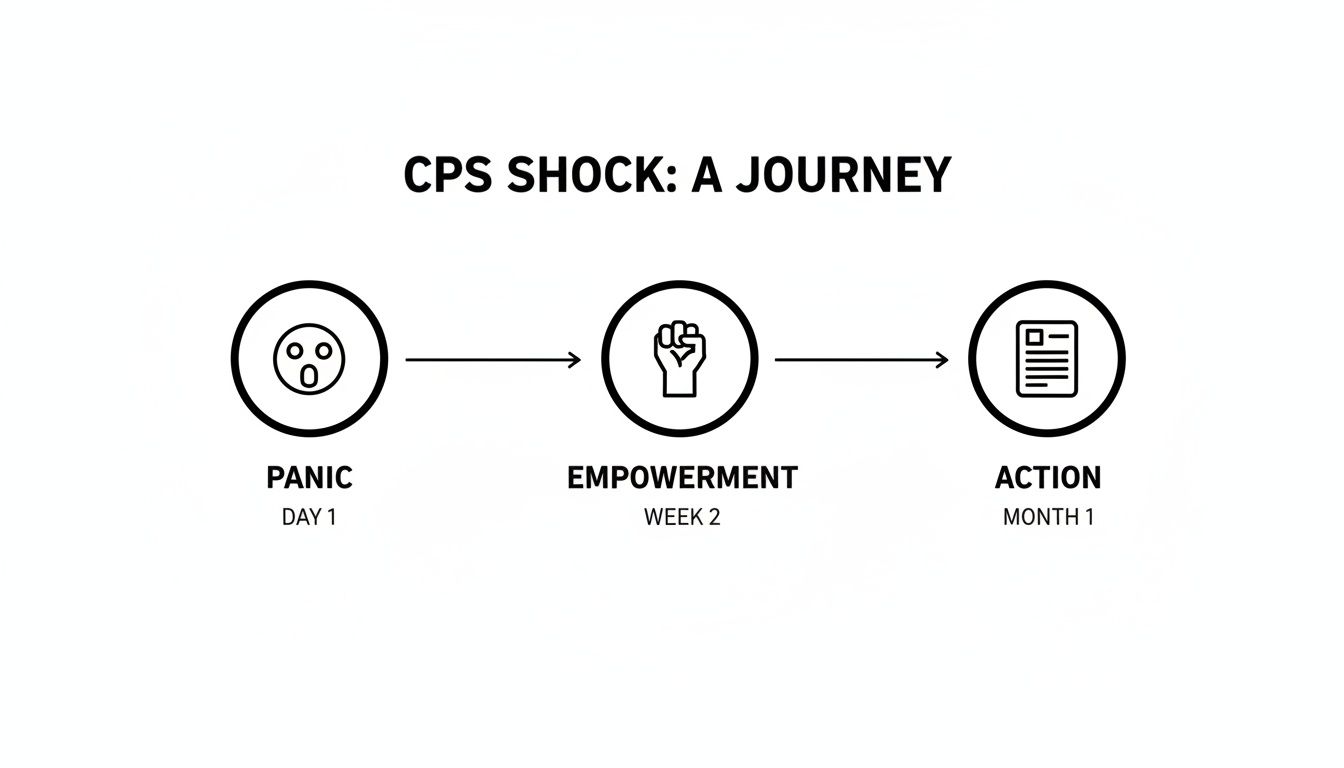
As you can see, the path forward involves channeling that raw emotion into a clear legal strategy. That strategy begins with a firm grasp of the state's allegations against you, which are all laid out in the affidavit of removal.
From Panic to Proactive Defense
The moments and days after CPS removes your child are a blur of high-stakes emotions and urgent questions. It is a profoundly disorienting and painful experience.
But knowledge is the first tool you can use to regain a sense of control. The Texas Family Code sets out very strict rules and timelines that CPS is required to follow. By learning this process, you start to see a path forward through the chaos.
Your primary goal is to challenge the state's reasons for the removal and demonstrate that your child is safe in your care. This fight begins by dissecting the affidavit of removal and preparing for that first, all-important court date.
So, let's walk through what this affidavit really is and the immediate steps you can take to start fighting for your family. If your child has just been removed, our guide on what to do when CPS removes your child in Texas offers immediate support. We'll help you understand your rights and the legal landscape you're now facing, guided by the specific laws here in Texas.
What Is an Affidavit of Removal in a Texas CPS Case?
When CPS removes your child from your home without a prior court order, the first major legal document you'll encounter is the Affidavit of Removal. It's crucial to understand this document because it sets the stage for everything that comes next.
In simple terms, an affidavit of removal is the caseworker’s sworn, written statement explaining why they believed your child was in such immediate danger that they had to act on the spot.

Think of it as the state's official story—their justification for taking emergency action. It is not a final ruling from a judge. It is not undeniable proof of anything. Instead, this affidavit is the opening move in a legal battle that has just begun.
This document gets filed with the court right after the removal, and it triggers a series of very strict legal deadlines. Knowing what this affidavit is—and what it isn't—is the first step in building a strong defense for the all-important court hearing that must happen within 14 days.
The Purpose of the Affidavit in a CPS Case
The affidavit serves a very specific function under Chapter 262 of the Texas Family Code. It’s the legal tool CPS uses to justify taking a child without getting a judge's permission first, an action reserved for true emergencies.
Imagine a scenario we see all too often: a caseworker receives an anonymous, unverified tip about drug use at your home on a Friday afternoon. Based on a brief, tense conversation and what they see in a messy house, the caseworker decides to remove the children, claiming they fear for the kids' safety over the weekend.
The affidavit of removal would be that caseworker’s written account of that visit, detailing every single observation they believe pointed to an "immediate danger."
This document is the cornerstone of the state's initial case against you. It contains the specific allegations you and your attorney must be prepared to challenge in court.
The law is clear that this document must contain specific, factual allegations—not just vague feelings or suspicions. It has to outline a "sufficient basis" for the caseworker's conclusion that there was an immediate danger to your child’s physical health or safety. You can get more context by reading our detailed guide on the complete CPS removal process in Texas.
Critical Timelines After a Child Is Removed by CPS
Once a child is removed and the affidavit is filed, the clock starts ticking on several non-negotiable deadlines. These timelines are set by the Texas Family Code, and understanding them is essential for you and your attorney to build an effective defense.
| Event | Deadline | What This Means for You |
|---|---|---|
| Emergency Removal | Day 0 | This is the day CPS physically takes your child from your custody without a court order. The clock starts now. |
| Filing of Lawsuit | By the next business day | CPS must file a formal lawsuit ("Suit Affecting the Parent-Child Relationship") and submit the Affidavit of Removal to the court. |
| Adversary Hearing | Within 14 days of removal | This is your first day in court. A judge hears initial evidence and decides if CPS has enough reason to keep temporary custody of your child. |
That fast-approaching 14-day deadline for the Adversary Hearing is everything. It is why you must contact an experienced CPS defense attorney the moment your child is removed. There is absolutely no time to waste in preparing your case to bring your child back home.
Analyzing the Affidavit: What CPS Must Prove
Under Texas law, CPS can’t just walk in and remove your child on a whim. The Texas Family Code, specifically Chapter 262, sets a very high legal bar they have to clear. The affidavit of removal is their written argument for why they met that standard, and your job—alongside your attorney—is to pick it apart, word by word.
At its core, the affidavit must lay out specific, believable facts showing an "immediate danger" to your child's physical health or safety. A caseworker’s gut feeling or vague suspicions simply won't cut it. The law demands concrete details.

When you and your lawyer dig into that affidavit, you're essentially reverse-engineering the state’s case against you. You’re hunting for the weak spots, the misrepresentations, and the claims they can’t back up. This document is the entire foundation for their case at the adversary hearing, and if that foundation is shaky, their whole case can come crashing down.
Scrutinizing the Claims
Your first read-through should focus on one thing: where did the caseworker get this information? The source of each allegation is absolutely critical.
- Direct Observation: Did the caseworker see the alleged danger with their own two eyes? For example, did they walk in and find illegal drugs sitting on the coffee table or notice unexplained injuries on your child?
- Hearsay: Is the claim based on something someone else told them? This could be anyone—a neighbor, an angry ex, or an anonymous caller. Hearsay is often unreliable and much easier to challenge in court.
Misrepresentation is another weak point we see all the time. Caseworkers are overworked and under immense pressure, and sometimes they exaggerate or flat-out misinterpret a situation to justify a removal. A messy house from a busy week might get spun into a "hazardous environment," or a toddler's normal tantrum could be described as a sign of severe emotional trauma.
Here’s a real-life example. We represented a mother whose affidavit claimed her home was "filthy and unsafe" with "rotting food on the counter." The mother had just come home from the grocery store and hadn't put everything away when the caseworker arrived. By providing the time-stamped grocery receipt and photos of her clean kitchen taken just an hour later, we proved the caseworker's description was a gross mischaracterization. That context changed everything for the judge.
The legal burden is on CPS to prove their case, not on you to prove your innocence. Your attorney's job is to hold them to that burden by challenging every piece of insufficient evidence they present.
Building Your Counter-Narrative
As you take apart each claim in the affidavit, you're also building your own powerful counter-narrative. This isn't about getting into an argument; it's about presenting cold, hard facts that tell the real story.
Here’s what you can start doing immediately:
- Take Photos and Videos: Use your phone to document the state of your home right now. Make sure the pictures are date-stamped. Show that it’s safe, clean, and stocked with food.
- Gather Witness Statements: Reach out to people who can speak to your parenting. Think teachers, doctors, neighbors, or family members who are willing to provide a written statement about your child's well-being.
- Collect Records: Things like school attendance records, recent report cards, and your child’s medical records can be incredibly powerful evidence that your child is, in fact, healthy and well-cared-for.
By systematically dismantling the state’s claims and building your own evidence-based story, you shine a spotlight on the weaknesses in the CPS case. This proactive, aggressive approach is your best strategy for the fast-approaching adversary hearing.
Your First Court Date: The Adversary Hearing
The adversary hearing is, without a doubt, one of the most important days in your entire CPS case. It's a fast-paced, high-stakes hearing that legally must happen within 14 days of your child's removal, where a judge makes a critical decision based on very limited information.
On this day, the court has one primary job: to decide if there’s enough evidence to believe your child was in immediate danger and must remain in CPS custody for now.

The state will hang its entire case on the affidavit of removal. Your attorney’s job is to pick that affidavit apart and show the judge that the "immediate danger" CPS claimed simply doesn't exist. This hearing is your first and best chance to bring your child home, which makes your preparation for it absolutely vital.
Who You'll See in the Courtroom
Walking into the courtroom for the first time can be incredibly intimidating. Just knowing who to expect can take a lot of the edge off.
You'll see a few key players:
- The Judge: The person who makes the final decision.
- The CPS Attorney: The lawyer representing the state (DFPS).
- Your Attorney: Your advocate, fighting for you and your child.
- The Ad Litem Attorney: A lawyer the court appoints to represent your child’s best interests.
- The CPS Caseworker: The person who wrote the affidavit and will probably be called to testify.
- You, the Parent: You will be there, and you might have to testify.
Everyone has a specific role, but the courtroom's focus will be squarely on the evidence from the CPS attorney and the counter-evidence your lawyer presents. The procedures can feel foreign, and it’s helpful to understand that different court dates have different goals. For instance, people often ask what happens at a bail hearing, which has its own specific format, much like this adversary hearing.
Getting Ready for Your Adversary Hearing
After handling hundreds of these hearings, we can tell you that preparation is everything. Those two weeks between the removal and your court date will feel like a lifetime. Your attorney will be your guide, but you have an active, critical role in gathering the proof needed to win.
Actionable Advice: Start your preparation immediately. Don't wait for your attorney to ask.
- Proof of Income: Pay stubs show you can provide for your child.
- Proof of Residence: A lease or mortgage statement proves you have stable housing.
- Letters of Support: Positive statements from teachers, neighbors, daycare providers, or family who can speak to your good parenting.
- Photographs: Date-stamped pictures of your clean, safe home to counter any claims to the contrary.
Your conduct and appearance in court matter more than you think. Judges are human. A parent who is calm, respectful, and dressed appropriately makes a far better impression than one who is visibly angry and emotional. Let your lawyer do the fighting for you.
Presenting yourself as a responsible, stable parent is just as important as any document you provide. The proactive work you put in during these crucial 14 days can be the very thing that brings your child back home.
Common Mistakes That Can Wreck Your CPS Case
In the whirlwind of stress and panic that follows a child's removal, it's terrifyingly easy to make a mistake that could sabotage your entire case. The fear is paralyzing, we understand. But from this moment forward, you must realize that every single thing you do and say is under a microscope. Knowing what not to do is just as critical as knowing what to do.
We've seen it happen countless times: a well-meaning parent tries to explain their side of the story to a caseworker without an attorney present. The parent thinks they're clearing things up, but their words get twisted and used against them in the affidavit of removal. What you see as a perfectly reasonable explanation, CPS can frame as an admission of guilt. Trying to handle these initial conversations on your own is one of the biggest mistakes you can make.
Protecting Your Rights from the Start
Another huge pitfall is your digital footprint. In a moment of frustration, you might send an angry text to a relative or vent your feelings on social media. You need to know that CPS can and will subpoena those records. They'll pull your words out of context and present them as "evidence" of your instability or anger, using them to justify the removal.
Here's the bottom line: from the second CPS gets involved, assume every conversation, text message, and social media post could end up as an exhibit in a courtroom. Act accordingly to protect your family.
A bad joke, a sarcastic comment, or a post made in anger can be devastating in a legal setting. It can be used to paint a completely inaccurate and damaging picture of you as a parent.
Your Immediate Action Plan
To sidestep these common but costly errors, you need a clear strategy, starting right now. This isn't the time to wait and see what happens. It's time to be decisive and protect your rights.
Here’s your actionable advice for navigating this crisis:
- Document Everything: Start a detailed log of every single interaction you have with CPS. Write down names, dates, times, and a summary of the conversation. This record is invaluable for you and your attorney.
- Do Not Sign Anything: Never sign a document from CPS—not a "Safety Plan," not a "Service Plan," nothing—without having your attorney review and approve it first. Signing can mean you are unknowingly waiving crucial parental rights.
- Get a Lawyer Immediately: This is the single most important action you can take. Hire an experienced CPS defense attorney right away. Ideally, you want a lawyer in your corner before you have any substantive conversations with the caseworker and long before the adversary hearing.
An attorney will be your voice, preventing you from making statements that could be misconstrued. They will manage all communication with CPS and start building your defense against the allegations in the affidavit of removal for your Texas case.
Answering Your Urgent Questions About CPS Removal
When you're caught in a CPS crisis, your world stops. The fear and confusion can be paralyzing, and you need clear, straightforward answers, not dense legal jargon. The moments after a child is removed are some of the most terrifying a parent can face.
We’ve stood with Texas families during these exact moments. Here, we answer the most pressing questions we hear, giving you the practical information you need to find your footing and start fighting back.
Can CPS Really Take My Child Without a Court Order?
It’s a question that cuts to the heart of every parent's fear. The answer is yes, but only in very specific, limited circumstances.
The Texas Family Code (Chapter 262) allows a caseworker to perform an "emergency removal" if they believe your child is in such immediate danger of physical or sexual abuse that waiting for a court order is not an option.
Once they do this, the clock starts ticking. CPS must immediately file a lawsuit and provide the court with a sworn statement—the affidavit of removal—explaining why they took your child. This action automatically triggers a court hearing within 14 days, where a judge will scrutinize their decision.
What Happens if the Judge Rules Against Me at the Hearing?
If the judge sides with CPS at that first adversary hearing, they will grant the agency temporary custody of your child. This is a devastating setback, but it is not the end of your case. Do not lose hope.
The court will then order a "service plan" under Chapter 263 of the Texas Family Code, which is your roadmap to getting your child back. It's a list of tasks you must complete, which could include parenting classes, counseling sessions, or drug assessments. Your attorney's role is critical here to ensure the plan is fair, achievable, and directly addresses the court's concerns, setting you on the fastest path to reunification. If the case progresses toward termination of parental rights, the standards of Chapter 161 will apply, making early, diligent work on your service plan essential.
Remember, the initial hearing is just the first step. The goal shifts to completing your service plan and proving to the court that you are a safe and capable parent.
How Can I Prove My Home Is Safe?
Right now, your word isn't enough—you need to build a case with solid proof. Documentation is your best friend when it comes to countering the claims in the CPS affidavit.
Here is actionable advice to create your own evidence:
- Take date-stamped photos and videos of your entire home. Show that it's clean, that there's plenty of food in the pantry and fridge, and that it’s a safe, normal environment for a child.
- Start gathering letters of support from people who can vouch for your parenting. Think teachers, doctors, daycare providers, neighbors, or family members who have seen you with your child.
- Collect documents that show your child is well-cared for. This could be school attendance records, recent report cards, or notes from their last medical check-up.
An experienced lawyer knows how to organize this evidence and present it effectively in court to dismantle the state's narrative piece by piece.
The path to reuniting your family after a CPS removal can feel incredibly lonely and confusing, but you do not have to walk it alone. The attorneys at the Law Office of Bryan Fagan have guided countless Texas families through this exact process with compassion and expert legal strategy. If your child has been removed, do not wait. Contact us now for a free, confidential consultation to understand your rights and start building your defense today. Your family's future is too important to leave to chance.