Skip to content
The phone call from Child Protective Services (CPS) can turn your world upside down. Suddenly, you're facing a formal court process, and one of the first and most critical steps is the Adversary Hearing. This isn't a trial to decide the final outcome of your case. Instead, it’s a focused court proceeding where a judge decides if there is enough evidence to keep your child in the temporary custody of the state while the investigation continues. This hearing happens fast—usually within 14 days of CPS removing your child from your home.
Your Family on the Line: The Purpose of a Texas Adversary Hearing

The moments after CPS removes your child are a whirlwind of confusion, fear, and heartbreak. It's easy to feel lost and powerless in the legal system, but understanding this initial hearing can give you back a sense of control and a clear path forward.
Under Chapter 262 of the Texas Family Code, the Adversary Hearing, also known as the "14-day hearing," has one main goal: for CPS to convince a judge that there is an urgent need to keep your child out of your home. CPS must prove two critical things: that there is an immediate danger to the physical health or safety of your child, and that it was not safe for your child to remain at home.
This hearing is different from other court appearances. To see how it fits into the bigger picture, you can learn more about what happens at an arraignment hearing in our related guide. At the Adversary Hearing, the judge’s decision will come down to specific facts and evidence that show whether the removal was legally justified.
The Core Questions a Judge Must Answer
A judge’s decision isn't based on a gut feeling; it's guided by a specific legal framework. They are evaluating evidence to answer two key questions:
- Was there an immediate danger? CPS must show that there was a real, urgent risk to your child's well-being that required their immediate removal.
- Were reasonable efforts made to keep the family together? The law requires CPS to try to prevent removal if possible. The judge will look at whether CPS offered services or support that could have kept your child safely at home.
The CPS system has a massive impact on Texas families. Many parents find themselves in court, legally fighting for their children, simply because of a misunderstanding or a false allegation. Presenting a strong, clear argument that directly addresses these two points is absolutely essential. With the right preparation, you and your family can make a compelling case for your child's immediate return, allowing you to work towards reunification from a position of strength.
Who Is in the Courtroom and What Their Roles Are
Walking into a courtroom for a CPS hearing can feel like stepping onto a stage where you don't know the script. It's intimidating, but it becomes much less confusing once you understand who the key players are and what each one is trying to do. This isn't like a TV courtroom drama; it's a serious proceeding where the future of your family is on the table.
The whole process is designed to move quickly, often at a dizzying pace. That's why it’s so critical to know who holds the power, who's arguing against you, and who is there to fight for you and your child.
The Main Participants and Their Objectives
At the head of it all is the Judge. They are the neutral referee in this process. Their job is to listen to the arguments from all sides and make the final call on whether CPS has met its burden of proof to keep your child in state custody. Their decision is guided entirely by the evidence presented about the safety and well-being of your child.
On the other side, you have the CPS Attorney, who is there representing the state agency. Their primary goal is to convince the judge that removing your child was necessary for their protection. They’ll highlight parts of the CPS investigation that they believe show an immediate danger, often pushing for the judge to name CPS as the temporary managing conservator of your child.
The CPS attorney isn’t there to argue about your character. At this point, they are focused on one thing: convincing the judge that leaving your child in your care poses a risk that requires the court's intervention.
Finally, and most importantly, is your Attorney. This person is your champion, your advocate, and your voice when you feel like you don't have one. Their mission is to challenge the CPS attorney's arguments by presenting a compelling case for your child's return. They’ll gather and show the judge evidence of your stability and fitness as a parent to prove that your child is safe with you. Their entire focus is on reuniting your family under the least restrictive conditions possible.
Knowing who's in the room and what they're trying to achieve is the first step in getting prepared. Below is a quick rundown to keep the players straight.
Key Players at Your Adversary Hearing
| Participant | Role and Objective |
|---|---|
| Judge | The Decision-Maker: Acts as a neutral party to weigh the evidence. Their goal is to make a ruling that is in the best interest of the child, based on the standards in the Texas Family Code. |
| CPS Attorney | The State's Advocate: Represents the Department of Family and Protective Services. Their objective is to present evidence to justify the child's removal and secure temporary orders from the court. |
| Your Attorney | Your Advocate: Represents you, the parent. Their mission is to argue for your child's return by challenging CPS's evidence and presenting proof that your child is safe in your care. |
| Parent(s) | The Accused: This is you. Your role is to remain calm, follow your attorney's advice, and provide any necessary information to help your lawyer build the strongest case for your family. |
| Ad Litem Attorney | The Child's Advocate: An attorney appointed by the court to represent the best interests of your child. They do not represent you or CPS. |
By understanding what each person wants, you can work more effectively with your attorney. This knowledge transforms you from a passive observer into an active participant in the fight to bring your child home.
How a Judge Decides: The Factors That Determine Custody
A judge's decision in a CPS Adversary Hearing isn't a gut feeling. It's a calculated assessment, guided by specific legal standards laid out in the Texas Family Code, Chapter 262. At its heart, the judge is performing a delicate balancing act: upholding your constitutional right to raise your family while also protecting the immediate safety of your child.
To do this, they zero in on one core pillar: whether there is a continuing danger to the physical health or safety of the child. Every single piece of information presented at the hearing is filtered through this lens.
Assessing Immediate Danger
The big question here is simple: Was your child in immediate danger at the time of removal? A judge is looking for concrete evidence, not just accusations or suspicions. CPS must present facts that show a real and urgent threat.
Factors that CPS might present as evidence of danger include:
- Allegations of Abuse or Neglect: Specific claims of physical, emotional, or sexual abuse, or failure to provide basic needs.
- Substance Abuse in the Home: Evidence of drug or alcohol abuse that puts the child's safety at risk.
- Unsafe Living Conditions: A home environment that is hazardous to a child's health or safety.
Imagine a scenario where CPS is called because of an argument between parents. The caseworker arrives and sees a messy house but no signs of abuse. A judge might find there was no immediate danger to justify removal. However, if a caseworker walks into a home and finds evidence of recent drug use with a young child present, a judge is far more likely to agree that removal was necessary. Your attorney’s job is to challenge CPS's evidence and paint a clear, compelling picture of a safe and loving home.
This flowchart breaks down the key players in the courtroom and how they present these arguments to the judge.
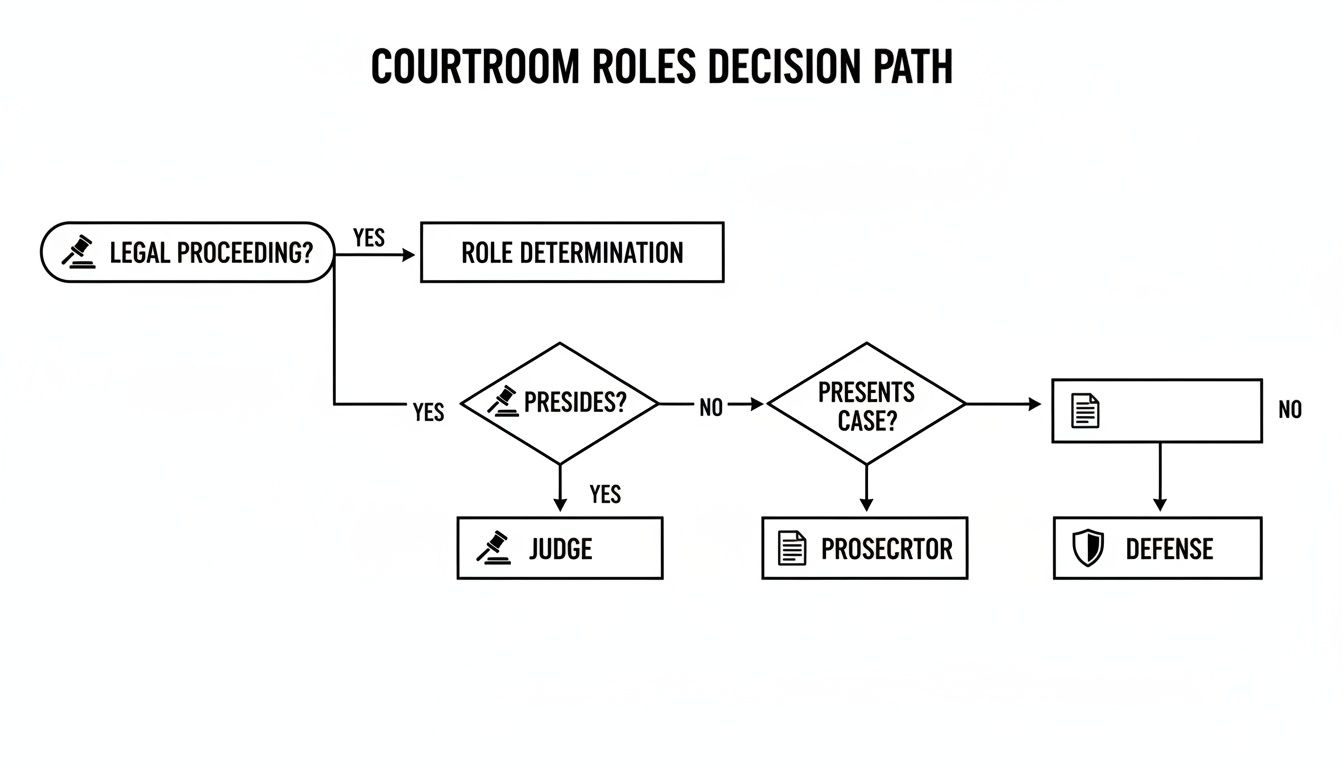
As you can see, the process flows from the judge's authority, with both the CPS attorney and your defense attorney making their cases to sway the final decision.
Evaluating Reasonable Efforts
The second major pillar is whether CPS made "reasonable efforts" to prevent the need for removal. The law prefers to keep families together. A judge will look closely at what the CPS caseworker did—or didn't do—before taking your child. Did they offer services? Did they explore placing the child with a relative instead of in foster care?
Adversary hearings aren't like the drawn-out dramas you see in movies; they are fast and high-stakes. In Texas, your hearing is set within 14 days of removal. The judge will weigh the evidence of danger—which is the key factor in CPS's case—alongside whether the agency did its job correctly. Your attorney’s role is to counter the state by presenting evidence of your willingness to work with CPS and your stable home environment. This is absolutely critical, as children who remain in foster care for extended periods face significant challenges. You can find more insights on global justice trends from Penal Reform International.
The judge must weigh the specific allegations against you. An accusation of a messy home will be viewed very differently than a credible report of physical abuse.
Understanding these factors is the key to a strong defense. It allows your attorney to get ahead of the game and start gathering the right evidence—like photos of your home, character references, and names of supportive family members—to build the most convincing argument for your child's return.
Understanding the Different Types of Court Orders
When a judge makes a ruling at the Adversary Hearing, it’s not always as simple as your child coming home immediately. The judge has a range of options, and each one comes with different rules you have to follow. Getting a handle on these possible outcomes is key for your family to prepare for what's next.
The outcome can be anything from your child being returned to your care to them remaining in foster care while you work on a court-ordered service plan. Knowing the difference between these orders is absolutely critical for understanding your rights and responsibilities.
The Best Case Scenario: The Case Is Dismissed
A dismissal is the best possible outcome you can hope for. It means the judge found that CPS did not have enough evidence to prove there was an immediate danger to your child. The case is closed, and your child is returned to you.
This kind of outcome is possible when a skilled attorney can effectively challenge CPS's evidence and show that the removal was not justified. It’s the result of strong preparation and presenting a compelling case that you are a safe and capable parent.
When Your Child is Placed with Relatives
If the judge finds there was a danger but believes a relative can provide a safe home, they may order a kinship placement. Your child would live with a grandparent, aunt, or other approved family member instead of in a foster home. This is often a better alternative, as it keeps your child with family they know and trust. You will likely have a service plan and visitation schedule to work toward reunification.
When CPS is Granted Temporary Custody
If the judge agrees with CPS, they will sign Temporary Orders naming CPS the Temporary Managing Conservator of your child. This means your child will remain in foster care or kinship care for the time being.
- Service Plan: You will be ordered to complete a "Family Plan of Service." This is a list of tasks and programs—like parenting classes, counseling, or drug assessments—that you must complete before your child can be returned.
- Visitation: The judge will also order a visitation schedule, outlining how often and under what conditions you can see your child.
The child welfare system is complex, and many families struggle to navigate the requirements of a service plan. Most parents want to do what's right for their children but feel overwhelmed by the process. For parents represented by firms like The Law Office of Bryan Fagan—which focuses on guiding Texas families through CPS cases—having an attorney to argue for a reasonable and achievable service plan from the get-go is absolutely essential.
Common Conditions of the Service Plan
The court will almost always set specific rules, known as conditions of your service plan, that you have to follow.
These conditions aren't meant to be punishments. Think of them as a roadmap the court gives you to show that you can provide a safe and stable home for your child. Common examples include attending all visitations, completing a psychological evaluation, or finding stable housing.
On top of the services, judges can add various conditions to ensure child safety. You can learn more about understanding different types of injunctions and see how they work as similar legal tools to restrict someone's contact. Failing to complete any part of your service plan—no matter how small it might seem—can delay reunification and, in the worst-case scenario, lead to the termination of your parental rights under Chapter 161 of the Texas Family Code.
Actionable Steps to Prepare for Your Texas Adversary Hearing

When your family is in crisis, having a clear plan is one of the few things that can give you a sense of control. The moments after your child is removed are a blur of confusion and stress, but the steps you take right away can genuinely change the outcome of the Adversary Hearing. Following a simple roadmap helps you focus and ensures your legal team has the ammunition they need to fight for you.
First thing's first: Do not sign anything from CPS without speaking to an attorney. The second is to get an experienced CPS defense attorney on the phone as soon as possible. These two moves are your shield, protecting your parental rights and laying the groundwork for a solid defense from the very beginning. Your attorney will take the lead, but the more you can do to prepare, the stronger your position will be.
Gather Your Essential Documents and Information
Your lawyer’s immediate goal is to paint a clear picture for the judge—a picture of a loving parent with a safe home who has every reason to have their child returned. They do this by presenting cold, hard evidence of your stability and your bond with your child. You and your family can get a head start by pulling these items together now:
- Proof of a Safe Home: Take photos or videos of your home, especially your child's room, the kitchen, and living areas, to show it is clean, safe, and appropriate.
- List of Supportive Relatives: Create a list of family members (grandparents, aunts, uncles) who could potentially care for your child if needed. Provide their names, contact information, and addresses.
- Character Witnesses: Make a list of people who can speak to your parenting skills—family, friends, teachers, or clergy. Their testimony can be powerful.
This information is the foundation of a convincing argument for your child's return. It turns abstract concepts like "parental fitness" into tangible proof a judge can see and hear. For more tips on finding the right lawyer to present this evidence, our guide on how to choose a criminal defense attorney is a great place to start.
Critical Mistakes to Avoid
Just as important as knowing what to do is knowing what not to do. A few common, and very human, mistakes can completely sink your chances of getting a favorable outcome.
Be extremely careful about what you say and who you say it to. Conversations with CPS workers are not confidential and can be used against you in court. Assume everything you say will be written down and reported to the judge.
Here are the biggest pitfalls you absolutely must avoid:
- Arguing with the Caseworker: It's natural to be angry and frustrated, but losing your temper with the caseworker will only hurt your case. Stay calm and professional in all communications.
- Being Less Than Honest with Your Attorney: Your lawyer can only defend you based on what they know. Hiding facts or fudging the details leaves them blindsided in court when the CPS attorney brings it up. You have to trust them with the truth so they can prepare for it.
- Posting on Social Media: Tell your family and friends to stay off social media. Do not post about the case, your child, or CPS. The agency's attorneys absolutely look at social media accounts for anything they can twist and use against you.
By taking these steps and sidestepping these common errors, you give your attorney the tools they need to build the strongest possible case for your child's return. This preparation is your first and best opportunity to bring your family back together.
What Happens After the Hearing Is Over
The Adversary Hearing isn't the finish line; it's the starting gun for the rest of your CPS case, a process governed by strict timelines under Chapter 263 of the Texas Family Code. Whether your child comes home or remains in state custody, the judge's decision sets the stage for everything that comes next. Understanding what's required of you is absolutely critical for protecting your parental rights and your family’s future.
If your child is not returned to you, the single most important thing you can do is start working on your court-ordered service plan immediately and follow every rule to the letter. Think of this plan as a fragile agreement with the court. One misstep—one missed class, one failed drug test, one uncooperative attitude—could delay reunification and put you at risk of losing your parental rights permanently.
If Your Child Remains in State Custody
Your next priority is staying in constant contact with your attorney. You'll need to work diligently on your service plan and prepare for the next court dates. Remember, being proactive is a huge advantage. It shows the judge you are serious about doing whatever it takes to get your child back.
But don't take it for granted. Failing to comply with your service plan can have severe consequences, often leading to the state filing a petition to terminate your parental rights. If you fail to appear in court, for example, the judge will issue a specific type of warrant, and it's important to understand the seriousness of what a capias charge means in Texas.
If the Judge Rules Against You
Getting a bad result at the Adversary Hearing can feel like a punch to the gut, but it is not the final word. We want to be very clear about this: there is still hope, and there are legal avenues we can pursue. An experienced attorney doesn't just pack up their briefcase and go home; they immediately start working on strategies for the next phase of your case.
An unfavorable decision is a setback, not a final defeat. The law provides a clear path forward focused on reunification, and we will guide you every step of the way.
Your next steps will include:
- Immediately Starting Your Service Plan: Your attorney can help you understand every requirement and find the resources you need to complete your services successfully.
- Preparing for the Status Hearing: The next hearing is typically within 60 days. This is your chance to show the judge the progress you've made.
- Fighting for Increased Visitation: We can advocate for more frequent and less restrictive visits with your child to maintain your crucial parent-child bond.
At The Law Office of Bryan Fagan, we stand by Texas parents every step of the way. We provide continuous guidance and aggressive representation from the first phone call with CPS all the way through to the final resolution of your case.
Common Questions About Texas CPS Hearings
When you're dealing with the stress and confusion of a CPS investigation, a million questions run through your mind. It's completely normal. Let's walk through some of the most pressing concerns families have about the Adversary Hearing process in Texas, giving you the clear, straightforward answers you need.
How Long Do I Have to Wait for an Adversary Hearing in Texas?
Texas law is clear: the Adversary Hearing must take place no later than the 14th day after the date your child was removed from your home. This first hearing is incredibly important—it's the first and best chance to challenge CPS's decision and fight for your child's return.
Can a Judge Terminate My Parental Rights at This Hearing?
No, absolutely not. The Adversary Hearing is only to decide temporary custody. The termination of parental rights is a much more serious legal action that can only happen much later in the case, after a full trial where CPS must meet a much higher burden of proof.
What if I Cannot Afford an Attorney?
It’s a tough spot to be in, but you have a right to an attorney in a CPS case. If you cannot afford to hire a lawyer, you must let the judge know at the very beginning of the hearing. The judge will ask you questions about your financial situation and, if you qualify, will appoint an attorney to represent you at no cost.
Crucially, your attorney is your advocate. Whether you hire them or the court appoints them, their job is to fight for you and your child, challenge CPS's evidence, and help you navigate the complex court process.
The hours following CPS involvement are frightening and disorienting, but you and your family do not have to face this alone. At The Law Office of Bryan Fagan, PLLC, our experienced attorneys understand what is at stake and are ready to fight for your family and protect your rights from the very start. We know the law, we know the courts, and we are dedicated to helping parents like you. For immediate help and a free, compassionate consultation, contact us today at https://texascpslawyer.net.