Skip to content
Yes, assault charges can be dropped in Texas. It happens more often than you might think, but the process isn't as simple as an accuser deciding to "take it back." The final decision rests with the prosecutor, who represents the State of Texas—not the individual who made the complaint. When your family's future is on the line, understanding this distinction is the first step toward regaining control.
The Reality of Facing an Assault Charge in Texas
Receiving a phone call that a loved one has been arrested for assault is a heart-stopping moment. Your mind races, filled with fear, confusion, and a desperate need for answers. For parents in Texas, this fear is often magnified by the looming threat of Child Protective Services (CPS) involvement, which can turn a criminal accusation into a fight for your family itself. The most urgent question is almost always the same: Can these charges be dropped?
The answer, thankfully, offers a glimmer of hope.

While an arrest feels permanent, it’s merely the start of a legal journey with many potential off-ramps. Many assault cases never reach a courtroom because they are dismissed for a variety of reasons. This guide will help you cut through the legal jargon and provide clear, practical guidance for navigating this terrifying time.
Understanding Why Prosecutors Drop Charges
A prosecutor’s primary role is to secure convictions on behalf of the state. However, they will not push a case forward if they don't believe they can win. The State of Texas must prove guilt "beyond a reasonable doubt"—the highest legal standard. If their case appears weak, they are often more willing to dismiss it than risk losing at trial.
This decision is strategic, always based on the facts and available evidence. Here are some of the most common reasons a prosecutor might drop an assault charge:
- Insufficient Evidence: The case is simply too weak. Perhaps the police report contains conflicting stories, there is a lack of physical proof, or the witnesses are not credible. A flimsy case is a losing case.
- Witness or Accuser Issues: The alleged victim is the prosecution's key witness. If they recant their statement, become uncooperative with the District Attorney's office, or cannot be located, the case can completely fall apart.
- Constitutional Violations: Police must follow strict procedures. If they conducted an illegal search, failed to read you your Miranda rights properly, or violated other constitutional protections, a judge can throw out crucial evidence. Sometimes, this is enough to gut the entire case.
- A Strong Self-Defense Claim: If there is credible evidence showing you were protecting yourself or another person from harm, a prosecutor may conclude that a jury would likely acquit you and decide not to proceed.
In the U.S., for every 1,000 reported sexual assaults—a category that often overlaps with assault charges—only about 50 lead to an arrest. That means a staggering 95% of cases don't even get that far, often because of weak evidence. This gives you an idea of how often charges are dropped well before trial. You can see the full statistics from RAINN's overview of the criminal justice system.
A smart, proactive defense can transform a frightening situation into a manageable one. Throughout this guide, we’ll explore these paths to dismissal, showing you how to build the strongest possible defense from the very beginning.
Why the Prosecutor Controls Your Case, Not the Accuser
It’s one of the most common—and dangerous—myths in Texas criminal law: the idea that the accuser can simply "drop the charges." You've seen it in movies—a dramatic courtroom moment where the alleged victim has a change of heart, and the case is dismissed.
That is pure fiction. In the real world, it doesn't work that way.
The moment a police report is filed and an arrest is made, the situation changes. It is no longer a private dispute. It officially becomes “The State of Texas vs. [Your Name].” From that point on, the government controls the case, and the person making the decisions is the prosecutor—the District Attorney or County Attorney. Their job is to represent the interests of the state, not the personal feelings of the accuser. For families caught in the middle, this shift in control is often shocking and terrifying.
The Power of Prosecutorial Discretion
So, what does it mean for the prosecutor to be in charge? It comes down to a legal principle called prosecutorial discretion. Think of the prosecutor as the gatekeeper of the criminal justice system. They review every piece of the puzzle—the police report, witness statements, photos, your criminal history—and decide if there is enough evidence to build a viable case.
Ultimately, they are asking one simple question: "Can I prove this case beyond a reasonable doubt to a jury?"
If the answer is no, or even a hesitant "maybe," they are far more likely to dismiss the entire matter. Prosecutors operate with limited time and resources; they want to focus on cases they are confident they can win. This is precisely where a skilled, proactive defense attorney can change the entire trajectory of your case.
A prosecutor's decision isn't driven by emotion or what feels fair. It’s a cold, hard calculation based on the available evidence and the odds of getting a conviction. Their duty is to the State of Texas, and that duty includes dropping weak or unsubstantiated cases.
How a Defense Attorney Can Influence the Prosecutor's Decision
While you cannot simply call the prosecutor and ask them to drop your case, your defense attorney absolutely can. An experienced lawyer doesn't wait for the first court date. They begin working immediately, opening a line of communication with the prosecutor, often before formal charges are even filed.
Here’s how a good defense attorney can get in the prosecutor’s ear and influence their decision:
- Presenting New Evidence: Your attorney can bring forward crucial evidence that the police might have overlooked or ignored. This could be anything from text messages revealing the accuser’s real motives, witnesses who can provide an alibi, or security footage that tells a completely different story.
- Exposing Weaknesses in the State's Case: A skilled lawyer will tear apart the police report and witness statements, looking for inconsistencies, contradictions, and procedural mistakes that make the state's case look flimsy.
- Challenging the Accuser's Credibility: Does the accuser have a history of making false claims? Do they have a clear reason to lie, like trying to get the upper hand in a custody battle? Your attorney will make sure the prosecutor knows all about it.
Let's imagine a real-life scenario. A couple has a major argument, and in a moment of anger, one person calls 911 and alleges assault. The next morning, tempers have cooled, and they deeply regret the call. They want to take it all back and may even sign an affidavit of non-prosecution, a sworn statement declaring they don't want the case to proceed.
That affidavit alone won't automatically kill the case. But in the hands of your attorney, it becomes a powerful tool. They will take that document straight to the prosecutor and argue, "Look, your main witness no longer wants to cooperate. Without them, your case is unwinnable." This kind of strategic pressure is often exactly what’s needed to convince a prosecutor to drop the charges. Your attorney becomes your voice, your advocate, and your best chance at shutting the case down before it ruins your life.
An arrest is not the end of the story. For many Texans facing an assault charge, it’s just the beginning of a legal process with more twists and turns than expected. A prosecutor’s initial case might look strong on paper, but it’s often full of holes that a sharp defense attorney can expose.
Identifying those weak points is the first step toward building a defense that could get the entire case thrown out.
The reality is, the State of Texas must prove its case beyond a reasonable doubt. That is an incredibly high bar. If a prosecutor has any real doubt they can meet that standard, they're often more willing to dismiss the charges than risk losing in front of a jury. This is where a proactive defense can make all the difference.
Insufficient Evidence
The most common reason an assault case gets dismissed is a simple lack of solid proof. An accusation is just an accusation; it is not enough to secure a conviction in Texas. The prosecutor needs credible, consistent, and convincing evidence to have a chance at winning.
When the evidence is shaky, the whole case can fall apart. This happens more often than you’d think:
- Conflicting Stories: The alleged victim’s story changes from one day to the next, or their account doesn't align with what other witnesses saw. These inconsistencies create doubt, and doubt is the prosecution's enemy.
- No Physical Proof: In many assault cases, there are no visible injuries, no weapon was found, and nothing was damaged. Without physical evidence, the case becomes a "he said, she said" scenario, which is notoriously difficult for a prosecutor to win.
- Lack of Credible Witnesses: What if the only witnesses were intoxicated? Or what if they have an obvious grudge against the accused? If a witness isn't believable, their testimony is essentially worthless in court.
A good defense attorney will meticulously pick apart the state's evidence, shining a spotlight on every contradiction and gap until the prosecutor is forced to admit their case just isn't strong enough to move forward.
Constitutional Rights Violations
Police officers must follow a strict set of rules when investigating a crime and making an arrest. When they break those rules and violate your constitutional rights, any evidence they find as a result can be thrown out of court. This is known as the "exclusionary rule," and it can be an absolute case-killer.
For example, if the police enter your home without a warrant or probable cause and find something they want to use against you, your attorney can file a Motion to Suppress, arguing the search was illegal. If the judge agrees, that evidence is gone. The prosecutor might be left with nothing.
Other common violations include:
- Failure to Read Miranda Rights: If you're in custody and the police question you without informing you of your right to remain silent and your right to an attorney, anything you say can likely be suppressed.
- Illegal Traffic Stops: If an officer pulls you over without a valid legal reason and finds evidence during that stop, that evidence can be thrown out.
When law enforcement oversteps its bounds, the entire case against you can be compromised. This isn't just some legal technicality—it’s a fundamental part of a fair process and often the key to getting assault charges dropped.
Witness and Victim Issues
The alleged victim is almost always the prosecution's star witness. So, what happens when that star witness decides they don't want to cooperate anymore, or when their credibility comes into question? The state's case can fall apart in a hurry.
It’s not uncommon for an alleged victim to decide they no longer want to press charges. They might even sign an Affidavit of Non-Prosecution, which is a formal document stating their wish to have the case dropped. Now, this affidavit doesn't automatically force the prosecutor to dismiss the case—the State of Texas can still proceed. But it sends a very strong signal that their main witness is going to be uncooperative, or even hostile, on the stand.
Statistics also show just how fragile these cases can be. For every 1,000 survivors who report an assault, many cases fizzle out for reasons that have nothing to do with the facts. For instance, 20% of victims fear retaliation, and 13% believe the police won't help, causing them to withdraw from the process. This shows just how often an initial accusation fails to become a conviction, especially when a defense attorney can point out the case's underlying weaknesses. You can discover more insights about the complexities of victim reporting from EVAW International.
A Strong Self-Defense Claim
Texas law is very clear: you have the right to defend yourself. If you can show that you had a reasonable belief that you were in immediate danger and that you only used the force necessary to protect yourself, you have a complete defense against an assault charge.
Of course, you can't just say it was self-defense; you have to build the case for it. This means gathering evidence—eyewitness testimony, pictures of your own injuries, or maybe even a history of threats made by the other person. When your lawyer can present a compelling self-defense story to the prosecutor, it can persuade them that a jury would likely find you not guilty. At that point, dismissing the case becomes the most logical move.
How a Defense Attorney Gets Charges Dropped
Simply hoping a prosecutor dismisses your case is not a strategy. A seasoned Texas defense attorney doesn't wait for the state to have a change of heart. Instead, they work immediately to actively dismantle the prosecutor's case, creating the very reasons for the prosecutor to drop the charges.
This process begins the moment you hire them. Your lawyer will open a line of communication with the District Attorney’s office, often before formal charges are even filed. They start building a counter-narrative, presenting evidence the police may have missed, and highlighting critical weaknesses in the state’s argument from day one.
This flowchart illustrates some of the common pathways a defense attorney can take to get a case thrown out.
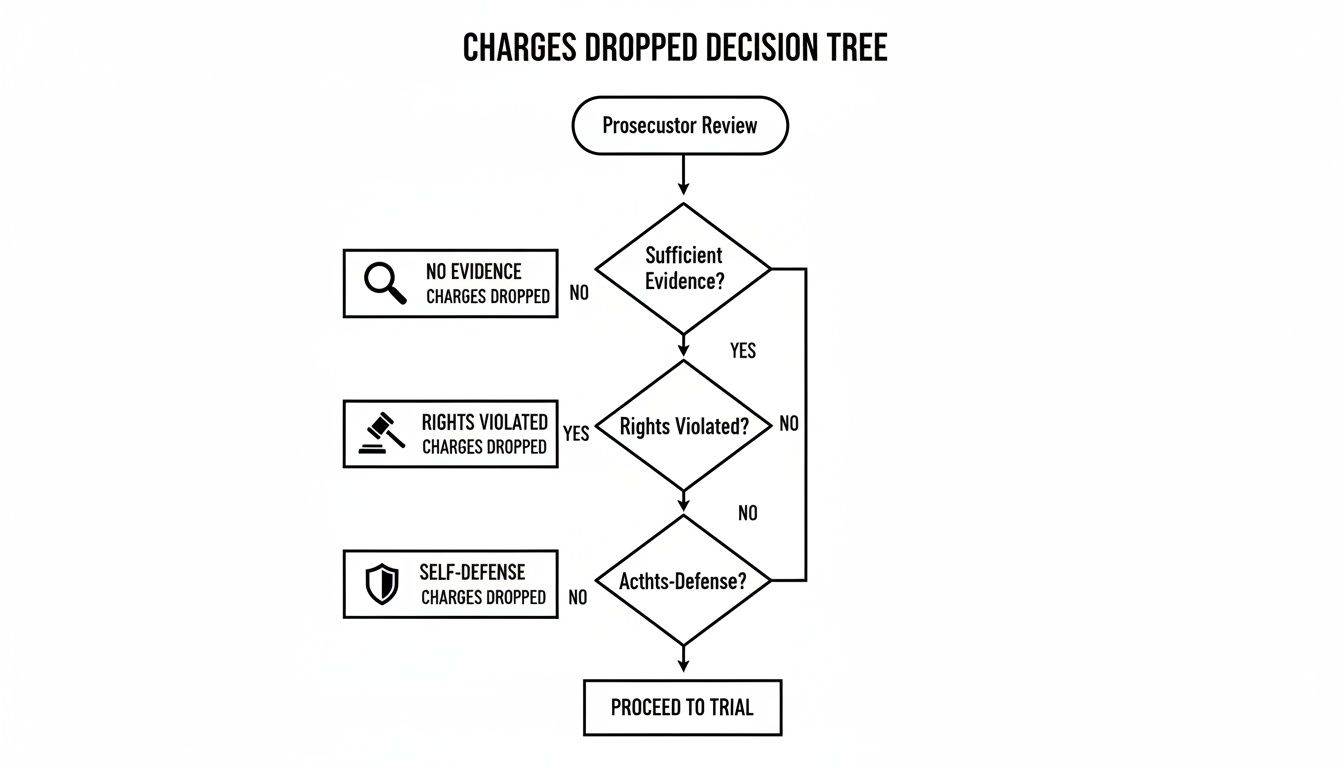
As you can see, a dismissal often hinges on proving the state's case is fundamentally flawed, whether due to a lack of solid proof, procedural errors, or a valid legal defense like self-defense.
An experienced lawyer has a full toolkit of legal strategies they can use to protect you. Below is a look at some of the most common—and effective—approaches.
Comparing Legal Defense Strategies for Assault Charges
The table below breaks down some of the key legal maneuvers a defense attorney can deploy. Each one has a specific goal and is best used in certain situations, but they all aim to achieve the best possible outcome for you.
| Legal Strategy | Primary Goal | When It's Most Effective | Potential Outcome |
|---|---|---|---|
| Motion to Suppress Evidence | To exclude illegally obtained evidence from the case. | When police violated your constitutional rights during a search, seizure, or interrogation. | Key evidence is thrown out, potentially forcing the prosecutor to dismiss the case entirely. |
| Pre-Trial Diversion (PTD) | To complete a court-approved program in exchange for a dismissal. | For first-time offenders in less severe assault cases who are willing to meet specific conditions. | Charges are formally dismissed upon successful completion of the program. |
| Plea Negotiations | To reduce the original charge to a lesser offense or arrange for a dismissal after probation. | When the evidence against you is significant but there's room to negotiate a better outcome than trial. | The assault charge is reduced (e.g., to disorderly conduct) or dismissed after deferred adjudication. |
| Independent Investigation | To uncover new evidence that weakens the prosecution's case. | When there are eyewitnesses, surveillance footage, or other facts the police missed or ignored. | New exculpatory evidence is presented to the prosecutor, leading to a dismissal. |
These strategies aren't mutually exclusive, and a good lawyer will often use a combination of tactics tailored to the unique facts of your case.
Filing a Motion to Suppress Evidence
One of the most powerful tools in a defense lawyer’s arsenal is the Motion to Suppress. This is a formal request asking the judge to throw out evidence because it was obtained illegally, violating your constitutional rights. If the judge grants the motion, that evidence is gone. It cannot be used against you in court.
Imagine the police searched your car without a warrant or probable cause and found something they want to use against you. Your attorney would immediately file a motion arguing the search was unconstitutional. If the judge agrees, that evidence is out. Sometimes, that's enough to gut the prosecution’s entire case, leaving them with no choice but to dismiss the charges.
A Motion to Suppress isn't about arguing your innocence. It's about holding law enforcement accountable and ensuring the rules were followed. When they aren't, the case against you can completely collapse.
Negotiating for Pre-Trial Diversion
For many first-time offenders, especially in less serious assault cases, a Pre-Trial Diversion (PTD) program can be a lifeline. Think of it as an alternative to a traditional court battle that allows you to earn a dismissal. It’s essentially a contract between you and the prosecutor's office.
If you’re accepted into a PTD program, you’ll have to complete certain conditions. These often include:
- Attending anger management classes or counseling sessions
- Completing a set number of community service hours
- Paying restitution to the alleged victim, if applicable
- Staying out of legal trouble for a specific period (usually 6-12 months)
Once you successfully check all the boxes, the prosecutor formally dismisses your case. This lets you avoid a criminal conviction and, down the road, you can often get the arrest cleared from your public record. An attorney is crucial for negotiating your entry into one of these programs. For a deeper dive into the dismissal process, check out our guide on how to get criminal charges dropped.
Using Plea Negotiations to Secure a Dismissal
Sometimes, the smartest path forward involves strategic negotiation. Your attorney might engage in plea bargaining with the prosecutor to get the assault charge knocked down to a much lesser offense, like disorderly conduct. This is often a win-win: the prosecutor gets a conviction for a minor offense, and you dodge the life-altering consequences of an assault conviction on your record.
In some situations, a plea deal can even be structured to result in an eventual dismissal. For example, you might plead guilty to a lesser charge in exchange for "deferred adjudication," which is a form of probation. If you complete the probation period successfully without any new trouble, the case is dismissed, and you won't have a final conviction. This strategy is an excellent way to resolve a case without the stress and uncertainty of a trial.
Immediate Steps to Take After an Assault Accusation
The moments after being accused or arrested for assault are a blur of fear and confusion. It's easy to feel completely disoriented, but what you do—and more importantly, what you don't do—in these first few hours can dramatically impact the outcome of your case.
Taking the right actions right away is about protecting your rights and starting to build a strong defense. The goal is to get the charges dropped, and that work begins now.

This is not the time to panic or try to explain your side of the story to the police. It's time for careful, deliberate action.
Exercise Your Right to Remain Silent
This is the single most important action you can take. You have a constitutional right to remain silent, and you must use it. Anything you say to law enforcement can and will be twisted and used against you, even if you are innocent and only trying to be helpful.
Politely but firmly state, "I am exercising my right to remain silent, and I would like to speak with an attorney." Then, stop talking. Do not answer questions, offer explanations, or apologize. Your silence cannot be used as proof of guilt, but your words most certainly can.
Contact an Experienced Defense Attorney Immediately
Time is not on your side. The prosecutor's office begins building its case against you from the moment of arrest. You need a skilled advocate in your corner to start building your defense just as quickly.
The period between an arrest and the formal filing of charges is a critical window. An attorney can often intervene during this phase, presenting exculpatory evidence to the prosecutor before they even make a final charging decision. This early intervention can sometimes stop a case in its tracks.
When you need legal help right away, services like lawyers on demand can offer rapid expert assistance. Whatever you do, don't wait until your first court date, which is usually the arraignment. You can learn more about what happens at an arraignment hearing to see why having your lawyer there from the start is so vital.
Preserve All Potential Evidence
Memories fade, and digital evidence can disappear. As soon as possible, write down everything you remember about the incident. At the same time, gather any proof that could support your case.
This evidence might include:
- Text Messages and Emails: Save every conversation you had with the accuser or any witnesses. These can provide crucial context or even contradict the allegations.
- Social Media Posts: Take screenshots of relevant posts from yourself, the accuser, or anyone else involved.
- Photos and Videos: Keep any pictures or recordings from around the time of the incident, especially any that show injuries you sustained.
- Witness Information: Make a list of names and contact information for anyone who saw what happened or can speak to your character.
Comply with All Bail and Bond Conditions
Once you are released from jail, you will be given specific rules to follow. If you violate any of these terms, your bond can be revoked, and you will end up back behind bars. It also makes you look uncooperative to the court—the last thing you want.
The most common and important condition is a No-Contact Order. This means you cannot communicate with the alleged victim in any way—no calls, texts, emails, or even messages passed through a friend. Following these rules isn't a suggestion; it's non-negotiable and absolutely essential for a successful defense.
Clearing Your Record After a Dismissal
Getting the news that your assault charges have been dropped brings an incredible wave of relief. It feels like the end of a nightmare. However, there is one final, critical step you must take to truly put this chapter behind you and protect your family’s future.
Even after a dismissal, the record of your arrest does not simply vanish. It remains publicly accessible, a ghost that can haunt you for years. This record can appear on background checks, creating serious obstacles when you apply for a job, try to rent a home, or seek a professional license.
Wiping the Slate Clean
For many Texas families, this is a shocking realization. The good news is that you have powerful legal options to permanently clear your name. This is where an expunction or an order of nondisclosure comes into play. These are not just legal technicalities; they are tools for reclaiming your life.
Think of it this way: a dismissal stops the immediate threat, but an expunction heals the wound completely. It allows you to move forward without the shadow of a false or unproven accusation following you.
Expunction vs. Order of Nondisclosure
Understanding the difference between these two remedies is key. They both offer protection, but one provides a much cleaner break from the past.
- Expunction: This is the gold standard. An expunction, sometimes called "expungement," results in the physical destruction of all records related to your arrest. It’s as if it never happened. You can legally deny the arrest ever occurred on any application.
- Order of Nondisclosure: This remedy seals your record from public view. While law enforcement and certain government agencies can still see it, private entities like employers and landlords cannot.
Eligibility for each depends on the specifics of your case. Generally, you can seek an expunction if your case was dismissed outright, you were acquitted at trial, or you successfully completed a pre-trial diversion program. We can help you understand the process of how to seal a criminal record in Texas and determine which path is right for you.
Post-conviction relief options like expunctions are vital for those who have been wrongly charged. With data suggesting around 5% of accusations may be false and that the vast majority of assault cases do not result in jail time, it's clear that charges often vanish—especially with experienced counsel protecting your rights. You can learn more about these trends in criminal justice.
Frequently Asked Questions About Dropping Assault Charges
When you’re facing an assault accusation, your mind races with a thousand questions. It can feel like you're lost in a legal labyrinth. We understand. Here are clear, straightforward answers to the questions we hear most often from Texas families going through this stressful time.
How Long Does It Take for Assault Charges to Be Dropped?
There’s no magic number. Getting an assault charge dropped in Texas can take anywhere from a few weeks to several months, depending entirely on the specific facts of your case.
Several factors influence this timeline:
- Case Complexity: A straightforward case with clear evidence of self-defense might be dismissed relatively quickly. A more complicated situation will naturally take longer to resolve.
- The Prosecutor’s Workload: The reality is that District Attorney's offices are often overwhelmed. A heavy caseload can create delays that are outside of your control.
- Your Defense Strategy: A proactive defense attorney who gets involved early can sometimes accelerate the process. By presenting convincing evidence to the prosecutor before formal charges are filed, they can often bring about a faster resolution.
An experienced lawyer can assess your situation and give you a realistic idea of what to expect.
Can Domestic Assault Charges Be Dropped?
Yes, they absolutely can be—but it is almost always a tougher fight. Prosecutors and judges in Texas take family violence allegations extremely seriously. Most D.A.'s offices have special divisions dedicated to these cases and are trained to push forward even if the accuser changes their story or signs an affidavit of non-prosecution. An accusation alone can also trigger a CPS investigation under Texas Family Code Chapter 262, raising the stakes significantly for parents.
That said, a dismissal is far from impossible. A strong defense that uncovers evidence of false allegations, proves you were defending yourself, or highlights major holes in the state's case can certainly lead to the charges being dropped. The bar is just higher.
Does an Affidavit of Non-Prosecution Guarantee a Dismissal?
No, it does not, and this is a critical point for families to understand. An affidavit of non-prosecution is a sworn statement from the alleged victim telling the D.A. they don’t want to press charges and wish for the case to be dropped. While it is a powerful piece of evidence for your lawyer, the prosecutor is under no legal obligation to honor it.
Think of an affidavit of non-prosecution as a powerful tool, not a magic bullet. It seriously weakens the prosecutor’s case by showing their star witness is uncooperative, but the State of Texas can still legally move forward if they think they have enough other evidence to secure a conviction.
If My Case Is Dropped Will I Get My Legal Fees Back?
In nearly every situation, the answer is no. You are responsible for paying your own legal fees, regardless of the case's outcome. The court system does not reimburse defendants for their attorney's fees, even if you are found "not guilty" or the case is dismissed. This is precisely why investing in skilled legal help from the very beginning is so important—the goal is to achieve the best possible outcome efficiently, protecting both your freedom and your finances.
The weight of an assault charge is heavy, but you should not have to carry it alone. At The Law Office of Bryan Fagan, PLLC, we understand the profound fear and stress you and your family are facing, especially when the threat of a CPS case looms. Our team is here to offer compassionate support and mount a vigorous defense to protect your rights, your future, and your family. If you are dealing with an assault accusation, contact us today for a free, confidential consultation to discuss your case and learn how we can help.