Skip to content
The flashing red and blue lights in your rearview mirror can feel like a nightmare. One minute, you're a parent driving home; the next, you're facing a DWI arrest, and your mind is racing with questions. How will this affect my kids? My job? My family's future? The fear and confusion in that moment are overwhelming, and it's easy to feel like your world is collapsing.
We understand. At The Law Office of Bryan Fagan, we work with Texas families facing their toughest moments. An arrest is not a conviction, and this is not the end of your story. It is the beginning of a legal process where having a compassionate, knowledgeable guide is crucial. This guide is for you—the parent trying to protect your family while navigating the complexities of a 1st DWI offense in Texas.
What Happens After a First DWI Arrest in Texas
A first-time DWI in Texas is typically charged as a Class B Misdemeanor. That's a serious charge carrying potential penalties like fines up to $2,000, jail time ranging from 72 hours to 180 days, and a driver's license suspension. While that’s the standard, the actual outcome depends entirely on the specific facts of your case and the strength of your defense.
This is a tough situation, but it's not hopeless. Let's break down what happens right after the arrest.
The Immediate Aftermath of a DWI Arrest
From the moment an officer pulls you over, they are conducting an investigation designed to build a case against you. It's an intimidating process, but every step is governed by strict legal rules.
Here’s what that investigation usually looks like:
- The Initial Traffic Stop: The officer can't just pull you over for no reason. They need "reasonable suspicion"—a valid reason like speeding, swerving, or another traffic violation—to initiate the stop.
- Field Sobriety Tests: You'll likely be asked to perform a series of physical tests on the side of the road, known as Standardized Field Sobriety Tests (SFSTs). These are coordination exercises used to establish probable cause for an arrest.
- Chemical Testing (BAC): The officer will then request a breath or blood sample to measure your Blood Alcohol Concentration (BAC). In Texas, the legal limit for most drivers is 0.08%.
- Arrest and Booking: If the officer believes they have enough evidence, you'll be arrested, taken to jail, and formally booked.
This all happens incredibly fast, and it’s easy to feel like you have no control. But here's the thing: every single part of that process will be scrutinized by a skilled defense attorney. Was the initial stop legal? Were the sobriety tests administered correctly? Were there issues with the breathalyzer? Flaws in police procedure can become the foundation of a powerful defense.
It's a common myth that getting arrested for DWI means you're automatically guilty. The truth is, an arrest is just the beginning of a long legal fight. A strong defense can challenge the evidence and work towards getting the charges reduced or even dismissed entirely.
This guide will break down the two separate legal battles you’ll face—the criminal case in court and the administrative fight to save your driver's license. While this is a serious challenge, it's one you can manage with the right information and the right legal team fighting for you. Your future is worth it.
Understanding the Two Legal Battles You Must Fight
After a DWI arrest, it’s easy to get tunnel vision and assume you’re facing just one legal problem. But that’s a dangerous mistake. The reality is that you are immediately thrown into a fight on two completely separate fronts, each with its own set of rules, deadlines, and potential consequences.
This is a critical detail that many people facing a 1st DWI offense in Texas don't realize until it's far too late.
The first front is the criminal case. This is the one everyone pictures: the State of Texas, represented by a prosecutor, trying to convict you of a crime. This path involves court dates, digging through evidence, and facing penalties like hefty fines, probation, or even jail time.
The second—and far more urgent—battle is the Administrative License Revocation (ALR) process. This is a civil case brought by the Texas Department of Public Safety (DPS) with a single, focused goal: to suspend your driver’s license. These two cases run on parallel tracks, and what happens in one doesn't automatically dictate the outcome of the other.
This flow chart helps visualize the two distinct paths your case takes the moment you're arrested.
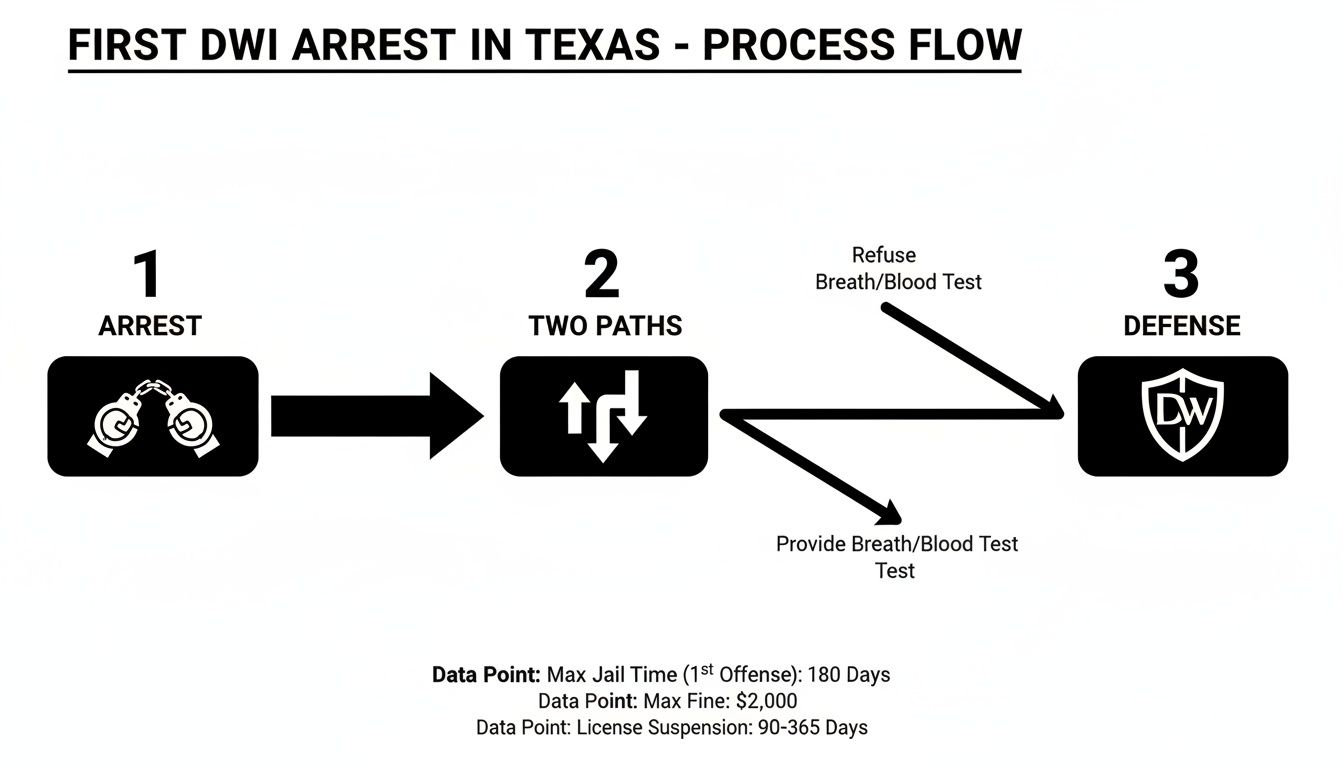
As you can see, the arrest immediately splits into simultaneous criminal and administrative proceedings. Both demand a smart, strategic defense right from the start.
To make this clearer, let's break down how these two cases differ and what's at stake in each.
Criminal Case vs ALR Hearing At a Glance
The following table offers a side-by-side look at the key differences between the criminal court case and the administrative license hearing. It's crucial to understand these distinctions because the strategy for each is completely different.
| Aspect | Criminal Court Case | Administrative License Revocation (ALR) Hearing |
|---|---|---|
| Purpose | To determine guilt or innocence of a DWI crime. | To determine if DPS can legally suspend your driver's license. |
| Parties Involved | State of Texas (Prosecutor) vs. Defendant | Texas Department of Public Safety (DPS) vs. Driver |
| Standard of Proof | Beyond a reasonable doubt (a very high standard). | Preponderance of the evidence (just enough evidence to show it's more likely than not). |
| What's at Stake? | Freedom, criminal record, fines, probation, jail time. | Driving privileges. |
| Timeline | Slower; can take several months or even over a year to resolve. | Extremely fast; you have only 15 days to request a hearing. |
| Key Deadline | Varies by court and procedural step. | 15 days from arrest to request the hearing. This is absolute. |
Understanding this table is the first step toward building a solid defense. You simply can't treat them as one and the same.
The Criminal Case: Your Freedom and Your Record
The criminal case is where the state must prove, beyond a reasonable doubt, that you were operating a motor vehicle in a public place while intoxicated. This is a high bar for the prosecution to clear, and a skilled attorney can challenge every single piece of the state's evidence—from the traffic stop to the chemical test results.
Here's what this process typically involves:
- Court Appearances: You'll have several required court dates, starting with an arraignment where you'll enter a plea of "not guilty."
- Discovery Process: Your lawyer will get their hands on all the evidence the state has against you. Think police reports, dashcam and body camera videos, and the results from any breath or blood tests.
- Negotiations and Trial: Many DWI cases are resolved through plea negotiations. However, you always have the constitutional right to take your case to trial, where a judge or jury will decide your fate.
A conviction here means a permanent mark on your record and the serious penalties discussed throughout this guide. For a deeper dive into defense strategies, you can learn more about how to fight a DWI in Texas in our detailed article.
The ALR Hearing: Your Driving Privileges
While the criminal case slowly churns through the court system over months, the ALR process moves at lightning speed. And it contains the single most important deadline in your entire DWI case.
You have only 15 days from the date of your arrest to formally request an ALR hearing. If you miss this deadline, your license gets suspended automatically. No second chances.
This hearing isn’t about whether you're guilty of a crime. The judge is only there to decide if DPS had the right to take your license in the first place. All DPS has to prove is that the officer had reasonable suspicion for the stop and probable cause for the arrest.
This is where hiring a lawyer immediately becomes critical. Experienced and specialized DUI/DWI lawyers know this 15-day deadline is non-negotiable and understand how to challenge the state’s evidence within the narrow scope of this hearing. Losing your license can upend your life, making it impossible to get to work, run errands, or take care of your family. The ALR hearing is a battle you absolutely cannot afford to ignore.
The Real Penalties for a First DWI Conviction
When the legal system slaps the label "Class B Misdemeanor" on a 1st DWI offense in Texas, it's easy to dismiss. The term sounds almost administrative, far less scary than the reality. But don't get lost in the legal jargon—a conviction is much more than just a label. It kicks off a domino effect of penalties that can throw your finances, your freedom, and your family's stability into chaos for years.
The penalties you see in the law books are just the tip of the iceberg. That initial fine? It's often just a fraction of what you'll actually end up paying. Getting a clear picture of the full cost is the first step in understanding exactly what a dedicated DWI attorney is fighting to protect you from.
Breaking Down the Standard Class B Misdemeanor Penalties
For a standard, run-of-the-mill first DWI where your Blood Alcohol Concentration (BAC) is under 0.15, the law sets out a specific range of punishments. These are the foundational penalties that prosecutors use as a starting point for plea deals and that judges hand down in sentencing.
Consider a real-life scenario: A mother is driving home after a celebratory dinner for her anniversary. She felt fine to drive, but a minor traffic error leads to a stop. A breathalyzer puts her just over the 0.08 limit. Suddenly, she's not just a parent; she's a defendant facing a Class B Misdemeanor. While the law lists fines up to $2,000, court costs and state fees can quickly push that total closer to $5,000. She's also facing a mandatory 72 hours in jail and a license suspension of up to a year, creating an immediate crisis for getting her kids to school and herself to work. This is the reality many Texas parents face. You can find more details on the penalties for a first DWI offense in Texas on ULG Law.
When the Stakes Get Higher: A BAC of 0.15 or More
Things get a whole lot more serious if your BAC comes back at 0.15 or higher. The law sees this as a much more dangerous level of impairment, and the penalties get ramped up to match that severity.
A high BAC takes a first DWI from a Class B to a Class A Misdemeanor. That one little change has a huge impact on the potential consequences:
- Heftier Fines: The maximum fine immediately doubles, jumping from $2,000 to $4,000.
- More Potential Jail Time: The maximum jail sentence balloons from 180 days to up to one full year.
- Mandatory Ignition Interlock: A conviction almost guarantees you'll have to install an ignition interlock device on your car just to be able to drive.
This isn't just a minor tweak; it completely changes the game. The prosecutor has far more leverage, and the judge has a much wider array of harsh punishments at their disposal.
The Hidden Costs Beyond Fines and Jail
The true cost—both financially and personally—of a DWI conviction goes far beyond what happens in the courtroom. These are the "hidden" penalties that stick with you long after your case is officially closed. For many families, these are the consequences that cause the most stress and strain.
A DWI conviction is more than a legal problem; it's a life problem. The court-ordered penalties are just the beginning. The ongoing costs and requirements create a long-term financial and logistical burden that can be incredibly difficult to manage.
These additional requirements aren't suggestions; they're mandatory parts of probation, designed to be both a punishment and a lesson.
- DWI Education Program: You’ll have to attend a 12-hour state-approved DWI education class.
- Victim Impact Panel (VIP): You will be required to sit through a panel where victims of drunk driving accidents share their heartbreaking stories.
- Community Service: Expect to be ordered to complete anywhere from 24 to 100 hours of community service.
- Probation Fees: Every month, for up to two years, you'll be paying fees to the county just for the privilege of being on probation.
- Ignition Interlock Device (IID): If the court orders it, you're on the hook for the installation cost (around $100) plus monthly monitoring fees (about $80-$100).
- SR-22 Insurance: Get ready for your car insurance rates to go through the roof. You'll also have to file an SR-22 certificate with the state for years, which essentially brands you as a high-risk driver.
When you start adding it all up, the real price tag for a first DWI conviction can easily soar past $10,000. This is the financial storm that an experienced DWI defense attorney works to help you avoid or navigate.
How to Save Your Driving Privileges
For most of us in Texas, a driver's license isn't a luxury—it's the key to our daily lives. Losing your ability to drive can throw your entire world into chaos. Simple things like getting to work, picking up the kids from school, or even grabbing groceries become logistical nightmares. This is exactly why the fight to save your driving privileges after a 1st DWI offense in Texas is so urgent and so critical.
The most important thing to grasp right away is that this battle happens on a very tight timeline. As we've mentioned, you're fighting two separate cases at once. The one against your license—the Administrative License Revocation (ALR) process—moves at lightning speed.
The Critical 15-Day Deadline for an ALR Hearing
From the moment of your arrest, a countdown clock starts ticking. You have exactly 15 days to formally request an ALR hearing with the Texas Department of Public Safety (DPS). Miss this deadline, and your license will be automatically suspended. No second chances.
This hearing is your one and only shot to challenge the state's attempt to take your license before your criminal case even gets rolling. It’s a civil proceeding, completely separate from the criminal court, and it has a much lower burden of proof. The DPS only needs to show it was "more likely than not" that the officer had a valid reason to stop you and make the arrest.
A sharp attorney can use the ALR hearing to pick apart the officer's actions and testimony. They'll scrutinize every detail:
- Did the officer have a legitimate reason (reasonable suspicion) to pull you over in the first place?
- Did they have enough reason (probable cause) to believe you were intoxicated and make an arrest?
- Was the breath or blood test administered correctly, following every single legal protocol?
Even if you don't win the hearing, it's an invaluable "test run" for your criminal case. It gives your attorney a chance to question the arresting officer under oath, locking in their story and often uncovering weaknesses that can be used to your advantage later on.
Securing an Occupational Driver's License
So, what happens if you miss the 15-day window or the judge rules against you at the hearing? You're not necessarily stranded. The next move is to petition the court for an Occupational Driver's License (ODL), sometimes called an essential need license.
An Occupational Driver's License is a special, restricted license that allows you to drive to and from specific locations for essential reasons. It's a lifeline that keeps your world from grinding to a halt while your license is suspended.
An ODL isn't a free pass to drive wherever and whenever you want. It comes with strict limitations set by a judge, designed to ensure you can only drive for truly necessary activities, such as:
- Traveling to and from your job.
- Getting to school or other educational programs.
- Performing essential household duties, like taking your kids to school or daycare.
- Attending court dates, probation meetings, or counseling sessions.
The judge will spell out the exact hours you can drive (often a 4-hour or 12-hour window) and the specific counties where you can operate a vehicle. Depending on the details of your case, the judge might also require you to install an ignition interlock device (IID) on your car as a condition of getting the ODL. For a complete walkthrough, our guide on how to get an occupational license in Texas breaks down the entire process.
Acting fast to request the ALR hearing and, if needed, petition for an ODL is absolutely vital to keeping your family's life on track.
The Long-Term Impact on Your Family and Career
When a Texas judge hands down a sentence for a 1st DWI, that’s just the opening act. The real, lasting damage often comes later, creating ripples that spread through your family, your finances, and your career for years to come. For the Texas parents and families we work with, these hidden consequences are what cause the most stress long after the court case is over.
One of the first financial gut punches usually comes from your auto insurance company. A DWI conviction immediately gets you re-labeled as a high-risk driver. That new label means your insurance premiums are going to skyrocket—often doubling or even tripling. And that price hike isn't temporary; it can stick with you for three to five years.
The SR-22 and Professional Licensing Risks
On top of the higher premiums, you’ll have to file an SR-22 certificate with the state just to keep your policy active. An SR-22 isn’t actually insurance. It’s a form your provider files to prove you have the minimum liability coverage Texas requires. Think of it as a constant flag on your driving record, and if your coverage lapses for even a day, your license will be suspended all over again.
The fallout can seep directly into your career, especially if you hold a professional license or drive for a living. For teachers, nurses, pilots, or commercial drivers, a DWI conviction can trigger a review by your licensing board. Suddenly, the license you worked so hard to earn could be on the line, facing suspension or even revocation.
A permanent criminal record complicates life in ways most people never see coming. It becomes a barrier when you're applying for a new job, trying to get a promotion, or even just renting an apartment. For parents, it can become a weapon used against you in a child custody battle.
Why Fighting the Charge Is Worth It
The weight of the system feels crushing, and it's easy to think fighting is pointless. The arrest numbers in Texas certainly paint a stark picture of how common these charges are—and how often they stick. In 2020 alone, the Texas Department of Public Safety reported 83,088 DWI charges, with over 97% leading to formal charges. Out of those, a staggering 33,476 people pled guilty, while only 1,826 entered not guilty pleas. That shows just how intimidating the process feels without a strong lawyer in your corner.
But here’s the critical part: outcomes change dramatically depending on where you are and the defense you build. In Dallas County, for instance, about 45-55% of first-time, non-injury DWIs end in a non-conviction. Harris County is tougher, with a 40-50% rate. These numbers prove one thing: a strategic defense can make all the difference. You can dig deeper into these DWI statistics and trends on Shawn Brown Law.
- Employment: Most job applications ask if you have any misdemeanor or felony convictions. A DWI on your record can get your application tossed in the trash, limiting your career path.
- Housing: Landlords run background checks. A recent criminal conviction is often all it takes for a rental application to be denied, making it harder to find a stable home for your family.
- Family Law: While a single DWI won't usually be the sole reason to lose custody, it can be used as proof of poor judgment. This can seriously complicate custody agreements and visitation rights.
Fighting a DWI charge is really an investment in protecting your family’s stability and your professional future. Avoiding a conviction means you get to sidestep all these long-term consequences that can follow you around for years. That's why having a skilled defense from day one is so essential.
Clearing Your Record After a First DWI Case

The fear that a single mistake will follow you forever is a heavy weight to carry after a DWI arrest. A lot of people believe a 1st DWI offense in Texas automatically creates a permanent criminal record, but that simply isn’t always true. Texas law provides pathways to a second chance—real opportunities to move forward with a clean slate.
Knowing about these options from the very beginning can give you some peace of mind and shows why it’s so critical to fight the charge from day one. In Texas, there are two primary tools for clearing your name: expunctions and orders of nondisclosure. Each one works differently and has its own strict set of rules for who qualifies.
Expunction: The Path to Wiping the Slate Clean
Think of an expunction as hitting the delete button on your arrest record. It's the most powerful option out there because it legally allows you to deny the arrest ever happened. But because it’s so powerful, the eligibility is extremely narrow and usually reserved for cases that end with the best possible outcome.
You might be eligible for an expunction if your DWI case ended in one of these ways:
- Acquittal: You went to trial and a judge or jury found you "not guilty."
- Dismissal: The prosecutor decided to drop the charges against you.
- Pardon: You received an official pardon from the Governor of Texas.
When a judge grants an expunction, all government agencies are ordered to destroy their records of your arrest. It’s as if it never happened, offering a true fresh start.
Nondisclosure: Sealing Your Record from Public View
What if your case didn't get dismissed or end in an acquittal? There’s still hope. An order of nondisclosure is the next best thing to an expunction. It doesn't erase the record, but it seals it from the public. This means that when potential employers, landlords, or nosey neighbors run a background check, they won't see it.
For a first-time DWI, you could qualify for nondisclosure if you successfully completed a special kind of probation, like deferred adjudication. Texas law has also opened the door for some first-time offenders to seal their records even after completing regular probation, as long as certain conditions are met (for example, your BAC wasn't 0.15 or higher). We can give you a detailed breakdown of how long a DWI stays on your record and determine if your case qualifies for sealing.
Facing a first DWI in Texas isn't a dead end. Stats show a skilled defense can dramatically slash the worst outcomes. While a standard offense carries up to 180 days in jail and a $2,000 fine, a good attorney can make a world of difference. Dismissal rates can be as high as 34% in some Texas courts, and a victory like that is what opens the door to getting your record cleared.
It’s crucial to understand how quickly the penalties ramp up. If your BAC was 0.15 or higher, the charge gets bumped to a Class A Misdemeanor, with up to a year in jail and a $4,000 fine. These pathways to clearing your record are precisely why fighting for the best possible result from the moment of arrest is so incredibly important.
Common Questions After a First DWI Arrest in Texas
When you're staring down a 1st DWI offense in Texas, the questions can feel like a tidal wave. They’re the kind of worries that keep you up at night, replaying every moment. My goal here is to cut through that noise and give you straight answers to the questions I hear most often from families in your exact situation.
Should I Refuse a Breathalyzer or Blood Test?
This is probably one of the toughest, most high-stakes decisions you can make on the side of the road. Texas has an "implied consent" law, which means that just by having a driver's license, you’ve already technically agreed to give a breath or blood sample if an officer lawfully arrests you for DWI.
Here's the catch-22: Refusing the test automatically triggers a driver's license suspension through a separate civil process. While it means the prosecutor won't have a neat piece of scientific evidence showing your BAC, it doesn't stop them from filing charges. It just creates a definite license penalty while they build their case another way. There's no easy answer here, and the fallout is immediate, which is why it's a decision best discussed with an attorney right away.
Will I Definitely Go to Jail for My First DWI?
This is the big one—the fear that overshadows everything else. While jail time is technically on the table (up to 180 days for a standard first-time offense), it is not the typical outcome for a straightforward case.
Unless there are aggravating factors—like a car accident, a child in the car, or a very high BAC—most judges will sentence first-time offenders to community supervision, also known as probation, instead of jail. But getting to that point requires a solid legal strategy. A strong defense is what stands between you and the worst-case scenario.
The total cost of a first DWI conviction can easily spiral to between $5,000 and $10,000. That number includes everything from fines and court costs to probation fees and skyrocketing insurance rates.
How Much Does a First DWI Actually Cost?
The financial hit is way more than just the court-ordered fine, which can be up to $2,000. The real cost is a slow burn of fees and expenses that stack up over months and even years.
You're not just paying a single fine. You're looking at a mountain of costs, including:
- The initial fine and all the associated court costs.
- Monthly fees to your probation officer.
- The cost of hiring an attorney to defend you.
- Dramatically higher insurance premiums and SR-22 filing fees.
- Installation and monthly monitoring for an ignition interlock device.
- Tuition for mandatory DWI education classes.
Fighting the charge isn't just about your record; it's a direct investment in protecting your family from these crushing, long-term financial burdens.
A DWI arrest can leave you feeling lost and alone, but you do not have to go through this by yourself. At The Law Office of Bryan Fagan, we understand what is at stake for you and your family. We are here to provide clear, compassionate legal guidance and fight to protect your future. Your family’s well-being is our priority. Contact us today for a free, confidential consultation to discuss your case and learn how we can help you navigate this difficult time.