Skip to content
The moment a Child Protective Services (CPS) caseworker knocks on your door, your world can feel like it's spinning out of control. The question, "Can CPS take my child in Texas?" goes from a distant fear to a heart-pounding reality. It's a moment filled with confusion, panic, and a desperate need for answers. You feel judged, scared, and completely alone, fearing that one wrong word could tear your family apart.
Yes, CPS can take your child in Texas, but they cannot do so on a whim. The law sets an incredibly high bar for such a drastic step, requiring concrete evidence of an immediate danger to your child’s physical health or safety. A CPS investigation does not automatically mean your child will be removed.
This guide is here to replace that anxiety with knowledge. At The Law Office of Bryan Fagan, we understand the fear you're experiencing. We want to provide the clear, practical guidance you need to navigate this challenge. We will walk you through the process, grounding our advice in Texas Family Code, so you understand your rights and can protect your family.
The Moment Your World Stops: A CPS Knock on the Door
Nothing can prepare you for that heart-stopping knock and the flood of fear that comes with finding a CPS caseworker on your doorstep. Suddenly, the question, "Can CPS take my child in Texas?" isn't some distant worry—it's a terrifying, in-your-face reality. That single knock can feel like the ground has crumbled beneath you, leaving you confused, anxious, and desperate for answers.

This guide is here to replace that anxiety with knowledge. At The Law Office of Bryan Fagan, we know from experience that an investigation is not a conviction, and a home visit does not mean a guaranteed removal. We're going to walk you through this process step-by-step, grounding everything in Texas law so you understand exactly what your rights are and what to expect.
Why Is CPS at My Home?
If CPS—also known as the Department of Family and Protective Services (DFPS)—shows up, it’s because someone has filed a report alleging child abuse or neglect. In Texas, literally anyone can make a report, including:
- Teachers or other school officials
- Doctors, nurses, or hospital staff
- Neighbors, friends, or family members
- Even an anonymous caller
The caseworker's job is to investigate that report and figure out if a child is truly safe. It's crucial to remember that false reports do happen, and many situations are simply misunderstood. A CPS home visit in Texas can feel incredibly intrusive, but how you handle it can change everything.
A Real-Life Scenario: A Misunderstood Injury
Picture this: A mom, Maria, is at home with her toddler. He’s an active, clumsy little boy who took a tumble at the playground yesterday and now has a large, nasty-looking bruise on his forehead. A well-meaning neighbor spots the bruise through the window, fears the worst, and calls the CPS hotline.
When the caseworker arrives, Maria is blindsided by panic. She’s terrified that any word she says could be twisted and used to take her child away from her. She doesn’t know her rights or what to do.
This feeling of dread is completely normal. But what you do in this moment can significantly steer the direction of the entire investigation. Your goal is to stay calm, be cooperative but cautious, and know that you have rights.
This guide is your first step toward getting back a sense of control. It will arm you with the information you need to protect your family. We firmly believe that with compassionate guidance and a clear understanding of the law, you can face this challenge head-on and work toward the best possible outcome for you and your children.
The Legal Standard for Child Removal in Texas
When a CPS caseworker shows up at your door, the single most terrifying question running through your mind is, "Can they just take my child?" The answer is a hard no—they can’t remove your child based on a hunch, a single anonymous phone call, or a messy living room. Texas law, specifically Chapter 262 of the Texas Family Code, sets a very high and specific legal bar that CPS must clear before they can take the drastic step of separating a family.
This legal standard isn’t there to judge your parenting style or punish you for a mistake; it’s designed to protect families from unwarranted government overreach. The entire system is supposed to revolve around one core concept: immediate danger.
Defining Immediate Danger
So what does "immediate danger" actually mean in the eyes of a judge? It’s much more than just a vague concern. To justify removal, CPS needs credible evidence showing there is an active, ongoing, and serious risk to your child's physical or emotional well-being right now.
This is a critical distinction. A one-time argument, a disorganized home, or letting your teenager stay out a little past curfew will almost never meet this threshold. CPS has to prove that leaving the child in the home would expose them to a real, immediate threat.
According to the Texas Family Code, there must be a "danger to the physical health or safety of the child" that makes removal necessary. This means the caseworker needs actual facts, not just suspicions or personal opinions, to back up their actions.
This high legal standard is a safeguard, ensuring a temporary crisis or a misunderstanding doesn't lead to the trauma of removing a child from their home. For a deeper dive into the specific criteria CPS has to follow, you can learn more about the specifics of child removal procedures in Texas CPS investigations.
Emergency Removal vs. Court-Ordered Removal
CPS can remove a child in two main ways, and both depend on that idea of immediate danger. Understanding the difference between them is vital for knowing your rights.
Emergency Removal Without a Court Order: This is the most urgent and serious scenario. It only happens when a caseworker believes a child is in such immediate peril that there’s absolutely no time to get a judge's permission. This is reserved for extreme situations, like finding a child with severe, unexplained injuries, a parent who is dangerously intoxicated and unable to function, or a home where illegal drugs and weapons are easily accessible.
Removal With a Court Order: More often, if CPS believes a child is unsafe but not in imminent peril, they have to go to a judge first. They present their evidence and ask the judge for a court order that authorizes the removal. This process gives a neutral third party—the judge—the opportunity to review the facts and decide if breaking up your family is truly necessary.
A Relatable Scenario
Imagine a parent, John, who is recovering from surgery and has a legal prescription for pain medication. An angry ex-partner decides to cause trouble and calls CPS, falsely claiming John is abusing drugs and neglecting their child. When the caseworker arrives, the house is a bit messy and John looks tired, but the child is clean, fed, and seems perfectly happy.
In this situation, there is no immediate danger. The caseworker has no evidence of drug abuse or neglect. They cannot just take John's child. Instead, their job is to continue the investigation, which might include asking John to sign a release for his medical records to confirm the prescription. A messy home and a malicious report simply do not meet the high legal standard for removal in Texas.
What Happens After CPS Takes Your Child?
The moment your child is taken from you is a moment of pure devastation. The shock and grief can be paralyzing, but what you do in the hours and days that follow is absolutely critical. Once CPS has removed a child—whether through an emergency action or with a court order—a strict legal clock starts ticking. This isn't just an investigation anymore; it has become a formal lawsuit against you, officially called a Suit Affecting the Parent-Child Relationship (SAPCR).
This legal process moves at a lightning pace, and you have to be ready to act just as quickly. The initial days are a whirlwind of legal filings and urgent deadlines, all culminating in the most important hearing of your case: the Adversary Hearing. This is your first, and often your best, chance to challenge the removal and fight to get your child back home.
The Critical 14-Day Adversary Hearing
Under Chapter 262 of the Texas Family Code, if your child was removed in an emergency without a prior court order, a full hearing must be held within 14 days. This is the Adversary Hearing. Think of it as your first day in court, where a judge will listen to both sides and make a pivotal decision about your child’s immediate future.
At this hearing, the burden is entirely on CPS. They have to prove to the judge that there was a genuine, immediate danger to your child that justified the removal and that it is still unsafe for your child to return to your care. If they can't meet this high legal bar, the judge has the power to order your child returned to you right then and there.
- CPS Presents Its Case: They will bring forward their evidence, which might include testimony from the caseworker, photos, or police reports.
- You Present Your Defense: This is your opportunity to tell your side of the story, introduce your own evidence, and have witnesses testify on your behalf.
- The Judge Makes a Ruling: After hearing both sides, the judge will decide whether to return the child to you, place the child with a relative, or order the child to remain in the temporary custody of the state (foster care).
This timeline shows how the Texas legal standard guides the process from an initial report to a court decision.
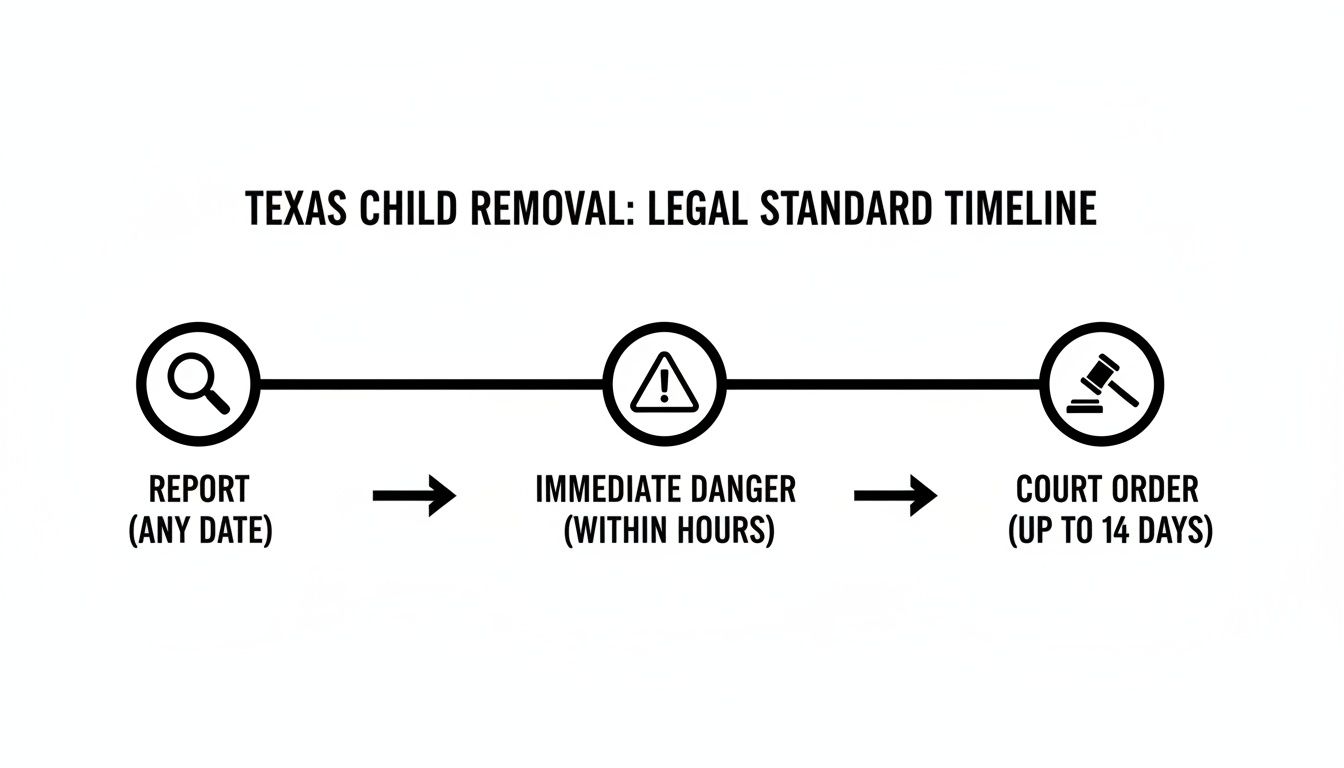
The image makes it clear that a mere report isn't enough; CPS must prove to a court that there was immediate danger before a removal is authorized or upheld.
The deadlines following a child's removal are strict and unforgiving. Understanding this timeline is the first step in preparing your defense.
Texas CPS Removal Timeline: What Parents Must Know
This table outlines the critical legal deadlines and events immediately following a child's removal by CPS in Texas, as mandated by the Texas Family Code.
| Event | Deadline | What This Means for Parents |
|---|---|---|
| Emergency Removal | Day 0 | CPS takes temporary custody without a prior court order, citing immediate danger. The legal clock starts now. |
| Lawsuit Filed (SAPCR) | By next business day | CPS files a formal lawsuit against you. You are now a defendant in a case that could affect your parental rights. |
| Adversary Hearing | Within 14 days of removal | This is your first court date. CPS must prove the removal was necessary. This is your best chance for an immediate return of your child. |
| Status Hearing | Within 60 days of removal | If your child is not returned at the Adversary Hearing, the court holds this hearing to review the case status and your progress. |
These early deadlines set the stage for the entire case. Missing an opportunity or being unprepared can have consequences that last for months, or even years.
A Real-World Scenario: The Race to the Hearing
Imagine a single dad, David, who is wrongly accused of substance abuse by an estranged family member. Based on the false but convincing report, CPS shows up at his home and performs an emergency removal of his daughter. David is devastated and feels completely helpless.
He's told an Adversary Hearing will happen in 10 days. The caseworker suggests that if he just cooperates, everything will work out fine. But David knows that a false accusation, left unchallenged, could destroy his family.
This is where time is your greatest enemy. Ten days is not a lot of time to prepare for a court battle that will determine your child’s immediate future. Waiting for CPS to "do the right thing" is not a strategy; it's a gamble you cannot afford to take.
David immediately hires an attorney. His lawyer gets to work, gathering evidence to prove the allegations are baseless. This means lining up character witnesses, digging up David's recent negative drug test from a pre-employment screening, and prepping David to testify clearly and confidently in court.
At the hearing, his attorney methodically dismantles the caseworker's arguments, showing there was never any real evidence of substance abuse or danger. Because David acted fast, the judge orders his daughter returned to him at the end of the hearing.
This scenario highlights the absolute urgency of that 14-day window. The Adversary Hearing sets the tone for the entire case. Losing this hearing often means your child will remain in foster care for months while you navigate a lengthy and demanding service plan. Winning it can mean bringing your child home where they belong.
Know Your Rights During a CPS Investigation
When a CPS caseworker is standing on your porch, it’s easy to feel like you have no power. The pressure to answer every question, sign every document, and comply with every request is immense. But this is the moment where knowing your rights becomes your most powerful tool. Asserting your rights isn't about being difficult or uncooperative; it's about protecting your family and ensuring the investigation is fair.

Both the U.S. Constitution and the Texas Family Code give you specific protections. Understanding them can stop you from accidentally saying or doing something that could be twisted and used against you. Remember, you can be polite without giving up your fundamental rights.
Your Right to Refuse Entry Without a Warrant
A CPS caseworker is a government agent, which means your home is protected by the Fourth Amendment's shield against unreasonable searches. What this means in plain English is you do not have to let a caseworker into your home without a court order or a search warrant. They cannot force their way inside.
How you handle this moment is critical, though. Simply slamming the door can look hostile and uncooperative. A much better approach is to step outside, close the door behind you, and speak with them politely on your porch or in your yard.
What to Say:
"I want to be cooperative, but I am not comfortable letting you into my home right now. I am happy to speak with you out here. If you have a court order, I will gladly comply."
This response shows you are willing to talk but are also aware of your rights. It’s firm, respectful, and legally sound. If they keep insisting, you can repeat that you will not consent to a search without a warrant and that you would like to speak with an attorney first.
Your Right to Remain Silent and Have an Attorney
You have the right to remain silent, and you absolutely have the right to have an attorney present during any questioning. Caseworkers are trained to ask open-ended questions designed to get you talking. Anything you say can—and will—be documented in their report and can be used against you in court.
Picture this scenario: A caseworker shows up unannounced and starts grilling you about an allegation of drug use. They pressure you to take a drug test on the spot and sign a "safety plan" you haven't even had time to read. Feeling cornered, you might agree just to make them go away. Unfortunately, this can lead to disastrous consequences.
Instead, you can politely decline to answer any substantive questions until you have legal counsel.
Actionable Advice: Polite But Firm Scripts:
- On answering questions: "I want to cooperate fully, but before I answer any detailed questions about the allegations, I need to speak with my attorney."
- On signing documents: "I am not going to sign anything today until my lawyer has had a chance to review it."
- On taking a drug test: "I am not refusing, but I will not submit to any tests until I have consulted with my attorney."
An experienced family law attorney can step in and manage all communication with CPS on your behalf. This creates a crucial buffer, preventing you from being cornered or making statements under duress.
For non-English speaking parents, understanding legal notices and court orders from CPS is absolutely critical. To ensure you accurately comprehend these crucial documents, it's essential to seek professional help with your legal paperwork, specifically by using reliable translation services for legal documents. Your rights are only powerful if you fully understand them.
Answering the question, "Can CPS take my child in Texas?" often comes down to how you navigate these first interactions. By knowing your rights and getting legal help right away, you shift from a position of fear to one of empowerment.
The Reunification Roadmap: How to Get Your Child Back
When your child is removed by CPS, your world narrows to a single, all-consuming mission: bringing them home. The focus shifts from defending yourself against allegations to actively proving you are the parent your child needs and deserves. It can feel like an impossible, uphill battle, but Texas law actually provides a structured path back to your child. This path is called the Plan of Service.
Think of the Plan of Service as your personalized roadmap to getting your child back. It's a formal, court-ordered document drafted by CPS that lays out exactly what the court needs to see from you to resolve the issues that led to the removal. It’s not meant to be a punishment—it's a series of tasks designed to show the judge that you are a safe, committed, and capable parent.

This plan is your chance to take back control. By diligently completing every single task, you aren’t just checking off boxes on a list; you are building a powerful case for your family's future, piece by piece.
What Is in a Plan of Service?
Your Plan of Service will be tailored specifically to the allegations made against you. While every plan is unique, most include a mix of services and goals aimed at addressing the court’s specific concerns.
Some of the most common requirements include:
- Parenting Classes: These courses help you learn new skills and strategies for managing your child’s behavior and your own stress.
- Individual Counseling or Therapy: This is often required to address personal challenges like past trauma, anger management, or mental health concerns.
- Substance Abuse Treatment: If drugs or alcohol played a role in the removal, this could involve counseling, regular testing, or a full rehabilitation program.
- Maintaining Stable Housing and Employment: The court needs to see that you can provide a safe, consistent, and stable home for your child.
- Attending All Visitations: Showing up for every single scheduled visit with your child is non-negotiable. It’s one of the clearest ways to show your unwavering commitment.
It is absolutely critical that you understand and agree with the terms of this plan before the judge signs off on it. Your attorney can, and should, negotiate the terms to make sure they are fair, reasonable, and actually achievable for you.
A Scenario of Proactive Compliance
Imagine a mother, Sarah, whose child was removed over concerns about an unstable living situation and a past struggle with substance abuse. Her service plan requires her to attend parenting classes, complete an outpatient drug treatment program, submit to random drug tests, and find stable housing.
Instead of feeling defeated, Sarah and her attorney treat the plan like a project with a clear deadline. She immediately signs up for the first available parenting class and gets a certificate of completion. She never misses a counseling session or a drug test, and she makes sure to get documentation for every negative result.
She creates a binder. In it, she places her class certificate, printouts of her clean drug tests, letters from her counselor, and a copy of her new lease agreement. When she goes to court for review hearings, she doesn't just tell the judge she’s doing the work—she shows the judge with a thick file of concrete proof.
This kind of meticulous documentation is incredibly powerful. It transforms subjective claims ("I'm doing better") into objective facts the court can rely on. It demonstrates to the judge, the caseworker, and everyone involved that Sarah is not just compliant, but deeply dedicated. This level of proactive effort can dramatically speed up the reunification process.
Your Action Plan for Success
Treating your service plan with this level of seriousness and organization is the key to getting your child home. The more evidence you can gather to prove your progress, the stronger your case for reunification becomes. You can find out more in our detailed guide on what to expect when reuniting with a child after CPS to help you prepare for this emotional and important process.
Your focus should be crystal clear:
- Understand Every Requirement: Work with your lawyer to make sure you know exactly what is expected of you, with no ambiguity.
- Complete Tasks Early: Don't procrastinate or wait for deadlines. The sooner you complete a service, the better it looks.
- Document Everything: Keep a detailed file with certificates, attendance records, test results, and any other proof of your compliance.
- Maintain a Positive Attitude: Show the caseworker and the court that you are an active and willing partner in ensuring your child’s safety.
This journey is a marathon, not a sprint. But with a clear strategy and a determined effort, you can navigate the path back to your child.
Frequently Asked Questions About Texas CPS Cases
When you're caught in the whirlwind of a CPS case, it's natural to have a thousand questions racing through your mind. The fear and uncertainty can feel paralyzing, making it almost impossible to find the clear answers you desperately need. At The Law Office of Bryan Fagan, we've walked alongside countless Texas parents through this very ordeal, and we want to offer you the same direct, legally-grounded answers we provide our clients.
Think of this section as your first step toward clarity and taking back a sense of control.
Can CPS Force Me to Take a Drug Test?
Let's be clear: no, CPS cannot physically hold you down and force you to provide a sample for a drug test without a court order. However, how you handle this request is incredibly important. If you refuse, a caseworker—and later, a judge—will almost certainly see that refusal as an admission of guilt.
A "no" is almost always seen as a red flag. The court will likely assume you refused because you knew you wouldn't pass. This is a critical moment where you need to pause and call an attorney immediately before you answer.
Actionable Advice: Instead of a hard "no," say: "I am not refusing, but I will not submit to any tests until I have consulted with my attorney." Your lawyer can then step in, advise you on the best path forward, and negotiate the terms of any testing, making sure your rights are protected from the start.
Will CPS Separate Me from My Newborn at the Hospital?
This is one of the most terrifying fears for any expecting parent, but it’s a drastic step that only happens in very specific and serious situations. A caseworker won't just show up to take your baby without a powerful reason to believe the newborn is in immediate danger.
This step is generally reserved for situations involving:
- A known and documented history of very recent substance abuse.
- A positive drug test from either the mother or the baby right after birth.
- An active CPS case that is already open against the parent.
- A total lack of prenatal care, which can be seen as a sign of potential neglect.
If CPS has these kinds of serious concerns, they can launch an investigation right there in the hospital. They might ask for a "hospital hold" to keep you from taking the baby home and will immediately go to a judge to get an emergency order for temporary custody. In these time-sensitive moments, having an attorney ready to intervene is absolutely essential.
How Long Does a CPS Case Last in Texas?
Texas law puts CPS cases that involve removing a child on an incredibly fast track, something lawyers often call the "rocket docket." This is laid out in Chapter 263 of the Texas Family Code, and the whole point is to find a permanent, stable home for the child as quickly as possible.
If your child is taken and put into foster care, the court is legally required to make a final decision on the case within 12 months from the day your child was removed. A judge can grant one extension for another six months, but only if there are extraordinary circumstances and it's proven to be in the child's best interest.
This tight, one-year timeline means there is no room for error or delay. You must start working on your court-ordered service plan with your attorney from day one. Any procrastination could put your parental rights in serious jeopardy.
This rapid process highlights just how urgent it is to be proactive and have a strong lawyer guiding you through every single deadline.
Does CPS Have to Place My Child with a Relative?
Yes, they absolutely do. Texas law requires CPS to prioritize placing a child with a fit and willing relative. This could be a grandparent, aunt, uncle, or even a close family friend—what the law sometimes calls "fictive kin." This is always the first and best choice over putting a child with strangers in a foster home.
Keeping a child with family helps reduce the trauma of removal and maintains those crucial emotional bonds.
Actionable Advice: If you have a relative or trusted friend who could provide a safe home, you need to give their name and contact information to your caseworker and attorney immediately. CPS is required to perform a home study on that relative to make sure their home is a safe and suitable place. The faster you provide this info, the faster that process can begin—potentially keeping your child out of the foster care system entirely.
Can CPS Terminate My Parental Rights?
Yes, this is the most severe and permanent outcome in a CPS case, which is why every part of the process must be taken so seriously. The termination of parental rights legally and forever severs the parent-child relationship.
However, it is a last resort. Before a judge can take this drastic step, CPS must prove two things by "clear and convincing evidence"—a very high legal bar to clear:
- That you committed one of the specific grounds for termination listed in Chapter 161 of the Texas Family Code. This could include endangering the child, failing to complete your service plan, or having a substance abuse issue that makes you unable to parent.
- That ending your rights is in the best interest of the child.
Documenting every step you take is crucial. To get your child back, you'll need to show the judge evidence of your progress. Knowing how to properly export text messages from iPhone for legal use can be a vital skill in proving your commitment and communication. Your attorney's job is to fight back and show that termination is not what's best for your child and that bringing your family back together is the right path forward.
Facing a CPS investigation is one of the most frightening experiences a parent can endure. The questions feel endless, and the stakes couldn't be higher. You do not have to face this journey alone. At The Law Office of Bryan Fagan, our team is here to provide the compassionate and authoritative legal guidance you need to protect your family. We will stand with you, fight for your rights, and work tirelessly to bring your child home where they belong. Contact us today for a free, confidential consultation to discuss your case and start building your defense.