Skip to content
There is no feeling quite like the cold dread that sets in when a Child Protective Services (CPS) investigator contacts you about a physical abuse allegation. The phone call or knock on the door is a moment that stops time, plunging your family into a state of fear and confusion. For a Texas parent, this is the start of a bewildering and invasive process where your family is put under a microscope and your parental rights hang in the balance. These are high-priority investigations that can escalate with breathtaking speed. Under the Texas Family Code, CPS often has just 24 hours to determine if your child is safe. What you do in these first few hours and days is absolutely critical to protecting your family.
The Shock of a CPS Physical Abuse Allegation

Nothing can prepare you for the moment your world stops. The words "physical abuse allegation" are terrifying, and the wave of fear, anger, and confusion that washes over you is a completely understandable human response. Your first instinct is probably to say, "This is just a huge misunderstanding." And very often, you're right. But it's crucial to grasp that CPS, which is part of the Texas Department of Family and Protective Services (DFPS), is legally required to investigate every credible report they receive. They don't have a choice.
How an Allegation Begins
An investigation doesn't just materialize out of thin air. It's always triggered by a report, and most of the time, that report comes from a "mandatory reporter"—think doctors, teachers, or therapists who are legally obligated to report even a suspicion of abuse.
Let me share a relatable scenario we've seen play out countless times. Imagine your eight-year-old is a daredevil on the monkey bars. He takes a tumble and ends up with a nasty-looking bruise on his arm. The next day at school, the nurse sees it and, doing her job, asks how it happened. He's a shy kid and just mumbles, "At home." That's it. The nurse, following protocol, makes a call. Suddenly, you're staring down a cps physical abuse allegation texas investigation over a simple playground accident. This is how easily innocent moments can get twisted into a formal inquiry that threatens to tear your family apart.
Understanding the Legal Framework: Texas Family Code
CPS doesn't make up the rules as they go. They operate under a strict set of laws laid out in the Texas Family Code. When an allegation suggests an immediate risk, it's flagged as a Priority One (P1) investigation. This classification legally requires CPS to attempt a face-to-face meeting with your child within 24 hours.
The initial goal of the investigator isn't to validate what a great parent you are; it's to determine if your child is in immediate danger. This is a critical distinction that needs to guide every single thing you do and say.
The investigator's playbook is written in the law. Here are the key statutes that govern their actions:
- Texas Family Code Chapter 261: This chapter maps out the entire procedure for investigating a report of child abuse or neglect.
- Texas Family Code Chapter 262: This section details what happens in an emergency removal and the crucial court hearings that must follow.
- Texas Family Code Chapter 161: This is the part of the code that deals with the termination of parental rights—the most devastating outcome possible in a CPS case.
While physical abuse allegations aren't the most common type of confirmed case, they are taken extremely seriously and pursued aggressively. In 2022, physical abuse accounted for about 10.9% of the 54,207 confirmed child victims in Texas. Federal monitors have also pointed out that these high-stakes investigations often miss their tight deadlines, which can drag out the uncertainty and risk for families.
The feeling of being falsely accused is gut-wrenching, but knowing how to respond is your first and best line of defense. You can learn more about how to handle this situation by reading our detailed guide on what to do when falsely accused. When you're facing a cps physical abuse allegation texas, panic is understandable, but a clear strategy is your most powerful asset.
Your First 24 Hours: Protecting Your Rights
The first 24 hours after a CPS investigator contacts you about a physical abuse allegation are the most critical you will ever face. The choices you make in this very short window can set the tone for the entire case. Your mind is probably reeling, and there's a powerful urge to say or do anything to make this nightmare disappear. Giving in to that panic is the single worst move you can make.
You have to grasp the crucial difference between being cooperative and accidentally incriminating yourself. Politeness is not the same as signing away your rights. Saying yes to everything an investigator wants isn't cooperation—it’s often just handing CPS the ammunition they need to use against you in court.
Stay Calm and Say Very Little
In this first encounter, silence is your most powerful ally. You have a right to remain silent, and you absolutely should use it. Politely but firmly tell the investigator that you will not answer questions, sign documents, or agree to anything until you have an attorney present.
A simple, respectful script can be your lifeline:
- "I want to cooperate, but I can't speak with you or sign anything until I've talked to my lawyer."
- "Could you please give me your business card and the allegations in writing? My attorney will contact you."
This isn't an admission of guilt. It's what a smart, responsible parent does when they understand the seriousness of a cps physical abuse allegation texas investigation. This is an actionable step to protect your family.
How to Respond When CPS Arrives
| Action to Take (Do) | Actions to Avoid (Don't) | Why It Matters |
|---|---|---|
| Stay calm and be polite. | Don't argue, yell, or become hostile. | An investigator's notes about your demeanor can be used against you. A calm attitude shows you are in control. |
| Ask for identification and the written allegations. | Don't answer questions or volunteer information. | You have a right to know who you are dealing with and what you are being accused of. Anything you say can be misinterpreted. |
| State that you will speak with them only after consulting an attorney. | Don't sign any documents, waivers, or "safety plans." | This protects your legal rights and prevents you from agreeing to terms that could be used to remove your child. |
| Record the interaction if legal in your state and you are in a public place. | Don't try to "explain" your side of the story on the spot. | A recording can be objective evidence, but panicked explanations often become twisted "admissions" later. |
Remember, the investigator's job is to gather evidence for a case, not to be your friend. Following these simple dos and don'ts can prevent you from making a catastrophic mistake in the first few minutes.
The Danger of an "Innocent" Conversation
Let me tell you about a real-world scenario that shows just how dangerous these initial conversations can be. A father, completely blindsided by a CPS visit, was trying to make sense of his son's unexplained bruises. Panicked, he started rambling, "I just don't know what happened, maybe he fell… I've been so stressed lately, I just feel like I'm losing it."
He thought he was just being honest, showing his distress. But months later in court, the CPS attorney twisted his words completely: "Your honor, the father himself admitted he was 'losing it' and couldn't even account for his own child's injuries." His innocent, panicked statement became a key piece of evidence against him.
Your words are evidence. Once you say them, you can't take them back. The investigator's job is not to be your friend or therapist; it is to gather information that can be used to build a case.
Preserve Everything and Speak to No One
The moment CPS contacts you, you are officially in evidence-preservation mode. Do not delete a single text message, email, or social media post. Save it all, even if you think it has nothing to do with the case.
Just as importantly, you need to stop discussing the case with anyone but your lawyer.
- Do not talk to the other parent, especially if you're separated or divorced.
- Do not vent to friends or family over the phone or on social media.
- Do not try to confront the person you think might have made the report.
Any of those conversations can be subpoenaed. Your friends and family could be forced onto a witness stand to testify about what you said. The only communication that is legally protected and confidential is the one you have with your attorney.
The steps you take right now are absolutely critical, especially if an investigator is at your door asking to come inside. You need to know what you can and cannot refuse. To get a better handle on your specific rights in this situation, you can review our guide on how to manage a CPS home visit in Texas.
Navigating the CPS Investigation and Court Timeline
When a physical abuse allegation lands on your doorstep, the Texas CPS system kicks into high gear, following a strict and often dizzying timeline. Trying to understand this process while you're in the middle of a crisis is overwhelming, to say the least. But this isn't a journey you should take blind. The Texas Family Code lays out the map—the critical milestones, deadlines, and hearings that will define the next chapter for your family.
It's easy to feel lost in the storm of a CPS case. But knowing the path forward allows you to prepare for each stage. The process is broken down into two main parts: the initial investigation and, if it comes to it, the court proceedings that follow.
The Investigation Phase: From Initial Contact to a Finding
The clock starts ticking the second CPS gets a report. A cps physical abuse allegation texas is almost always a Priority One case, meaning things move fast.
- 24-Hour Response: The law says CPS must attempt to see the alleged victim within 24 hours. This is why that first knock on the door feels so sudden and jarring.
- 45-Day Investigation Window: From that first contact, the investigator has about 45 days to wrap up their investigation and issue a formal finding. In more complex situations, this can be stretched to 90 days.
During this 45-day sprint, the investigator will be busy. They'll conduct interviews with you, your children, and others. They'll dig through records and perform risk assessments to decide if your home is safe. They might also pressure you to sign a Safety Plan—a so-called voluntary agreement that can seriously restrict contact with your kids. Never sign one of these without having an experienced attorney review it first. This is a practical step to protect your rights.
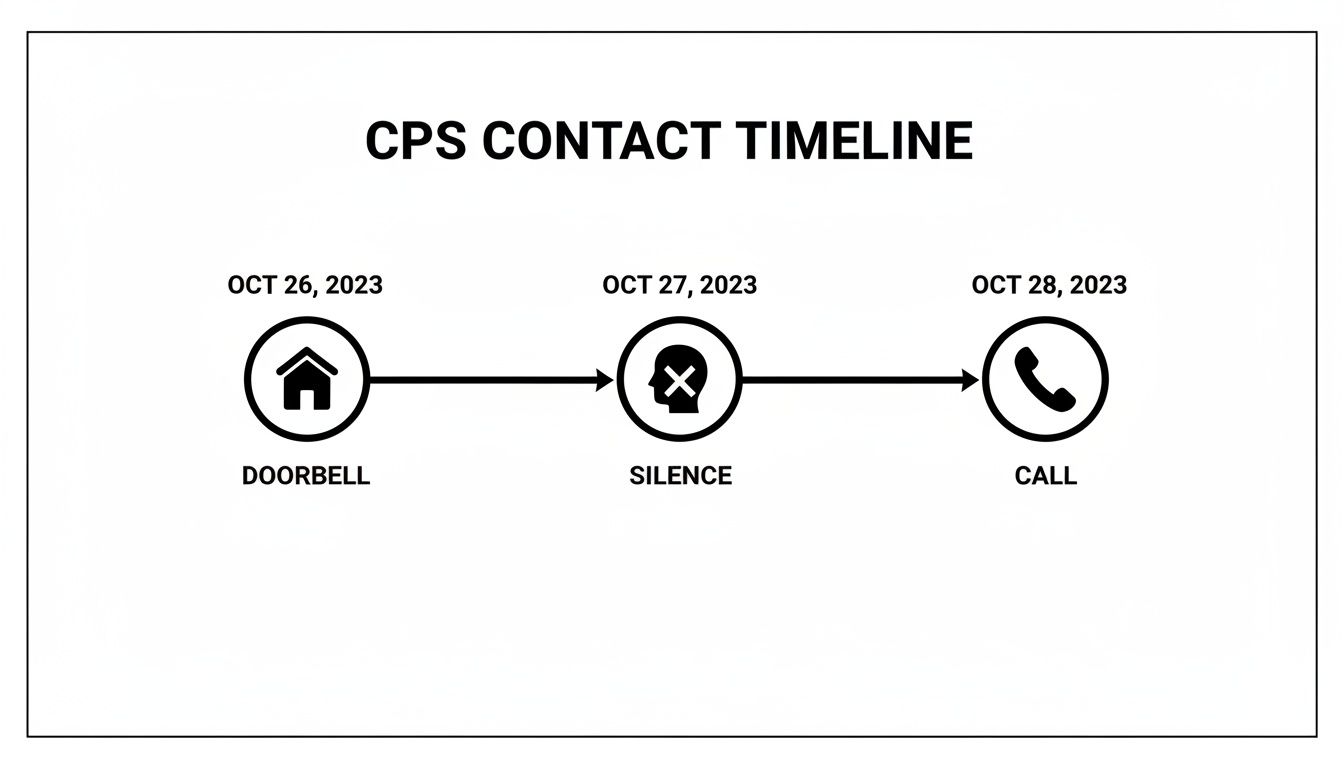
The message is simple but vital: after that initial contact, your immediate response should be to stay silent and call a lawyer.
Once the investigation is done, the caseworker will close the case with one of a few possible findings:
- Ruled Out: They determined no abuse happened. This is the best-case scenario.
- Unable to Determine: There wasn't enough evidence to confirm or deny abuse.
- Reason to Believe (RTB): The investigator concluded that it's more likely than not that physical abuse occurred. An RTB finding is serious business and often acts as the trigger for a lawsuit against you.
The Court Process: When CPS Files a Lawsuit
If CPS decides your child is in "imminent danger" and removes them from your home, or if an RTB finding prompts them to seek court intervention, a formal lawsuit starts. This is where things get really serious, and the timeline, governed by Texas Family Code Chapters 262 and 263, becomes unforgiving.
The first, and arguably most important, court date is the Adversary Hearing. This must happen within 14 days of your child's removal. At this hearing, the burden is on CPS to prove to a judge that there was an urgent need to take your child and that it’s still not safe for them to return home. This is your first real shot at getting your child back quickly, and you need to be ready.
From there, the case moves through a series of checkpoints:
- Status Hearings: Held every 60 days, these hearings are for the judge to check on your progress with court-ordered services (your "Family Service Plan") and your child's well-being in foster care.
- Permanency Hearings: These take place at regular intervals to establish a permanent goal for your child—whether that’s reunification with you, placement with a relative, or, in the worst-case scenario, adoption.
The entire court process is on a fast track toward a final resolution, which culminates in a Final Hearing, or trial. This trial has to happen within about one year of when your child was first removed. Here, a judge or jury makes the ultimate call. The outcome could be anything from your child coming home to the permanent termination of your parental rights under Chapter 161 of the Texas Family Code. This is exactly why having a sharp attorney fighting for you from day one is absolutely non-negotiable.
It's also worth knowing that the system designed to protect children is far from perfect. A federal oversight report in 2020 exposed major problems within Texas CPS. It found that nearly a third of top-priority physical abuse investigations weren't even started within the required 24-hour window, and a staggering 79% were not completed on time. These delays only prolong the nightmare for innocent families caught in the system.
Getting a handle on the timeline is the first step toward taking back some control. For a much deeper look into what to expect during the investigation itself, you can learn more about the CPS investigation process in our detailed article.
When a CPS Case Becomes a Criminal Matter
One of the most dangerous realities of a cps physical abuse allegation in Texas is that it rarely stays just a family law matter. These accusations have a nasty habit of spilling over, triggering a parallel—and potentially far more severe—criminal investigation.
All of a sudden, you're not just fighting to keep your family together; you're fighting for your freedom. It's a terrifying crossroads. On one side, you have the family court case with CPS, where your parental rights are on the line. On the other, the District Attorney's office could be building a criminal case for something like Injury to a Child, putting your entire future at risk.
The Two-Front War: Family vs. Criminal Court
You have to understand that these are two completely separate legal arenas. They operate on different rules and, most importantly, different standards of proof. A "win" in one court doesn't automatically save you in the other.
- Family Court (CPS Case): The standard of proof here is a "preponderance of the evidence." This just means CPS has to convince a judge that it's more likely than not (think 51% sure) that the abuse happened. This lower bar makes it much easier for CPS to get involved in your life.
- Criminal Court: Here, the standard is much, much higher: "beyond a reasonable doubt." To get a conviction, the prosecutor must prove to a jury that there's no other logical explanation for the facts except that you committed the crime.
This dual-track system is a minefield. Anything you say or do in your CPS case can, and probably will, find its way into the hands of a criminal prosecutor. The two investigations are not firewalled from each other.
How Your Cooperation Can Backfire
Let me walk you through a heartbreakingly common scenario we see all the time. A dad is blindsided by a physical abuse allegation. He's terrified, but he believes that if he just cooperates fully with the CPS investigator, he can clear his name and make this nightmare go away.
He doesn't hire a lawyer, worried it will make him look guilty. He agrees to a "voluntary" safety plan, shows up for every meeting, and gives long, detailed statements trying to explain the misunderstanding. He's so focused on showing compliance that he signs documents without reading the fine print.
A statement made to a CPS investigator is not confidential. It can be handed directly to a police detective or a prosecutor and used to build a criminal case against you. Your attempt to cooperate can become the prosecution's star evidence.
A few weeks later, a letter arrives from the District Attorney's office. He's being charged with Injury to a Child. The foundation for the charge? His own statements, which are now being twisted to sound like a confession. That safety plan he signed is now being painted as an admission that he's a danger to his own child.
This isn't just bad luck; it's a calculated strategy. A parent trying desperately to save their family in one courtroom inadvertently hands the government the rope to hang them in another. This is precisely why trying to handle a cps physical abuse allegation texas case without a unified legal strategy is so incredibly dangerous.
Building a Strong Defense to Protect Your Family

When you’re facing a cps physical abuse allegation in Texas, feeling powerless is a completely normal reaction. But you can't let that feeling take over. Now is the time to build a proactive, solid defense to protect your family and clear your name. This isn't a time to wait and see what happens; it’s about taking strategic action with your attorney to carefully dismantle the state's case.
Your defense begins with a simple, but absolutely critical, principle: document everything. Every single phone call, email, and conversation you have with a CPS caseworker needs to be logged. Start a detailed journal immediately—note the date, time, who you spoke with, and precisely what was said. This careful record-keeping can shine a light on inconsistencies in the CPS investigation and can become powerful evidence in court.
Gathering Your Counter-Evidence
While CPS is busy building a case against you, your attorney will be building one for you. This means collecting evidence that tells the real story. Your full cooperation in this process is absolutely essential.
Imagine this scenario: a child has a medical condition like Ehlers-Danlos syndrome, which is known to cause easy bruising. A teacher sees the bruises and, understandably concerned, makes a report. To an outsider, it looks bad. A strong defense, however, immediately pivots to gathering:
- Medical Records: We'd pull all historical medical files, notes from doctors, and any diagnostic reports that confirm the pre-existing condition.
- Expert Testimony: A statement or live testimony from a medical expert who can explain the condition and its symptoms to a judge is invaluable.
- Character Witnesses: Testimony from teachers, neighbors, and friends who can speak to your patient and loving parenting style helps paint a complete picture.
This kind of counter-evidence shifts the whole narrative. It’s no longer about "unexplained bruises"; it's about "medically explained symptoms." That one shift can completely undermine the CPS allegation.
A critical part of building your defense is a detailed analysis of all the medical documentation. These records can be complex, so understanding them fully is key. You may want to consult resources on medical records reviews to make sure no crucial detail gets missed.
Challenging the Investigation and the Accuser
A major part of any good defense strategy is to put the CPS investigation itself under a microscope. Was it conducted properly? Was it biased from the start? Did the investigator even follow the procedures laid out in the Texas Family Code? Your attorney will be looking for any procedural errors or signs of confirmation bias—that’s when an investigator only looks for evidence that supports their initial suspicion.
In many of these cases, the credibility of the person who made the report is a central issue. If the allegation came up during a messy divorce, for example, your lawyer can introduce evidence showing a history of parental alienation or malicious behavior from the other parent.
This isn't about attacking a child. It's about revealing the motivations of any adult who might have coached or manipulated them. Your attorney can challenge the accuser's credibility by pointing out inconsistencies in their story or a pattern of making false claims.
Navigating the Family Service Plan Strategically
If your case ends up in court, there’s a good chance you’ll be ordered to complete a Family Service Plan. This plan will include services like parenting classes, counseling, or substance abuse assessments. A lot of parents worry that participating is the same as admitting guilt. It’s not.
How you handle the service plan, though, is critical. Here is some actionable advice for navigating it with your attorney's guidance:
- Comply Diligently: Go to every single class and appointment. Participate actively and show that you are a willing and capable parent.
- Document Your Progress: Save every certificate of completion, ask for positive reports from counselors, and keep proof of attendance for every service you complete.
- Maintain Your Innocence: While you complete the plan, you and your attorney will continue to assert your innocence in all court filings and hearings. Your compliance simply shows the judge you're a responsible person, not that you're guilty.
When you successfully complete your service plan, you provide the court with tangible proof that you are a safe and committed parent. This makes it much, much harder for CPS to argue for keeping your family separated or terminating your rights. Your proactive defense and your documented compliance become a powerful one-two punch.
Answering Your Urgent Questions About CPS Allegations
When that phone call or knock on the door comes from CPS, your world can feel like it’s spinning out of control. Your mind is flooded with a thousand questions, all of them urgent, all of them terrifying. Fear and uncertainty can be absolutely paralyzing.
Let's cut through the noise. Here are some direct answers to the most pressing concerns we hear from parents who are suddenly facing the nightmare of a physical abuse allegation.
Can CPS Force Me to Take a Drug Test?
CPS will likely ask you to take a drug test, but here's the bottom line: they can't force you to do it without a court order.
However, saying "no" is a tricky situation. It's your right to refuse, but you have to understand how that refusal will be perceived. Caseworkers and judges often interpret a refusal as a sign that you have something to hide, and it can be used against you.
This is a strategic call, not an emotional one. Don't make this decision alone. An experienced attorney can help you weigh the risks and benefits based on the specific allegation you're facing. If a drug test seems completely unrelated to the physical abuse claim, your lawyer can fight its relevance in court. If you do agree, your lawyer will make sure the test is done under fair conditions, protecting your rights every step of the way.
What Happens if My Child Made a False Allegation?
This is, without a doubt, one of the most painful and delicate situations a parent can ever face. Your first instinct—and the most important one—is to stay calm. Absolutely do not confront, punish, or try to coach your child to change their story. Any of these actions can be twisted and used against you as witness tampering or further abuse.
When dealing with a false allegation from a child, your actions must be driven by legal strategy, not gut-wrenching emotion. The goal is to dismantle the claim with cold, hard evidence, not by directly challenging a child who might be scared, confused, or even manipulated.
Your immediate next step is to get your attorney involved. A good lawyer will push for a forensic interview with a neutral, highly-trained professional who knows how to question a child properly without leading them. At the same time, your legal team will be working tirelessly to dig up evidence that contradicts the claim—things like proof the child was coached, has a history of making things up, or is being used as a pawn in a bitter custody fight.
How Do I Get My Child Back if CPS Removed Them?
If your child has already been removed, your most important piece of actionable advice is to prepare for the Adversary Hearing. This hearing is your first formal chance to fight the removal in front of a judge, and under the Texas Family Code (Chapter 262), it must happen within 14 days.
This hearing is your shot to prove that there is no "imminent danger" to your child's physical health or safety at home. Your attorney will present evidence and make the case that the removal was an overreaction and that your child can be safely returned to your care immediately.
If the judge doesn't return your child at that hearing, the road to reunification involves following every single court order and completing your Family Service Plan with precision. By showing you’re fully compliant, you build a powerful case, giving the court tangible proof that you’re doing everything necessary to create a safe home for your child’s return.
Facing a cps physical abuse allegation in texas is one of the most frightening challenges a parent can endure. The stakes are immense, and every case is different. But you do not have to go through this alone. We understand the fear and confusion you are experiencing, and we are here to offer both legal strength and human compassion. The experienced family law attorneys at the Law Office of Bryan Fagan are here to stand with you, protect your family, and guide you through this fight with reassuring, practical guidance.
Contact The Law Office of Bryan Fagan for a Free Consultation to discuss your case and let us help you transform that fear into a focused, effective legal defense.