Skip to content
When Child Protective Services (CPS) intervenes in your family, the fear and confusion can be overwhelming. As a grandparent, your first instinct is to protect your grandchildren, to wrap them in safety when their world feels like it's falling apart. The question racing through your mind—"Can grandparents get custody from CPS?"—is one we hear often. In Texas, the answer is a firm and hopeful yes. In fact, Texas law, guided by the Texas Family Code, prioritizes placing children with loving relatives over unfamiliar foster homes.
This guide is designed to replace your fear with a clear, actionable plan. We'll walk you through the process, from that initial heart-stopping call from CPS to building a strong case in court, providing the practical, reassuring guidance you need.
Your Grandchildren's Future Is on the Line

Receiving a call from a CPS caseworker is a moment that stops your heart. It's a uniquely painful crisis, a whirlwind of fear for your grandchild’s safety mixed with deep concern for your own child. In that storm of emotion, it’s easy to feel powerless. But it is critical to understand that you have rights and a vital role to play. You are not a bystander in this process; you can be your grandchild's staunchest advocate.
You are far from alone. Grandparents across Texas and the country are stepping up more than ever. The U.S. Census Bureau reports that over 2 million grandparents in the U.S. are the primary caregivers for their grandchildren, with many taking on this role after CPS intervention. This trend highlights how essential grandparents are when parents are unable to provide a safe home.
Understanding Your Role in a Texas CPS Case
Here in Texas, the legal system is built on the profound importance of family connections. When CPS must remove a child from their parents' home, the Texas Family Code (Chapter 262) legally requires the agency to search for suitable relatives to provide care. This is where you come in.
By presenting yourself as a safe, stable, and loving option from the very beginning, you can fundamentally change the course of the case for the better.
The court's primary goal is always the "best interest of the child." A stable, familiar home with a grandparent is often seen as the best possible outcome when parents cannot care for their children.
This legal preference for family placement, known as kinship care, is a cornerstone of Texas family law. It gives you a significant advantage over non-relative foster placements. This isn't just a policy; it's a recognition that children thrive when they remain connected to their family roots.
To help you navigate the legal landscape, it’s useful to understand a few core concepts that will appear repeatedly in a CPS case.
Key Legal Concepts for Texas Grandparents in a CPS Case
This table breaks down some of the most important legal terms you'll encounter. Familiarizing yourself with this language will help you feel more prepared and in control during conversations with caseworkers, attorneys, and the court.
| Legal Concept | What It Means for Grandparents | Why It Matters in a CPS Case |
|---|---|---|
| Best Interest of the Child | The court's number one priority. They will evaluate your ability to provide a safe, stable, and loving home. | Your home environment, financial stability, and your relationship with the child will be closely examined to determine if placement with you meets this critical standard. |
| Standing | Your legal right to file a lawsuit or petition the court for custody. | In Texas, grandparents often have "standing" if the child has lived with them for at least six months or under other specific circumstances outlined in the Texas Family Code. An attorney can help you establish this crucial first step. |
| Kinship Care | The official term for placing a child with relatives instead of in a traditional foster home. | Texas law prefers kinship care, giving you a legal advantage and helping keep your grandchild connected to their family identity and culture. |
| Temporary Managing Conservator (TMC) | A temporary legal status granting someone the rights and duties of a parent, often given to CPS or a relative while the case is ongoing. | You can petition the court to be named the TMC, which would give you the authority to make important decisions for your grandchild's well-being. |
Understanding these terms isn't about becoming a legal expert; it's about knowing your rights and the framework the court uses to make life-altering decisions for your grandchild.
Preparing for the Journey Ahead
Stepping up to seek custody is a profound act of love, but it also means planning for a future you may not have expected. As you focus on your grandchildren's long-term well-being, their education will be a top priority. This is a good time to explore options and compare college savings plans for your grandchildren to help set them up for future success.
Facing a CPS investigation is daunting, but you don't have to do it alone. The experienced attorneys at The Law Office of Bryan Fagan are here to offer the compassionate, authoritative guidance you need to protect your family.
What to Do When CPS Removes Your Grandchildren
The phone call or knock on the door from CPS is a moment no grandparent ever wants. Learning that your grandchildren have been removed from their home is chaotic, heartbreaking, and terrifying. But the first 72 hours are absolutely critical. Your actions during this initial window can dramatically shape where your grandchildren end up. This is your chance to be a proactive force for stability, not a passive observer.
Your first move? Contact the assigned CPS caseworker immediately. Introduce yourself, express your deep concern for the children, and state your intention clearly: you want to provide a safe, loving, and immediate home for them. This isn't the time for anger or blame. Your role right now is to present yourself as the solution.
Making an Immediate, Positive Impression
From that very first conversation, you need to project capability, cooperation, and commitment. A caseworker is dealing with a crisis and is looking for the safest, most stable path forward for the children. Your goal is to make placing the children with you the easiest and best possible choice.
Consider a real-life scenario we often see: A grandmother, we'll call her Maria, gets the devastating news on a Friday afternoon. Instead of waiting until Monday, she immediately finds the caseworker's number and calls. She calmly explains that she has a spare bedroom already set up for the children, is ready to submit to a background check that day, and can handle all school and medical appointments. This kind of prepared, cooperative, and immediate response makes a world of difference and sets a positive tone for the entire case.
When you present yourself as a prepared and cooperative partner, you're aligning with CPS's primary goal: ensuring the child's safety in a stable home. Your proactive steps can be the deciding factor.
Taking Actionable Steps to Secure Placement
Being prepared involves more than just a phone call. It’s time to gather evidence that supports your words. This initial legwork demonstrates to CPS that you are serious, organized, and ready to step up without delay.
Here are concrete actions you can take right away:
- Document Your Home: Take clear photos of a clean, safe bedroom ready for your grandchildren.
- Show Stability: Gather copies of recent utility bills or your lease/mortgage statement to prove you have a stable residence.
- Volunteer for Screening: Proactively offer to complete a background check and any other required assessments. Don't wait to be asked.
- Communicate Clearly: Follow up your phone call with a polite, professional email summarizing your conversation and reiterating your desire to provide a home.
These first hours and days are pivotal. To better understand the entire journey ahead, our guide on what happens when a child is removed by Texas CPS is an invaluable resource. By acting swiftly and strategically, you build a strong foundation for your effort to gain custody and give your grandchildren the security they so desperately need.
Navigating the Texas CPS Court Process
When you're thrown into the Texas CPS court system, it can feel like landing in a foreign country with its own language and rules. The process has a specific timeline and is filled with legal terminology. Our goal is to translate that legalese into a clear, straightforward path so you know exactly what to expect, turning anxiety into a focused strategy.
The court journey typically begins with a crucial initial hearing, often called an Adversary Hearing or a "14-day hearing." This must happen within 14 days of CPS removing your grandchildren. At this hearing, CPS must present evidence to a judge to justify the removal. This is your first official opportunity to make your voice heard and present yourself as a placement option.
The Stages of a CPS Case
As a grandparent seeking custody, it's vital to understand that this isn't a single event. It's a series of hearings and legal milestones, each with a specific purpose, governed by Chapter 263 of the Texas Family Code.
You'll quickly become familiar with terms that carry immense weight for your grandchild's future:
- Temporary Managing Conservator (TMC): This is the legal term for someone granted temporary custody of a child while the CPS case is ongoing. For many grandparents, becoming the TMC is the first major goal. It allows you to provide a safe, stable home and make important decisions for your grandchild as the case unfolds.
- Permanent Managing Conservator (PMC): This is the ultimate goal for many grandparents. Being named the PMC gives you the permanent legal rights and responsibilities to care for your grandchildren, providing them with the lasting stability they need to heal and grow.
The infographic below highlights the first proactive steps you should take to position yourself as the best, most loving option for your grandchildren.
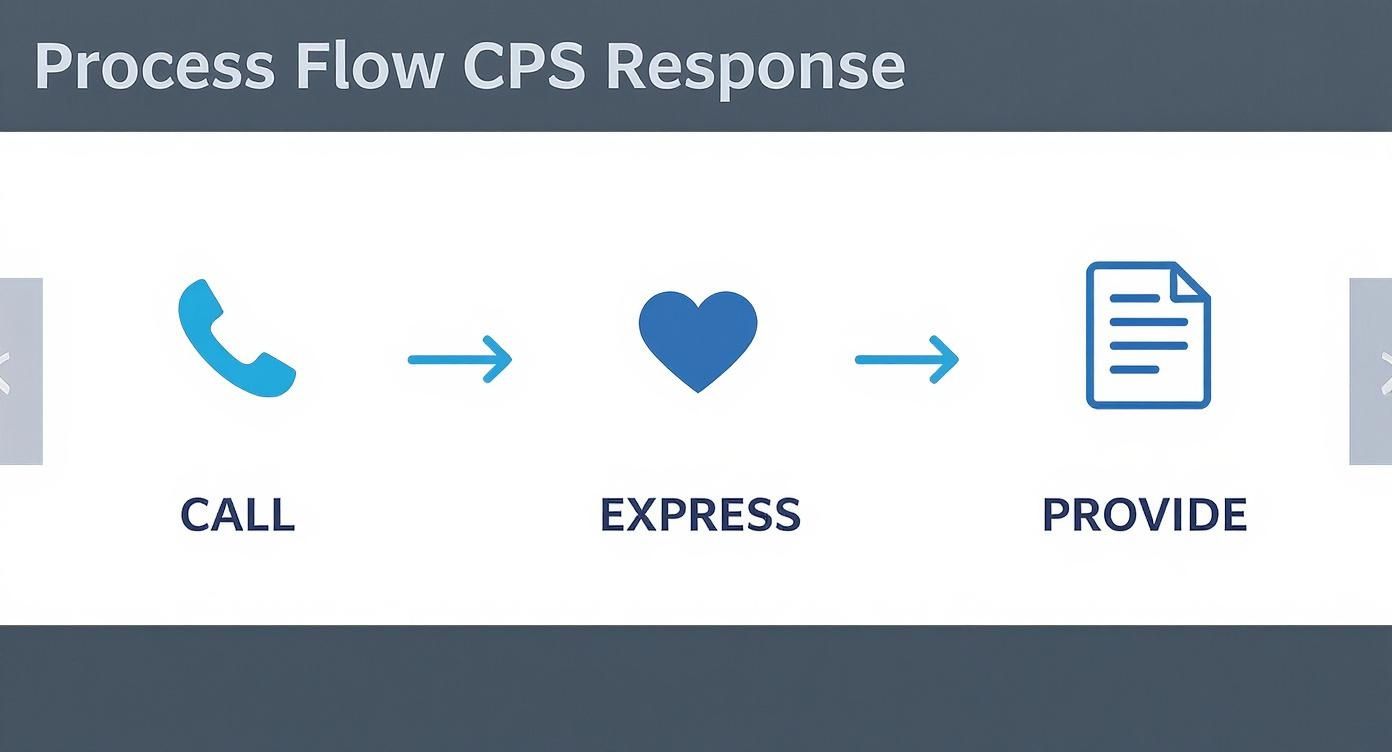
This visual guide underscores a key point: your immediate communication with CPS and your willingness to provide necessary information are foundational to your success.
A Real-Life Example of Unwavering Commitment
Let me share the story of a grandmother we represented. Guided by her attorney, she attended every single status and permanency hearing—without exception. And she didn't just show up; she came prepared. At each court date, she presented new, heartfelt letters from her grandchildren's teachers and neighbors that documented how well they were doing and how stable they were in her care. She kept a journal of their progress and was always ready to provide the judge with a positive update.
A consistent, documented effort speaks volumes to a judge. It demonstrates an unwavering commitment that goes beyond words, proving you are the anchor your grandchildren need in a storm.
This grandmother’s persistence created a powerful, compelling record of stability and love. It showed the judge, hearing after hearing, that she wasn't just a temporary solution but the best long-term answer for these children. Her consistent advocacy was instrumental in the judge's final decision to grant her permanent custody, giving those children the secure future they so desperately needed.
Building a Compelling Case for Custody

When you are seeking custody of your grandchild from CPS, your primary task is to prove to the court that placing the child with you is in their "best interest."
This legal standard goes far beyond love and good intentions. It’s about presenting concrete, undeniable evidence that you can provide the stability, safety, and nurturing environment your grandchild needs. Think of yourself as building a case, piece by piece, that paints a crystal-clear picture of security and care for the judge.
The first step is to start gathering documents. This is the tangible proof that backs up your commitment.
- Financial Stability: Collect recent pay stubs, bank statements, or proof of retirement income. This isn't about being wealthy; it's about showing you have the resources to meet a child’s daily needs.
- A Safe Home: Locate your lease agreement or mortgage statements. Just as importantly, take bright, clear photos of your clean and safe home, paying special attention to the room where your grandchild will sleep.
- Your Character and Bond: Reach out to people who know you and your grandchild well—teachers, counselors, neighbors, or close family friends. Ask them to write letters of support that speak to your strong, loving bond and your capabilities as a caregiver.
Leveraging Your Legal Advantage
The good news is, you're not starting from scratch. The Texas Family Code gives you a significant head start by legally prioritizing the placement of children with relatives whenever possible.
This is known as kinship placement, and it is rooted in the powerful belief that children almost always do better with family than with strangers.
By seeking custody, you are not just acting out of love; you are aligning with a core principle of Texas law. Your role as a grandparent is recognized and valued by the court system.
This legal preference is a powerful tool in your favor. It means that when you present a solid, well-organized case, you are already the option the court is inclined to choose. For a deeper dive into this process, our guide on how to get kinship custody breaks down the essential details for Texas grandparents.
Addressing Potential Roadblocks Head-On
Building a strong case also means being ready to address any potential challenges. Life is complex, and very few people have a flawless history. Perhaps there’s a minor offense on your record from decades ago, or maybe one of the parents is actively fighting against you getting custody.
Do not let these issues derail your efforts. Being transparent and proactive is always the best strategy. An experienced CPS attorney can help you frame your history in the proper context, showing the court that a past mistake does not define your ability to be a wonderful caregiver today. They can build a powerful argument explaining why, despite any obstacles, you remain the best, most loving, and most stable option for your grandchildren.
Sadly, many families in this situation face real hurdles. Research from the Brookings Institution highlights that children living with grandparent caregivers often face tough socioeconomic challenges, with 13% living in deep poverty. This reality often stems from the difficult circumstances, like parental substance abuse, that led to CPS involvement in the first place. You can read the full Brookings Institution report on grandparent caregivers to learn more about these national trends.
Adjusting to Life After a Custody Order
Receiving that custody order is a monumental victory. It's a moment of profound relief after what was likely a long, emotionally draining battle. But it is so important to see this court order as the beginning of a new journey, not just the end of an old one.
You have officially stepped back into the role of a primary parent. For your grandchildren, they are likely just beginning to process the trauma that led them to your door. This new chapter requires a different kind of strength, one focused on healing, patience, and adjustment for everyone. The key to helping your new family unit not just survive, but truly thrive, is acknowledging the challenges ahead and putting a support system in place early.
Finding Your Support System
You do not have to walk this new path alone. Texas has a network of resources designed specifically for kinship caregivers like you, and tapping into them is crucial for managing the emotional and financial strain that can arise.
Here's where to start looking:
- Kinship Caregiver Support Groups: There is nothing more validating than connecting with other grandparents who just get it. They understand the unique challenges and can be an incredible source of practical, real-world advice.
- Trauma-Informed Counseling: Your grandchildren have been through a lot. Finding therapists who specialize in helping children process their experiences with CPS involvement can make a world of difference in their healing.
- Financial Assistance Programs: Unexpectedly raising children can create a real financial burden. Look into Texas programs that may offer financial aid to kinship families to help ease that strain.
Taking on the care of your grandchildren is an act of immense love, but it's not a role you were meant to fill in isolation. Building a strong support network isn't a sign of weakness; it's a sign of your commitment to giving them the very best.
Managing New Family Dynamics
One of the most delicate challenges you may face is managing court-ordered visitation with the children's parents. This requires a difficult balancing act: you must protect your grandchildren's emotional well-being while also complying with the judge's orders.
Creating clear guidelines and predictable routines is essential. These are often formalized through the process of developing a legal parenting plan, which can provide structure and minimize conflict.
This is a time for incredible patience, solid structure, and immense compassion—for both your grandchildren and yourself. Remember, the goal is to build a stable, predictable, and healing home where they can finally feel safe.
Frequently Asked Questions from Texas Grandparents
Navigating a CPS case kicks up a storm of urgent, practical questions. When your world is turned upside down, you need clear, direct answers. Here are some of the most common concerns we hear from Texas grandparents who are bravely stepping up for their grandkids.
Will CPS Pay Me to Care for My Grandchildren?
In many cases, the answer is yes. If you become an officially verified kinship placement, you can be eligible for financial assistance from the state. This support is designed to help you provide the best possible stability and care for your grandchild.
This often includes a monthly stipend, similar to what non-relative foster parents receive, and ensures your grandchildren are covered by Medicaid for their healthcare needs. To activate these benefits, it is vital to complete all required CPS paperwork, background checks, and any necessary training as quickly as possible.
What if My Own Child Objects to Me Getting Custody?
It's a heartbreaking and surprisingly common scenario: a parent objects to you—their own mother or father—getting custody of their child. The most important thing to remember is that a parent's objection does not decide the outcome. The judge's sole focus is the "best interest of the child."
If the parent’s own actions are the reason CPS got involved, their objections will carry far less weight in court. Your attorney’s job is to build a powerful case demonstrating that your home offers the safety and stability the child needs to thrive, regardless of the parent's wishes.
Under the Texas Family Code, the court's primary duty is to protect the child. A stable, loving home with a grandparent will almost always be prioritized over a parent's objection when that parent is unable to provide a safe environment.
Can I Adopt My Grandchildren After Getting Custody?
Yes, adoption is a possible final step. It creates a permanent, legal parent-child relationship but can only happen after the biological parents' legal rights have been terminated by the court.
Termination of parental rights, governed by Chapter 161 of the Texas Family Code, is a very serious legal action. It is reserved for situations where parents prove they cannot or will not remedy the dangerous conditions that led to CPS intervention. If the court takes that step, as the current legal custodian, you would be in the primary position to file for adoption and provide your grandchildren with a forever home.
What if I Have a Minor Offense on My Record?
A mistake from your past does not automatically disqualify you from getting custody. CPS and the court will carefully review any criminal history, focusing on the nature of the offense, when it happened, and whether it poses any conceivable risk to a child today.
A minor, non-violent offense from many years ago is often not a barrier. The key is to be completely honest and upfront about your history with your attorney and CPS from the very beginning. Transparency builds trust and allows your legal team to address the issue proactively.
The questions and complexities of a CPS case can feel overwhelming, but you do not have to face them alone. At The Law Office of Bryan Fagan, we understand what is at stake—your family's future. Our experienced and compassionate attorneys are here to answer your questions, fight for your rights, and guide you with strength and empathy every step of the way. Contact us today for a free, confidential consultation to discuss your specific situation. Visit https://texascpslawyer.net to get the help you and your grandchildren need now.