Skip to content
When you're trying to put your life back together, especially with your family's future on the line, the last thing you need is more confusion. But that’s exactly what happens when you’re on probation. The simple idea of traveling—visiting your parents one county over, taking your kids to see their grandparents in another state, or even just leaving town for a job interview—can feel overwhelming and terrifying. You’re working so hard to do everything right, but the fear of making one wrong move can be paralyzing.
For Texas parents, navigating the justice system often goes hand-in-hand with navigating Child Protective Services (CPS). A criminal charge can trigger a CPS investigation, and the terms of your probation can directly impact your ability to meet CPS requirements, like visiting your children if they’ve been placed with a relative out of town. The question, "Can you travel while on probation?" isn't just about freedom; it’s about holding your family together.
Your Freedom on a Leash: Can You Travel on Probation?

Let’s be crystal clear: Yes, you can travel while on probation in Texas, but it's not a right you can demand. It's a privilege that requires explicit, written permission from your probation officer or the court. Think of it less as a simple 'yes' or 'no' question and more as a careful process you must follow to avoid devastating consequences for you and your family.
Imagine this scenario: You're a mother in Houston on deferred adjudication for a drug possession charge. You've been sober for a year, attending every class, and working hard to comply with both your probation and your CPS service plan. Your son has been temporarily placed with his grandmother in Louisiana, just across the state line. Missing his birthday is unthinkable, not just for you, but for him. For you, getting permission to travel isn’t about a vacation; it’s about showing your child you’re still his mom and proving to CPS you’re a stable, committed parent.
The Hard Reality of Travel Restrictions
The desire to see your family is natural, but the legal system views travel through a lens of risk. Your probation officer and the judge need to ensure you remain accountable and under their supervision. Under the Texas Family Code, particularly during a CPS case, your ability to comply with court orders is paramount. A probation violation, like unauthorized travel, could be used by CPS to argue that you are not following court orders, potentially jeopardizing your reunification efforts under Chapter 262 or 263.
It's not just a Texas thing. A nationwide analysis found that 57% of U.S. jurisdictions flat-out prohibit out-of-state travel without getting permission first. Here in Texas, those rules are enforced with zero wiggle room. Nationally, about 10% of people admitted to state prisons aren't there for new crimes. They're there for technical violations—like taking an unauthorized trip. That statistic shows just how high the stakes are for your freedom and your family.
It’s also important to know the lingo. People often use "probation" and "parole" interchangeably, but they have key legal differences that impact your freedom. If you're unsure, it's worth taking a moment to understand the difference between parole and probation.
Key Factors That Tip the Scales
Your chances of getting travel approved hinge on several factors your probation officer will scrutinize. Getting a "yes" is never a sure thing; it all comes down to your specific case and how you've handled yourself while under supervision.
- Your Track Record: Have you been a model probationer? This means paying fines, attending every required class (like parenting or substance abuse courses), and passing all drug tests. A clean record sends a powerful message that you’re responsible and can be trusted.
- The Reason for Your Trip: A verifiable family emergency, a critical work trip, or a required visit with your child in another city will always be viewed more favorably than a vacation. The "why" matters, especially when your parental rights are on the line.
- The Nature of Your Offense: The original crime plays a role. Someone on probation for a serious felony will face tighter restrictions than someone on misdemeanor probation.
- Your Destination and Itinerary: Vague plans are a red flag. A detailed plan—including where you’ll stay, for how long, and who you’ll be with—shows your trip is well-thought-out and not an attempt to evade supervision.
Quick Guide to Probation Travel Eligibility in Texas
| Factor | What It Means for Your Travel Request | Example |
|---|---|---|
| Compliance History | A perfect record of following all rules (payments, classes, check-ins) builds trust and makes approval more likely. | You've paid all fines on time and have completion certificates from your court-ordered parenting classes. |
| Reason for Travel | Essential travel (family emergency, work, required CPS visit) is viewed more favorably than recreational travel. | Your mother is having emergency surgery in another state, and you have a letter from her doctor. |
| Nature of Offense | The more serious the original crime, the more scrutiny your request will receive. Misdemeanor offenses often have more leeway. | A person on probation for a non-violent, first-time offense has a better chance than someone with a history of violent felonies. |
| Detailed Itinerary | A clear, verifiable plan shows you are organized and not trying to evade supervision. Vague plans raise red flags. | You provide flight confirmations, a hotel reservation under your name, and a daily schedule for your trip. |
Ultimately, the decision comes down to whether the court believes you are a low risk and that your travel is legitimate. Being prepared with a solid, well-documented request is your best chance at getting the green light to see your family.
Understanding Your Specific Travel Restrictions
The stack of papers the court gave you isn't just legal jargon—it's your personal rulebook. Your freedom to travel hinges entirely on what’s written in those "conditions of community supervision." Assuming you know the rules is a dangerous gamble that could land you in jail and give CPS a reason to argue for termination of your parental rights under Chapter 161 of the Texas Family Code.
Your first step is to read that document, front to back. It will tell you, in no uncertain terms, where you are allowed to be. For some, the boundary is the county line; for others, it might be the entire state. Ignoring these specific terms is one of the fastest ways to trigger a probation violation.
Supervised vs. Unsupervised Probation
One of the biggest factors determining your travel freedom is whether your probation is supervised or unsupervised. This detail changes the entire game.
Think of unsupervised probation (often called deferred disposition) as being on an honor system. The court trusts you to stay out of trouble without regular check-ins. Travel is generally simpler, though you must still follow any geographic boundaries in your order.
Supervised probation, on the other hand, means you need a "hall pass" for any trip. You're assigned a probation officer you must report to, and they are the gatekeeper for all travel requests. You cannot leave your designated area without getting their explicit, written permission first.
"Your probation order is not a suggestion; it is a legally binding contract between you and the court. Every condition, including travel restrictions, carries the full weight of the law. Understanding its exact terms is your first and most important responsibility."
Successfully finishing probation means knowing your personal rulebook inside and out. If you're confused by any of the legal language, now is the time to ask for clarification—not after you’ve accidentally broken a rule. You can get a better handle on your obligations by learning more about how probation works in Texas.
Misdemeanor vs. Felony Probation
The seriousness of your original offense also plays a huge role in your freedom. Courts view risk differently for misdemeanors and felonies, and that's reflected in the conditions they set.
- Misdemeanor Probation: These cases usually come with fewer restrictions. If you were convicted of a first-time DWI or theft, your travel boundaries might be wider. Officers are often more willing to approve travel, especially with a perfect track record.
- Felony Probation: This is a different ballgame. Because the crime was serious, people on felony probation are under intense scrutiny. Travel is often locked down to your home county unless you have a truly compelling reason approved through a formal process.
Let's look at a real-world example. Sarah, a mother in Austin, is on misdemeanor probation for shoplifting. She's been a model probationer for six months. When her sister in Dallas has a baby, her probation officer approves a weekend travel permit without much fuss. Her offense was non-violent, and she’s proven she can be trusted.
Now consider Mark, who is on felony probation in Houston for aggravated assault. His children are with their grandparents in El Paso per a CPS safety plan. He wants to attend a parent-teacher conference, but his request is denied by his officer. The trip is essential for his CPS case but is seen as high-risk by his officer. Mark's only option is to have an attorney file a formal motion with the court, presenting evidence of his compliance and the importance of the trip for family reunification.
These scenarios drive home a critical truth: your specific charge lays the groundwork for your limitations. Knowing your status helps you set realistic expectations before asking to travel.
How to Formally Request Permission to Travel
Getting permission to travel on probation isn't like asking a friend for a favor. It’s a formal process that demands preparation, honesty, and clarity. Approaching this the right way not only boosts your chances of getting a "yes," but also shows the court you're taking your obligations seriously—a key factor in both probation and CPS cases.
Your first move is to contact your probation officer well in advance of when you want to leave. A last-minute call is a recipe for denial. Most departments want at least two weeks' notice, but giving them more time is always better.
Your Action Plan for a Successful Request
When you reach out, you can't just say, "I want to go to another state." You need a solid, detailed, and verifiable plan that leaves no room for questions. Think of it as building a case for why your travel is both necessary and low-risk.
Before picking up the phone, gather all the essential information your probation officer will ask for. Being prepared shows you respect their time and are handling your responsibilities.
The infographic below breaks down the different levels of supervision, which directly shapes how you'll handle a travel request.
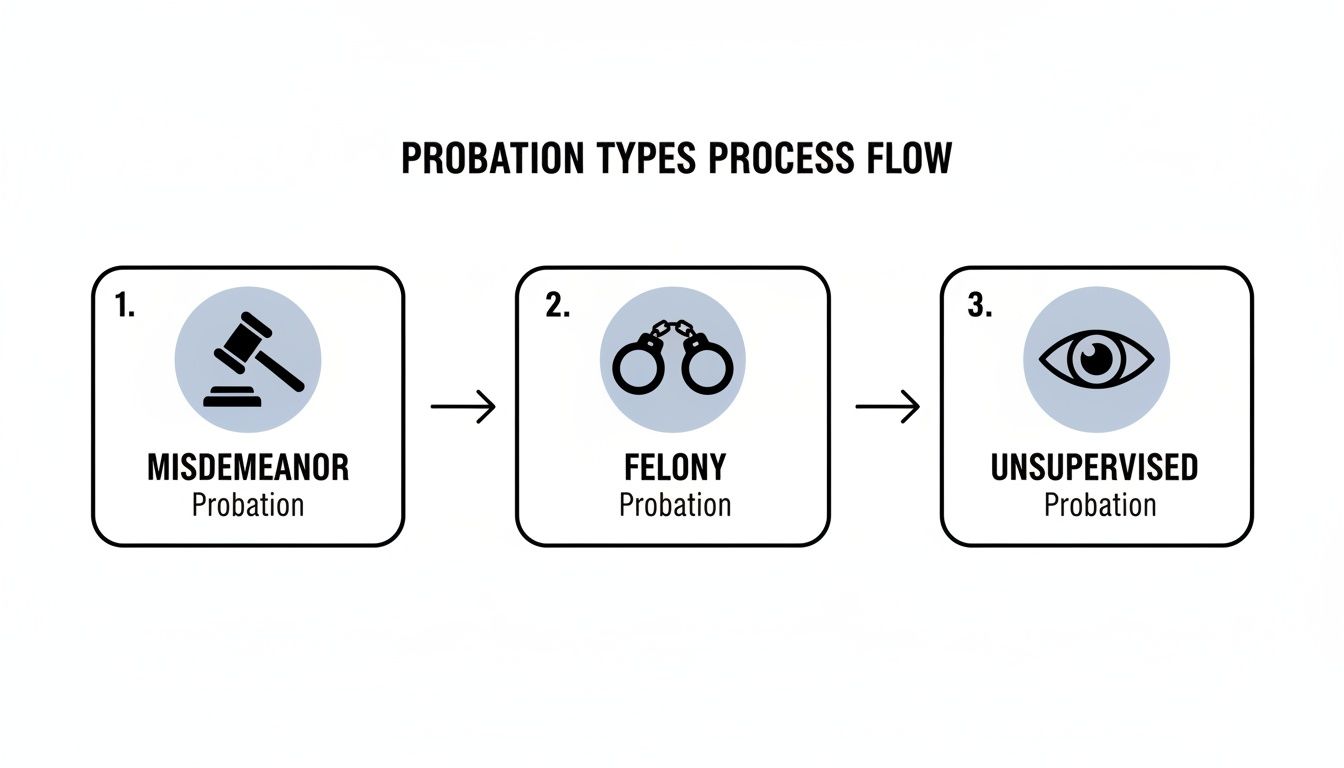
As you can see, the rules get much tighter as you move from unsupervised to felony probation. That makes a well-prepared, thorough request even more critical.
The Travel Request Checklist
To make your request as strong as possible, use this checklist to pull together every piece of information and documentation you'll need.
- A Valid Reason for the Trip: Be specific. Is it a mandatory work conference? A critical family medical issue? A court-ordered visit with your child? Vague reasons like "visiting friends" are less likely to be approved.
- Exact Travel Dates: Provide the day you plan to leave and the exact day you will be back. An open-ended trip is a huge red flag.
- Your Destination Address: You must have the physical address where you will be staying—not just the city and state.
- Mode of Transportation: How are you getting there? If you're driving, say so. If you're flying, be ready to hand over your flight itinerary.
- Contact Information: Share the phone number where you’ll be staying, plus the names and contact info for the people you'll be with.
- Supporting Documentation: This is where you seal the deal. If a parent is in the hospital, get a letter from the doctor. If the trip is for work, get a letter from your employer. If it's for a CPS visit, have a letter from the caseworker.
Picture this: a mother on probation needs to take her child to a specialist medical appointment in another state. She should come prepared with the appointment confirmation letter, the doctor's full name, and the clinic's address. That level of detail turns her request from a simple "I want to go" into a documented, verifiable need.
When You Need a Formal Motion to Permit Travel
Sometimes, your probation officer can't—or won't—approve a request on their own authority. This happens most often for out-of-state or longer trips, especially on felony probation. When that's the case, your only path forward is to get permission directly from the court.
This requires your attorney to file a formal "Motion to Permit Travel." This is a legal document presented to the judge, laying out all the details of your proposed trip and making the argument for why it should be granted.
This isn't something you can handle on your own. It may require a hearing where your lawyer presents your case. Having an experienced attorney navigate this process is essential to getting the judge to approve your motion, especially when your family's future is at stake.
Common Reasons Travel Is Approved or Denied
When you request to travel, your probation officer isn’t just flipping a coin. Their decision is a calculated assessment of risk and responsibility. Understanding what the court is looking for helps you frame your request in the strongest way possible. It boils down to two things: the reason for your trip and your personal track record.
Any travel request gets weighed against the core goals of your probation. A last-minute plea for a vacation with vague details screams "red flag." It suggests you aren't taking this seriously. On the other hand, a well-planned, necessary trip backed up with documents shows you're managing your life responsibly within the court's rules.
Reasons That Often Get a Green Light
Your odds of getting a "yes" go way up when your reason for travel is seen as legitimate and essential—especially when it supports the goals of family reunification and stability.
Here are the kinds of requests that are commonly approved:
- Essential Work-Related Trips: If your job requires you to attend a conference or client meeting, this is usually approved. Be ready to provide a letter from your employer.
- Documented Family Emergencies: A serious illness or the death of a close family member is almost always a valid reason. You will need proof, like a note from a hospital or funeral home.
- Court-Ordered Appearances: This includes appearances for your CPS case, custody hearings, or any other legal matter in another jurisdiction.
- Required CPS Visits or Services: If you must travel to visit your children or attend a specialized service mandated by your CPS plan, this is a very strong reason for approval.
Why Travel Requests Are Often Denied
On the other hand, some requests are denied because they're viewed as high-risk, frivolous, or simply not important enough to justify an exception.
A denial is likely if:
- Your Trip is Purely for Fun: A spontaneous weekend trip or vacation with no compelling purpose is rarely going to be approved.
- Your Plans are Hazy: "I need to go visit family" won't cut it. Without specific addresses, names, and a clear itinerary, your PO has nothing concrete to approve.
- You Have a Poor Compliance History: This is the big one. If you’ve missed check-ins, failed drug tests, or are behind on fines, your officer has no reason to trust you. Building and maintaining that trust is everything.
A particularly tough issue is travel for essential healthcare. In the U.S., about 800,000 women are currently on probation or parole. For those living in states with restrictive laws, getting certain medical procedures means crossing state lines—a legal minefield. For instance, a woman in Texas needing to travel to New Mexico for specific reproductive care must get permission first, a process that can clash with urgent medical needs. You can discover more insights about how probation rules impact healthcare access on mronline.org.
Your actions speak louder than any request you can make. A consistent history of paying your fines, showing up for classes, and keeping an open line of communication with your officer is the best evidence you can offer. It proves you aren't a risk; you're a success story in the making.
What Happens If You Travel Without Permission?

After months of doing everything right, the thought of a quick, unapproved trip can be tempting. You might tell yourself, "It's just for a day. I'll be back before my check-in." This is a dangerous gamble that can unravel every bit of progress you've made with the court and with CPS. The risks are severe, and the consequences can change your life in an instant.
Leaving your approved area without permission is a direct violation of your probation. Once discovered, the prosecutor will almost certainly file a Motion to Revoke your probation. This asks the judge to send you to jail or prison to serve your original sentence. For a parent in a CPS case, this is catastrophic. It can be used as direct evidence against you, potentially leading to the termination of your parental rights.
How a Small Trip Becomes a Big Mistake
Think about the father in Texas just months from finishing his probation. He decided to drive to a neighboring state for a weekend to help a friend move. On the drive back, he was pulled over for a broken taillight.
When the officer ran his license, his probation status flashed across the screen. He was arrested on the spot. What started as a harmless trip spiraled into a legal nightmare. In his CPS case, the violation was presented as proof that he couldn't follow court orders, severely damaging his chances of reunification with his children.
A probation violation isn’t a minor slip-up; it’s a serious breach of the court’s trust. The consequences of unauthorized travel are never, ever worth risking your freedom and your family for.
The Penalties Go Beyond Jail Time
Even if you avoid having your probation completely revoked, the court can still impose other harsh penalties. The judge has a lot of leeway to make your life much harder. Understanding the full scope of felony probation rules in Texas helps put these outcomes into perspective.
Other penalties for unauthorized travel can include:
- Extending Your Probation: The judge can add months or even years to your supervision.
- Imposing Hefty Fines: You could be ordered to pay thousands of dollars in new fines.
- Adding Stricter Conditions: The court might order a GPS ankle monitor, more frequent drug tests, or extra community service hours.
- Short-Term Incarceration: You might get a "taste of jail" with a short stay in the county lockup—often called "shock probation"—before resuming your sentence under much tighter scrutiny.
The bottom line is simple: your freedom and your family are on the line. Following the proper steps isn't just about avoiding trouble. It's about protecting the future you're working so hard to rebuild for your children.
What to Know About International Travel on Probation
If getting approval for a trip across state lines is difficult, traveling outside the United States while on probation is nearly impossible. For almost everyone on probation, the dream of an international vacation or visiting family abroad is out of reach until their supervision is finished. Getting a judge to sign off on this is exceptionally rare because you're up against two massive legal walls.
First, you have to get past the U.S. justice system. An international trip almost always demands a formal court order. This means your attorney has to file a motion and convince a judge that your reason for leaving the country is truly extraordinary.
The Double Barrier of Approval
Even if a Texas court grants you permission, you immediately face a second, often impossible, obstacle: the immigration laws of your destination country.
Your criminal record doesn't vanish at the border. Many countries have strict entry requirements and will deny a visa or entry to anyone with a criminal history. For example, some countries have very specific health and character requirements for Australian visas that can be an automatic disqualifier. A U.S. court order means nothing to a foreign immigration agent—their country's laws are the only ones that matter.
Ultimately, a Texas judge can permit you to leave the United States, but they cannot force another country to let you in. This reality makes most international travel requests a non-starter from the beginning.
Global Rules and Realistic Expectations
This isn’t just a Texas or U.S. issue; strict travel controls are a standard part of community supervision everywhere. The most honest advice we can give is to manage your expectations.
For the entire time you're on probation, your number one goal should be successful completion. Once your sentence is over and your case is closed, the world will open back up to you, free of these legal restrictions.
Frequently Asked Questions About Probation Travel
The rules around probation can feel like a maze, and it's normal to have questions. We've heard many of the same worries from Texas families, so we've put together the most common questions to give you clear, straight-up answers.
Can My Probation Officer Deny My Travel Request for No Reason?
No, not for no reason at all. While your probation officer (PO) has a lot of discretion, their decisions must be based on the goals of your supervision and the facts of your case. A PO would be justified in saying no if you have a history of non-compliance, if the trip's purpose seems questionable, or if it conflicts with mandatory classes or court dates. If you feel a denial is unfair, your next step should be to talk to an experienced lawyer.
What If I Need to Travel for a Last-Minute Family Emergency?
Life happens. If you're facing a genuine emergency—like a sudden death or a critical illness in your immediate family—your first step is to contact your probation officer immediately. Do not just leave. Pick up the phone before you go anywhere. Be ready to provide proof as quickly as possible, such as a note from the hospital or a funeral announcement. In moments like these, open, honest, and fast communication is the only way to avoid a violation.
Does Having a Lawyer Help Get My Travel Request Approved?
Absolutely. A skilled attorney can be a game-changer, especially for out-of-state travel or if you're on felony probation. They know exactly how to package the request to give it the best chance of success.
A lawyer can:
- File a formal "Motion to Permit Travel" with the court.
- Professionally gather and present all necessary supporting documents.
- Negotiate directly with the probation department or prosecutor.
- Represent you at a hearing to argue why the travel is necessary for your job, family, or CPS case.
Bringing in a lawyer significantly boosts your odds of getting a complex or critical travel request approved.
Having skilled legal counsel isn't just about paperwork; it's about telling your story in a way that gives the court confidence in its decision to grant you permission to travel.
Can I Travel If My Probation Is Transferred to Another State?
This is a common point of confusion. The process for permanently moving your probation to another state is called the Interstate Compact for Adult Offender Supervision (ICAOS). This is a long, formal process for people who are relocating, not just visiting. If you are just visiting another state to see family, you are not transferring your probation. You must follow the standard travel permit process with your Texas PO.
The rules surrounding probation can feel like you're walking a tightrope, especially when your relationship with your children is on the line. But you don't have to navigate this alone. The fear and confusion are real, but so is hope. If you have questions about your travel rights, are facing a probation violation, or need help with a related CPS matter, the compassionate and experienced team at The Law Office of Bryan Fagan is here to protect your freedom and help you rebuild your family. For a free, confidential consultation to discuss your case, contact us today. We are here to listen and to help.