Skip to content
When a felony charge lands on your doorstep, it feels like the weight of the world is suddenly on your shoulders. The fear of being separated from your children, the confusion about the legal maze ahead—it can be overwhelming. In Texas, felony probation, what the courts call "community supervision," can be the lifeline that keeps you out of prison and at home with the people who depend on you. But this second chance isn't a free pass. It's a structured path with strict rules, and understanding them is crucial to protecting your family.
What Felony Probation in Texas Really Means for Your Family

The moment a judge sentences you to probation instead of prison, the first feeling is immense relief. You can still drive your kids to school. You can still have dinner with your family. You can sleep in your own bed. But right behind that relief, a new anxiety often creeps in. What, exactly, does this opportunity demand? And how could it impact your parental rights if something goes wrong?
Probation is a formal, legally binding contract with the court. You’re essentially serving a sentence in the community, but always under the watchful eye of a probation officer. For parents, this situation is especially delicate. A probation violation doesn't just risk your freedom; it could trigger an investigation by Child Protective Services (CPS), especially if the original charge involved family violence, drugs, or endangerment. A CPS case can have devastating consequences, potentially leading to the temporary or even permanent removal of your children, as outlined in chapters like Texas Family Code 262 (Procedures in Suit by Governmental Entity to Protect Child) and 263 (Review of Placement of Children Under the Care of the Department of Family and Protective Services).
This system is a huge part of criminal justice in Texas. The Texas Department of Criminal Justice (TDCJ) recently oversaw 326,005 people on community supervision, making it the largest part of the state's correctional population. This number shows how many Texas families are walking the same tightrope you are. You can find more insights on Texas correctional population statistics at Prison Legal News.
Key Components of Texas Felony Probation
Successfully completing probation means getting a handle on its core parts. For parents, this balance is everything—it’s about keeping your family stable while working toward a clean slate.
- Strict Adherence to Conditions: These are the non-negotiable rules of your probation. They can range from regular check-ins and random drug tests to strict curfews and travel bans. A violation could be seen by CPS as a sign of instability.
- Constant Accountability: You'll be assigned a Community Supervision Officer (CSO)—your probation officer—who monitors your progress. Building a respectful, honest relationship with your CSO is critical.
- Financial Obligations: Probation isn't free. You'll be responsible for monthly supervision fees, court costs, and fines. Budgeting for these costs is a huge part of making it through successfully.
Navigating the felony probation rules in Texas isn't just about avoiding mistakes; it's about proactively proving to the court and to your family that you deserve this chance. Every condition you meet is a step toward closing this chapter for good.
Deferred Adjudication vs. Straight Probation: Understanding Your Path

When facing a felony charge, the road ahead can look foggy. The justice system often presents what seems like a simple choice but is actually a critical crossroads: deferred adjudication or straight probation.
These aren't just legal terms. The path you take will fundamentally shape your family's future, and understanding the massive difference is one of the most important things you can do. One path offers the chance to eventually wipe the journey off your public map entirely. The other leaves a permanent marker—a felony conviction that can impact everything from housing to your ability to volunteer at your child’s school. Deciding which route to fight for is a crucial negotiation your attorney will handle.
The Power of a Second Chance: Deferred Adjudication
Deferred adjudication is often the most sought-after outcome. With this option, you plead "guilty" or "no contest," but the judge defers a finding of guilt. This means you are not formally convicted of the felony. Instead, the court places you on community supervision for a set period.
If you successfully complete all the terms—every meeting, payment, and class—the case is dismissed. It's officially closed without a conviction stamped on your record. This is a game-changer. For a deeper look, you can learn more about what deferred adjudication in Texas entails and how it can protect your future.
The greatest benefit of deferred adjudication is avoiding the lifelong stigma of a felony conviction. It keeps doors open for employment, housing, and professional licenses that a conviction would slam shut.
The catch is significant. If you violate the terms of your deferred adjudication, the judge can revoke your probation and sentence you anywhere within the full punishment range for the original offense, all the way up to the maximum prison time. Your second chance is gone.
Living with a Conviction: Straight Probation
Straight probation, sometimes called regular probation, is different. This path begins after you have been formally convicted and sentenced for the felony. The judge sentences you to jail or prison time but then "probates" or suspends that sentence, allowing you to serve it in the community under supervision.
With straight probation, you have a permanent felony conviction on your record. It will follow you on background checks for the rest of your life. While it keeps you out of a cell, it comes with the heavy, lifelong burden of being a convicted felon.
A Relatable Scenario:
Imagine Maria, a single mother, is charged with a state jail felony after a dispute with an ex-partner. Her primary concern is keeping custody of her children and avoiding a CPS case.
-
Path 1 (Deferred Adjudication): Her attorney negotiates for deferred adjudication. She completes two years of probation, attends anger management classes, and has no further incidents. The case is dismissed. When she later applies for an apartment, the background check comes back clean. Crucially, CPS is never involved because she avoided a conviction related to family conflict.
-
Path 2 (Straight Probation): Maria is convicted and gets two years of probated sentence. The felony conviction is permanent. Five years later, she is told she cannot volunteer on her son's school field trip because of the conviction. The conviction could also be used against her in future family court proceedings.
Both paths kept Maria with her children, but the long-term impacts on her family's life couldn't be more different. This is why having a skilled attorney fighting for the best possible outcome is an absolute necessity.
The Everyday Rules of Felony Probation
Once on felony probation, your life is governed by rules from the court. Sticking to them is the only way to finish your term and move forward. Think of these rules in two parts: standard conditions that apply to nearly everyone, and special conditions crafted specifically for you and your case.
Understanding this framework is the first step. The court isn't just trying to punish you; it's guiding you toward rehabilitation. Every rule is a piece of the puzzle you have to solve to prove you're ready for a fresh start for yourself and your children.
Standard Conditions: The Universal Rules
A core set of standard conditions forms the foundation of almost every felony probation sentence in Texas. They are non-negotiable and demand absolute compliance.
Most people on felony probation will be required to:
- Report Regularly: You must meet with your probation officer on a set schedule, usually once a month. Missing these meetings is a common and very serious violation.
- Maintain Employment: The court expects you to find and hold a legitimate job to support yourself and your family.
- Pay All Fees and Fines: Probation isn’t free. There are monthly supervision fees, court costs, and any fines or restitution ordered.
- Stay Out of Trouble: You cannot commit any new criminal offenses. This is critical for parents, as a new charge could easily trigger CPS involvement.
- Remain in the County: You are generally forbidden from leaving your county of residence without written permission from your probation officer.
These rules create structure and accountability. They’re there to ensure you're contributing to society and staying on the straight and narrow.
Special Conditions: Rules Tailored to Your Case
While standard conditions are universal, special conditions are customized to address the circumstances of your felony charge. A judge adds these to target the root causes of the behavior and lower the odds of it happening again.
A special condition is the court’s way of saying, "This is what you personally need to work on." It’s a direct response to your charge, aimed at rehabilitation and family safety.
For example, if the charge involved substance abuse, a common trigger for CPS cases, special conditions might include:
- Completing a substance abuse treatment program.
- Submitting to frequent, random drug tests (urinalysis).
- Staying away from places where drugs or alcohol are sold or used.
If the charge was related to family violence, the court might order:
- Completing a Battering Intervention and Prevention Program (BIPP).
- Having no contact with the victim.
- Attending anger management or parenting classes.
These tailored requirements are meant to be rehabilitative, forcing you to confront the issues that led to your arrest and demonstrate you are a safe parent. You can get a more detailed look at how probation works in Texas to see how these conditions fit into the bigger picture. Completing these requirements is an actionable step you can take to show a judge—in both criminal and family court—that you are committed to change.
What Happens When You Violate Probation in Texas
The fear of messing up is constant for anyone on felony probation. You worry that one wrong move—a missed meeting, a failed test—could land you in jail and away from your children.
A violation isn't an automatic ticket to prison, but the process that follows is serious and moves fast. Understanding what's coming is your best defense.
The Motion to Revoke Your Probation
When your probation officer believes you’ve violated a condition, they file a Motion to Revoke Probation. This document lays out exactly which rules they say you broke.
Violations generally fall into two categories:
- Technical Violations: Failing to follow specific terms, like missing curfew, failing to pay fees, or not finishing a required class.
- New Law Violations: Being arrested and charged with a new criminal offense while on probation.
Once the motion is filed, the court issues an arrest warrant. You’ll be taken into custody and held until a hearing, often without the chance to post bond.
The Revocation Hearing
A judge decides your fate at this hearing. It's critical to understand that this is not a new criminal trial. The standard of proof is much lower. In a regular trial, a prosecutor must prove guilt "beyond a reasonable doubt." In a revocation hearing, they only need to show a "preponderance of the evidence."
This means they only have to convince the judge that it’s more likely than not that you violated the terms. This lower bar makes it far easier for the prosecutor to win, which is why having sharp legal defense is non-negotiable.
This visual guide breaks down the process, from the initial conditions to the potential fallout from a violation.
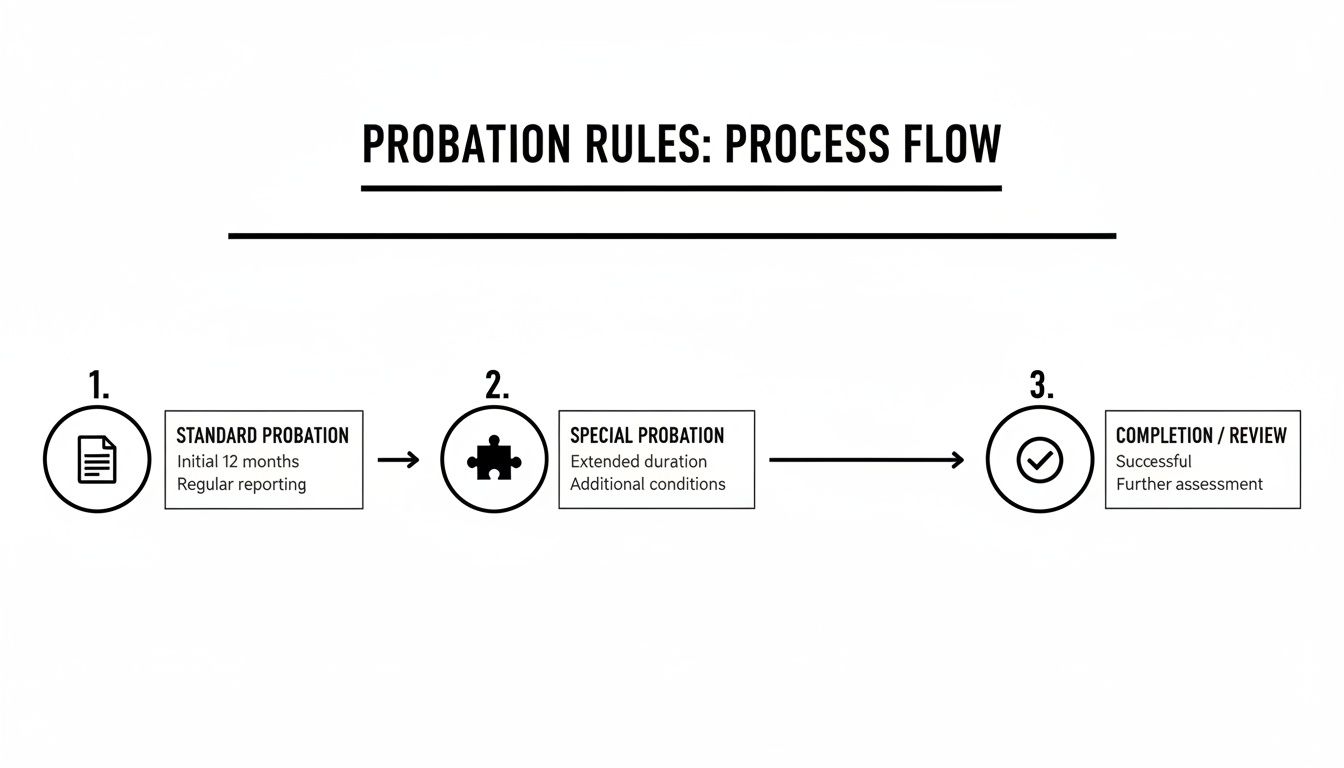
As the flowchart shows, any slip-up can trigger the revocation process.
The stakes are incredibly high. Across the country, 21% of people on felony probation who exit the system do so because a violation landed them in prison. In Texas, the pressure is even higher. With the challenges facing the Texas prison system and its overcrowding, judges enforce probation rules with an iron fist. A revocation could not only lead to prison but also be used by CPS as grounds for terminating parental rights under Texas Family Code Chapter 161.
A Real-Life Scenario: Why Communication Is Everything
Picture this: David, a father of two on probation in Dallas, gets a frantic call. His daughter fell at school and needs to go to the emergency room. David drops everything and rushes to the hospital, completely forgetting he has a check-in with his probation officer that afternoon. He misses the meeting. A few days later, a warrant is out for his arrest for a technical violation.
In this situation, David’s violation wasn't malicious; it was a parent responding to a family emergency. But without immediate action and the right legal help, the court might only see a missed appointment—a blatant disregard for the rules.
This is exactly where proactive communication and a good lawyer make all the difference. An actionable first step for David would be to call his attorney immediately. His lawyer can then explain the situation to the probation officer and the court, providing hospital records as proof. This shows the judge the violation wasn't intentional and could lead to his probation being reinstated instead of revoked.
How to Defend Against a Probation Violation
Getting the notice that your probation officer filed a Motion to Revoke can make the walls feel like they’re closing in. It’s a gut-wrenching moment. You’ve been working hard to follow the felony probation rules in Texas to be there for your family, and now this.
Remember: an allegation is not a conviction. You have rights, and there are powerful ways to fight back. The key is to move fast. Don’t wait for the hearing date and hope the problem will disappear. An experienced attorney can get ahead of the situation, dig into the prosecutor’s claims, and start building a strong case to keep you free and with your family.
Challenging the Allegation Directly
The most direct defense is to attack the violation itself. Was the accusation accurate? Were there mistakes in how evidence was gathered? A skilled lawyer knows where to look for weak spots.
Take a failed drug or alcohol test, for instance. It’s not always an open-and-shut case. A solid defense might involve:
- Questioning Test Validity: Was the sample handled correctly? Could it have been contaminated? Certain foods and over-the-counter medications can trigger false positives.
- Presenting Alternative Evidence: Perhaps you have eyewitnesses or other proof showing you were not in violation as claimed.
The goal is to show the judge that the state can't meet its burden of proof. Even with the lower "preponderance of the evidence" standard, an allegation still needs credible facts.
Presenting Mitigating Circumstances
Sometimes, a technical violation did occur. But the reason why it happened is the most important part of the story. This is where we bring in mitigating circumstances. The point isn’t to make excuses but to explain what happened in a way that shows it wasn’t a willful act of defiance.
A violation that happened because of a genuine life crisis—a medical emergency, a sick child—is viewed very differently by a judge than one from carelessness. Proving you had a legitimate reason can be the difference between getting reinstated and getting revoked.
Let’s go back to David, the father who missed his meeting to rush his daughter to the ER. An effective defense would be built on collecting hard proof. Actionable advice for David would be to gather:
- Hospital admission records or a note from the doctor.
- Phone logs showing he attempted to call his probation officer.
- Testimony from family members confirming the emergency.
By presenting concrete evidence, his lawyer can argue that David was acting as a responsible parent. That context is powerful. It can persuade a judge to give him another chance, maybe by modifying his probation instead of sending him to jail and risking his family's stability.
Life After Probation: Early Termination and Clearing Your Record

Successfully finishing felony probation is a monumental achievement. It’s the moment the massive weight you’ve carried finally lifts, letting you and your family breathe a genuine sigh of relief. But the journey toward a truly clean slate doesn't necessarily end there.
Texas law provides powerful tools to help you reclaim your future, including the possibility of ending supervision early and, in some cases, clearing your public record.
Can You Get Off Probation Early in Texas?
Yes, you can. Texas law allows you to ask for an early release from community supervision once you’ve hit certain milestones. This requires filing a formal motion with the court that sentenced you.
To be considered for early termination, you generally must have:
- Completed at least one-third of your original probation term or two years, whichever is less.
- Paid all fines, court costs, and restitution in full.
- Successfully finished all required classes, counseling, or treatment programs.
- Maintained a perfect track record with no violations.
A judge will review your motion and decide if an early release is in the "best interest of justice." The key is to present a compelling case that highlights your rehabilitation and proves that continued supervision is no longer necessary.
Clearing Your Record After Probation
The ultimate goal for most families is putting this chapter behind them for good. How you clean up your record depends entirely on the type of probation you completed.
If you successfully completed deferred adjudication, you were never convicted of a felony. This opens the door to an Order of Nondisclosure, a powerful tool that seals your criminal record from public view. While law enforcement can still access it, potential employers, landlords, and the general public will not. It is the closest you can get to a truly clean slate, helping you fully move on and provide for your family.
As people rebuild their lives, many also focus on managing their public image. Guidance on how to improve online reputation can be incredibly valuable. For those who were convicted and served straight probation, the options are more limited, but it's still crucial to speak with an attorney to see if your felony can be expunged in Texas: https://texascpslawyer.net/can-felonies-be-expunged-in-texas/
Successfully navigating the felony probation rules in Texas is a marathon. With over 84% of individuals released in a recent fiscal year being under community supervision, having expert legal guidance is critical. These numbers show how vital a strong post-probation strategy is for parents who want to mitigate the lifelong impacts of a felony charge and protect their family's future.
Frequently Asked Questions About Texas Felony Probation
Living under felony probation brings up countless questions, and the anxiety of not knowing the right answer can be immense. Here are some of the most common questions we hear from parents navigating the realities of supervision.
Can I Travel While on Felony Probation in Texas?
Not without permission. A standard rule of probation is that you cannot leave your county without getting written approval from your probation officer first.
Thinking about an out-of-state trip for a family vacation? That requires even more planning. You will almost certainly need the judge’s approval, so you must request a travel permit well in advance. Your officer will review your track record and the reason for the trip before deciding. Never leave without permission; it is a serious violation that can jeopardize everything you've worked for.
What Should I Do If I Get Pulled Over by the Police?
Stay calm and be polite. The law requires you to inform the officer that you are on felony probation. Always have your ID and probation paperwork with you in your vehicle.
Critically, even if you just get a simple speeding ticket, you must report this interaction to your probation officer immediately. Failing to report any contact with law enforcement is a technical violation and can land you in serious trouble. Honesty and transparency are your best allies.
Can My Probation Officer Search My Home or Car?
Yes. When you agree to the terms of community supervision, you waive some constitutional protections against unreasonable searches. This gives your probation officer the authority to search your home, car, and person without a warrant to ensure you're following the rules. This is a standard part of supervision, and it’s something you must be prepared for. A key piece of actionable advice is to ensure your home is always in compliance—free of any illegal items or substances—to avoid a simple search turning into a major violation that could attract CPS attention.
The rules can feel like a minefield, but every question you ask is a step toward successfully getting through this. Keeping an open line of communication with your attorney is the single best thing you can do to stay on track and protect your family.
The fear and confusion that come with a felony charge and the complexities of the felony probation rules in Texas can feel isolating, but you are not alone. At The Law Office of Bryan Fagan PLLC, we understand what is at stake for you and your children. Our experienced attorneys are here to provide the authoritative and compassionate guidance you need to protect your rights, answer your questions, and fight for the best possible outcome for your family. For a free, confidential consultation to discuss your case and learn how we can help, contact us today at https://texascpslawyer.net.