Skip to content
The moment you see flashing lights in your rearview mirror, your heart sinks. For a parent, that feeling is magnified a thousand times. Your mind doesn't just race with worry about a ticket; it jumps to what this could mean for your family, your job, and your children. If a moment of panic, confusion, or fear leads to a decision to keep driving, you can suddenly find yourself facing serious charges for evading arrest.
This situation can feel isolating and terrifying, but you are not alone. Many good people—caring parents and responsible Texans—find themselves in this exact spot. A single, panicked decision under pressure does not define who you are. Understanding your rights and the legal landscape is the first step toward regaining control, protecting your family, and fighting for your future.
When a Simple Traffic Stop Becomes a Serious Charge
Seeing those red and blue lights can trigger a wave of anxiety. Maybe you're on a dark, unfamiliar road and your first thought is the safety of your child in the back seat. Perhaps you're already dealing with the immense stress of a Child Protective Services (CPS) investigation, and the fear of another official encounter is overwhelming.

In these high-stress moments, choosing to drive a little further to find a well-lit, safe place to stop can be misinterpreted by law enforcement. What you see as a responsible choice for your family's safety can be twisted into a criminal charge for evading arrest.
We understand. A moment of fear doesn't make you a bad person or an unfit parent. It makes you human.
Understanding the Human Element in These Cases
The legal system often looks at events in black and white, but your story—the why behind your actions—is filled with color and context. The police report may simply say you "failed to stop," but it won't capture the real story.
- A Real-Life Scenario: Imagine a single mother driving home late with her sleeping toddler. An unmarked car begins to tail her aggressively before turning on a single, dashboard-mounted light. Fearing for her child's safety and unsure if it's a real officer, she continues driving toward a familiar, well-lit gas station. Her intention wasn't to flee; it was to protect her child. This context is everything.
It is crucial to remember that:
- Fear is a natural reaction. Especially for parents navigating the stress of a CPS case, any interaction with authority can be intimidating.
- Confusion can lead to inaction. Not knowing where to stop safely can easily be misinterpreted as defiance.
- Your intent is the key. The law requires the prosecution to prove you intentionally fled, not just that you failed to pull over immediately.
These charges often pop up in the massive misdemeanor system in the United States, where an estimated 13 million misdemeanor charges are filed every year—and that doesn't even count speeding tickets. This system can sweep everyday people into complex legal battles over minor infractions that escalate without warning. You can read more about the scale of misdemeanor charges and their impact on Americans.
A charge of evading arrest isn’t just about “running from the cops.” It’s about your state of mind. The prosecution has to prove you made a conscious, willful choice to escape, and that’s often where the strongest defenses are built, especially for parents trying to do the right thing under pressure.
This guide is your first step toward understanding the law, exploring your defense options, and getting back some sense of control over your family's future.
What Does a Prosecutor Actually Have to Prove in an Evading Arrest Case?
When you’re facing an evading arrest charge, it's easy to feel like it's your word against the officer's, and that the police report has already sealed your fate. But that’s just not how our legal system works. In Texas, the state can’t just point a finger and say you fled; they have a very specific, and surprisingly high, legal mountain to climb.
To get a conviction, a prosecutor must prove every single element of the crime beyond a reasonable doubt. This isn't just legal jargon—it's the highest standard of proof we have. It means the jury can't just think you're probably guilty; they have to be completely convinced.
The Three Pillars of the Prosecution's Case
Think of the state’s case as a three-legged stool. If you kick out even one of those legs, the whole thing comes crashing down. The prosecutor is required to prove all three of the following:
- You intentionally fled. This is all about what was going on in your head. Did you make a conscious, deliberate choice to get away?
- You knew the person was a peace officer. The State has to show you were aware that the person trying to pull you over or stop you was a cop.
- The officer was trying to lawfully arrest or detain you. The officer needed a legitimate, legal reason to stop you in the first place.
If the prosecutor stumbles on even one of these points, they don't have a case. Let's break down what each of these really means in the real world.
Element 1: Intentional Fleeing
That word "intentionally" does a lot of heavy lifting here. It’s not enough for the state to show you didn’t pull over the second you saw flashing lights. They have to prove your actions were a purposeful attempt to escape.
Let's say you're driving down a dark, busy highway late at night. You see police lights pop up behind you. Instead of slamming on the brakes and stopping on a dangerous, unlit shoulder, you slow down, flip on your hazards, and drive another mile to a well-lit gas station parking lot.
A prosecutor might try to frame that as fleeing. But your actions tell a different story—one of trying to comply safely, not trying to evade. That distinction is everything. The focus isn't just on the action, but the why behind it.
Element 2: Knowledge of the Officer
This one sounds simple, but it gets complicated fast. The prosecution has to prove, without a doubt, that you knew the person trying to stop you was a law enforcement officer.
What if they were in an unmarked car with no siren, just a single light flashing on the dashboard you couldn't really see? Or what if someone on foot in street clothes started yelling "stop" without ever identifying themselves as an officer? In those moments, it's perfectly reasonable that you wouldn't have known you were being ordered to stop by the police.
The burden is squarely on the state to prove what you knew and when you knew it. Your perception of the event is what truly matters, and if there's any doubt, that's a weakness in the prosecution's case.
Element 3: A Lawful Stop
Here’s the one that often gets overlooked. The officer's reason for trying to stop you in the first place must have been legal. Police can't just stop people on a hunch or because they feel like it. They need what the law calls reasonable suspicion—a legitimate reason to believe a crime has been, is being, or is about to be committed. Usually, this is a simple traffic violation like speeding or having a taillight out.
But what if the officer had no legal basis for the stop? If they pulled you over without a valid reason, then the entire stop was illegal from the get-go. In that situation, any charge that comes from it, including evading arrest, may be thrown out completely. Challenging the legality of that initial stop is often one of the most powerful ways to dismantle the state's entire case.
How Evading Arrest Penalties Escalate From Misdemeanor To Felony
Not all charges for evading arrest are created equal in Texas. The potential penalties can swing wildly from a serious misdemeanor all the way to a life-altering felony.
Often, the entire difference comes down to one simple question: were you on foot or in a vehicle? A split-second decision made under pressure can dramatically change the legal consequences you're facing. Understanding how these charges escalate is the first step in grasping the seriousness of your situation.
On Foot vs. In a Vehicle: The Critical Distinction
When a person flees from an officer on foot, the charge is typically a Class A Misdemeanor. While this is the most serious type of misdemeanor in Texas—carrying penalties of up to one year in jail and a fine up to $4,000—it is still a misdemeanor.
The moment a motor vehicle is used to flee, the entire legal landscape changes. Texas law automatically elevates the charge to a State Jail Felony. The potential consequences immediately become much more severe, highlighting just how differently the justice system views these two scenarios.
The logic behind this massive jump in severity is public safety. A person running on foot poses a relatively limited danger to others, but a car chase puts the public, the officers, and the driver at significant risk. This escalation is one of the most important things to understand about charges for evading arrest.
The flowchart below shows the core elements a prosecutor must prove just to get a conviction in the first place, which is the foundation for any potential penalty.
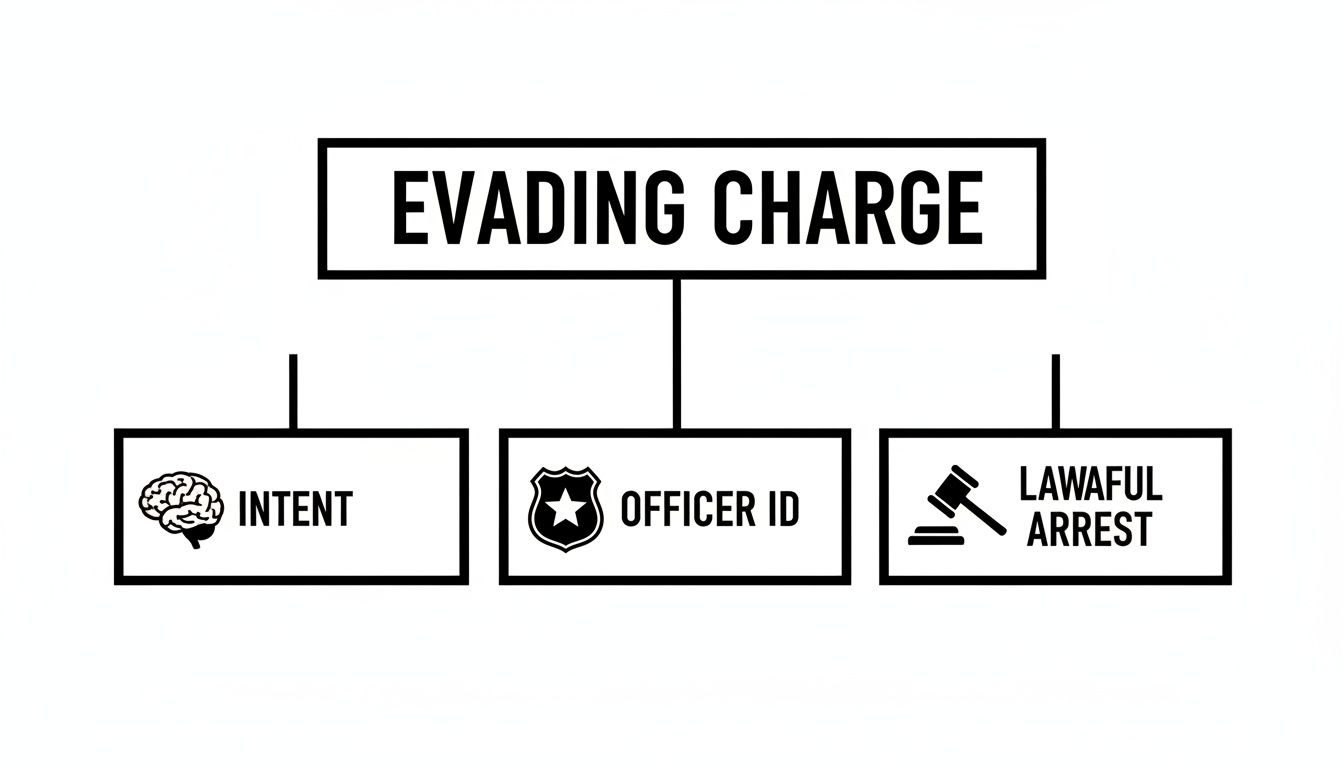
Without proving intent, that the officer was identifiable, and that the arrest was lawful, the state's case shouldn't even get to the penalty phase.
Aggravating Factors That Increase Penalties
But using a vehicle isn't the only thing that can make the penalties worse. The law includes several "aggravating factors" that can elevate a felony charge even higher, leading to substantially more prison time.
These factors kick in when:
- Someone suffers serious bodily injury: If another person is seriously hurt as a direct result of the attempt to flee, the charge can be enhanced to a Third-Degree Felony.
- Someone is killed: If the act of evading arrest directly results in someone's death, the charge escalates to a Second-Degree Felony.
- You have a previous conviction: A prior conviction for evading arrest will also lead to enhanced charges.
This is where a bad situation can become a nightmare. A moment of panic can quickly spiral, stacking felony charges on top of each other and putting your freedom in serious jeopardy.
Texas Evading Arrest Penalties at a Glance
To put it all into perspective, this table breaks down the potential penalties you could face, showing just how quickly the stakes can rise.
| Offense Level | How It's Committed | Potential Jail/Prison Time | Maximum Fine |
|---|---|---|---|
| Class A Misdemeanor | Fleeing on foot | Up to 1 year in county jail | Up to $4,000 |
| State Jail Felony | Fleeing in a vehicle | 180 days to 2 years in state jail | Up to $10,000 |
| Third-Degree Felony | Causing serious bodily injury while fleeing | 2 to 10 years in prison | Up to $10,000 |
| Second-Degree Felony | Causing a death while fleeing | 2 to 20 years in prison | Up to $10,000 |
As you can see, what starts as a basic flight from an officer can end with the possibility of spending decades behind bars, depending entirely on the circumstances.
Building Your Defense Against an Evading Arrest Charge
Getting charged with evading arrest can feel like an impossible situation. It often feels like it's just your word against a police officer's, and that the deck is stacked against you from the start. But it's absolutely critical to remember this: an arrest is not a conviction.
The prosecution carries the entire burden of proof. There are powerful, well-established legal strategies that can be used to pick apart their case and protect your future. Many of the most successful defenses aren’t about denying what happened, but about explaining the context and what was going through your mind at that moment.
A skilled attorney knows how to shift the focus from the simple act of not stopping immediately to the reason you didn't. By grounding legal strategies in relatable, real-world situations, we can expose the weaknesses in the state’s argument and fight for the best possible outcome for you.
Challenging the Element of Intent
The single most important word in the entire evading arrest statute is "intentionally." To get a conviction, the prosecutor has to prove, beyond a reasonable doubt, that you made a conscious and willful decision to flee from the police.
This is often the weakest link in their case. Why? Because many situations that look like evasion are actually rooted in something else entirely—confusion, panic, or a legitimate concern for safety.
A classic example is when someone is looking for a safe place to pull over. Imagine an officer hits their lights behind you on a busy, multi-lane highway at night, or on a dark, rural road with no shoulder. Instead of slamming on the brakes in a dangerous spot, you slow down, turn on your hazard lights, and drive to the next well-lit exit or gas station.
In that scenario, your actions show an intent to comply safely, not an intent to escape. An experienced attorney can effectively argue that you weren't fleeing at all. You were simply acting as any reasonable and prudent driver would to ensure both your safety and the officer's.
Arguing You Did Not Know It Was an Officer
Another core element the state absolutely must prove is that you knew the person trying to stop you was a police officer. This defense is particularly powerful in situations involving unmarked cars or officers who aren't in uniform.
Think about this common scenario: you're driving, and an unmarked sedan with a small, flashing light on the dashboard starts tailgating you aggressively. You might understandably think it’s just an impatient or dangerous driver, not law enforcement. Your decision to change lanes or even speed up a bit to create distance could easily be twisted to look like evasion.
If the officer failed to clearly identify themselves through a marked patrol car, a proper siren, and official attire, it creates significant doubt about whether you truly "knew" you were being lawfully detained. Your perception at that moment is what matters.
This defense strategy puts the focus squarely on the officer's actions. Did they provide you with clear, unmistakable notice that they were law enforcement attempting a stop? If not, there can be no intentional flight.
Questioning the Legality of the Initial Stop
Sometimes, one of the strongest defenses has nothing to do with whether you fled. Instead, it challenges the officer's legal right to stop you in the first place. The Fourth Amendment protects you from unreasonable searches and seizures, which means an officer can't just detain you without a valid reason.
Legally, this reason is called "reasonable suspicion"—a specific, articulable fact suggesting you have committed, are committing, or are about to commit a crime. This is usually a minor traffic violation.
- No Traffic Infraction: If an officer pulls you over based on a "hunch" without actually seeing you commit a traffic violation, the stop is illegal.
- Mistake of Law: If an officer stops you for something that isn't actually against the law (like believing your single working brake light is illegal when state law only requires one), that stop is invalid.
If the initial stop was unlawful, any evidence or charges that came from it—including evading arrest—can be thrown out. This is based on a legal principle known as the "fruit of the poisonous tree." When the foundational stop is illegal, the entire case against you can crumble.
Exploring the different paths to get criminal charges dropped often begins with a deep dive into that very first police encounter. An experienced attorney can file what’s called a motion to suppress, and if it's successful, it can lead to a complete dismissal of your case.
The Hidden Consequences of an Evading Conviction on Your Life
When you’re facing charges for evading arrest, it’s easy to focus only on what happens inside the courtroom. The immediate worries—fines and potential jail time—are front and center. But a conviction carries a heavy price that follows you long after your case is closed, creating ripples that can disrupt your entire life and the stability of your family.
Many people never see these "collateral consequences" coming until it’s far too late.

These aren’t part of the official sentence handed down by a judge, but they can be just as punishing. They chip away at your freedom, your ability to provide for your loved ones, and your future in ways you might not have imagined.
Your Driver's License and Your Livelihood
Let’s start with one of the most immediate and disruptive hits: a conviction for evading arrest in Texas means an automatic suspension of your driver's license. This isn't a maybe. It's a guarantee.
Think about what that really means for your day-to-day life. Getting to work, dropping the kids off at school, or even just a simple grocery run can instantly become a logistical nightmare. And if your job depends on driving—like a delivery driver, a tradesperson, or a traveling salesperson—this isn't just an inconvenience. It's a direct threat to your income, often leading to immediate job loss.
A conviction for evading arrest isn't just a black mark on your record; it's a direct threat to your ability to work and support your family. The loss of your license can set off a devastating chain reaction of financial and personal crises.
The Long Shadow of a Permanent Criminal Record
An evading arrest conviction, particularly if it's a felony, doesn't just fade away. It creates a permanent criminal record that follows you everywhere. This record is just a simple background check away for potential employers, landlords, and professional licensing boards.
This single event can throw up roadblocks in almost every corner of your life:
- Finding a Job: Many companies have strict policies against hiring people with felony convictions, especially for jobs that require a high level of trust, handle finances, or involve working with the public.
- Securing Housing: Landlords almost always run background checks. A criminal record can lead to a denied rental application, making it incredibly difficult to find a safe place for your family to live.
- Professional Licenses: If you work in a field that requires a state license—think nursing, teaching, or real estate—a conviction can get your license denied or even revoked.
- Family Law and CPS Cases: This is where the consequences hit closest to home for parents. A criminal conviction can be used against you in a child custody dispute or a CPS case. Under the Texas Family Code, a recent conviction can be considered evidence of endangerment, potentially jeopardizing your custody rights or making it harder to reunify with your children if they are in foster care.
Immigration Consequences for Non-Citizens
For anyone who isn’t a U.S. citizen, the stakes are dramatically higher. An evading arrest conviction can be classified as a crime that triggers severe immigration penalties. This could mean deportation, no matter how long you've lived in the United States or how deep your family roots are here.
This isn't a theoretical risk. Federal authorities are increasingly aggressive on offenses that mirror state-level evading charges, especially those related to border encounters. Recent data shows a massive spike in federal prosecutions for these types of cases, which come with much harsher penalties. You can discover more about these federal prosecution trends and their impact to see just how serious the situation has become.
Understanding what's truly at stake is the first step. It shows why fighting an evading arrest charge from day one is so critical—not just to stay out of jail, but to protect your job, your family, and your entire future.
What to Do Immediately After an Arrest for Evading
The moments after an arrest are a blur of confusion, fear, and uncertainty. What you do—and just as importantly, what you don't do—in these first few hours can set the entire course for your case. Taking the right steps from the very beginning is your first, and best, line of defense.
Your single most critical action is to clearly and calmly use your constitutional rights. You need to say two things out loud: "I am exercising my right to remain silent," and "I want an attorney." Once you make those statements, law enforcement is legally required to stop questioning you.
Take These Actionable Steps Now
This is absolutely not the time to try and explain your side of the story to the police. Even if you believe you're completely innocent, anything you say can be twisted and used against you. Your focus should be on these crucial first steps instead:
- Remain Silent: Don't answer questions, offer up explanations, or even make small talk with the officers.
- Request a Lawyer: Repeat your request for an attorney as many times as you need to. Don't sign a single document until your lawyer is there with you.
- Document Everything: As soon as you possibly can, write down every detail you can pull from your memory. What street were you on? What exactly did the officer say? What were the road conditions like? Stress makes memories fade fast, so getting it all down on paper is vital.
If you or a loved one has been arrested for evading, one of the immediate hurdles is getting out of jail. This process almost always means posting bail, so it’s helpful to understand what a bail bond is and how it works to get someone home. A good lawyer can get to work on this right away, fighting for a reasonable bail amount at your very first court appearance.
Why You Need a Lawyer Immediately
An experienced attorney does so much more than just show up for you in court. They act as your shield from the very start. For anyone facing charges in Texas, it’s critical to understand that evading arrest is often stacked on top of other charges, like DWI, which makes the potential penalties skyrocket.
Your lawyer's first job is to get between you and the prosecution. They make sure your rights are protected through every single phase, from the bond hearing all the way to plea negotiations. You can learn more about what happens at an arraignment hearing to see just how important it is to have legal counsel by your side.
If you or someone you care about is facing an evading arrest charge, the time to act is now. The Law Office of Bryan Fagan is committed to defending Texas families. We offer a confidential, no-cost consultation to listen to your story and start building your defense today.
Common Questions About Evading Arrest Charges in Texas
When you're suddenly facing an evading arrest charge, your mind can spin with questions and "what-ifs." The uncertainty is often the worst part. Let's walk through some of the most common questions we hear from clients, providing clear, straightforward answers to help you get a better handle on your situation.
Can I Be Convicted if I Didn’t Know Police Were Behind Me?
This is a critical point and often a powerful defense. For the prosecutor to win a conviction, they have to prove beyond a reasonable doubt that you intentionally fled from someone you knew was a police officer. If you genuinely didn't see the lights or hear the sirens, that core element of "intent" is missing.
Think about it: maybe you were listening to loud music, deep in thought, or the officer was in an unmarked car and didn't properly signal. These are completely reasonable explanations for why you wouldn't have known they were trying to pull you over. An experienced attorney can take these facts and build a strong defense that cuts to the heart of the state's case.
What if I Was Just Trying to Find a Safe Place to Stop?
This is an incredibly common and smart reaction. Nobody wants to pull over on the shoulder of a busy highway or on a dark, isolated road—it's just not safe for you or the officer. The key here is showing that your actions were driven by safety and a desire to comply, not an attempt to escape.
To make that clear, the best course of action is to immediately slow down, turn on your hazard lights to acknowledge the officer, and then drive to the very first safe, well-lit spot you can find. Taking these steps creates a clear record that you were cooperating, which can be a compelling counter-argument to the claim that you were intentionally fleeing.
How Can an Evading Arrest Charge Affect My CPS Case?
This is a fear that weighs heavily on any parent involved with CPS. A criminal charge—especially a felony like evading in a vehicle—can significantly complicate your CPS case. CPS may view the charge as evidence of poor judgment or a failure to protect your children, even if they weren't in the car. It can be used as a reason to delay reunification or even as grounds in a termination of parental rights case under Texas Family Code § 161.001, which lists criminal conduct that endangers a child as a factor.
It is absolutely vital to have a legal team that understands both criminal defense and family law. An attorney can work to show CPS that the charge was the result of a misunderstanding or a moment of panic, not a reflection of your parenting. Fighting the criminal charge aggressively is your best defense in both courts.
The path forward after being charged with evading arrest can feel complicated and intimidating, but you don't have to walk it alone, especially when your family's future is on the line. At The Law Office of Bryan Fagan, we understand the fear and uncertainty you're up against. We are dedicated to defending Texas parents with compassion and strength. We're here to listen to your side of the story and build a powerful defense to protect your rights, your freedom, and your family. Contact us today for a free, confidential consultation to discuss your case.